This Highway Makes More Money Than Most Philippine Companies — And It’s Literally Above Your Head
From towering giants to digital screens, uncover the massive industry that makes millions from your daily commute
This Highway Makes More Money Than Most Philippine Companies — And It’s Literally Above Your Head
From towering giants to digital screens, uncover the massive industry that makes millions from your daily commute
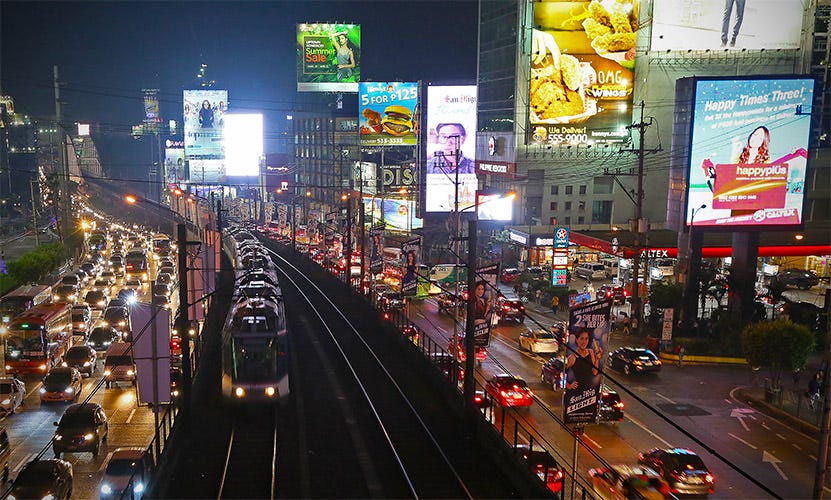
The Epifanio de los Santos Avenue (EDSA) isn’t just Metro Manila’s main artery — it’s a 23.8-kilometer advertising goldmine generating billions in revenue annually. Every day, over 400,000 vehicles traverse this highway, making it the Philippines’ most coveted outdoor advertising real estate. But behind the dazzling displays lies a complex ecosystem of regulations, massive profits, and environmental concerns that most commuters never consider.
The Numbers Game: EDSA’s Billboard Census
The size of all outdoor signs and structures is limited to 216 square meters inclusive of the space required for landscape or vertical gardens, according to agreements between the Metropolitan Manila Development Authority (MMDA) and outdoor advertising companies. Current estimates suggest there are approximately 800–1,200 billboard structures along the entire EDSA corridor, though exact numbers fluctuate due to regulatory changes and new installations.
The revenue generated from EDSA billboards is staggering. Prime locations command monthly rates ranging from ₱500,000 to ₱2.5 million, with digital LED boards reaching up to ₱4 million per month for premium spots. This translates to an estimated annual industry revenue of ₱15–20 billion from EDSA alone.
The Power Players: Companies Dominating the Skyline
Several major companies control the majority of EDSA’s advertising landscape:
Outcomm Inc. stands as one of the Philippines’ largest outdoor advertising companies, specializing in LED video boards and traditional billboards. Their strategic locations along EDSA include high-traffic areas like Guadalupe and Shaw Boulevard intersections.
OAAP (Outdoor Advertising Association of the Philippines) members collectively own most of the premium spots. These include established players like:
- Prime Advertising Philippines
- Adtel Inc.
- OOH Philippines
- Moving Walls (digital advertising specialist)
The industry is highly consolidated, with the top 10 companies controlling approximately 70% of all EDSA billboard inventory.
Tax Revenue: The Government’s Cut
The billboard industry generates substantial tax revenue for both national and local governments. Each billboard structure is subject to:
- Business permit fees: ₱15,000–50,000 annually per LGU
- Clearance fees: ₱25,000–75,000 from MMDA
- Income tax: Standard corporate rates on advertising revenue
- Local taxes: Varies by city, typically 2–5% of gross revenue
Conservative estimates suggest the government collects ₱2–3 billion annually in various taxes and fees from the EDSA billboard industry, with Makati City, Mandaluyong, and Quezon City being the primary beneficiaries.
Marketing Psychology: The Science of Highway Hypnosis
EDSA billboards leverage several psychological principles to maximize impact:
Repetition Effect: The average EDSA commuter sees the same billboard 10–15 times per month, creating powerful brand recall. Studies show that billboard campaigns along EDSA achieve 85–90% brand recognition rates among regular commuters.
Contextual Advertising: Companies strategically place products relevant to commuter needs — fast food near meal times, coffee during morning rush, and entertainment during evening traffic.
Digital Dynamics: LED boards can change messages every 8–10 seconds, allowing multiple advertisers to share premium real estate while maintaining viewer attention through motion and color variation.
The Big Spenders: Top Industries Utilizing EDSA Billboards
Based on advertising spend and frequency, the top industries advertising on EDSA include:
- Telecommunications (Globe, Smart, PLDT) — 25% of total inventory
- Banking and Financial Services (BDO, Metrobank, BPI) — 20%
- Real Estate (Ayala Land, SM Development, Century Properties) — 15%
- Automotive (Toyota, Mitsubishi, Honda) — 12%
- Consumer Goods (Procter & Gamble, Unilever, Nestlé) — 10%
- Fast Food and Beverages (McDonald’s, Jollibee, Coca-Cola) — 8%
- Government Campaigns (Department of Health, BSP) — 5%
- Others (Entertainment, Fashion, Technology) — 5%
Election Season: Democracy’s Price Tag
During election periods, billboard rates skyrocket by 300–500%. Political advertising becomes the most lucrative segment, with candidates and parties paying premium rates for strategic positioning:
- Presidential campaigns: ₱8–12 million per month for prime EDSA locations
- Senatorial candidates: ₱3–6 million per month
- Local positions: ₱1–3 million per month
The 2022 elections generated an estimated ₱8 billion in outdoor advertising revenue nationally, with EDSA capturing approximately 15–20% of this spending.
The Dark Side: Light Pollution and Environmental Impact
EDSA’s billboards contribute significantly to Metro Manila’s light pollution crisis. Studies indicate that illuminated advertising along the highway generates approximately 40% more artificial light than necessary for road safety.
Environmental concerns include:
- Disruption of natural circadian rhythms for nearby residents
- Increased energy consumption (see electricity costs below)
- Visual pollution affecting urban aesthetics
- Contribution to urban heat island effect through heat-generating LED systems
Power Consumption: The Electric Bill
The electricity consumption of EDSA billboards is substantial:
Traditional Illuminated Billboards:
- Average consumption: 15–25 kW per billboard
- Monthly cost: ₱45,000–75,000 per structure
Digital LED Boards:
- Average consumption: 50–150 kW per billboard
- Monthly cost: ₱150,000–450,000 per structure
The total estimated monthly electricity consumption for all EDSA billboards is approximately 25–35 megawatts, equivalent to powering 20,000–25,000 average Filipino households. This generates monthly electricity costs of ₱90–130 million for the entire EDSA corridor.
DIY Dreams: Can You Build Your Own Billboard?
The short answer is: it’s extremely difficult and expensive. Here are the requirements:
For Private Property Billboards:
- Own or lease property with EDSA frontage
- Secure building permits from local government units
- Obtain MMDA clearance (₱25,000–75,000)
- Comply with structural engineering requirements
- Meet size limitations (maximum 216 square meters)
- Maintain minimum distances from traffic signals and intersections
Estimated Costs for DIY Billboard Construction:
- Structural engineering and foundation: ₱800,000–1.2 million
- Billboard face and materials: ₱300,000–500,000
- Permits and clearances: ₱100,000–200,000
- Installation and labor: ₱200,000–400,000
- Total: ₱1.4–2.3 million for a medium-sized structure
Construction and Management: The Behind-the-Scenes Industry
Most billboard owners don’t handle construction themselves. Specialized companies provide turnkey services:
Major Construction Companies:
- Steel Asia Manufacturing Corporation (structural components)
- Prime Steel Mills (framework and supports)
- Local electrical contractors for lighting and LED installation
Management Services Include:
- Site preparation and foundation work
- Structural fabrication and installation
- Electrical and lighting setup
- Permit processing and regulatory compliance
- Ongoing maintenance and content management
Government Policies: The Regulatory Maze
Private commercial signs, billboards and streamers installed over or across and along public thoroughfares, center islands and street rights-of-way, whether it be National Road or Secondary Road are strictly prohibited according to MMDA regulations.
Key policies governing EDSA billboards include:
MMDA Regulation №04–004, Series 2004: The primary regulatory framework establishing guidelines for billboard installation and display along major thoroughfares.
Executive Order №165 (2022): Updated national guidelines for outdoor advertising signs and billboards, emphasizing safety and environmental considerations.
Key Regulatory Requirements:
- Minimum 200-meter distance between competing billboards
- Height restrictions based on location and traffic patterns
- Mandatory landscape elements for structures over 100 square meters
- Prohibitions on installations over road rights-of-way
- Required clearances from MMDA and local government units
LGU Requirements and Fees: The Local Government’s Take
Each city along EDSA has specific requirements:
Quezon City:
- Business permit: ₱35,000–50,000 annually
- Additional advertising tax: 3% of gross revenue
- Structural inspection fees: ₱15,000–25,000
Makati City:
- Business permit: ₱40,000–60,000 annually
- Billboard tax: 2.5% of gross advertising revenue
- Environmental compliance certificate: ₱20,000
Mandaluyong City:
- Business permit: ₱25,000–40,000 annually
- Signage permit: ₱10,000–20,000
- Fire safety clearance: ₱5,000–10,000
Pasay City:
- Business permit: ₱30,000–45,000 annually
- Advertising permit: ₱15,000–30,000
- Building code compliance: ₱10,000–20,000
The Digital Revolution: Modern Advertising Beyond Billboards
The advertising landscape is rapidly expanding beyond traditional roadside billboards:
Elevator Advertising: Companies like AdMov and Elevator Media Philippines have installed digital screens in over 2,000 elevator systems across Metro Manila, generating ₱500 million in annual revenue.
Building-Integrated Digital Displays: Modern office buildings and shopping centers are incorporating large-scale LED walls as architectural elements, creating new premium advertising inventory.
Transit Advertising: Digital screens in MRT and LRT stations, plus bus and jeepney advertising, represent a ₱3 billion annual market segment.
Major Players in Modern Digital OOH:
- Moving Walls: Dominates digital billboards and programmatic advertising
- AdMov: Leading elevator and building advertising specialist
- JCDecaux Philippines: International player focusing on transit and street furniture
- Clear Channel Philippines: Premium digital billboard networks
Market Share Breakdown:
- Moving Walls: 35% of digital OOH market
- Traditional billboard companies adapting: 40%
- International players: 15%
- New technology companies: 10%
The Future of EDSA Advertising
The industry is evolving rapidly with several trends reshaping the landscape:
Programmatic Advertising: Real-time bidding for billboard space, allowing advertisers to purchase specific time slots and target demographics more precisely.
Interactive Technology: Augmented reality integration and QR code campaigns that bridge physical and digital advertising.
Sustainability Initiatives: Solar-powered LED systems and eco-friendly materials becoming standard requirements.
Data Analytics: Advanced traffic pattern analysis and demographic targeting through mobile data and AI-powered content optimization.
The Economic Impact: Beyond the Billboard
The EDSA billboard industry supports thousands of jobs across multiple sectors:
- Direct employment: 5,000–7,000 jobs in advertising, construction, and maintenance
- Indirect employment: 15,000–20,000 jobs in supporting industries
- Economic multiplier effect: Every peso spent on billboard advertising generates an estimated ₱3.50 in related economic activity
Conclusion: The Highway That Built an Empire
EDSA’s billboard industry represents more than just advertising — it’s a multi-billion peso ecosystem that influences consumer behavior, generates substantial tax revenue, and provides thousands of jobs. As the Philippines’ economy continues to grow, this highway advertising empire will likely expand, evolve, and adapt to new technologies while maintaining its position as Southeast Asia’s most valuable outdoor advertising corridor.
The next time you’re stuck in EDSA traffic, remember: you’re not just commuting — you’re participating in one of the region’s most sophisticated and lucrative marketing experiments, where every glance is calculated, every message is strategic, and every peso spent is designed to capture your attention and influence your decisions.
The billion-peso highway continues to evolve, but one thing remains constant: in the battle for Filipino consumers’ minds, EDSA remains the ultimate battleground.
메타데이터
- post_id
- d895fdb0635b
- slug
- this-highway-makes-more-money-than-most-philippine-companies-and-its-literally-above-your-head-d895fdb0635b
- url
- https://medium.com/@gabrielconcepcion/this-highway-makes-more-money-than-most-philippine-companies-and-its-literally-above-your-head-d895fdb0635b
- canonical_url
- https://medium.com/@gabrielconcepcion/this-highway-makes-more-money-than-most-philippine-companies-and-its-literally-above-your-head-d895fdb0635b
- author_url
- https://medium.com/@gabrielconcepcion
- status
- ok
- fetched_at
- 2026-06-16 19:09:56