LLM-based agentic systems in medicine and healthcare — a structured, explained summary
Paper: Qiu et al., Nature Machine Intelligence (2024)
LLM-based agentic systems in medicine and healthcare — a structured, explained summary
Paper: Qiu et al., *Nature Machine Intelligence* (2024)
TL;DR
This paper maps a new layer in medical AI: LLM-based agentic systems that do more than generate answers. The focus here is on systems that can process information, plan, use memory, call tools, collaborate with other agents and carry out multi-step tasks across a healthcare workflow. In medicine, that opens the door to applications such as clinical workflow automation, decision support and multi-agent diagnosis, while also raising a harder engineering question: how to make these systems reliable once they move from answering prompts to participating in real processes.
Why this paper was written
A large share of the recent discussion around medical LLMs has centered on question answering, summarization and benchmark performance. This paper shifts the attention to a broader systems view. The authors are interested in what happens when a language model becomes part of a larger decision process, with planning, memory, external tools and interaction between components.
That framing fits healthcare unusually well. Clinical work rarely consists of one clean input followed by one clean output. A real task may involve reading fragmented history, pulling relevant labs, checking medications, consulting guidelines, summarizing key findings, deciding whether more information is needed and then helping move the workflow forward. The paper is therefore pointing to a structure that resembles actual medical work more closely than the usual single-prompt setup.
What the paper means by agentic systems
The clearest contribution of the paper is its compact definition of LLM-based agentic systems. The authors describe systems that can process information, plan and decide, recall and reflect, interact and collaborate, use tools and act. That list matters because it turns the discussion away from language fluency alone and toward system behavior over multiple steps.
The figure in the paper helps organize the idea further. It separates ordinary LLMs, traditional agents and LLM-based agents. That distinction is useful. A standard LLM can generate text, summarize documents or answer questions. A traditional agent can follow predefined action logic. An LLM-based agent adds flexible reasoning to that structure and uses it to guide planning, tool use and task execution. Once that happens, the core object is no longer just a model. It becomes an orchestrated system.
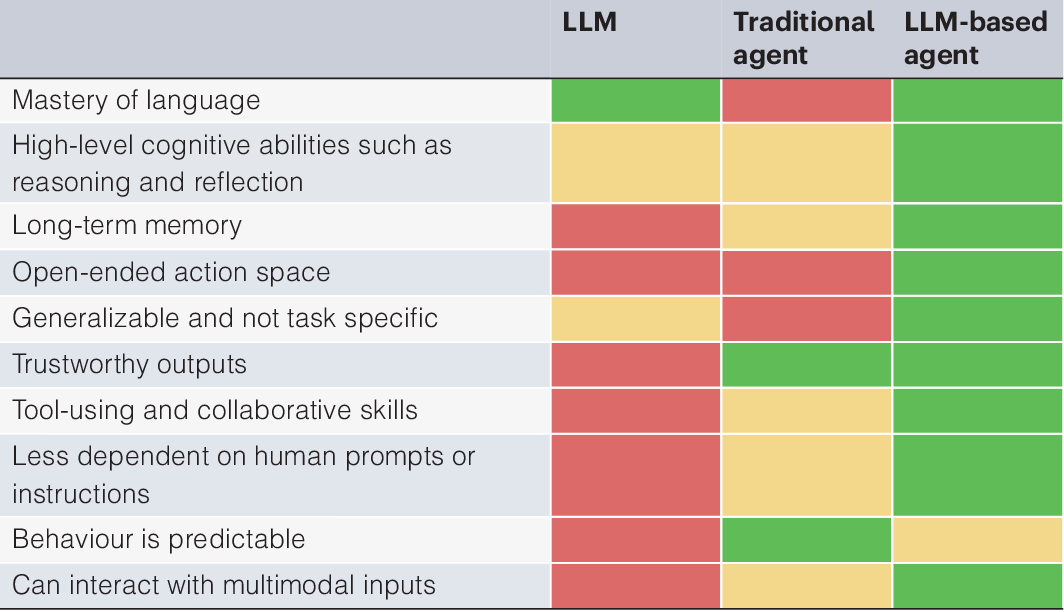
Characteristics of LLMs, traditional agents and LLM-based agents.
Why this matters in healthcare
The healthcare examples in the paper are broad, but they all come from the same underlying property of medical work: complexity spread across steps, people and data sources. Clinical environments are full of repetitive but cognitively expensive tasks. Records are scattered. Decisions depend on context. Relevant knowledge may sit in notes, labs, images, messages, protocols and external references at the same time.
An agentic setup is attractive in this setting because it can potentially help manage that structure. A system can retrieve missing information, decide which tool to use, keep track of prior context, coordinate subtasks and support a longer chain of reasoning than a single response typically captures. That is why the paper mentions applications ranging from workflow automation to diagnostic collaboration. The underlying idea is consistent across them: useful medical intelligence often depends on managing a sequence, not only producing an answer.
The technical shift
What makes this paper interesting from an engineering perspective is that capability is being distributed across a system rather than concentrated entirely inside model weights. Once an agent can access retrieval systems, databases, calculators, guidelines or other specialized tools, performance depends on much more than the base model’s internal knowledge.
At that point, the main questions become architectural. How does the system decide what to do next? How does it store and reuse relevant context? When does it call an external tool? How does it verify what came back? How does it recover when one step fails? These are systems questions, and in healthcare they matter immediately because many clinically useful tasks already depend on external sources of truth.
This also explains why the agentic direction feels more substantial than another round of prompt engineering. A strong medical application usually requires more than polished text generation. It requires grounded access to data, structured task decomposition and some form of control over the sequence of actions.
The opportunities
The paper presents a field with large practical upside. Agentic systems could help with clinical documentation, information retrieval, care coordination, decision support and educational or collaborative settings. A multi-agent diagnostic setup is especially interesting because it mirrors a familiar property of medicine: difficult decisions often improve when multiple perspectives are combined and when reasoning is made iterative rather than immediate.
There is also a strong operational angle here. Many healthcare bottlenecks come from time spent navigating systems rather than from purely diagnostic difficulty. Any system that can reliably reduce clerical burden, gather relevant context faster or help structure a downstream decision could have value even before full clinical autonomy becomes a serious topic.
The harder part
The paper also points toward a more demanding safety and evaluation problem. Once a system can plan, retrieve, call tools and act across steps, the failure modes become broader. Errors can emerge from sequencing, memory, incorrect tool use, poor coordination between agents or premature action under uncertainty.
That matters in medicine because reliability is judged at the workflow level. A fluent answer can still sit inside a brittle process. A system may retrieve the wrong piece of history, miss an important contraindication, carry forward an incorrect assumption or present a plausible summary built on a flawed chain of steps. In this setting, the engineering burden grows with the capability.
This is one of the most important ideas in the paper, even though it is presented briefly. As medical AI systems become more agentic, evaluation has to move beyond isolated response quality and toward the behavior of the full system inside realistic tasks.
How to read this paper
This is a short Comment, so it does not offer the kind of empirical depth one would expect from a benchmark paper or a large clinical study. Its value comes from framing. It gives the reader a compact way to think about the next stage of medical AI systems and a vocabulary for discussing that stage in concrete terms.
That makes it useful for engineers, because it identifies where the design problem is moving. The frontier here is tied to orchestration, tool use, memory, collaboration and controlled action across multi-step medical workflows. Those are very different concerns from ordinary single-turn evaluation, and they are likely to shape a large share of future medical AI development.
Closing
The main contribution of this paper is conceptual clarity. It shows how LLMs in healthcare are evolving into agentic systems that can plan, retrieve, collaborate and act across tasks. That broadens the application space considerably. It also places much more weight on architecture, control and safety at the system level. In healthcare, that shift is likely to matter as much as any gain in raw model accuracy.
메타데이터
- post_id
- d897e3b193df
- slug
- llm-based-agentic-systems-in-medicine-and-healthcare-a-structured-explained-summary-d897e3b193df
- url
- https://medium.com/@alexyorov/llm-based-agentic-systems-in-medicine-and-healthcare-a-structured-explained-summary-d897e3b193df
- canonical_url
- https://medium.com/@alexyorov/llm-based-agentic-systems-in-medicine-and-healthcare-a-structured-explained-summary-d897e3b193df
- author_url
- https://medium.com/@alexyorov
- status
- ok
- fetched_at
- 2026-06-09 15:37:30