Navigating the Trade-Offs of Distributed Transactions
In a monolithic application powered by a single relational database, maintaining data consistency is easy. If a user buys a product, you…
Navigating the Trade-Offs of Distributed Transactions
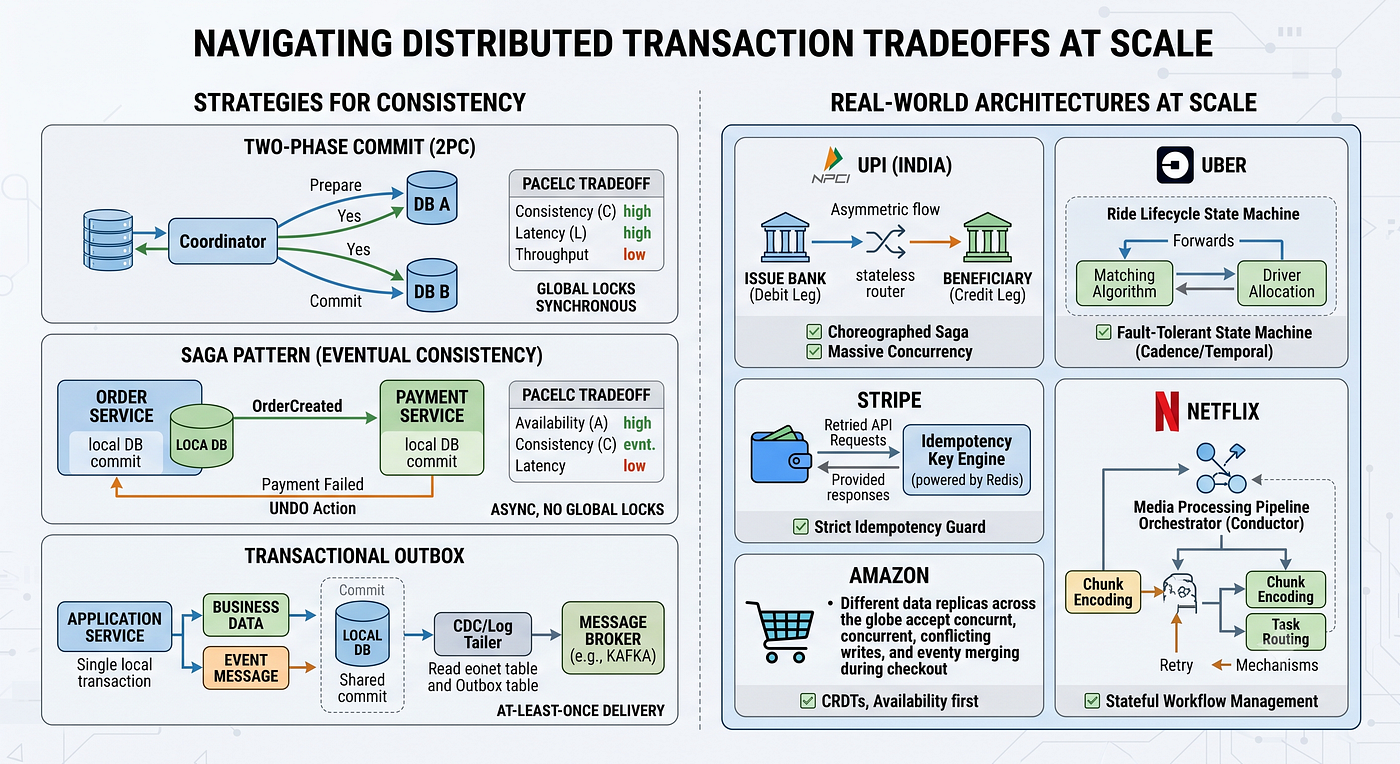
In a monolithic application powered by a single relational database, maintaining data consistency is easy. If a user buys a product, you open a single database transaction, deduct the inventory, charge the user, log an audit trail, and hit COMMIT. If anything breaks midway through, the database engine clean rolls back the state. You are completely protected by the laws of ACID (Atomicity, Consistency, Isolation, Durability).
However, as systems scale out into microservices and polyglot databases, that luxury disappears. A single business action now spans multiple databases, physical servers, and third-party APIs. If your payment service successfully bills a customer, but your fulfillment service crashes before securing the inventory, your system enters an inconsistent, broken state.
This post tears down the classic problem of distributed transactions, analyzes the engineering trade-offs of the most prominent architectural solutions, and highlights how massive, nation-scale transaction engines manage consistency under catastrophic scale.
The Core Dilemma: PACELC and the CAP Theorem
In a distributed environment, you are bound by the laws of the CAP Theorem and its extension, PACELC. When a network partition (P) inevitably occurs, you must choose between Availability (A) or Consistency (C) . Else (E), when the system is running normally without partitions, you must choose between Latency (L) or Consistency (C).
Trying to enforce strong consistency across multiple network boundaries forces your databases to hold locks on rows for prolonged periods. This paralyzes throughput, increases latency, and introduces catastrophic cascading failures if a single node becomes unresponsive.
To solve this, the industry has devised several architectural patterns, each accepting a unique set of trade-offs.
Step-by-Step Architectural Patterns & Trade-offs
Step 1: Two-Phase Commit (2PC)
The closest relative to a standard database transaction is the Two-Phase Commit (2PC) protocol. It relies on a central Coordinator component that asks all participating databases (Cohorts) to prepare to commit data before executing the final write.
- Phase 1 (Prepare): The coordinator asks all participants if they are ready to commit. The cohorts reserve locks on their rows and reply “Yes.”
- Phase 2 (Commit): If everyone votes “Yes,” the coordinator commands everyone to write the data permanently. If anyone votes “No” or fails to respond, the coordinator commands an abort.
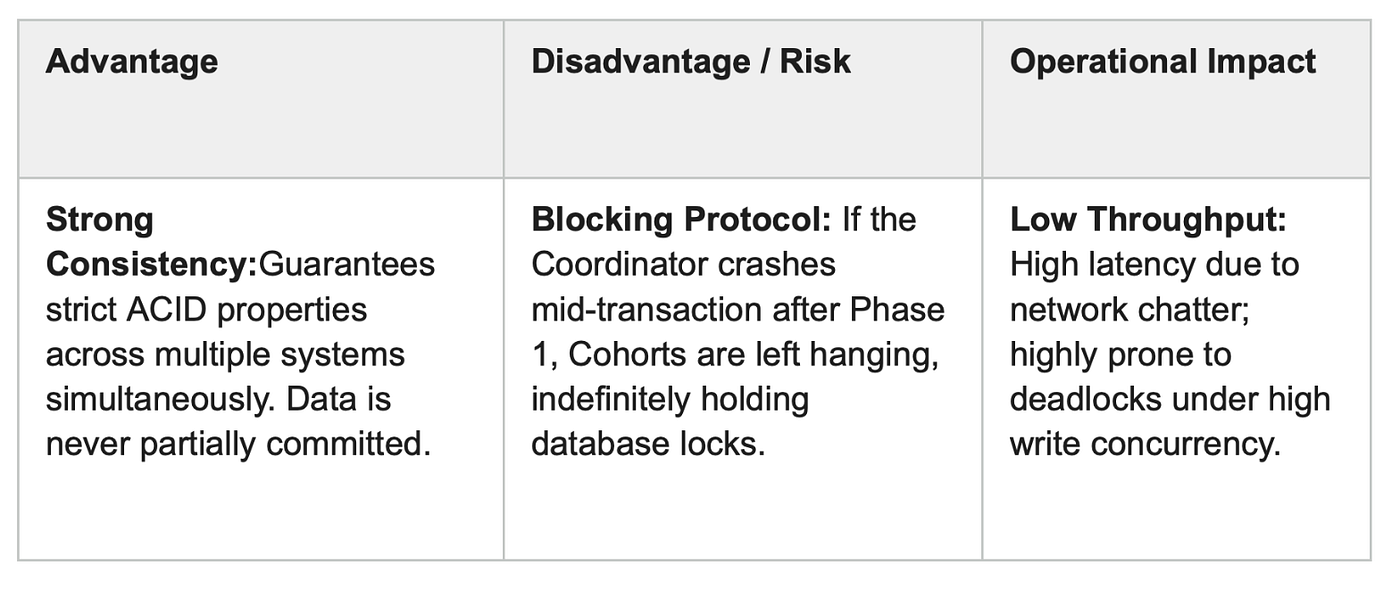
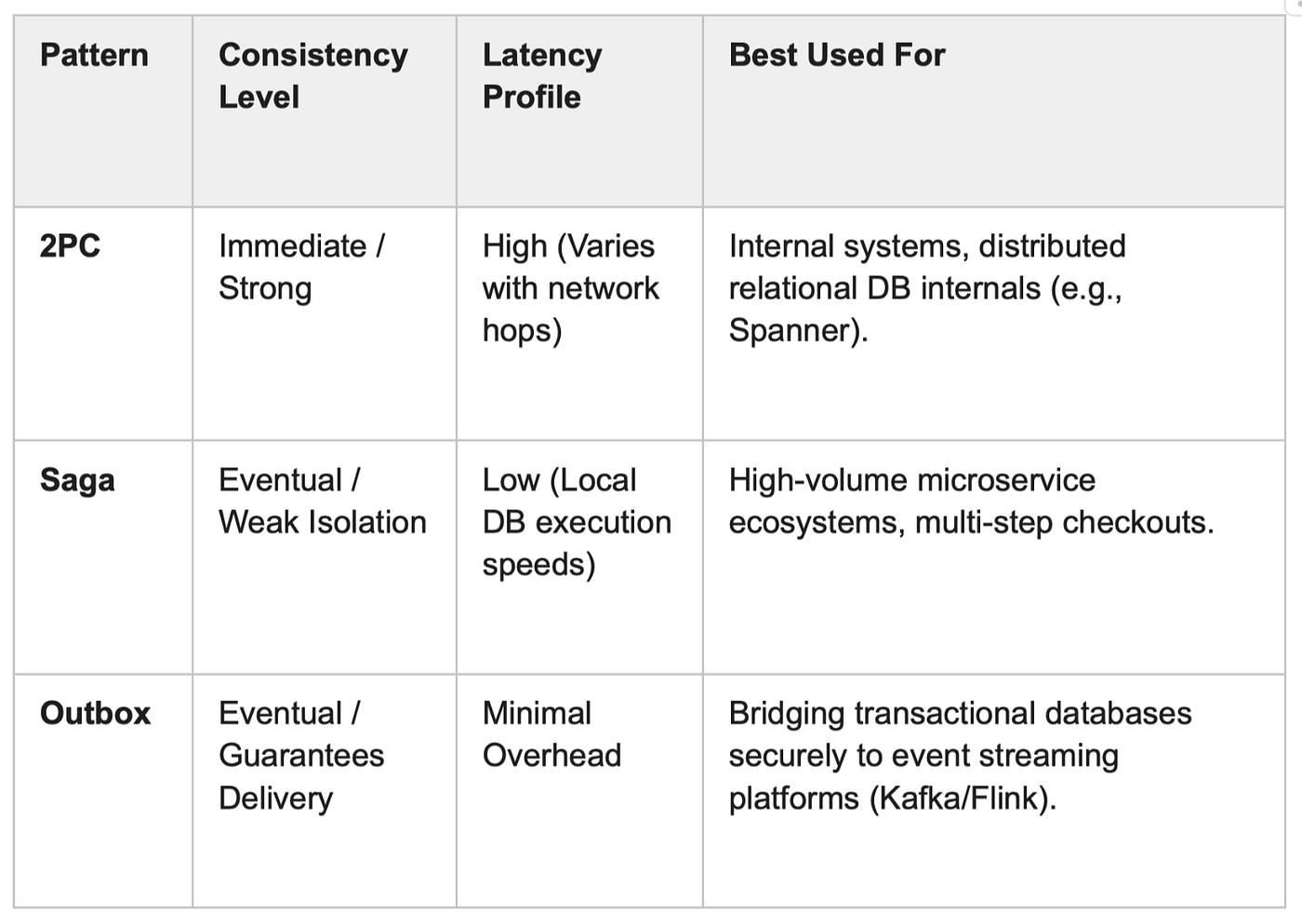
Trade-off Matrix: Two-Phase Commit (2PC)
Step 2: The Saga Pattern (Eventual Consistency)
Recognizing that blocking database locks destroy horizontal scaling, the industry pivoted toward the Saga Pattern. Instead of locking all resources globally, a Saga breaks a distributed transaction into a linear sequence of local, independent transactions.
Each microservice updates its own local database and immediately releases its locks. It then emits an event or message to trigger the next service. If a step fails, the system triggers a series of backward Compensating Transactions — explicit business actions meant to undo previous steps (e.g., if a payment fails, the compensating step issues a manual refund to the customer’s account ledger).
Sagas are generally designed using two typologies:
- Choreography: Decoupled, event-driven flow where services independently listen to events and react.
- Orchestration: A central “Saga Conductor” explicitly directs individual microservices over synchronous or asynchronous APIs.
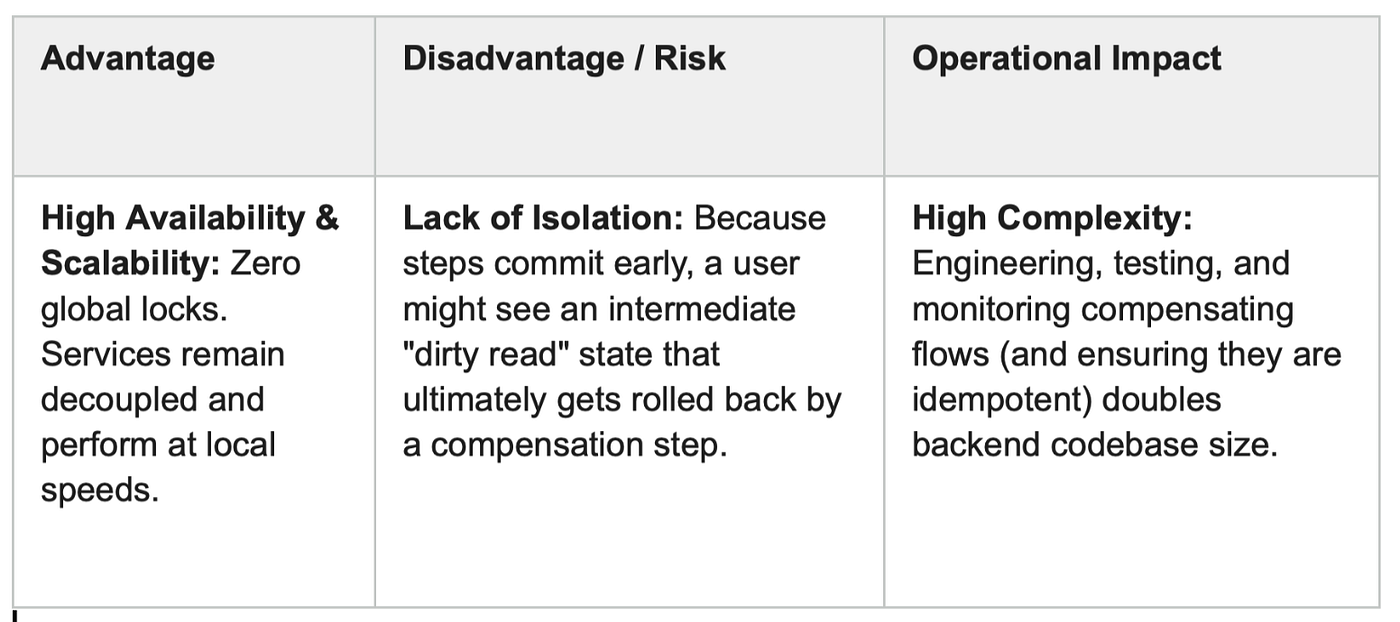
Trade-off Matrix: Saga Pattern
Step 3: Transactional Outbox Pattern
A massive vulnerability in event-driven Sagas is the “Dual-Write Problem.” If your microservice writes data to its local database and then immediately sends a notification event to a message broker like Apache Kafka, the network can drop the Kafka message after the database successfully commits. This breaks the state machine of the Saga.
The Transactional Outbox Pattern mitigates this. Instead of a direct dual-write, the service writes the business entity and an outbound message payload into the same database using a single, local ACID transaction. A secondary background process (a log tailer or Change Data Capture engine) continuously reads the Outbox table and reliably pushes the message to the broker.
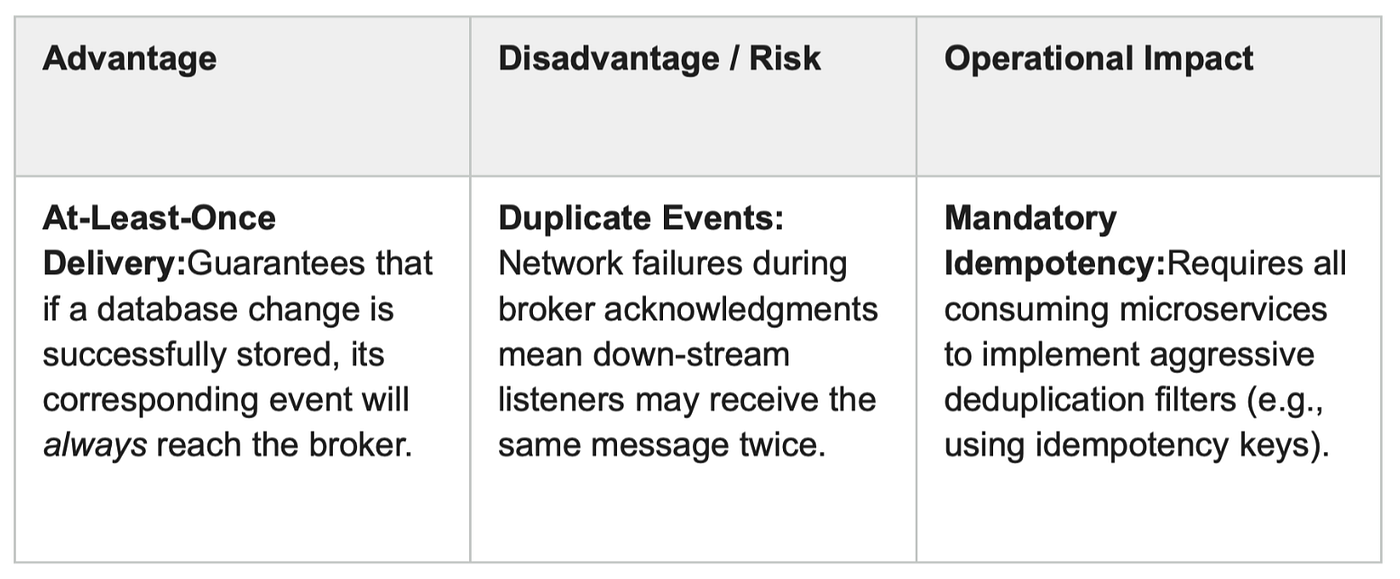
Trade-off Matrix: Transactional Outbox
Conclusion
Distributed transactions are inherently an architectural trade-off between safety and speed. Enforcing strict, global ACID guarantees using synchronous blocking locks (like 2PC) limits scale and compromises system availability. Modern architecture almost universally embraces Eventual Consistency via asynchronous, event-driven strategies like Sagas and Outbox patterns. You trade structural simplicity for the ability to process thousands of transactions per second across a global surface area.
High-Volume Real-World Case Studies
For massive-scale architectures processing millions of operations per second, standard transactional strategies crumble under the weight of database operations. The following five case studies demonstrate how industry giants re-engineer the problem entirely.
1. Unified Payments Interface (UPI) — India
- The Scale: UPI handles over 15 billion transactions a month, processing up to 600+ million daily actions.It handles real-time inter-bank transfers across hundreds of separate banking rails simultaneously.
- The Approach: UPI uses a hyper-optimized, highly distributed Choreography-based Saga pattern built over stateless routing infrastructures and event meshes. The core network switch (managed by the National Payments Corporation of India, or NPCI) acts as a stateless transactional router rather than an application-level state machine. It uses high-performance in-memory key-value layers to route Virtual Payment Addresses (VPAs) in O(1) time.
- Handling the Ledger: The architecture cleanly splits the transaction into asymmetric, independent debit and credit legs. The NPCI forces the issuer bank to atomically debit funds, releases the state, and asynchronously commands the beneficiary bank to credit the recipient. If the credit phase fails due to beneficiary downtime, the transaction is marked as pending, and a background asynchronous worker pool resolves the settlement or initiates a compensating credit reversal — completely bypassing blocking database locks across distinct institutions.
2. Uber — The Choreographed Ride Lifecycle
- The Scale: Tens of thousands of rides requested concurrently worldwide, matching drivers, allocating trips, updating ledgers, and triggering notifications.
- The Approach: Uber handles this massive volume using an asynchronous workflow engine called Cadence (now open-sourced as Temporal). Uber abandoned standard transactional states in favor of stateful workflows.
- Handling the Ledger: A ride lifecycle is modeled as a resilient, fault-tolerant state machine. If a driver cancels a matched ride, rather than rolling back a database entry, Cadence triggers a forward compensation task to re-run the matching algorithm for the next nearest driver, keeping the transaction state alive and avoiding system-wide locks.
3. Stripe — Idempotency and API Gateway Ledgers
- The Scale: Millions of global commerce transactions routed through hundreds of financial institutions daily.
- The Approach: Stripe treats Idempotency as its primary distributed defense mechanism. Their infrastructure relies heavily on an API Gateway-level idempotency engine backed by Redis.
- Handling the Ledger: Every request is tagged with a unique idempotency key. If a network blip occurs during a distributed transaction, the client retries the request safely. The idempotency layer intercepts the retried request and instantly re-serves the exact cached response from the initial execution without ever triggering duplicate internal microservice flows or database mutations downstream.
4. Amazon — The Decentralized Shopping Cart
- The Scale: Millions of global checkouts during flash sales like Prime Day.
- The Approach: Amazon’s shopping cart infrastructure relies heavily on the principles defined in their Dynamo architecture paper — leveraging Conflict-Free Replicated Data Types (CRDTs) and client-side resolution.
- Handling the Ledger: To ensure the “Add to Cart” function never fails or lags, Amazon allows different database replicas across the world to accept conflicting writes concurrently without coordinating. When the user checks out, the system merges the divergent histories. If a conflict occurs, it leans towards availability (e.g., showing an item twice rather than losing a potential sale), allowing human or business-level logic to handle anomalies instead of technical transactions.
5. Netflix — Choreographing the Media Processing Pipeline
- The Scale: Ingesting massive video files and splitting them into thousands of parallel chunk-encoding operations across a distributed cloud computing fleet.
- The Approach: Netflix engineered an internal orchestration engine named Conductor to manage microservice workflows.
- Handling the Ledger: Instead of relying on data layer consistency, Conductor uses an explicit JSON-defined state machine. It manages timeouts, handles backoffs, and tracks state variables across thousands of workers asynchronously. If a worker processing a video chunk dies, Conductor tracks the failure heartbeat, isolates the bad compute node, and assigns the task to a fresh worker instance — guaranteeing eventual completeness of the macro-transaction without any database row locking.
메타데이터
- post_id
- d8a135e7c0d5
- slug
- navigating-the-trade-offs-of-distributed-transactions-d8a135e7c0d5
- url
- https://medium.com/@bhaveshAn/navigating-the-trade-offs-of-distributed-transactions-d8a135e7c0d5
- canonical_url
- https://medium.com/@bhaveshAn/navigating-the-trade-offs-of-distributed-transactions-d8a135e7c0d5
- author_url
- https://medium.com/@bhaveshAn
- status
- ok
- fetched_at
- 2026-08-02 14:36:00