Self Learning: ALB vs NLB — I finally understood the real difference
For the longest time, I used to think:
Self Learning: ALB vs NLB — I finally understood the real difference
For the longest time, I used to think:
ALB = “normal load balancer”
NLB = “faster load balancer”
But recently, while revisiting AWS networking fundamentals, I realized the decision is not about speed.
It’s about Layer 7 vs Layer 4.
What clicked for me
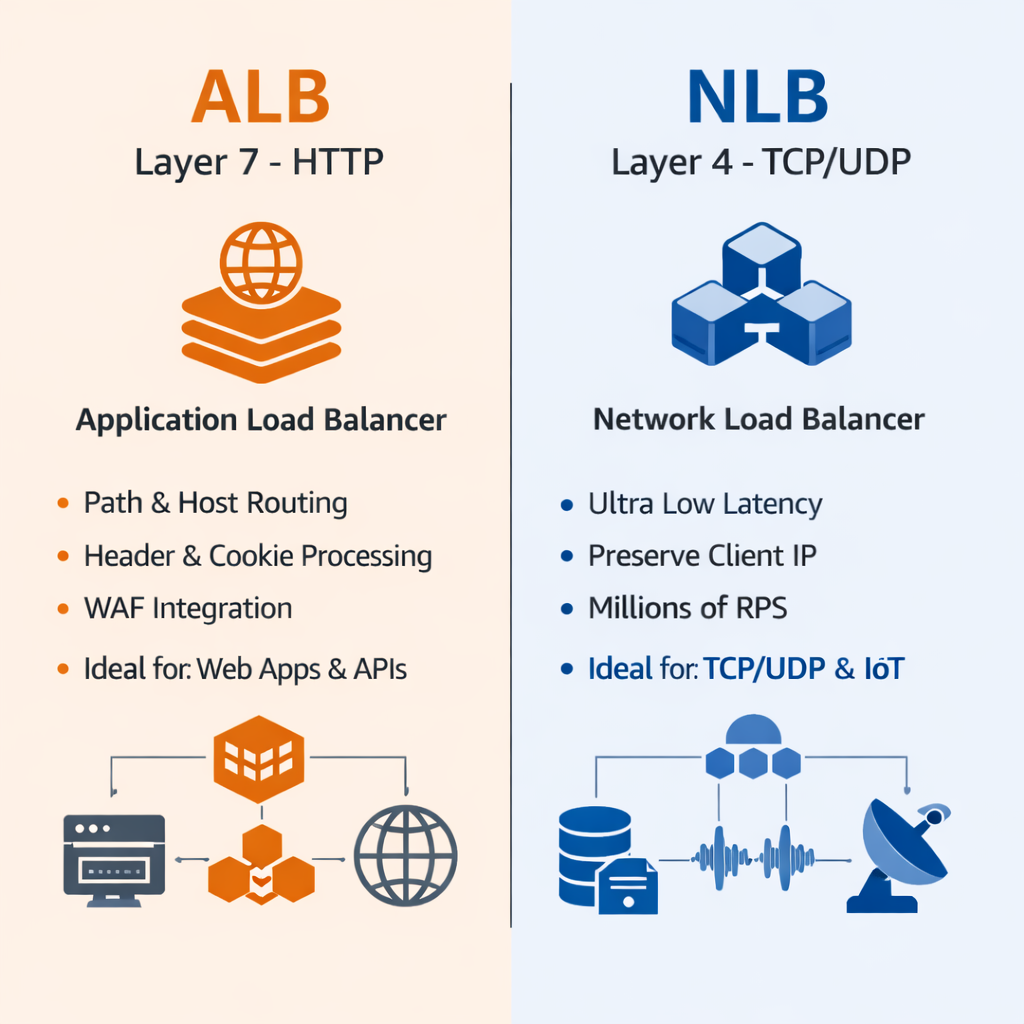
ALB (Application Load Balancer) works at Layer 7.
It understands HTTP.
That means it can:
- Route based on path (/api, /auth)
- Route based on hostname
- Inspect headers
- Integrate cleanly with WAF
- Support microservices-style routing
So ALB is not just balancing — it’s making routing decisions at request level.
This is why it’s perfect for:
- Web applications
- REST APIs
- Microservices behind one entry point
NLB (Network Load Balancer) works at Layer 4.
It doesn’t care about HTTP. It cares about TCP/UDP connections.
That means:
- Extremely low latency
- Handles sudden traffic spikes very well
- Preserves client IP
- Works for non-HTTP protocols
- Supports long-lived connections better
AWS even mentions NLB can handle millions of requests per second and scales automatically.
So NLB is not “smarter” — it’s more raw and connection-focused.
Another important realization
AWS doesn’t give fixed “max RPS” numbers.
Instead:
- ALB scales using LCU (Load Balancer Capacity Units)
- NLB scales using NLCU
Capacity depends on:
- New connections
- Active connections
- Bandwidth
- Rule evaluations (for ALB)
So the real question isn’t:
“How many RPS can it handle?”
It’s:
“What dimension of traffic is dominant in my system?”
My simple rule now
If I need:
- HTTP awareness
- Path-based routing
- Microservices behind one entry point
→ I choose ALB
If I need:
- TCP/UDP
- Very high throughput
- Low latency
- Long-lived connections
- Preserved client IP
→ I choose NLB
메타데이터
- post_id
- d8a1d1dfc681
- slug
- self-learning-alb-vs-nlb-i-finally-understood-the-real-difference-d8a1d1dfc681
- url
- https://medium.com/@tushar-dudhane/self-learning-alb-vs-nlb-i-finally-understood-the-real-difference-d8a1d1dfc681
- canonical_url
- https://medium.com/@tushar-dudhane/self-learning-alb-vs-nlb-i-finally-understood-the-real-difference-d8a1d1dfc681
- author_url
- https://medium.com/@tushar-dudhane
- status
- ok
- fetched_at
- 2026-06-12 18:14:10

