AI Lead Scoring That Reps Actually Use: A Practical Guide for SMB and Mid-Market Revenue Teams
Points-based lead scoring didn’t fail because of the concept — it failed because the scores stopped matching rep reality, and reps quietly…
AI Lead Scoring That Reps Actually Use: A Practical Guide for SMB and Mid-Market Revenue Teams
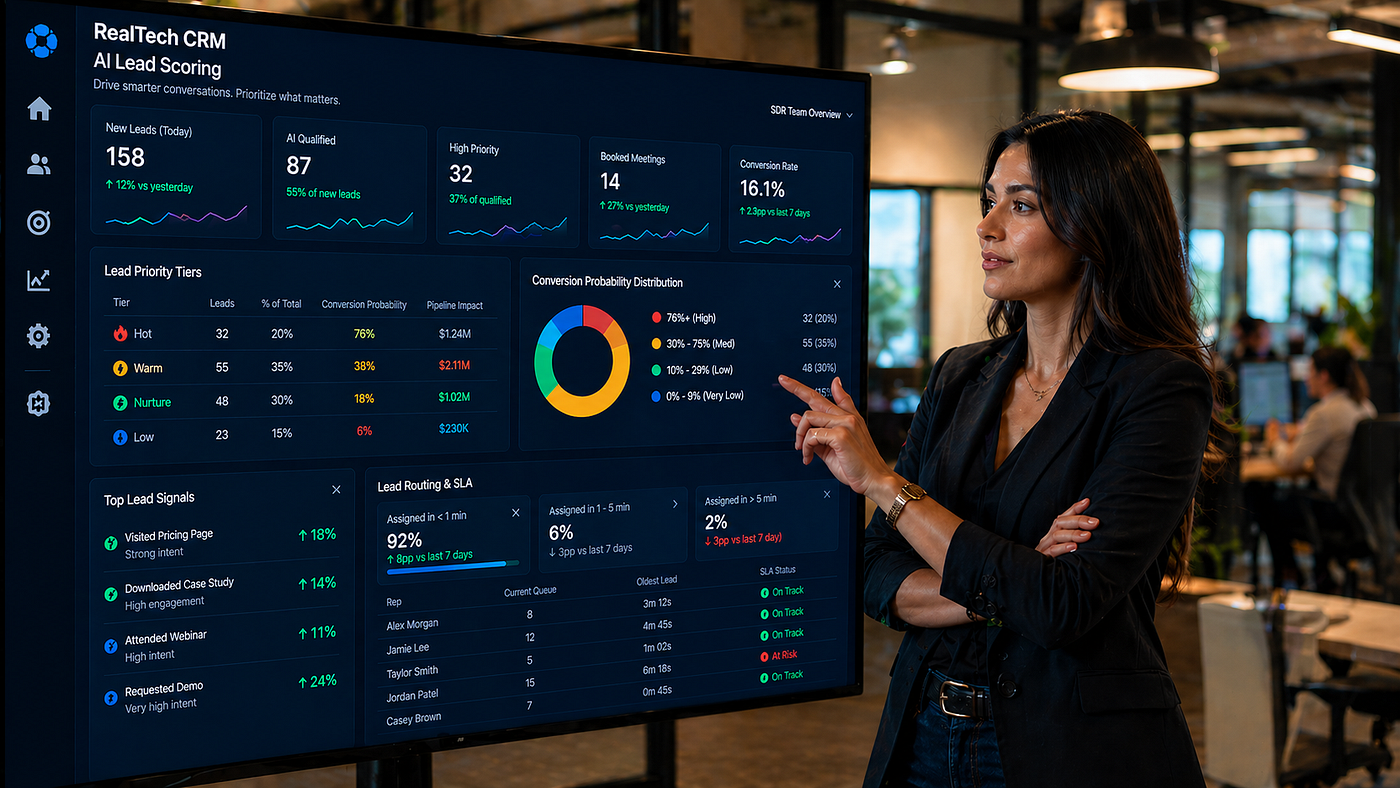
A dashboard enabling SDR leaders to prioritize high-value leads, track conversion likelihood, and optimize response SLAs in real time.
Points-based lead scoring didn’t fail because of the concept — it failed because the scores stopped matching rep reality, and reps quietly stopped using them.
Sound familiar? Marketing celebrates a 90-point MQL. The SDR calls it, finds a student doing research, and the trust in the entire system erodes within a quarter. The problem was never scoring — it was static rules applied to dynamic buyer behavior.
Modern ML-based lead scoring fixes this at the root. And the numbers are unambiguous: machine-learning scoring delivers up to 75% higher conversion than traditional rule-based models, with top-performing teams hitting ~6% lead-to-opportunity conversion versus the 3.2% industry average. For Heads of Demand Gen, VP Marketing, and SDR Leaders in B2B SaaS, martech, HR tech, and cybersecurity — here’s the practical playbook to build it, wire it into workflows, and keep it improving.
Picking the Right Features for Your Initial Model
The most common mistake in ML scoring is using every data point available. More features ≠ better model. Start with high-signal, low-noise inputs across three layers.

Machine learning insights revealing the most impactful CRM, product, and marketing signals driving predictive performance.
CRM Signals (Fit)
- Firmographics: Company size, industry vertical, revenue range, geography — does this account match your ICP?
- Role and seniority: Job title parsed to decision-maker vs. influencer vs. end-user
- Historical patterns: Closed-won accounts — what did they look like at the lead stage? Work backwards from winners.
- Negative fit signals: Company size outside your serviceable market, competitor employee, student email domain
Product Signals (Intent — Critical for SaaS)
- Trial start + depth of feature activation within first 72 hours
- Return visit frequency and time-in-product during trial
- Workflow completion rates — leads who complete a core workflow convert at 3–4× the rate of those who don’t
- API key generation or integration setup — strong proxy for serious evaluation
Marketing Signals (Engagement Quality, Not Volume)
- Content specificity: Pricing page, ROI calculator, comparison pages — high intent. Blog post on generic topic — low intent.
- Webinar attendance vs. registration-only (massive difference in conversion correlation)
- Email click-through on product-specific content vs. thought leadership
- Recency and velocity — a lead active across 4 touchpoints in 7 days beats one with 12 touchpoints over 90 days
Start with 8–12 features maximum. A clean logistic regression model with the right features will outperform a bloated gradient boosting model trained on garbage signals every time.
One underused source: Closed-lost data. Leads that scored high but didn’t convert reveal model blind spots — usually around timing, budget, or stakeholder level. Feed these into your initial training set explicitly.
Calibrating Scores With Reps and Wiring Into Workflow
A score that lives in a marketing dashboard and never changes rep behavior is decorative analytics. The goal is behavioral change at the point of action.

From 3.2% to 6% conversion — the difference between guessing and ML-scored lead prioritization
Step 1 — Calibration Sessions (Do This Before Full Launch)
Run structured sessions with 4–6 SDRs and AEs:
- Show them 20 leads: 10 the model scores high, 10 it scores low
- Ask: Would you call this? Why or why not?
- Where reps disagree with the model consistently → investigate the signal gap, not the rep
Reps aren’t wrong when they override scores. They’re surfacing context the model hasn’t learned yet.
Document every disagreement. These become your first retraining inputs.
Step 2 — Wire Scores Into Routing, SLAs, and Cadences
This is where scoring becomes real. Map score bands to specific workflow rules:

Step 2
Non-negotiable integrations:
- Score visible on lead record in CRM — not a separate tab, right on the main view
- Score change alerts: Lead moved from 52 → 81 in 48 hours → triggers SDR notification
- Sequence enrollment automated by score band, no manual SDR decision required
Step 3 — SLA Enforcement as the Trust Signal
The fastest way to kill rep trust in scoring is high-scored leads sitting unworked for days. Enforce SLAs with visibility:
- Weekly SDR scorecard showing response time by lead score band
- Manager dashboard: leads scored 85+ not contacted within 1 hour flagged in red
- Speed-to-lead on high-score leads tied to SDR performance reviews
When reps see that high-scored leads get to them fast and convert at higher rates — trust builds fast.
A/B Testing Models and Closing the Retraining Loop
A scoring model is not a launch — it’s an ongoing system. Teams that treat it as a one-time setup watch accuracy decay within two quarters as buyer behavior shifts.
Running the A/B Test (Weeks 5–8 of Rollout)
Split your lead flow — not randomly, but stratified by score band:
- Group A (AI-scored routing): Leads routed and sequenced by ML score
- Group B (control): Leads worked by existing process or simple MQL threshold
Measure for 6–8 weeks minimum across:
- Lead-to-opportunity conversion rate by group
- Sales cycle length from first touch to opportunity creation
- CAC payback period for closed deals originating from each group
- Rep-reported score accuracy (weekly 1–5 rating per lead contacted)
Don’t declare a winner at 3 weeks. Conversion cycles in mid-market take time — premature conclusions produce wrong model changes.
The Retraining Cadence

The Retraining Cadence
Feeding Outcomes Back In — The Mechanics
Every lead that reaches a closed-won or closed-lost outcome should automatically write back to your scoring training dataset:
- Closed-won → positive label with all features at time of scoring
- Closed-lost → negative label, but segment by reason (budget, timing, competition, no decision) — each tells the model something different
- No-show / ghost → separate label, often reveals over-scored leads with weak intent signals
This writeback loop — when automated — compounds model accuracy quarter over quarter without requiring manual data science work for every cycle.
The KPIs That Tell You It’s Working
Lead-to-Opportunity Conversion Baseline before launch. Target: move from industry average (~3.2%) toward top-performer range (~6%) within two quarters. Measure by score band, not in aggregate — aggregate numbers mask which tier is driving gains.
CAC Payback Period AI scoring improves CAC payback through two mechanisms: higher conversion (fewer wasted SDR hours per opportunity) and better fit leads (shorter sales cycles, higher ACV, lower early churn). Track payback period by lead source × score band cohort.
The leading indicator to watch in the first 30 days isn’t conversion — it’s rep adoption rate: what percentage of high-scored leads are being worked within SLA? If that number isn’t above 85%, fix the workflow before fixing the model.
The teams winning on pipeline efficiency aren’t prospecting harder — they’re prospecting smarter, with models that learn from every outcome and workflows that make the right action the path of least resistance.
Ready to build a scoring system your SDRs actually trust? Let’s talk →
⇢ For more like this, join our Telegram channel → https://t.me/howdyanalytics
메타데이터
- post_id
- d8a32f242c48
- slug
- ai-lead-scoring-that-reps-actually-use-a-practical-guide-for-smb-and-mid-market-revenue-teams-d8a32f242c48
- url
- https://medium.com/@deepaksethionly/ai-lead-scoring-that-reps-actually-use-a-practical-guide-for-smb-and-mid-market-revenue-teams-d8a32f242c48
- canonical_url
- https://medium.com/@deepaksethionly/ai-lead-scoring-that-reps-actually-use-a-practical-guide-for-smb-and-mid-market-revenue-teams-d8a32f242c48
- author_url
- https://medium.com/@deepaksethionly
- status
- ok
- fetched_at
- 2026-06-09 15:37:30





