The Micro-Obedience Paradox: Why the Most Agreeable Person in the Room Is Losing the Most
You nodded four times today in meetings where you actually disagreed, and you did not count a single one of them as a decision.
The Micro-Obedience Paradox: Why the Most Agreeable Person in the Room Is Losing the Most
You nodded four times today in meetings where you actually disagreed, and you did not count a single one of them as a decision.
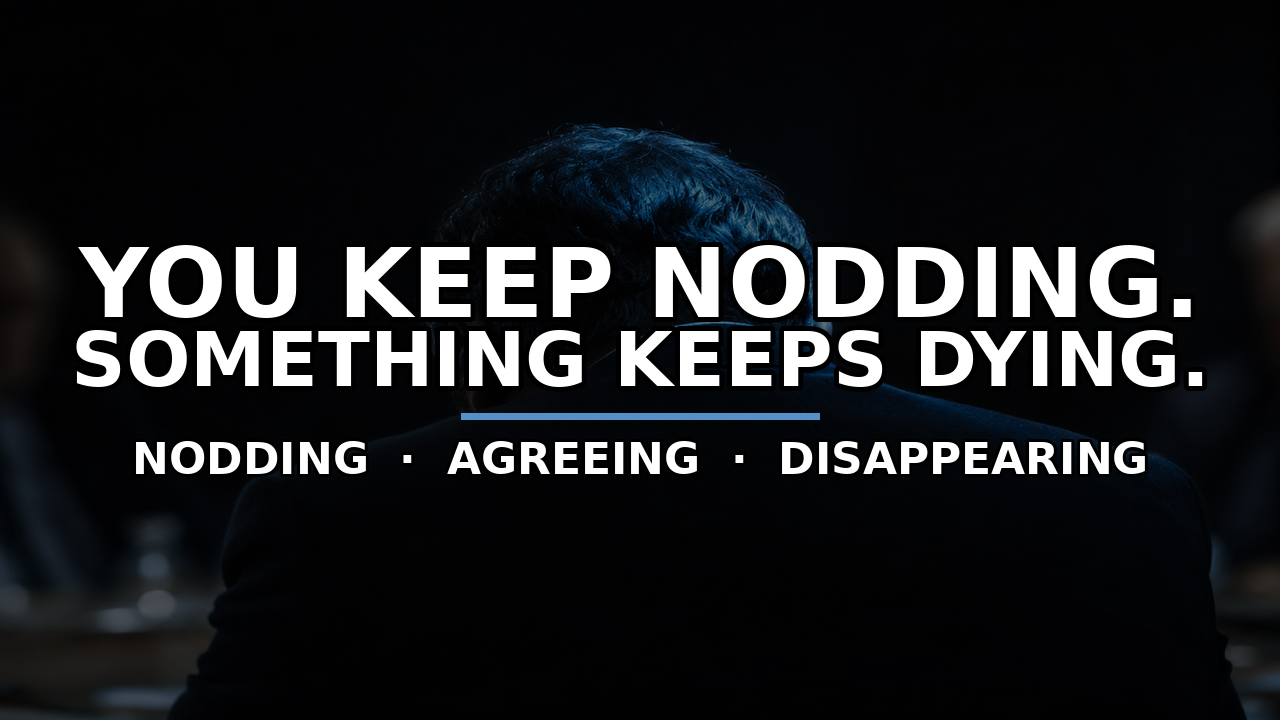
The nod happens before your opinion does, which means something else is voting on your behalf. Watch it happen in real time. Someone proposes something off, and your head is already moving up and down while your actual thought is still forming a sentence in the back of your mind. By the time the thought is ready to speak, the room has moved on, and your body has already delivered its verdict.
This is not a flaw in your communication style. It is not a personality trait you were born with. It is a mechanism, and once you can see it, you cannot easily unsee it in your own week.
We call this micro-obedience, and it is not one betrayal, it is a thousand small ones stacked so evenly you never notice the pile growing. Nobody wakes up and decides to abandon their own judgment at work. What actually happens is smaller and much harder to catch: agreeing a meeting time works when it does not, saying “sounds great” about a plan you can already see the flaw in, staying quiet when the framing of a problem is wrong because correcting it would take more energy than the moment seems to deserve.
Gallup’s most recent workplace data found that only 28 percent of employees strongly agree that their opinions count at work (Gallup, https://www.gallup.com/workplace/692954/anemic-employee-engagement-points-leadership-challenges.aspx)..) Seven out of ten people, in other words, are showing up to rooms where they have already concluded, somewhere below conscious thought, that saying the true thing is not worth the cost of saying it.
Global employee engagement has dropped to its lowest point since 2020, and the silence is not incidental to that number, it is a driver of it. Gallup’s 2026 State of the Global Workplace report puts global engagement at roughly 20 percent (Gallup, https://www.gallup.com/workplace/349484/state-of-the-global-workplace.aspx)..) A 2026 report from Radical Candor found that 61.3 percent of individual contributors regularly watch their colleagues stay silent when they hold a different opinion in a meeting (Radical Candor, https://www.globenewswire.com/news-release/2026/05/07/3290244/0/en/new-radical-candor-report-reveals-6-in-10-employees-are-afraid-to-speak-up-at-work.html)..) This is not a handful of unusually agreeable people. This is most rooms, most weeks.
The instinct is to treat this as a communication problem. Take the assertiveness course. Learn the “I feel” sentence structure. Practice saying no in the mirror before the big meeting. None of that is wrong exactly, but it treats the nod as a skill you have not learned yet, when the nod is actually happening below the level where skills operate.
Your nervous system decides the room is safer with your agreement in it, and it makes that decision faster than your vocabulary can intervene. This is the fawn response, the lesser known fourth option alongside fight, flight, and freeze. Fawning is the nervous system’s strategy of pleasing a perceived threat into calming down. It shows up in dramatic relationships, and it shows up in a Tuesday afternoon status meeting, in the half second before you say “no notes” about a plan you have real notes on.
The compliant employee and the genuinely generous one can look identical in a single meeting and become completely different people after five years of it. Adam Grant’s research at Wharton distinguishes between givers, people making an active choice toward generosity from a full sense of self, and workers whose agreeableness is actually threat management dressed up as teamwork (Adam Grant, Wharton Management, https://mgmt.wharton.upenn.edu/profile/grantad/)..) In any one meeting, you cannot tell them apart from the outside. Over years, one of them is building something. The other is quietly disappearing into the role.
Solomon Asch proved decades ago that people will say something out loud they can see is false, just because the group said it first, and nothing about a modern office has made that pull weaker. His original conformity experiments are still cited today because the finding holds: put a person in a room with others confidently stating something untrue, and a meaningful share of people will go along with it rather than trust their own eyes (Asch conformity legacy research, https://pubmed.ncbi.nlm.nih.gov/15661682/)..) Add a manager, a performance review cycle, and a mortgage payment to that room, and the pull toward agreement only gets stronger.
Nobody has ever received a performance review that says “excellent at disagreeing accurately,” which tells you exactly what the system is actually rewarding. We reward “collaborative.” We reward “low maintenance.” We reward “easy to work with.” None of that language can tell the difference between someone offering their honest agreement and someone offering the agreement that keeps them safe. Since the system cannot tell the difference, it rewards both identically, and that reward structure is quietly training the second one to become the default.
In manufacturing, catastrophic failure almost never comes from one big defect. It comes from thousands of tiny ones that were each within tolerance. This is the part of the pattern most people miss entirely. Micro-obedience does not feel dangerous in any single instance, which is exactly why it is dangerous in aggregate. Nobody experiences the moment their self-trust broke. They experience an accumulation, invisible at the time, that eventually shows up as exhaustion with no clear cause, or a resume full of achievements that somehow do not feel like theirs.
Your body already knows the difference between the true yes and the fawn yes, most of us just stopped listening to it years ago. Pay attention the next time you agree to something you do not actually agree with. Notice your chest. Notice whether your shoulders creep up. Notice whether your breath gets shorter, as though it is trying to take up less space in case someone hears the hesitation in it. That reaction is not dramatic. It is your body casting a dissenting vote while your mouth casts the opposite one, out loud, on the record.
The pattern behind which meetings get your true yes and which get your fawn yes is not random, and that is either the most disturbing part of this or the most useful, depending on what you do with it. If the pattern is not random, it is trackable. If it is trackable, it belongs to you rather than to the situation. That single distinction is the difference between feeling at the mercy of every room you walk into and starting to notice, with some precision, exactly which rooms and which people pull the nod out of you fastest.
None of this means disagreeing with everything, loudly, in every meeting starting tomorrow. That is a different kind of performance, not an actual fix. What it means is noticing, this week, the exact moment your head starts moving before your mind has weighed in. That noticing, on its own, before any technique or strategy gets involved, changes what happens next.
You already know this pattern. You have felt the flicker under the nod more times than you have counted. It has a name now. What you do with the name is the next question, and it is worth sitting with longer than the length of this article.
I write about the psychology underneath ordinary workplace behavior. My book Why You Keep Sabotaging Yourself at Work is available on Amazon now.
메타데이터
- post_id
- d8a3d111bfbe
- slug
- the-micro-obedience-paradox-why-the-most-agreeable-person-in-the-room-is-losing-the-most-d8a3d111bfbe
- url
- https://medium.com/@drtiffanyantoine/the-micro-obedience-paradox-why-the-most-agreeable-person-in-the-room-is-losing-the-most-d8a3d111bfbe
- canonical_url
- https://medium.com/@drtiffanyantoine/the-micro-obedience-paradox-why-the-most-agreeable-person-in-the-room-is-losing-the-most-d8a3d111bfbe
- author_url
- https://medium.com/@drtiffanyantoine
- status
- ok
- fetched_at
- 2026-08-01 20:16:16