AI Sovereignty Without Researchers Is an Empty Strategy
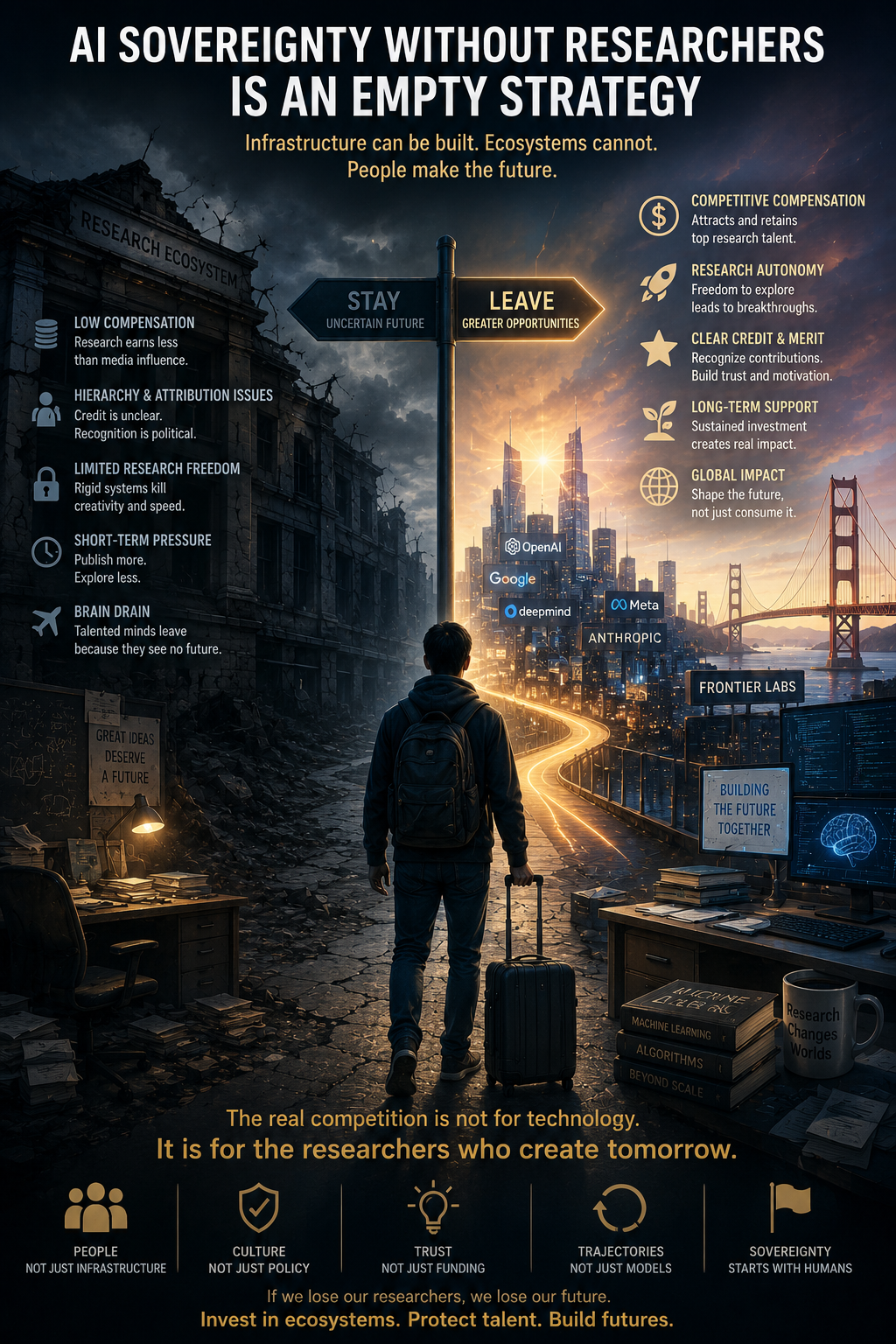
Why the global AI race is not only about infrastructure, but about the structural collapse of research ecosystems outside the United States
AI Sovereignty Without Researchers Is an Empty Strategy
Why the global AI race is not only about infrastructure, but about the structural collapse of research ecosystems outside the United States
Introduction
Across Europe, Asia, and much of the non-U.S. world, governments are beginning to speak seriously about:
- AI sovereignty
- national foundation models
- cyber defense systems
- domestic compute infrastructure
- strategic technological independence
South Korea is no exception.
Recent discussions surrounding AI security, autonomous cyber capabilities, and large-scale foundation models have accelerated political interest in building a national AI ecosystem capable of competing in the emerging global order.
But beneath these discussions lies a structural contradiction that is rarely addressed directly:
A nation cannot build AI sovereignty while simultaneously losing the researchers capable of sustaining it.
The current AI race is often framed as a competition of:
- GPUs
- data centers
- investment capital
- model scale
In practice, however, the deeper bottleneck is increasingly human.
And outside the United States, that bottleneck is becoming severe.
1. The Global Gravity Well Problem
The modern AI ecosystem exhibits an extreme form of concentration.
The most advanced:
- compute infrastructure
- frontier models
- research visibility
- citation networks
- venture capital
- publication influence
are overwhelmingly concentrated within the U.S. frontier ecosystem.
As a result, many researchers outside the United States no longer perceive domestic institutions as destinations.
They perceive them as transit points.
The “Trajectory Drift” of Researchers
In many countries, including South Korea:
- talented researchers enter local institutions
- build credentials domestically
- accumulate publications and experience
- then migrate toward Silicon Valley or U.S.-aligned labs
This is often described as a salary problem.
It is not only a salary problem.
It is also a problem of:
- research autonomy
- institutional flexibility
- visibility
- attribution
- long-term career survivability
Researchers do not merely follow money.
They follow environments where meaningful work appears structurally possible.
2. Infrastructure Cannot Replace Research Culture
Governments increasingly discuss:
- sovereign models
- national compute clusters
- AI security frameworks
- independent inference infrastructure
These are important.
But infrastructure alone does not produce innovation.
A GPU cluster without a sustainable research culture becomes an expensive shell.
The deeper issue is that many research ecosystems outside the U.S. suffer from structural instability:
- excessive hierarchy
- slow institutional adaptation
- short-term evaluation metrics
- publication quantity pressure
- unclear attribution structures
- weak support for independent or interdisciplinary work
Over time, these conditions produce a dangerous outcome:
researchers optimize for survival rather than exploration
3. The Attribution Crisis
One of the least discussed problems in AI research ecosystems is attribution instability.
In highly hierarchical systems, younger researchers often perceive that:
- intellectual ownership is ambiguous
- seniority outweighs originality
- visibility is politically mediated
- institutional affiliation matters more than contribution
Whether fully accurate or not, the perception itself has consequences.
When researchers lose confidence that their work will remain attached to their name:
- risk-taking decreases
- frontier exploration weakens
- long-term projects become irrational
- safe incremental work dominates
Eventually, the system begins to produce:
- managerial optimization instead of
- conceptual breakthroughs
This is not merely a fairness issue.
It is an innovation issue.
4. Why Researchers Become Content Creators
A striking phenomenon has emerged across many countries:
serious researchers increasingly migrate toward media ecosystems
including:
- YouTube
- podcasts
- public intellectual branding
- newsletters
- social media analysis
This is often dismissed as vanity or self-promotion.
But structurally, it reflects something deeper:
research alone is no longer economically stable for many independent thinkers
In some cases:
- public visibility generates more sustainable income than research itself
- media appearances produce more reward than publications
- intellectual labor becomes inseparable from content labor
As a result, the research ecosystem gradually transforms:
from:
- knowledge production
toward:
- visibility competition
This creates profound long-term instability.
5. Independent Researchers and the Structural Shift
Ironically, the modern AI era is also weakening the monopoly of institutional research.
Today:
- open repositories
- public datasets
- AI-assisted synthesis
- distributed publishing platforms
- DOI-based working papers
- crawler-indexed research archives
allow independent researchers to participate in theoretical discourse at unprecedented speed.
This creates a new tension:
Traditional institutions still dominate legitimacy.
But increasingly, independent researchers influence conceptual emergence.
In some domains especially:
- alignment
- interaction dynamics
- symbolic systems
- human-AI communication
- trajectory modeling
independent work may move faster than institutional consensus.
The problem is sustainability.
Without structural support, many independent researchers operate under conditions of:
- financial instability
- limited visibility
- weak institutional protection
- uncertain long-term continuity
Yet paradoxically, they may also represent some of the most experimentally flexible parts of the ecosystem.
6. AI Sovereignty Requires Human Sovereignty
The phrase “AI sovereignty” is becoming increasingly common.
But sovereignty is not merely ownership of infrastructure.
It is the ability to:
- retain researchers
- sustain long-term inquiry
- protect intellectual continuity
- reward original work
- preserve conceptual independence
Without these conditions, national AI ecosystems risk becoming:
- consumer layers built on top of
- externally produced intelligence systems
This creates a dangerous asymmetry:
countries may possess AI infrastructure without possessing AI trajectories of their own
Conclusion
The current AI race is often framed as a technological competition.
In reality, it may be something more fragile:
a competition over whether nations can maintain coherent research ecosystems under extreme global concentration pressures.
The central issue is not merely:
- compute
- models
- cybersecurity
- funding
It is whether researchers themselves still believe meaningful futures can exist within their own systems.
Because once researchers psychologically detach from a national ecosystem, the collapse begins long before the resignation letter is written.
And no amount of infrastructure can compensate for a research culture that no longer believes in itself.
[Author’s (Kim, Jace) Research Portfolio]
메타데이터
- post_id
- d8a7233071be
- slug
- ai-sovereignty-without-researchers-is-an-empty-strategy-d8a7233071be
- url
- https://medium.com/@jk1849716/ai-sovereignty-without-researchers-is-an-empty-strategy-d8a7233071be
- canonical_url
- https://medium.com/@jk1849716/ai-sovereignty-without-researchers-is-an-empty-strategy-d8a7233071be
- author_url
- https://medium.com/@jk1849716
- status
- ok
- fetched_at
- 2026-07-28 07:07:08






