Copper Y Joint vs Refnet Joint: What’s the Difference?
Understand the key differences between Copper Y Joints and Refnet Joints to choose the right refrigerant branch fitting for your VRF HVAC…
Copper Y Joint vs Refnet Joint: What’s the Difference?
Understand the key differences between Copper Y Joints and Refnet Joints to choose the right refrigerant branch fitting for your VRF HVAC project.
The efficiency of a Variable Refrigerant Flow (VRF) system depends not only on the outdoor and indoor units but also on the quality and design of its refrigerant piping network. Among the most important components in this network are refrigerant branch fittings, which ensure that refrigerant is distributed evenly throughout the system.
When planning or installing a VRF project, HVAC professionals often come across two commonly used terms: Copper Y Joint and Refnet Joint. While these components perform a similar function, they are not always the same. Understanding their differences can help contractors, consultants, and MEP engineers make informed decisions during system design and installation.
In this article, we’ll explore the differences between a Copper Y Joint and a Refnet Joint, their applications, advantages, and how to choose the right option for your VRF project.
What Is a Copper Y Joint?
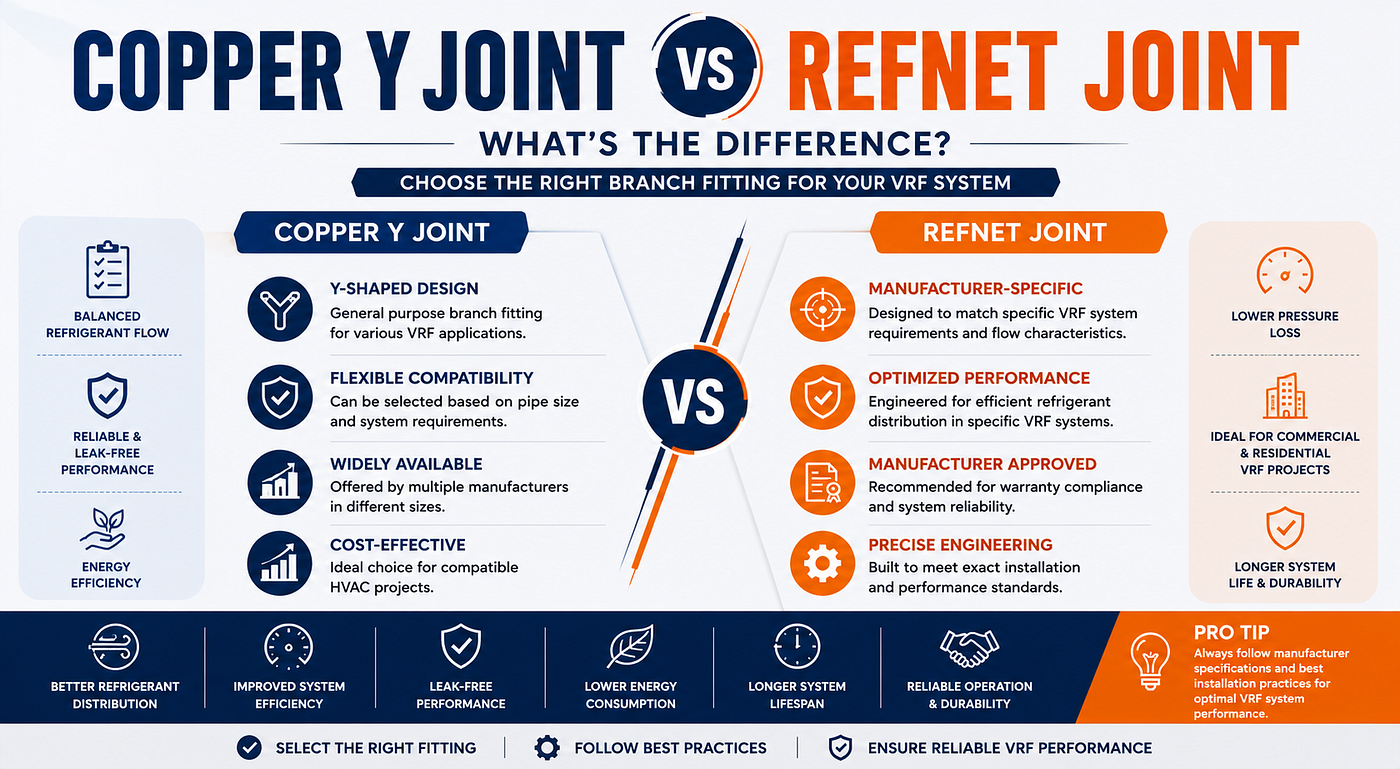
A Copper Y Joint is a refrigerant branch fitting designed to split the flow of refrigerant from one main pipeline into two branch lines. It features a Y-shaped design that allows refrigerant to flow smoothly while minimizing pressure loss.
These fittings are widely used in commercial and residential VRF systems because they help maintain balanced refrigerant distribution to multiple indoor units.
High-quality Copper Y Joints are typically manufactured from refrigeration-grade copper and engineered to withstand high operating pressures while providing reliable, leak-free performance.
What Is a Refnet Joint?
A Refnet Joint is a manufacturer-approved refrigerant branch fitting specifically designed for certain VRF air conditioning systems. The term “Refnet” is commonly associated with branch piping solutions supplied or specified by VRF equipment manufacturers.
Unlike a generic Copper Y Joint, a Refnet Joint is often designed to match the refrigerant flow characteristics and installation requirements of a particular VRF brand.
These joints are engineered to optimize refrigerant distribution according to the manufacturer’s system design, ensuring compatibility and reliable system performance.
Copper Y Joint vs Refnet Joint: A Quick Comparison

Similarities Between Copper Y Joint and Refnet Joint
Although there are differences, both components share several important characteristics.
Both are designed to:
- Split refrigerant flow efficiently
- Reduce pressure loss
- Improve refrigerant distribution
- Support multiple indoor units
- Operate under high refrigerant pressure
- Increase HVAC system efficiency
- Provide durable and leak-resistant performance
Their primary objective is the same — to ensure efficient refrigerant circulation throughout a VRF system.
Key Differences Explained
1. Purpose and Design
A Copper Y Joint is a general refrigerant branch fitting used in many HVAC piping layouts. It is available in different sizes to suit various VRF installations.
A Refnet Joint, on the other hand, is designed according to the engineering requirements of specific VRF manufacturers. The internal geometry and flow characteristics may be optimized for that particular system.
2. Compatibility
Compatibility is one of the biggest differences.
Copper Y Joints can often be selected based on pipe size and refrigerant capacity, whereas Refnet Joints are generally specified by the HVAC equipment manufacturer.
Following manufacturer recommendations is important to ensure warranty compliance and optimal system performance.
3. Installation Requirements
Both fittings require professional installation, but Refnet Joints often have stricter installation instructions.
Technicians should always verify:
- Refrigerant flow direction
- Pipe diameters
- Installation orientation
- Straight pipe length requirements
- Brazing procedures
Proper installation practices, including nitrogen purging and pressure testing, remain essential for both components.
4. System Performance
Both fittings are designed to maintain smooth refrigerant flow.
However, manufacturer-approved Refnet Joints may offer optimized refrigerant distribution within their designated VRF systems because they are engineered specifically for those units.
A properly selected Copper Y Joint also delivers excellent performance when installed according to engineering specifications.
5. Availability and Flexibility
Copper Y Joints are widely available from HVAC component manufacturers in multiple configurations.
Refnet Joints are generally supplied or recommended for use with particular VRF equipment brands.
This makes Copper Y Joints a flexible option for customized HVAC projects where compatible specifications are met.
Which One Should You Choose?
The right choice depends on your project requirements.
Choose a Copper Y Joint when:
- The project specifications allow compatible refrigerant branch fittings.
- You’re sourcing high-quality refrigeration-grade copper components.
- The fitting matches the required pipe size and refrigerant capacity.
- The design complies with engineering drawings and applicable standards.
Choose a Refnet Joint when:
- The VRF equipment manufacturer specifies its use.
- The project requires strict compliance with manufacturer installation guidelines.
- Warranty conditions depend on approved refrigerant branch fittings.
- You are working with proprietary VRF system designs.
Always refer to the HVAC equipment manufacturer’s documentation before making a selection.
Installation Best Practices
Whether you’re installing a Copper Y Joint or a Refnet Joint, following proper installation procedures is essential.
Some best practices include:
- Verify refrigerant piping layouts before installation.
- Use the correct fitting size.
- Clean all pipe ends before brazing.
- Purge with dry nitrogen during brazing.
- Maintain proper pipe alignment.
- Perform pressure testing.
- Complete vacuum evacuation before charging refrigerant.
- Apply proper insulation after installation.
These practices help ensure reliable system performance and reduce the risk of refrigerant leaks.
Related Components Used in VRF Piping
Modern VRF systems include several specialized refrigerant piping components besides branch joints.
Depending on the project design, HVAC professionals may use:
- VRF Copper Branch Kits for complete refrigerant branch assemblies.
- VRF Copper Joints designed for reliable refrigerant distribution.
- Copper Y Fittings for branching refrigerant flow where appropriate.
- **Copper Tee Joint** fittings in specific piping configurations, when permitted by the system design.
- Approved brazing materials and suitable Copper Compound products as recommended during installation to help achieve durable, leak-resistant joints.
Selecting high-quality components from trusted manufacturers contributes to the overall reliability and efficiency of the HVAC system.
Common Mistakes to Avoid
Regardless of the fitting selected, avoid these common installation mistakes:
- Choosing the wrong fitting size
- Ignoring manufacturer guidelines
- Installing the fitting in the wrong direction
- Skipping nitrogen purging
- Poor brazing practices
- Inadequate pressure testing
- Improper insulation
- Failing to document installation details
Preventing these issues can significantly improve the performance and lifespan of the VRF system.
Benefits of Using High-Quality Refrigerant Branch Fittings
Whether you select a Copper Y Joint or a Refnet Joint, investing in high-quality fittings offers several advantages:
- Improved refrigerant flow
- Better energy efficiency
- Reduced pressure loss
- Leak-resistant performance
- Longer equipment life
- Lower maintenance costs
- Consistent cooling and heating performance
- Reliable operation in commercial and residential projects
These benefits make proper component selection an important part of every successful HVAC installation.
Conclusion
Although the terms Copper Y Joint and Refnet Joint are sometimes used interchangeably, they are not identical. A Copper Y Joint is a versatile refrigerant branch fitting suitable for many VRF installations, while a Refnet Joint is typically a manufacturer-specified component engineered for compatibility with particular VRF systems.
The best choice depends on the project’s design requirements, equipment specifications, and manufacturer recommendations. By selecting the correct fitting, following professional installation practices, and using high-quality refrigeration-grade components, HVAC professionals can achieve efficient refrigerant distribution, reliable system performance, and long-term operational success.
Understanding these differences enables contractors, consultants, and MEP engineers to make informed decisions that contribute to safer installations, improved energy efficiency, and dependable performance throughout the life of the VRF system.
FAQs
1. What is the difference between a Copper Y Joint and a Refnet Joint?
A Copper Y Joint is a Y-shaped refrigerant branch fitting used to distribute refrigerant in VRF systems, while a Refnet Joint is a manufacturer-specific branch fitting designed to meet the installation and performance requirements of certain VRF brands. Both serve a similar purpose but differ in compatibility and specifications.
2. Can a Copper Y Joint be used instead of a Refnet Joint?
It depends on the VRF system manufacturer’s recommendations. Some projects may allow a compatible Copper Y Joint, while others require a Refnet Joint to maintain system performance, warranty compliance, and proper refrigerant distribution.
3. Which is better for a VRF system: a Copper Y Joint or a Refnet Joint?
Neither is universally better. A Copper Y Joint is ideal for compatible HVAC applications, whereas a Refnet Joint is often the preferred choice when specified by the VRF equipment manufacturer. The best option depends on your project requirements and system design.
4. What is the primary function of a Copper Y Joint?
A Copper Y Joint divides refrigerant flow from the main pipeline into multiple branches, ensuring balanced refrigerant distribution to indoor units while minimizing pressure loss and improving overall VRF system efficiency.
5. Why is a Refnet Joint important in VRF installations?
A Refnet Joint is engineered to optimize refrigerant flow according to the manufacturer’s design. Using the correct Refnet Joint helps improve system performance, supports efficient refrigerant distribution, and ensures compatibility with specific VRF equipment.
6. Are Copper Y Joints and Refnet Joints made from the same material?
Yes. Both components are generally manufactured from high-quality refrigeration-grade copper, offering excellent durability, corrosion resistance, and the ability to withstand high operating pressures in HVAC systems.
7. Do Copper Y Joints require nitrogen purging during installation?
Yes. During brazing, dry nitrogen should be purged through the piping to prevent oxidation inside the copper pipes. This helps maintain a clean refrigeration circuit and protects the compressor from contamination.
8. What other components are commonly used with Copper Y Joints in VRF systems?
Depending on the project, HVAC professionals may also use VRF Copper Branch Kits, VRF Copper Joints, Copper Y Fittings, and other refrigerant piping accessories to complete the installation according to system specifications.
9. What are the common installation mistakes to avoid with Copper Y Joints and Refnet Joints?
Common mistakes include selecting the wrong fitting size, installing the joint in the incorrect direction, skipping nitrogen purging, poor brazing techniques, failing to perform pressure testing, and not following the manufacturer’s installation guidelines.
10. How do I choose the right refrigerant branch fitting for my VRF project?
The selection should be based on the HVAC system manufacturer’s recommendations, refrigerant pipe size, project specifications, and system capacity. Using the correct branch fitting helps ensure efficient refrigerant flow, reliable operation, and long-term performance of the VRF system.
메타데이터
- post_id
- d8b5b6d5f8d3
- slug
- copper-y-joint-vs-refnet-joint-whats-the-difference-d8b5b6d5f8d3
- url
- https://medium.com/@acharyabhairavi77/copper-y-joint-vs-refnet-joint-whats-the-difference-d8b5b6d5f8d3
- canonical_url
- https://medium.com/@acharyabhairavi77/copper-y-joint-vs-refnet-joint-whats-the-difference-d8b5b6d5f8d3
- author_url
- https://medium.com/@acharyabhairavi77
- status
- ok
- fetched_at
- 2026-07-18 00:21:44