Azure Synapse to Databricks SQL Conversion using LLMs — A Practical POC
Introduction
Azure Synapse to Databricks SQL Conversion using LLMs — A Practical POC
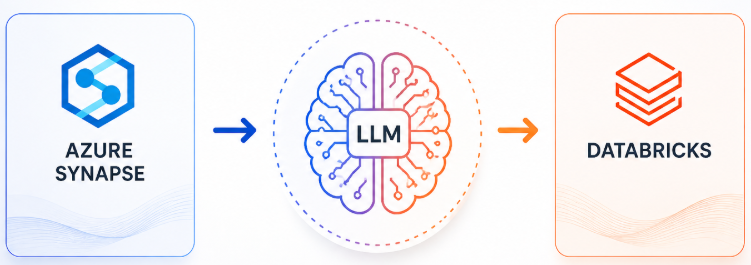
Introduction
Migrating SQL workloads from Azure Synapse Analytics to Databricks is a common challenge in modern data platforms. While both systems are powerful, their SQL dialects differ in subtle but important ways — function syntax, date handling, aggregation patterns, and system-specific behaviors.
At scale, these differences turn migration into a time-consuming and error-prone exercise, often requiring:
- Manual query rewrites
- Custom rule-based transformation engines
- Extensive validation cycles
Traditional approaches rely heavily on static mappings and scripts, which quickly become difficult to maintain as query complexity increases.
To explore a simpler alternative, I built a lightweight Proof of Concept (POC) using a Large Language Model (LLM) hosted directly within Databricks. Instead of relying on rule-based transformations, this approach leverages the reasoning capability of models like Llama 3.1 405B Instruct to understand and rewrite SQL across dialects.
The goal was intentionally minimal:
Can we convert Synapse SQL to Databricks SQL using just a model + prompt — without complex frameworks — and still maintain clarity, reliability, and measurable cost?
The answer: Yes — and surprisingly effectively.
This POC was executed entirely within the Databricks environment using a model serving endpoint, with no additional infrastructure or external dependencies.
Objective
This POC was designed with strict principles:
- Keep the logic simple and transparent
- Avoid rule engines or heavy parsing frameworks
- Use native Databricks capabilities
- Produce clean, review-ready SQL output
- Provide basic observability (token usage)
This is not a production system — it’s a capability demonstration.
Architecture Overview
Synapse SQL Input ↓ Prompt Construction ↓ LLM Inference (Databricks Model Serving) ↓ Databricks SQL Output (HTML Rendering) ↓ Token Usage
The solution follows a clean, linear pipeline:
1. Synapse SQL Input
The user provides a Synapse SQL query.
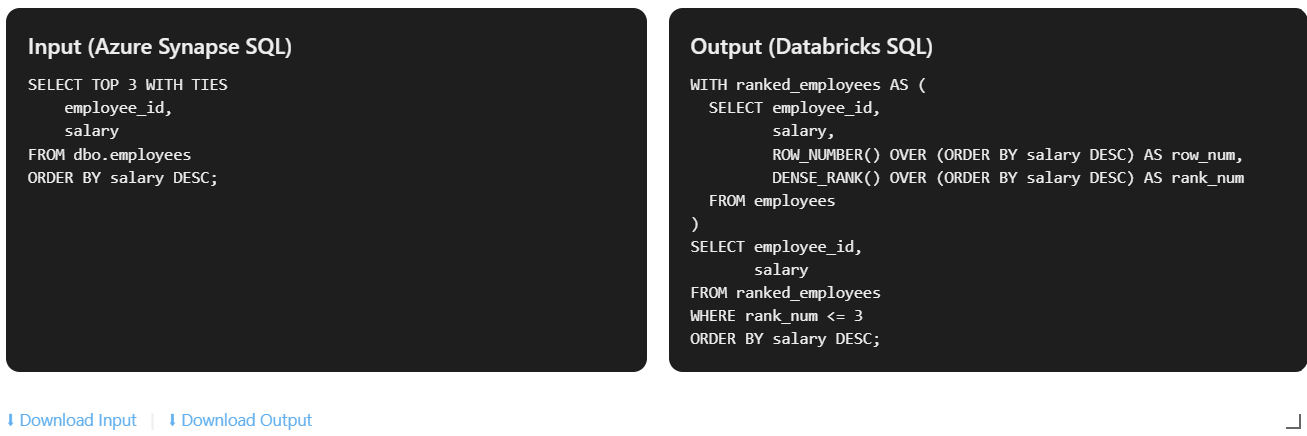
Example:
SELECT TOP 3 WITH TIES
    employee_id,
    salary
FROM dbo.employees
ORDER BY salary DESC;
2. Prompt Construction
A carefully designed system prompt guides the model to:
- Convert Synapse-specific syntax
- Preserve query intent
- Generate valid Databricks SQL
- Avoid explanations (SQL-only output)
Key transformation rules included:
Date Functions
GETDATE()→current_timestamp()DATEDIFFadjustments
String Functions
ISNULL→coalesceLEN→length
Aggregation
STRING_AGG→concat_ws(',', collect_list(col))
Row Limiting
TOP n→LIMIT nTOP WITH TIES→RANK()/DENSE_RANK()
👉 The prompt replaces what would traditionally be hundreds of transformation rules.
3. LLM Inference
The prompt is sent to a hosted model endpoint in Databricks using Llama 3.1 405B Instruct
What is this model?
This is a large-scale instruction-tuned language model based on the Llama 3.1 family.
- 405B parameters → one of the largest openly available models
- Instruction-tuned → optimized to follow structured prompts
- General-purpose → capable of reasoning, transformation, and code generation
The model:
- Understands the intent of the query
- Applies dialect transformations
- Generates equivalent Databricks SQL
How it’s used in this solution
The model is accessed via a Databricks Model Serving endpoint, which allows you to:
- Send structured prompts (system + user messages)
- Control behavior using parameters (e.g., temperature)
- Receive generated outputs in real time
Key configuration used:
- Temperature = 0 → Ensures deterministic and repeatable outputs
- Max Tokens = 2000 → Supports moderately complex SQL queries
4. Databricks SQL Output
The notebook displays:
- Input Synapse SQL
- Generated Databricks SQL
Rendered using HTML for a clean demo experience.
Sample output
5. Token Usage
Instead of estimating cost (which varies in Databricks), the POC exposes:
- Prompt tokens
- Completion tokens
- Total tokens
This provides:
- Transparency
- A proxy for cost
- Insight into model behavior
🎯 Why This Approach Works
Simplicity
No complex architecture, no dependencies — easy to understand and demo.
Determinism
Using temperature = 0 ensures consistent outputs across runs.
Flexibility
Prompt can be extended to support more patterns without changing code.
Speed
End-to-end conversion happens in seconds.
⚠️ Limitations
This is important for credibility.
- Output is not guaranteed to be 100% correct
- Complex edge cases may need manual adjustments
- No validation or execution testing is included
- Some Synapse features may not map directly
Execution Environment
This POC was implemented using:
- Databricks Free Edition
- Model Serving endpoint
- Notebook-based execution
🚀 Key Takeaways
- LLMs can significantly reduce SQL migration effort
- Prompt engineering can replace complex transformation logic
- Simpler architectures are more effective for quick wins / early-stage solutions
- Transparency (tokens vs cost) improves trust in demos
🧠 Final Thoughts
This POC demonstrates a shift in how we approach data engineering problems. Instead of building increasingly complex systems, we can:
Leverage intelligent models with simple pipelines to achieve meaningful results faster
While not a replacement for full-scale migration tools, this approach:
- Accelerates development
- Reduces manual effort
- Opens new possibilities in SQL modernization
Try it yourself
Code:
https://github.com/msprasad83/SynapsetoDBXDatabricks Free edition:
Free Edition | Replacing Databricks Community Edition
References:
A New Standard in Open Source AI: Meta Llama 3.1 on Databricks | Databricks Blog
메타데이터
- post_id
- d8c8ff7d3df4
- slug
- synapse-to-databricks-sql-conversion-using-llms-a-practical-poc-d8c8ff7d3df4
- url
- https://medium.com/@prasadms.it83/synapse-to-databricks-sql-conversion-using-llms-a-practical-poc-d8c8ff7d3df4
- canonical_url
- https://medium.com/@prasadms.it83/synapse-to-databricks-sql-conversion-using-llms-a-practical-poc-d8c8ff7d3df4
- author_url
- https://medium.com/@prasadms.it83
- status
- ok
- fetched_at
- 2026-06-17 08:20:12




