Holding Despair and Hope
Reflections on Altar-Making as an Expressive Arts Modality
Holding Despair and Hope: Reflections on Altar-Making as an Expressive Arts Modality
Preface
This past fall, I started my journey in graduate school at the California Institute of Integral Studies, studying Counseling Psychology with a concentration in Expressive Arts Therapy. I’m thrilled to be working towards a therapeutic practice. Somatic Utopic-Imagining (SUI) has long been a pedagogical framework for healing, but I am now gaining clarity on how my work will support the collective. At the beginning of each semester, my graduate cohort meets at a farm in Berkeley to convene for our intensive retreat. I began the spring semester discombobulated and very sensitive. I found so much wisdom in that sensitivity while participating in a class led by Mireya Alejo Marcet, where we created altars and sacred installations. I wrote a reflection on this experience and how it will inform my practice. I’m realizing how essential it is to honor ancestral trauma as much as we honor ancestral wisdom, as the two are interlinked. This honoring deepens our connection to our past that shapes our current environment, giving us a more holistic understanding of our potential for alternative futures.
Introduction
I came into the EXA Approaches Module 1 class with a lot of frustration and anger in my body. I was fatigued from socially interacting with classmates who seemed so happy, some with financial privileges and a sense of stability that I currently don’t possess. I was jealous of peers who seemingly had an easier, “lighter,” healing journey than mine. My healing journey is riddled with familial violence, sexual violence, oppression, enslavement, brutality, and exploitation. I often feel tasked with moving mountains in my journey of dismantling maladaptive behaviors that are normalized in my cultural location, and in examining the traumas that I’ve inherited. I felt sensitive and vulnerable, easily irritated, and ashamed to feel that way. The contrast between the pain flowing hot through my body like lava while watching my classmates engage with each other calmly and joyfully deepened my shame. I felt isolated, and I questioned why I couldn’t regulate my body while others around me presented with such tranquil energy. I didn’t have this clarity as to what exactly was bothering me when we started our first session. In that moment, I just felt tightening in my chest, my eyes fiery hot as tears began to form, my hands shaky, my limbs weak, and my torso and my head hot.
“Real is better than perfect.”
As we began to discuss our relationship to altar-making, I reflected on my experiences and realized that I had assumed that it was only appropriate to honor the positive aspects of your ancestral lineage or yourself. The idea of bringing real feelings and real experiences to the altar was something I was unfamiliar with. Somehow, in my personal intuitive exploration of altar-making throughout my life, I didn’t consider what it would look like to honor pain and sorrow. Ironically, I felt inclined to honor my ancestors and my connection to them, but disregarded our tethered connection in suffering and despair. I am deeply inspired to consider this altar-making practice and facilitate similar therapeutic exercises for future clients who may be experiencing systemic oppression. I want to facilitate spaces where participants can explore their sorrows, cry, grieve, and dance with their pain and tears, as that is just as useful and cathartic as exploring methods of resilience and resistance. I am currently far away from my family and feeling an intense yearning for home and familiarity. After our in-person sessions, I feel empowered to cultivate an altar space where I can feel the sensation of someone rubbing my back as I cry.
Bodily Connection to Environment
Connecting to my body to heighten my connection to my inner-world allowed me to examine my intense feelings without feeling overwhelmed by them. Before gathering materials, we were instructed to move our bodies around the space in ways that our bodies felt called to move. I remember shaking and feeling immediate catharsis as I listened to the beads and bangle bracelets on my wrists shake with me. This encouraged me to shake even more. As I shook my body, I kept my eyes closed, and I found myself moving away from my body and the negative emotions that overwhelmed me. At the same time, those emotions were being acknowledged in the shaking. After I opened my eyes, I felt more deeply connected to my surroundings in a way that didn’t feel too emotionally invested. This reminds me of the paradoxical phenomena that Shulman (2011) described as present features in a therapeutic group space. In the Stone Center’s Intimacy and Relational Model (Shulman, 2011, p. 214), there are paradoxes present in the group therapeutic space, such as ambivalence in vulnerable spaces, and vulnerability leading to growth. In this altar-making experience, I was able to deepen my exploration of my emotions by gaining some distance from them, and that distance was gained by deepening my connection to the present space that surrounded me. I was more vulnerable with myself as I moved in ways that my body desired, and I had to surrender my desire to care about what that movement looked like. There was a level of ambivalence that I had to adopt in order to deepen that vulnerability. These paradoxes that I found when moving freely granted the space for constructive investigation in my emotions.
Teleportation through Altar-Making
The altar-making process that we explored aligns with my understanding of expressive arts modalities as teleportative technologies. I felt fearless enough to gently and compassionately examine my emotions and their origins without judgment. This was possible by transporting away from the physical plane and stepping into the imaginative, creative plane. Through movement, I felt myself able to go into “the richness of the inner world so [I could] take it with [me] as [I] go about and navigate the real world” (Alejo Marcet, 2026). In this teleportation, I found the ability to externalize my feelings, which Shawn Patrick (2011) describes as a key process that occurs within Narrative Therapy. I was able to compassionately see my emotions as they were. In this space of compassion and curiosity, I was also able to discern the strengths, resources, and capabilities I possess. I’m realizing that in this process, I had a shame-filled narrative surrounding my emotions, and movement gave me the power to teleport to a space where I could examine my emotions without that shame. This process is going to be instrumental to my personal healing journey, and I look forward to employing these strategies and frameworks when working with oppressed peoples. Taking inspiration from this therapeutic intervention, I plan to invite future clients to explore an alternative reality, to then discover and develop new narratives that would better serve themselves in their actual reality.
The altar-making process mirrors the lens through which I aspire to offer therapeutic interventions. I aspire to cultivate spaces where oppressed peoples can examine their current realities to then imagine and design alternative ways of living and being that best serve themselves and the collective. I call this process Somatic Utopic Imagining (SUI), and I have found through facilitation that this process offers resilience to resist against the violent “matrix of domination” (Hill-Collins, 2000) we collectively face. I plan to take inspiration from the altar-making process and let it inform the interventions that I will facilitate with my population of interest. I seek to invite people who have experienced generations of systemic harm to step into different states of being that can offer immense insight into navigating real-world problems and emotions, as this altar-making process has offered me, to develop new narratives that capture both the pain and strength of our experiences. I believe that these experiences will be paramount to our movement towards collective liberation, a freeing of minds from oppression-influenced narratives to understandings that transcend this violent realm.
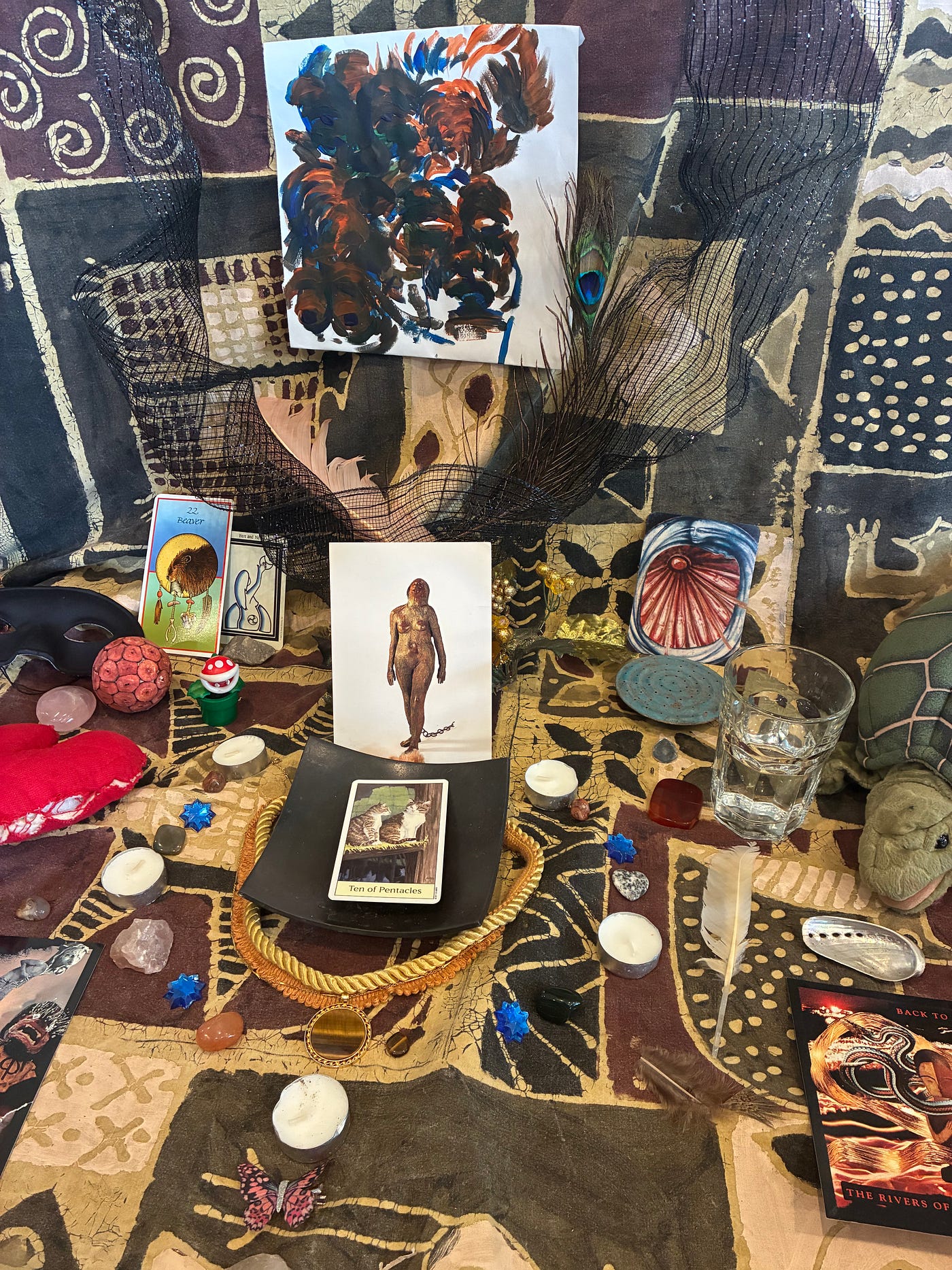
“Every Image has a Story” (Alejo Marcet, 2026)
I now have more clarity on what that meaning-making process can look like for future clients. As I gathered materials for my altar, meditated in front of my altar, and began to wonder what symbols emerged, I felt a calm confidence in my torso that allowed me to detach from any pressure to find a concrete or logical answer. Marcet’s guided prompts directed me to write down repeating symbols that I noticed and words that came to mind as I looked at my altar. This process gave me words to write a poem. As I wrote my poem, I felt empowered as an expert of my own experiences (Patrick, 2011, p. 313), like I had a deep knowing that poured out of me. After sharing my poem with classmates and receiving feedback of resonance and understanding, I realized how automatic and intuitive the meaning-making process is. There are still some symbols I found in my altar that I don’t yet have an explanation for, and I still feel very confident in the understanding that I derived from the experience. I am excited to reference this meaning-making process in future therapeutic facilitations, where I will invite clients to find their own language and nonverbal understandings of their creative explorations, expressions, and investigations.
Conclusion
For my Aesthetic Response (Figure 1), I drew a pink illustration of what the altar-making process felt like. A large comforting woman, an ancestor or a representation of my ancestors, arrives to me to acknowledge my pains and hold me with her hands. In the drawing, I am tucked away and sleeping right above my ancestors’ palms. While I sleep, my ancestors are taking me to a place of knowing, so that I can gain a deeper understanding and deeper acceptance of our shared sorrows and strengths. I went on a journey while held in their hands, and came back to the real world with the impression of her palms still on my body, supporting my back, legs, and feet as I walk to and face new challenges. I feel honored to eventually be guiding others to find something larger than themselves that they can hold on to and give them the strength to deepen their understanding of their being, both the despairing and the hopeful.
References
Alejo Marcet, M. (2026) Remembering Our Ancestral Knowing. EXA Approaches Altar/Sacred Installation. A Canvas in Movement
Hill Collins, P. (2000). Black feminist thought: Knowledge, consciousness, and the politics of empowerment (2nd ed.). Routledge.
Islam, L. S. (2026), Untitled [Drawing]
Patrick, S. (2018) Narrative Approaches. In Degges-White, S. & Davis, N. L. Integrating the Expressive Arts Into Counseling Practice: Theory-Based Interventions. (2nd Ed) (pp. 310–343). Springer Publishing Company.
Shulman, L. (2011). Dynamics and Skills of Group Counseling. Belmont: Brooks/Cole, Cengage Learning
Figure 1: Untitled, Laila Islam, 2026
![Islam, L. S. (2026), Untitled [Drawing]](https://miro.medium.com/v2/resize:fit:1400/1*mGV-ZATzhpMsIt4XGcpccw.jpeg)
Islam, L. S. (2026), Untitled [Drawing]
메타데이터
- post_id
- d8ca54fdb2c5
- slug
- holding-despair-and-hope-d8ca54fdb2c5
- url
- https://medium.com/@lailasislam/holding-despair-and-hope-d8ca54fdb2c5
- canonical_url
- https://medium.com/@lailasislam/holding-despair-and-hope-d8ca54fdb2c5
- author_url
- https://medium.com/@lailasislam
- status
- ok
- fetched_at
- 2026-06-14 11:28:49