From Scrap to System: Designing With Kabadiwallas
Context and community:
From Scrap to System: Designing With Kabadiwallas
Context and community:
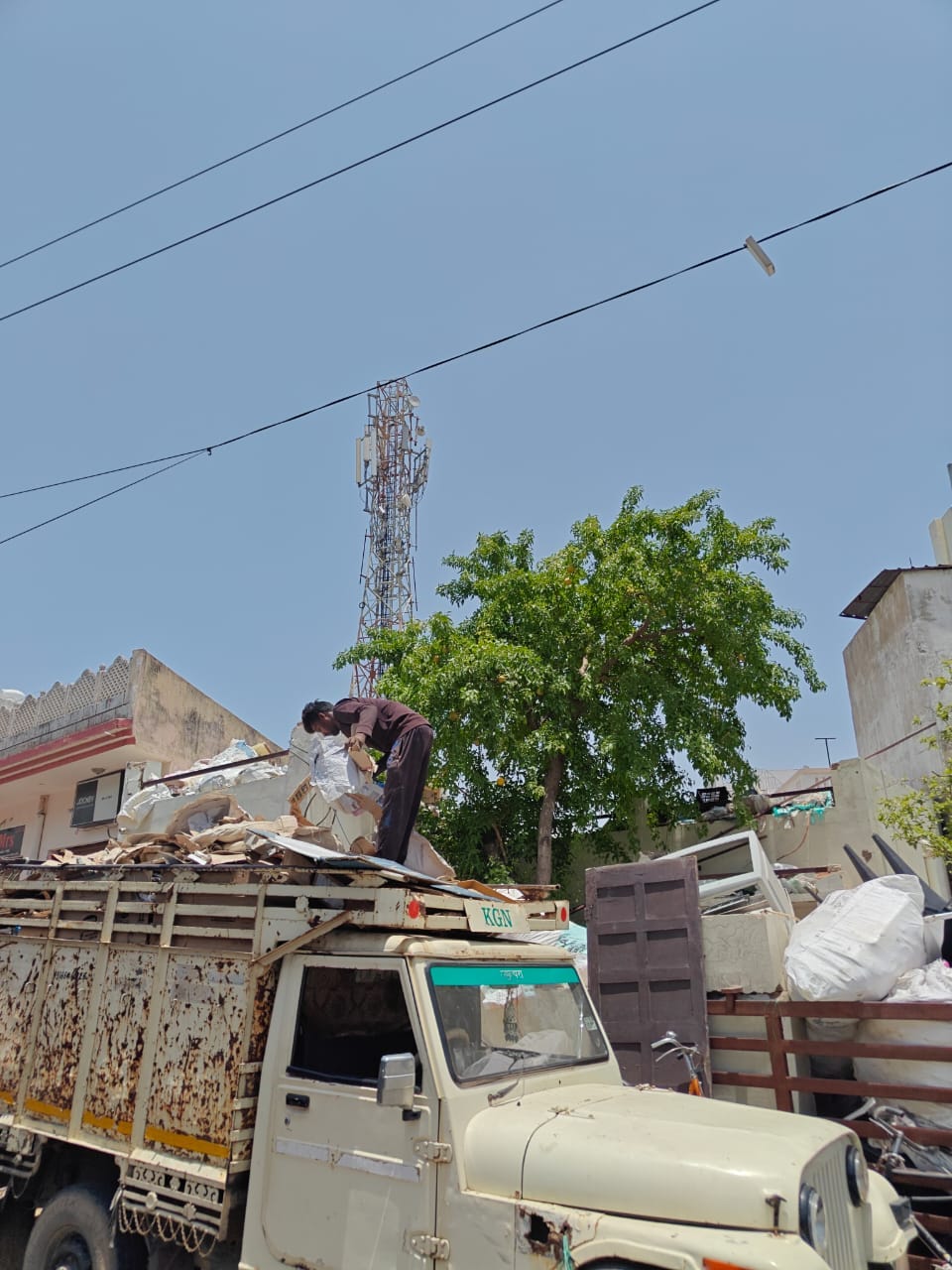
In the vibrant, invisible arteries of India’s urban waste economy, the kabadiwallas are vital workers. Daily, they gather, sort, and redirect hundreds of kilograms of scrap recyclables, yet frequently remain invisible to policies, data flows, and public acknowledgment. The community project, carried out in partnership with the city’s peripheral informal scrap collectors, investigated ways in which minimalist design interventions might bring greater visibility, dignity, and traceability to their labor.
The research was rooted in field interviews and observations undertaken with three kabadiwallas who had been in the business for decades. These men, and their enterprises, and their histories were the very substance of my research: they were not case studies, but working collaborators.
Listening First:
My journey started not with a solution or a design, but with a question: What do kabadiwallas already know that the system is missing? I spent three days at three locations — one in a crowded area of the city, one in a less crowded industrial area, and a third on the periphery of the urban sprawl. I interviewed, recorded workflows, inquired about materials, costs, sorting, safety, and community. I was not there to digitize their world. I was there to learn it. What I found was a system in which each kabadiwalla was part of a trust-based, skill-based, and market-conscious micro-economy. They monitored prices on WhatsApp, computed weights through truck-load subtraction, and compensated labor by task complexity. They had no formal software — but they had systems. My role was to listen to the systems and design with, not for, them.
Seeing Traceability as Trust:
As a designer, I was attracted to the tension between the top-down, grand ideals of waste management — smart cities, EPR compliance, and special recycling zones — and the street-level knowledge embodied by the kabadiwallas. Rather than rejecting traceability, they had developed their own version of it: handwritten ledgers, personal networks of familiarity, connoisseurship about materials, and strict codes of accepting stolen materials.
The issue was not that they could not be followed. It was that their traces were unreadable to formal systems.
I reshaped the design challenge: How do we make a device that would allow kabadiwallas to plug into traceable systems without disrupting what they currently do? The solution, I learned, wasn’t an application in any way; it was a bridge.
Lessons from the Field:
Throughout the three interviews, there were recurring themes:
Generational experience: All had been in the business since they were teenagers; one began in 1976.
Mechanical but precise systems monitored weights, categorized by types of material, and varied prices according to purity and color — white and black plastic, iron and aluminum.
Trust over paperwork: Sellers were recognized by reputation and face. No trust = no sale.
Digital threshold: All kabadiwallahs relied on WhatsApp for day-to-day price feeds, but none employed digital inventory software.
Stigma and marginalization: Residents of the neighborhood grumbled about dirt. The government levied fines, not assistance. “All the garbage comes from your houses — we’re just segregating it,” a kabadiwalla said.

Challenging mental models:
The largest obstacle is not so much the design of the tool but rather evoking an attitude shift. This is particularly prevalent in the older kabadiwallas, who operate within established patterns of habit and trust. They may even not perceive the advantages of source tracking or traceability logs. Any intervention, then, will need to:
Collaborate closely with them, employing familiar terms and materials.
Begin small with small successes, such as easy seller logs or printed reports.
Use peer adoption as a tactic for one kabadiwalla to influence another.
Respect their pace, and have a smooth, voluntary transition
Design here is more about cultural change than it is about tools.

The intervention:
Following these findings, I began researching ideas for a low-tech, modular solution that could potentially facilitate traceability without disrupting trust or familiarity. Though I have yet to build a solution, the way forward is clearer.
The proposed system can be:
Logging material types, weights, trader names, and prices (paper form, WhatsApp, or printable form)
Monitoring build up of inventory and alerting when quantity is ready for bulk selling
Adding trust by tagging repeat or familiar sellers
Creating informal traceability reports that kabadiwallas can easily share with buyers or municipal authorities.
This is not merely the process of formalizing their work; it is one of helping them to conceptualize and describe their already functioning systems within terminology that has meaning to formal structures, yet still protecting the integrity of what already works.

Reflections:
This project also taught me that informality is not lack of systems but a system. Most of the time, it turns out to be more responsive, innovative, and relational than digital technology that attempts to substitute it.
I learned how to unlearn my assumptions about design. I learned how to ask better questions. I learned that trust is a kind of infrastructure.
And perhaps above all, I learned that information isn’t neutral — neither is exposure. Who gets counted, and how, is always a political issue. Design, then, is more than merely interfaces; it is a quest for justice.

Impacts and possibilities:
Although nothing has yet been introduced, the process has yielded real opportunities. The kabadiwallas I spoke to were interested in testing a simplified tracking sheet. One even asked if he could send it to a friend who had just opened a shop.
That brief instant — a worker seeking to expand upon an idea that had yet to take shape — seemed to resonate with significance.
In the future, I would like to partner with local NGOs to implement a pilot in other backyards and create a WhatsApp-friendly material log that replicates pen-and-paper behavior.

Closing thoughts:
This project has posed questions which I still ask myself:
What constitutes an acceptable record?
Can traceability empower and not surveil?
What does inclusion look like when the system wasn’t designed for you?
Working with the kabadiwallahs has shown me the meaning of working with a system in its home environment — and doing so humbly, not just purposefully. I do not wish to superimpose my designs upon their world. Rather, I wish to work within it, with it, and incorporated into it. And perhaps, maybe just perhaps, that’s where things really do change.

메타데이터
- post_id
- d8d0f15b4f58
- slug
- from-scrap-to-system-designing-with-kabadiwallas-d8d0f15b4f58
- url
- https://medium.com/@dhimant.boss18/from-scrap-to-system-designing-with-kabadiwallas-d8d0f15b4f58
- canonical_url
- https://medium.com/@dhimant.boss18/from-scrap-to-system-designing-with-kabadiwallas-d8d0f15b4f58
- author_url
- https://medium.com/@dhimant.boss18
- status
- ok
- fetched_at
- 2026-08-24 10:20:15