The AI-Driven SDLC: Promise, Peril, and What Nobody Tells You
There is a particular kind of breathlessness that infects technology writing the moment a new paradigm arrives. We saw it with cloud…
The AI-Driven SDLC: Promise, Peril, and What Nobody Tells You
There is a particular kind of breathlessness that infects technology writing the moment a new paradigm arrives. We saw it with cloud computing, with microservices, with DevOps itself. Now, with AI woven into every stage of the Software Development Lifecycle from requirements gathering to post-deployment monitoring the breathlessness is back, louder than ever. The thesis is seductive: AI can make your software faster to build, more secure by design, and infinitely more scalable. But seduction and substance are different animals, and good engineering demands we interrogate both.
The piece circulating on Medium’s DevOps-Dev publication, concerning AI-driven SDLC and the construction of “secure, governed, and scalable” software, represents the optimistic vanguard of this conversation. It is well-intentioned, practically oriented, and at its best genuinely useful. It is also, at its edges, guilty of the very techno-optimism that has burned engineering teams before. This article is my reckoning with that tension.
BY THE NUMBERS
84% of developers were using or planning to use AI in development by 2025 (Stack Overflow). 51% of professional developers use AI tools daily. Gartner projects AI will influence 70% of all app design and development processes by 2026. These numbers are not hype but they are also not a strategy.
What the Advocates Get Genuinely Right
Let us begin with credit, because it is honestly due. The core argument that AI must be embedded across the entire SDLC, not bolted on at the end like an afterthought is correct and important. The old model of “write code fast, patch security later” has always been a liability masquerading as agility. AI offers something genuinely new here: the ability to enforce governance not as a bureaucratic checkpoint, but as a living, continuous thread woven through every phase of delivery.
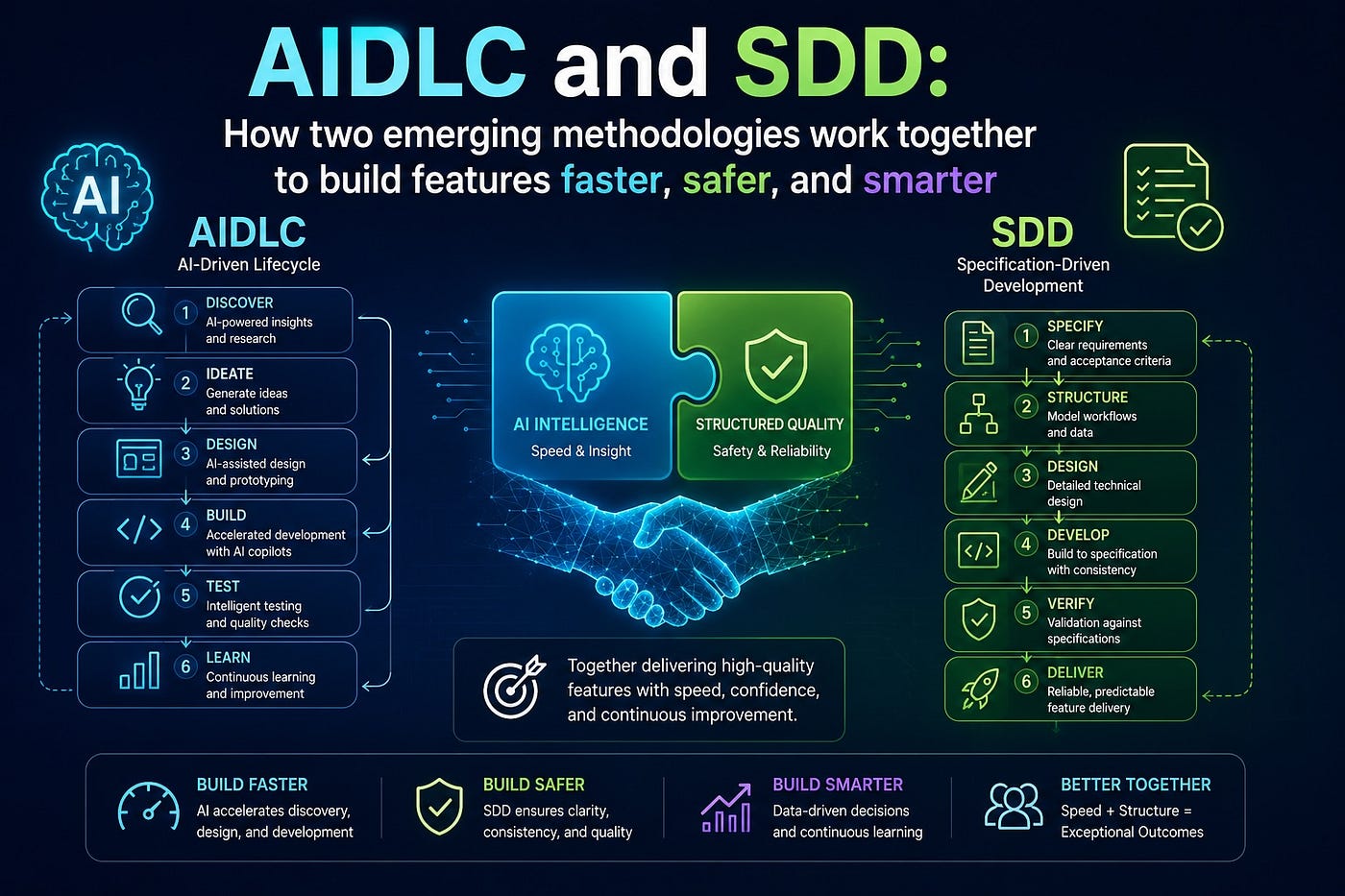
The notion of spec-driven development where formal specifications drive AI agents rather than loose natural-language prompts is perhaps the most intellectually honest framing I have encountered in this space. It acknowledges that AI is only as good as the context it operates in. Garbage prompts produce garbage software, and no amount of model intelligence compensates for ambiguous requirements upstream.
**“AI increases the speed of artifact creation, while the cost of mistakes stays high. The hard part is not choosing a model it is governing intent, integrating AI into delivery, enforcing evaluation gates, and keeping every change reversible.”**— From current AI-SDLC research literature, 2026
This observation deserves to be carved into the wall of every engineering department that has rushed headlong into AI adoption. Velocity without reversibility is just recklessness with a dashboard.
The Security Argument: Solid Foundation, Shaky Superstructure
The security dimension of the AI-driven SDLC narrative is where I find the most genuine value and, paradoxically, the most hidden risk. The integration of Application Security Posture Management (ASPM) platforms with AI-generated code pipelines is a meaningful advance. The ability to correlate vulnerability data from multiple AI tools and traditional scanners into a unified view, contextualised by business risk, is not a marketing claim it is a real operational improvement.
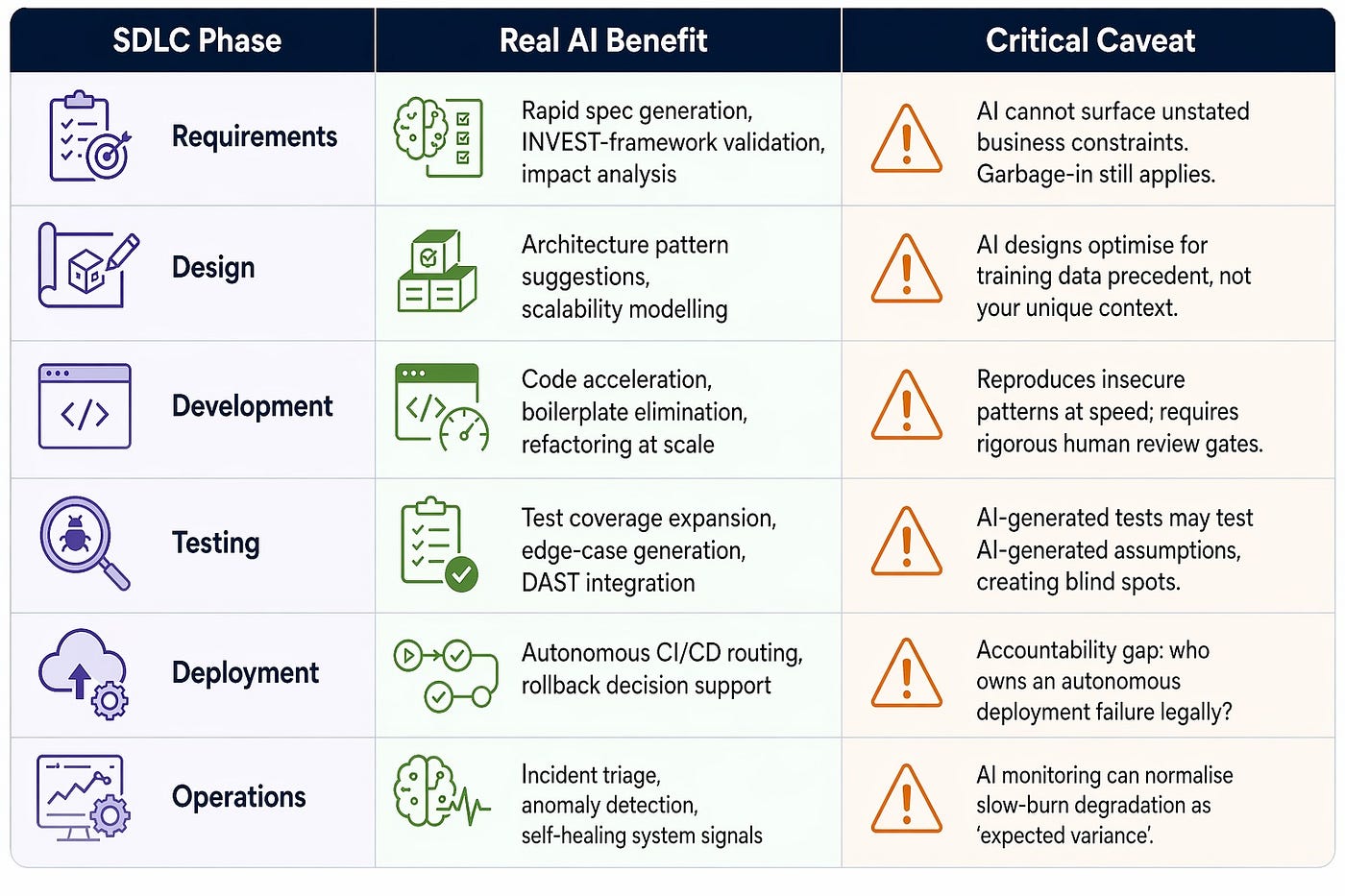
But here is what the optimists understate: AI code generation does not merely accelerate development; it also accelerates the introduction of subtle, hard-to-detect vulnerabilities. A model trained on the corpus of the internet, including its vast collection of insecure, outdated, and outright dangerous code will reproduce patterns of insecurity at the same speed it reproduces patterns of elegance. The AI is not reading your security policy. It is predicting the next token.
My View :
The most dangerous assumption in AI-SDLC advocacy is the implicit belief that because AI can flag vulnerabilities, AI-generated code will have fewer of them. These are separate claims. ASPM tools validating AI output are still, fundamentally, human-designed rules evaluating machine-generated code. The governance is only as strong as the rule set and threat surfaces evolve faster than rule sets do.
The honest practitioner will acknowledge that the security gains of AI-assisted development are real but bounded. They require a DAST-first (Dynamic Application Security Testing) verification layer not as an optional enhancement, but as a mandatory gate. Static analysis of AI-generated code alone is insufficient. The code may pass every pattern check and still be exploitable in ways that only runtime testing can reveal.
Governance: The Missing Chapter
If security is the undercooked steak in AI-SDLC conversations, governance is the missing course entirely. The word appears frequently in these discussions “governed workflows,” “governance layers,” “centralised guardrails” but the operational substance is rarely examined with rigour.
What does governance actually mean when an AI agent is autonomously writing code, creating pull requests, triaging bugs, and routing deployments? Who owns accountability when an AI-generated feature ships with a logic error that costs the business a client? The answer cannot be “the model” models do not sign off on quarterly results. It cannot be “the developer who approved the PR” if that developer had 47 other PRs to review that day and the AI-generated summary looked clean.
“GenAI can assist every SDLC phase but does not own accountability, risk acceptance, or production judgment. That boundary is not a missing feature is, it’s a governance requirement.” — AI-first SDLC research, 2026
This is the critical sentence that most AI-SDLC content gestures toward and then quietly abandons. The governance requirement demands institutional redesign, not just tooling selection. It demands new job descriptions, new incident response playbooks, new board-level conversations about AI risk appetite. A well-crafted article cannot substitute for that organisational work.
Scalability: The Seduction of Acceleration
The scalability argument is where AI-SDLC advocacy is at its most persuasive and I do not wish to dismiss it unfairly. The compression of development cycles from months to days, enabled by AI agents operating across planning, build, test, and deployment phases simultaneously, is a genuine competitive differentiator for organisations that implement it with discipline.
But scalability in software is never purely a question of throughput. It is a question of what you are scaling. Teams that use AI to scale a well-architected, well-governed, well-tested system gain real power. Teams that use AI to scale a poorly defined, under-specified, governance-light system are simply shipping their technical debt faster and at greater volume.
The Human Engineer in the Age of AI Orchestration
Perhaps the most consequential question the AI-SDLC debate raises and the one most conspicuously absent from promotional literature is: what happens to the engineer? The role is clearly shifting. The dominant emerging framing is that of the engineer as “orchestrator” someone who architects systems, decomposes problems, steers AI agents, and validates outputs.
This is a more cognitively demanding role than the one it replaces. It requires a deeper understanding of systems thinking, security principles, and quality standards are not a shallower one. The engineer who cannot critically evaluate AI-generated architecture will not be liberated by AI; they will be misled by it. AI amplifies capability; it does not substitute for the absence of it.
My View
There is a quiet irony lurking in AI-SDLC advocacy aimed at junior or mid-level practitioners: the tools that promise to accelerate your career may simultaneously atrophy the foundational skills that make you genuinely valuable. If you never write a complex SQL query because AI writes it for you, you will never develop the intuition to know when the AI’s query is subtly wrong at scale. Acceleration without comprehension is a debt with a variable interest rate.
My Verdict: A Framework Worth Building , With Eyes Open
Let me be direct: the AI-driven SDLC is not a hype cycle to be cynically dismissed. The productivity gains are measurable. The security improvements, when properly implemented with verification layers and governance frameworks, are real. The shift from linear, phase-gate delivery to continuous, AI-assisted feedback loops represents a genuine evolution in how software is built.
But the narrative that surrounds it particularly in practitioner-facing content suffers from a consistent omission: the work that cannot be automated. Establishing accountability structures. Defining AI risk appetite at the organisational level. Training engineers to be critical consumers, not passive recipients, of AI output. Building governance frameworks that evolve at the speed of the threat landscape, not the speed of your last sprint review.
The best AI-driven SDLCs will not be built by teams that trust AI the most. They will be built by teams that understand AI’s limitations most precisely, and design their systems and their governance around those limitations with the same rigour they apply to their architecture.
Early adoption carries real advantage but only for organisations that invest early, experiment responsibly, and build strong governance. That “and” is doing enormous work. It is the difference between an organisation that ships better software and one that ships catastrophe faster.
“The question is not whether to embed AI in your SDLC. That question is already answered. The question is whether your organisation has the governance maturity to deserve the speed AI offers.”
That is the question no tool vendor will ask you. It is the question you must ask yourself.
메타데이터
- post_id
- d8d990aa4394
- slug
- the-ai-driven-sdlc-promise-peril-and-what-nobody-tells-you-d8d990aa4394
- url
- https://medium.com/@itismohan.g/the-ai-driven-sdlc-promise-peril-and-what-nobody-tells-you-d8d990aa4394
- canonical_url
- https://medium.com/@itismohan.g/the-ai-driven-sdlc-promise-peril-and-what-nobody-tells-you-d8d990aa4394
- author_url
- https://medium.com/@itismohan.g
- status
- ok
- fetched_at
- 2026-06-09 15:37:30