How AI Is Transforming UCaaS in 2026: Best Practices to Leverage AI in Unified Communications
Quick Answer
How AI Is Transforming UCaaS in 2026: Best Practices to Leverage AI in Unified Communications
Quick Answer
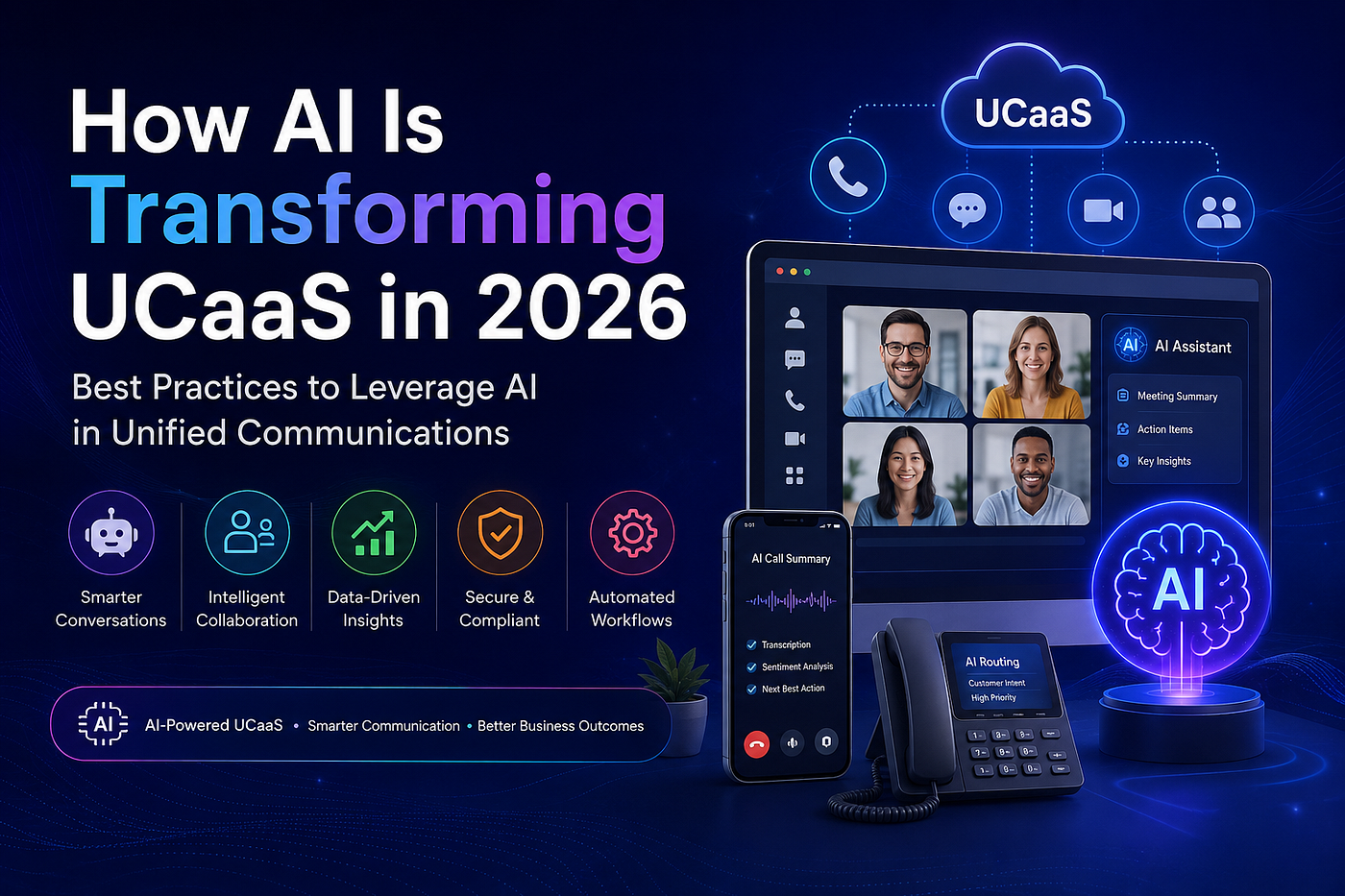
AI is transforming UCaaS (Unified Communications as a Service) by automating communication workflows, improving customer interactions, enhancing call intelligence, and enabling smarter collaboration across voice, video, messaging, and contact center systems. Businesses can leverage AI in UCaaS through real-time transcription, AI copilots, predictive analytics, intelligent routing, sentiment analysis, and workflow automation.
Introduction
Artificial Intelligence is fundamentally changing how businesses communicate.
Traditional UCaaS platforms were designed to centralize communication channels like voice, messaging, video conferencing, and collaboration tools. But in 2026, modern UCaaS systems are evolving into intelligent communication ecosystems powered by AI.
Platforms such as RingCentral, Microsoft Teams, Zoom Workplace, Cisco Webex, Dialpad, and custom UCaaS solutions are now integrating AI deeply into enterprise communication workflows. AI is no longer an optional add-on. It has become a core operational layer that improves productivity, customer experience, decision-making, and operational efficiency.
For enterprises, the real question is no longer whether AI belongs in UCaaS. The question is how to leverage AI effectively without compromising security, compliance, or user experience.
What Is AI-Powered UCaaS?
AI-powered UCaaS refers to unified communication platforms that use artificial intelligence to automate, analyze, optimize, and enhance communication processes.
These AI capabilities operate across:
- Voice communication
- Video conferencing
- Team collaboration
- Messaging systems
- Contact centers
- Workflow automation
- Meeting management
- Customer interactions
Modern AI-driven UCaaS platforms combine machine learning, natural language processing (NLP), speech recognition, predictive analytics, and automation technologies to improve communication experiences.
How AI Is Affecting UCaaS in 2026
AI is reshaping almost every layer of enterprise communication infrastructure.
1. AI-Powered Meeting Intelligence
One of the biggest changes in UCaaS is automated meeting intelligence.
Modern platforms now provide:
- Real-time transcription
- Automated meeting summaries
- Action-item extraction
- Speaker identification
- Follow-up generation
- Intelligent note-taking
Platforms like Microsoft Teams Copilot, Zoom AI Companion, and Cisco AI Assistant are reducing manual administrative work significantly.
Business Impact
Organizations save time by eliminating manual note-taking and improving post-meeting accountability.
2. Intelligent Call Routing
AI-driven routing systems analyze:
- Customer intent
- Caller sentiment
- Historical interactions
- Agent availability
- Skill matching
This allows enterprises to route calls more efficiently inside contact centers and customer support operations.
Benefits
- Faster resolution times
- Improved customer satisfaction
- Reduced operational overhead
- Better workforce optimization
3. Conversational AI and Virtual Assistants
AI chatbots and voice assistants are becoming central to UCaaS platforms.
These systems can:
- Handle routine inquiries
- Schedule meetings
- Route conversations
- Retrieve data
- Automate workflows
- Assist employees internally
This reduces repetitive workloads for human teams.
4. Real-Time Sentiment Analysis
AI can now analyze tone, speech patterns, and customer emotions during live interactions.
This helps organizations:
- Detect frustrated customers
- Improve agent coaching
- Reduce escalation risks
- Enhance customer experience
Dialpad and AI-powered contact center solutions are heavily investing in sentiment intelligence.
5. Predictive Analytics in Communication
AI analyzes communication data to identify patterns and forecast operational trends.
Examples include:
- Predicting call volumes
- Detecting customer churn risks
- Monitoring employee collaboration behavior
- Forecasting support demand
This allows enterprises to make proactive operational decisions.
6. AI-Based Noise Cancellation and Voice Enhancement
AI now improves communication quality automatically.
Capabilities include:
- Background noise suppression
- Echo cancellation
- Voice isolation
- Audio enhancement
- Bandwidth optimization
This has become especially important for hybrid and remote work environments.
7. AI Security and Fraud Detection
AI is also improving communication security.
Modern UCaaS systems use AI to detect:
- Suspicious login attempts
- Voice spoofing
- Spam calls
- Fraudulent communication patterns
- Data leakage risks
This strengthens enterprise communication security significantly. and you must read this, Unified Communicaiton Guide in detail
Benefits of AI in UCaaS
Improved Productivity
AI automates repetitive communication tasks, reducing manual effort across teams.
Better Customer Experience
AI improves response speed, personalization, and interaction quality.
Smarter Collaboration
Teams collaborate more effectively through intelligent meeting assistance and workflow automation.
Reduced Costs
Automation lowers operational expenses by minimizing repetitive support and administrative work.
Faster Decision-Making
AI-generated insights help enterprises make data-driven decisions quickly.
Challenges of AI in UCaaS
While AI offers major advantages, it also introduces challenges.
1. Data Privacy Concerns
AI systems process massive amounts of communication data.
Organizations must ensure compliance with:
- GDPR
- HIPAA
- SOC 2
- PCI-DSS
- Industry-specific regulations
2. AI Hallucinations and Inaccurate Summaries
AI-generated meeting notes and summaries may occasionally contain inaccuracies.
Human oversight remains important.
3. Integration Complexity
Enterprises with legacy infrastructure often struggle to integrate AI capabilities into existing communication environments.
4. User Adoption Resistance
Employees may resist AI tools if implementations feel intrusive or overly complex.
Best Practices to Leverage AI in UCaaS
Organizations that implement AI strategically gain the greatest value.
1. Start With Clear Business Goals
Do not implement AI simply because it is trending.
Identify specific business objectives such as:
- Improving customer support
- Reducing call handling time
- Enhancing collaboration
- Automating workflows
- Increasing productivity
AI should solve measurable operational problems.
2. Prioritize High-Impact Use Cases
Focus first on areas where AI delivers immediate value.
Best starting points include:
- Meeting transcription
- AI summaries
- Intelligent routing
- Chatbots
- Sentiment analysis
- Workflow automation
Avoid trying to automate everything at once.
3. Ensure Compliance and Data Governance
AI in communication systems handles sensitive information.
Enterprises should establish:
- Data retention policies
- Access controls
- Encryption standards
- Audit logging
- AI governance frameworks
Compliance must remain a top priority.
4. Keep Humans in the Loop
AI should augment employees, not fully replace them.
Human oversight is critical for:
- Decision-making
- Customer escalation
- Compliance validation
- Strategic communication
The best AI implementations combine automation with human intelligence.
5. Choose AI-Ready UCaaS Platforms
Not all UCaaS providers offer mature AI capabilities.
Businesses should evaluate:
- Native AI features
- API flexibility
- Integration capabilities
- Security architecture
- Scalability
- Custom AI model support
Custom UCaaS development may provide greater long-term flexibility for enterprises with specialized workflows.
6. Train Employees Properly
AI adoption depends heavily on user understanding.
Organizations should provide training on:
- AI workflows
- AI limitations
- Privacy policies
- Automation best practices
- Responsible AI usage
7. Continuously Measure Performance
Track KPIs such as:
- Average handling time
- Resolution speed
- Employee productivity
- Customer satisfaction
- AI accuracy
- Meeting efficiency
AI optimization should be an ongoing process.
Best AI Features Businesses Should Look for in UCaaS Platforms
Essential AI Capabilities
- Real-time transcription
- AI meeting summaries
- Smart search
- Intelligent call routing
- AI chatbots
- Sentiment analysis
- Workflow automation
- Voice analytics
- Predictive insights
- AI-powered compliance monitoring
Future of AI in UCaaS
AI will continue evolving from a support feature into a central operational layer.
Future UCaaS systems will likely include:
- Autonomous meeting agents
- Real-time multilingual communication
- AI-generated workflows
- Predictive customer engagement
- Personalized communication intelligence
- Advanced voice biometrics
- Fully AI-driven contact center operations
Enterprises that adapt early will gain significant operational advantages.
Frequently Asked Questions
How is AI changing UCaaS?
AI is improving UCaaS through automation, intelligent analytics, transcription, virtual assistants, sentiment analysis, and workflow optimization.
What are the benefits of AI in unified communications?
The main benefits include higher productivity, better customer experience, reduced operational costs, and smarter collaboration.
Which UCaaS platforms have the best AI features?
RingCentral, Microsoft Teams, Zoom Workplace, Cisco Webex, Dialpad, and custom AI-powered UCaaS solutions are among the strongest platforms in 2026.
Is AI in UCaaS secure?
AI-powered UCaaS can be secure when organizations implement proper governance, encryption, compliance controls, and access management policies.
What is the biggest challenge of AI in UCaaS?
The biggest challenges include privacy concerns, compliance risks, inaccurate AI outputs, and integration complexity.
The Bottom Line
AI is fundamentally transforming UCaaS from a communication platform into an intelligent business operations layer.
Organizations that strategically implement AI in unified communications can improve collaboration, automate workflows, reduce operational costs, and deliver significantly better customer experiences.
However, successful AI adoption requires more than simply enabling AI features. Businesses need clear objectives, strong governance, proper training, and carefully selected use cases.
The future of enterprise communication belongs to AI-driven unified communications systems that combine automation, intelligence, security, and human collaboration into a single ecosystem.
메타데이터
- post_id
- d8dd0d8758a5
- slug
- how-ai-is-transforming-ucaas-in-2026-best-practices-to-leverage-ai-in-unified-communications-d8dd0d8758a5
- url
- https://medium.com/@ecosmob.technology/how-ai-is-transforming-ucaas-in-2026-best-practices-to-leverage-ai-in-unified-communications-d8dd0d8758a5
- canonical_url
- https://medium.com/@ecosmob.technology/how-ai-is-transforming-ucaas-in-2026-best-practices-to-leverage-ai-in-unified-communications-d8dd0d8758a5
- author_url
- https://medium.com/@ecosmob.technology
- status
- ok
- fetched_at
- 2026-07-19 18:19:02