EigenLayer: The $15B-to-$7B Crash Nobody Saw Coming
When Restaking Went from “Free Money” to Reality Check
EigenLayer: The $15B-to-$7B Crash Nobody Saw Coming
When Restaking Went from “Free Money” to Reality Check
TL;DR
EigenLayer’s slashing launch on April 17, 2025 triggered a sharp repricing: TVL slid from over $15B at peak to roughly $7B by late 2025, and EIGEN fell around 86% from its highs (per CoinGecko). Yet nearly 40 AVSs are live (CoinDesk counted 39 at slashing launch), with Google Cloud and Coinbase Cloud listed as operators. This is a stress test, not a collapse: the question is whether restaking matures into modular security infrastructure — or remains leveraged risk until guardrails catch up.
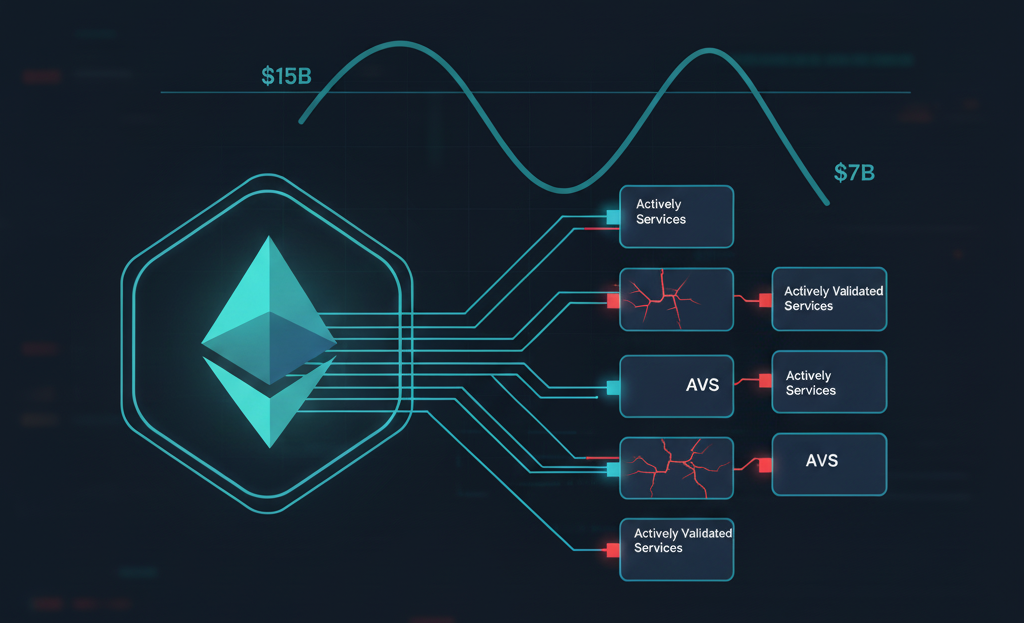
Image generated with Google Gemini (AI-generated illustration)
April 17, 2025, 9:47 AM EST
I was monitoring three Discord servers simultaneously when EigenLayer activated slashing — the moment everyone had been dreading (or dismissing) for months. Within minutes, the panic spread:
“My eETH won’t unstake — am I locked in?” “EIGEN just dropped 15% in 10 minutes” “Which AVS is going to blow up first?”
Six months later, the dust has settled. Total Value Locked dropped over 50% to roughly $7B (CoinDesk reported “over $7B” as of April 17). EIGEN token crashed from highs near $5.65 to lows around $0.75 (per CoinGecko, roughly -86%). Major LRT protocols bled double-digit losses. Yet nearly 40 AVSs are live on mainnet (CoinDesk counted 39 on April 17), and approximately 190 more are in development (per press releases and project updates).
This isn’t a failure story. It’s not a success story either. This is what happens when the market stress-tests innovation with real money.
Part 1: What Is Restaking? (The Security Guard Analogy)
Think of EigenLayer like hiring security guards. Traditionally, you open a bank and hire 50 guards — pay salaries, train them, build trust from scratch. Expensive and slow.
EigenLayer’s approach: rent the guards already protecting Ethereum. They work multiple jobs simultaneously — bank, jewelry store, museum. They earn multiple paychecks: ETH staking rewards plus fees from each client.
The catch? If a guard screws up at the jewelry store, they lose their deposit at the bank too. If the jewelry store goes bankrupt, guards might quit all their jobs at once. This is restaking — using the same collateral (staked ETH) to secure multiple protocols simultaneously.
In traditional Ethereum staking, you stake 32 ETH, validate blocks, earn 3–4% yield. Risk is isolated. In EigenLayer restaking, you stake 32 ETH on Ethereum, then secure five other protocols (AVSs — Actively Validated Services). You earn staking rewards plus AVS fees. But misbehave on any of them, you get slashed. Risk is interconnected. One protocol’s failure cascades across the system.
Let’s put numbers on this. If you restake across 5 AVSs, each with a conservative 1% annual slashing probability, your compound risk isn’t 1% — it’s roughly 5%. And that assumes risks are independent, which they’re not. Validators cluster around the same high-yield AVSs, use the same infrastructure, follow the same patterns. When one AVS breaks, it slashes an entire cohort. This is why April’s TVL crash wasn’t panic. It was rational repricing of interconnected risk.
Part 2: The Numbers Tell the Story
Let’s look at what actually happened:
[embed]
Three things jump out from these numbers:
First, capital fled but builders stayed. TVL dropped over 50%, but active AVSs nearly tripled from 15 to nearly 40. Speculative capital exited — the “20% APY” crowd who didn’t understand the risks. But serious operators remained. Google Cloud and Coinbase Cloud are listed as EigenLayer operators, signaling ongoing institutional participation. The ecosystem is transitioning from hype phase to building phase.
This is actually healthy. In 2021 DeFi summer, protocols with billions in TVL died overnight when incentives stopped. EigenLayer losing 50%+ TVL while gaining adoption suggests the remaining capital understands what it signed up for.
Second, token price and protocol health diverged. EIGEN crashed 86%, yet protocol adoption accelerated. In crypto, token dumps and protocol deaths aren’t the same thing. EigenLayer’s nearly 40 live AVSs and continued institutional involvement matter more than token price.
Third, the market is pricing real risk now. Before April, that $15B+ TVL mixed believers with yield farmers who hadn’t done their homework. After April, the remaining ~$7B represents people who understand the risk-reward trade-off. When slashing went live, over half the capital said no. That’s not failure — that’s price discovery.
Part 3: My Honest Take — Why I’m Neither Bullish Nor Bearish
Bulls say EigenLayer is AWS for Web3 security. Bears say this is 2008 CDOs all over again. My view: both are right, depending on when you ask.
What EigenLayer Got Right
The protocol solves a real problem. New blockchains and rollups struggle to bootstrap security. Hiring validators is expensive and slow. EigenLayer lets them rent security from Ethereum’s existing validator set. This is genuinely useful, not just clever financial engineering.
The technical design is solid too. The protocol includes unique stake allocation — a mechanism that isolates risks across AVSs. If you get slashed on one AVS, your stake on the other four isn’t automatically affected. This prevents total catastrophic failure and separates restaking from pure contagion risk.
And the ecosystem retains serious operators. Google Cloud and Coinbase Cloud joined as EigenLayer operators shortly after mainnet modules went live in April 2024, and remain listed through the TVL drawdown. When institutional operators stay through a 50%+ drop, it signals long-term commitment.
What the Market Exposed
Here’s a realistic failure scenario (illustrative, based on observed validator behavior). Picture an AVS running a cross-chain bridge that pays validators 8% APY through token emissions. If the token crashes significantly — say, losing 60–80% of value over a short period — real yield could fall below 2%. Within 72 hours, a significant portion of validators might unstake. The bridge’s security budget could collapse from $120 million to $70 million. DeFi protocols using that bridge would immediately pause withdrawals. The bridge wouldn’t fail technically — it would fail economically.
Then there’s the leverage tower that multiplies these risks. Users deposit ETH → get stETH via Lido → restake for eETH via Ether.fi → use eETH as Aave collateral → borrow stablecoins → buy more ETH. This is rehypothecation: the same collateral backing multiple liabilities. In 2008, this created CDOs. In 2025, we’re doing it with Ethereum’s security layer.
Risk pricing remains broken. There’s no standardized slashing framework. Each AVS sets its own rules — one might slash you for 10 minutes of downtime, another for one hour, a third for “incorrect attestations.” How do you calculate risk when rules differ everywhere and can change via governance votes?
Then there’s the governance attack surface. If an AVS’s governance gets compromised and passes a malicious slashing proposal, thousands of validators could lose stake. Who’s responsible? The AVS? EigenLayer? Ethereum social consensus? EigenLayer’s position: we don’t interfere with AVS governance. That sounds principled until the first major attack happens.
The brutal truth: this design works in bull markets when capital is abundant. But it could explode in bear markets when one failure triggers cascades. The question isn’t if an AVS will fail. It’s when, and whether the cascade can be contained.
November 2025 Update: EigenZero Expands Restaking Beyond ETH
On November 13, 2025 — just days before this article was finalized — EigenLayer, whose ecosystem expanded through the EigenCloud developer platform, partnered with LayerZero Labs to introduce EigenZero, the first implementation of the CryptoEconomic Decentralized Verifier Network (DVN) Framework, backed by $5 million in staked ZRO tokens (per LayerZero Labs’ November 13, 2025 announcement).
What is EigenZero? It enables cross-chain applications to select from multiple verifier networks with economic accountability through slashable stakes. Unlike pure technical verification (like ZK proofs), EigenZero adds economic deterrence: if validation fails, staked assets are slashed and users are compensated.
Why this matters: EigenZero proves the restaking model is evolving beyond pure ETH collateral. The system uses an optimistic verification approach with an 11-day challenge period — similar to optimistic rollups. If a cross-chain message is disputed and proven incorrect, the $5M ZRO stake gets slashed.
The bull case strengthens: This validates EigenLayer’s “AWS for security” thesis. LayerZero powers over 600 applications across 70+ chains (LayerZero ecosystem data, November 2025), and EigenZero gives them economic guarantees beyond technical correctness. If EigenZero succeeds, it could become the template for how protocols buy security in a modular world.
But the bear case also strengthens: We just added another layer of complexity to an already fragile system. Now we’re not just restaking ETH across multiple AVSs — we’re restaking ZRO tokens to secure cross-chain bridges. Token projects can now launch their own DVNs using native tokens as stakes, which means we’re multiplying the number of “security derivatives” in the system.
If a major cross-chain bridge fails and triggers EigenZero slashing, does that cascade back to EigenLayer’s ETH restakers? We don’t know yet. The system is only 48 hours old.
My take: EigenZero is a sign that restaking isn’t going away — it’s expanding. But it’s also a reminder that every new layer of composability adds new failure modes. The April 2025 stress test was just the beginning. The real test comes when EigenZero faces its first major dispute and $5M in ZRO gets slashed. Will the system contain the contagion, or will it cascade?
We’re about to find out.
Part 4: What Should You Do? (Three Investor Archetypes)
For Aggressive Investors
Consider allocating 5–10% of your portfolio to Liquid Restaking Tokens like eETH, rsETH, or pufETH. But set a clear stop-loss. If TVL drops another 30% from current ~$7B (roughly to $5B), that’s your exit signal — a risk management heuristic rather than a precise threshold. Why that level? Because at that point, you’ve breached half the peak TVL — a psychological marker where “correction” often becomes “collapse.” Historical precedent: DeFi protocols that lose 70%+ TVL rarely recover (Anchor Protocol, Olympus DAO). The current risk-reward: 3x upside if the ecosystem matures, or another 50% drawdown if a major AVS blows up. Only bet what you can afford to lose entirely.
For Conservative Investors
Stay out for now. Wait for these signals: First, at least one AVS generating sustainable revenue — real fees from actual usage, not token emissions. A data availability layer that charges rollups real money, for example.
Second, standardized risk frameworks. Clear slashing conditions across all AVSs. Insurance pools or reserve funds. Transparent risk dashboards that let you calculate your exposure.
Third, TVL stability for six months or more. No more 30% monthly drops. This shows the market has found equilibrium. Until these conditions are met, this is speculation, not investment.
For Researchers & Job Seekers
Treat EigenLayer as required reading, not an investment target. Study it because it proves modular security can work, even if imperfectly. This design pattern will influence next-generation infrastructure. Understanding restaking mechanics differentiates you in job interviews. When you’re interviewing at a Web3 company, saying “I understand how EigenLayer’s slashing conditions create systemic risk” is more impressive than “I made 50% on EIGEN token.” Learn the design thinking, not the token price movements.
Part 5: My Personal Position (Full Transparency)
I don’t hold EIGEN tokens. I don’t hold any Liquid Restaking Tokens like eETH or rsETH. I have zero exposure to AVSs.
But I do actively track which AVSs launch with real revenue models instead of token incentives. I monitor validator behavior during stress events. I follow EigenLayer’s governance decisions closely.
Why? Because this ecosystem will spawn the next generation of infrastructure protocols. Even if 80% of current AVSs fail, the 20% that survive could become critical infrastructure. I’m watching, not betting. There’s a difference.
Final Word: What the $8B Drawdown Taught Us
From over $15B to ~$7B (per CoinDesk), EigenLayer taught one lesson: innovation isn’t the same as an investable asset — timing and risk plumbing matter.
In late 2024, EigenLayer was a concept with valuation based on imagination. By late 2025, it’s become a stress test with value based on survival. If you bought at the peak, you’re down over 50%. If you buy now, you could triple your money or lose another 50%.
But here’s what matters more than any token price: the experiment continues. The need for reusable security is real. Nearly 40 AVSs are live. Institutions remain committed. The question is no longer whether modular security can work — it clearly can. The question is whether the crypto market has the discipline to manage it responsibly.
Because the next time someone pitches you “the next Ethereum-level innovation,” you’ll know exactly what question to ask: If TVL crashes 50%, will the builders still be here?
For EigenLayer, the answer was yes. Most projects can’t say that.
And that’s either the beginning of something transformative — or the calm before a storm nobody’s ready for. We’ll find out which one when the next crisis hits. Because in crypto, there’s always a next crisis.
The only question is: will you be positioned to survive it, or caught holding the bag when it arrives?
Disclosure: Independent analysis. Not financial advice. I hold no positions in EIGEN or related tokens.
Data Sources: EigenLayer Dashboard, DefiLlama, CoinDesk (April 17, 2025 slashing launch coverage), CoinGecko (EIGEN price data), 99Bitcoins (LRT TVL trends), The Block, Coinbase Cloud, CryptoNews (operator listings), Token Terminal (November 2025)
Note: Some sources (e.g., QuickNode, Sept 2025) report peak TVL reached $18B+ before April 2025; we use CoinDesk’s more conservative $15B+ figure from April 4, 2025 for consistency.
메타데이터
- post_id
- d8e73f7b3169
- slug
- eigenlayer-the-15b-to-7b-crash-d8e73f7b3169
- url
- https://medium.com/@pycheng9/eigenlayer-the-15b-to-7b-crash-d8e73f7b3169
- canonical_url
- https://medium.com/@pycheng9/eigenlayer-the-15b-to-7b-crash-d8e73f7b3169
- author_url
- https://medium.com/@pycheng9
- status
- ok
- fetched_at
- 2026-07-15 04:57:40