The G-Zero Horizon: Ian Bremmer’s Warning on a Leaderless World — and What Might Come After Trump
In this column, I explore Ian Bremmer’s influential G-Zero thesis — the idea that no single power or coalition is willing and able to lead…
The G-Zero Horizon: Ian Bremmer’s Warning on a Leaderless World — and What Might Come After Trump
In this column, I explore Ian Bremmer’s influential G-Zero thesis — the idea that no single power or coalition is willing and able to lead the international system. Drawing from his writings and recent commentary, including his appearance on The Diary of a CEO, I examine the origins of this geopolitical vacuum, its risks in 2026, and Bremmer’s focus on the United States as both symptom and accelerator of instability. While the framework offers a compelling lens on fragmentation, it also invites debate about resilience, adaptability, and whether disruption paves the way for renewal rather than collapse.
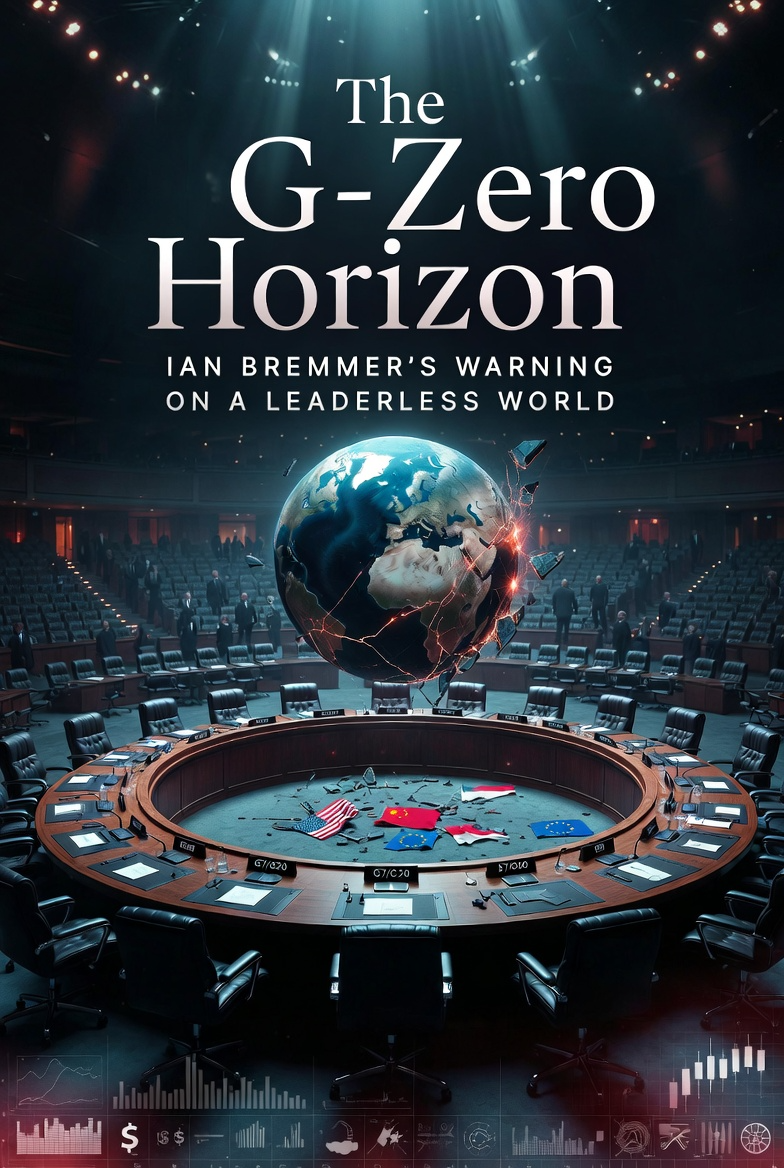
As the world grapples with tariffs, regional conflicts, and shifting alliances in 2026, one voice keeps returning to the microphone with a sobering diagnosis: Ian Bremmer. The founder of Eurasia Group and GZERO Media has spent years mapping geopolitical risk, and his long-standing G-Zero thesis feels increasingly relevant. In a recent podcast conversation, Bremmer framed the United States under a second Trump term not merely as a source of short-term volatility but as the epicenter of a deeper political revolution — one whose real consequences may only fully unfold after this administration ends.
The Birth of a Vacuum
Bremmer first laid out the G-Zero idea in his 2012 book Every Nation for Itself. The term plays on the familiar G7 and G20 groupings of major economies. In a G-Zero world, however, there is no effective global leadership. No country or durable alliance possesses both the capacity and the political will to underwrite global public goods — open sea lanes, financial stability, pandemic response, or enforceable trade rules.
The roots trace back to the 2008 financial crisis, which Bremmer sees as the decisive shock that exposed the misalignment between power realities and outdated institutions. The post-World War II order, anchored by American hegemony and Bretton Woods institutions, had already been fraying. The United States, exhausted by wars in Iraq and Afghanistan and burdened by domestic polarization and debt, grew less willing to play global policeman. At the same time, rising powers such as China, India, and Brazil gained economic weight but showed little interest in assuming leadership responsibilities. They became capable of blocking initiatives — spoilers, in Bremmer’s language — yet rarely stepped forward as constructive architects of new rules.
The result is a “geopolitical recession”: international institutions like the UN Security Council, IMF, and WTO no longer reflect the actual distribution of power, and cooperation on transnational challenges becomes ad hoc at best. Globalization continues, but unevenly, laced with protectionism, supply-chain weaponization, and regional hedging.
Living in the G-Zero
Bremmer has consistently warned that this leadership deficit breeds volatility. Power vacuums invite miscalculation. Rogue actors find space to maneuver. Smaller and more dependent nations suffer most, while adaptable large players with scale and resources can pivot more effectively. In his annual Top Risks reports, the G-Zero theme recurs; by 2025 he declared “The G-Zero wins” as the top risk, pointing to endemic instability that weakens security and economic architecture.
Flash forward to 2026, and Bremmer positions the United States itself as the principal driver of geopolitical uncertainty. In the Diary of a CEO discussion, he describes a “political revolution” underway — weakening domestic guardrails, a more centralized executive, and a sharply transactional “America First” foreign policy. Alliances strain under reduced U.S. commitment. Partners hedge by deepening ties elsewhere, particularly with China. The “law of the jungle” replaces rules-based norms in many domains, creating whiplash for markets and governments alike.
Bremmer’s deeper concern is not just the turbulence of the present moment but what lingers afterward. Eroded trust in institutions, politicized norms, and questions about the long-term character of American democracy could persist. The real crisis, he suggests, may be the shape of the system that emerges on the other side of this period — or whether a coherent system emerges at all.
Strengths of the Diagnosis
There is undeniable descriptive power in the G-Zero framework. It captures the observable gridlock in multilateral forums, the rise of great-power competition, and the selective disengagement we see in practice. Uneven responses to COVID, energy shocks tied to Ukraine, tariff volatility, and Middle East tensions all illustrate fragmented leadership rather than coordinated order. Bremmer’s realist grounding — acknowledging diffused power without romanticizing past eras — makes the thesis useful for businesses and policymakers assessing tail risks.
He also rightly notes that the G-Zero is transitional. Nature abhors a vacuum, and geopolitics eventually seeks new equilibria. Possible successors include sharper U.S.-China bipolar rivalry, a world of distinct regional blocs, or a painful renegotiation of rules once the costs of disorder mount sufficiently.
The Limits of the Lens
Yet any influential thesis deserves scrutiny. Critics argue that Bremmer sometimes overstates the vacuum. The United States retains profound structural advantages: dollar dominance, unmatched naval power, technological innovation, energy resources, and enduring alliance networks such as NATO, AUKUS, and the Quad. Transactional policies, while disruptive, can compel burden-sharing from free-riding partners and confront long-standing imbalances in trade and security commitments that earlier administrations often tolerated.
There is also a risk of underweighting human agency and historical resilience. American democracy has absorbed severe shocks before — contested elections, policy reversals, deep polarization — and adapted. Markets, courts, Congress, states, and civil society continue to demonstrate pushback and corrective capacity. What looks like irreversible institutional erosion to some can appear, to others, as necessary disruption of outdated arrangements and bureaucratic inertia.
Bremmer’s narrative can carry a pessimistic tint, one that fits a familiar template of “winners and losers in a disruptive age.” History suggests systems are often more antifragile than risk reports imply. The end of the post-Cold War order may clear space for clearer spheres of influence, renewed leverage, or fresh bargains rather than pure chaos. Outcomes will hinge less on inexorable structural forces and more on choices — about competitiveness, innovation, alliances, and domestic renewal.
Looking Beyond the Vacuum
In the end, Bremmer’s G-Zero thesis serves best as a diagnostic tool rather than a deterministic prophecy. It highlights genuine governance gaps on issues from AI regulation to climate coordination to debt sustainability. It warns against complacency in a contested, multipolar era. At the same time, it invites us to weigh the costs of the prior status quo — strategic overextension, alliance free-riding, regulatory capture — and to consider whether selective retrenchment or rebalancing can strengthen rather than weaken the United States over time.
As 2026 unfolds with its declared “tipping point” dynamics, the conversation Bremmer sparks remains vital. The real test is not whether we can perfectly forecast the shape of the next order, but whether we can navigate the present fragmentation with enough adaptability, pragmatism, and long-term thinking to shape a successor that serves stability and prosperity better than the interregnum it replaces.
The bus may lack a single driver for now. But passengers still have agency — and the road ahead, while bumpy, is not inevitably headed for collapse.
What do you think — is the G-Zero a temporary interlude or a more permanent condition? Share your thoughts below.
메타데이터
- post_id
- d8f2b4e13ae3
- slug
- the-g-zero-horizon-ian-bremmers-warning-on-a-leaderless-world-and-what-might-come-after-trump-d8f2b4e13ae3
- url
- https://medium.com/@poderico/the-g-zero-horizon-ian-bremmers-warning-on-a-leaderless-world-and-what-might-come-after-trump-d8f2b4e13ae3
- canonical_url
- https://medium.com/@poderico/the-g-zero-horizon-ian-bremmers-warning-on-a-leaderless-world-and-what-might-come-after-trump-d8f2b4e13ae3
- author_url
- https://medium.com/@poderico
- status
- ok
- fetched_at
- 2026-06-28 04:42:08