My Daughter Wanted to Be Like Her Classmates for Just 100 Days
Such wishes rarely satisfy
My Daughter Wanted to Be Like Her Classmates for Just 100 Days
She’s one-derful as she is

source: Cute Chameleon from PublicDomainPictures.net
As I picked up my daughter from school the other day, I sensed that the tears were not far below the surface. She was actively restraining a strong current of emotions, holding it all inside until we’d passed through the gate and taken enough steps closer to home.
From the outside, her behavior could have led you to believe that she was frustrated with me. She moved with restless urgency, as if trying to get somewhere, and away from me, fast. She made sure that a meter separated us at all times, quickening her steps in response to any of my own acceleration. Whenever I reached out and managed to catch her with my fingertips, pulling her close for a momentary embrace, she slipped free, wiggling through my arms and flapping side to side like a fish on land. I caught her for good as she lost her footing on a fallen palm frond in an attempt to reach the adjacent sidewalk before me. The underlying frustration was cast into words: the nurse had come in to give her some juice, and she hadn’t appreciated how her classmates had looked on.
A continuous glucose sensor (CGM), which has been inserted in her body since diagnosis with type 1 diabetes, decided to stop working. “Brief sensor issue,” it alerted. I had just performed a blood sugar check the old fashioned way minutes before and found the sensor to be accurate, so I decided to stay tuned.
Realizing that my daughter had forgotten her self-authored book, All About Dogs, in her classroom, we turned on our heels to begin the seemingly eternal three-block return to her school. Her excitement to retrieve it offered a momentary reset, a chance to forget the avoidance that had been on full display and pursue a recovery mission together. Finding the classroom door locked, we set our sights on home again. If my dad were to describe our progress towards home, he would say that we advanced “like two turtles… in a cloud of concrete.” Sometimes one of the turtles flailed along the way.
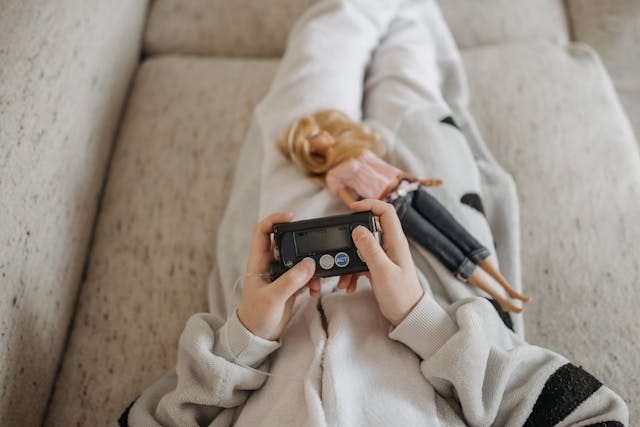
Any real progress was abruptly halted when an alarm of death sounded. The CGM had come back to life with a heart-stopping warning that blood sugar was critically low. To add to the orchestra of doom, my daughter’s insulin pump echoed the alarm, alerting us that all insulin delivery was paused until glucose rebounded to safer levels.
With type 1 in our lives for almost two years now, my rational brain told me that a critical low was very unlikely given everything I knew (when she’d last eaten, how much insulin was still active in her system, the test result from just 15 minutes prior). “Did you happen to scratch your monitor?” I asked my daughter. “Maybe?”, came the reply. She reported that she’d held off all school day but had in fact just rubbed her arm a little. I suspected that it was becoming detached and struggling to capture reads.
Even with a somewhat functional rational brain, those CGM alarms of impending danger with a capital D add about 500 gray hairs to your head in a nanosecond. You can practically feel your stem cells dying on the spot. The alarms jolt you into fight or flight mode, and you have no choice but to check again the old fashioned way as you scan your favorite tiny human for visual evidence to compound or ease your anxiety, the worry that you try to temper as you set down all of your belongings on the sidewalk and take their hand in yours.
The glucose result was not low, but now we were headed home to swap out a monitor that had chosen a dramatic moment to throw in the towel.
Upon closer inspection back home, we discovered that the monitor was indeed on its way out of her arm. It was having trouble accessing sugar to measure. Ever since the manufacturer had decided to change the adhesive, my daughter had battled with rashes. Some sensors left little to no trace that they had lived on her skin for ten days, while others were lucky to last more than five and left behind red scaly inflamed patches that begged to be itched. You would find her clawing her arm where a sensor had once been in her sleep. We lathered on ointment morning and night in their wake.
As we prepared for the monitor change, I was still replaying my daughter’s wish that she’d voiced as her monitor had decided go rogue on us: She wanted to be like her classmates, for just 100 days… No more insulin pumps. No more monitors. I had replied that I heard her, but reminded her that going device-free would mean more pokes in the form of blood sugar checks and insulin injections. She clarified her wish: she didn’t want the pokes, either. She wanted out of the diabetes calculations entirely.
Why 100 days? Probably because they’d just celebrated that many days of school not so long ago. Maybe also because, as a child, that number can feel like a lifetime.
I heard her, and I can’t say that the same thought had never crossed my mind. It had entered my headspace just the previous morning when I sat in her classroom for my volunteer shift. As the teacher wrapped up a story on the carpet, I scanned the faces of her classmates as they yawned or shifted their weight from side to side or twisted a stray strand of hair. I thought about how I was doing diabetes math, still pondering breakfast and how it was manifesting in my daughter’s bloodstream and whether she’d need a boost before snack rolled around. I sat for a moment with the idea of what it might feel like not to have to entertain such questions, to do drop-off and not refresh my phone application for a new blood sugar reading before stepping away.
This kind of a place-swapping wish is a familiar trope. Think Freaky Friday, 13 Going on 30, The Parent Trap, or in the world of children’s literature, Eric Carle’s The Mixed-Up Chameleon. The chameleon desires to more closely resemble different animals at the zoo, to take on the elephant’s ears, the seal’s fins, the giraffe’s neck. With each turn of the page, his “wish” is realized and his figure confused by the adoption of new traits that were never his own. As the book title suggests, the result is a mixed-up creature that has lost all authenticity and ultimately desires to shed the unnatural layers and exist as he did before.
But how does this map onto our own situation with type 1 diabetes? My daughter did not always live fueled by insulin from the outside. I’m not sure how much she remembers life as it was before, when you could lick the icing off your birthday cake without your parents performing math over your shoulder or reach in for a fistful of tortilla chips without any considerations of timing.
Like a chameleon, my daughter has shed her carefree skin. When I stop and think about it, I have, too. The child I pick up from school is still herself deep down, I am still the same mom that I was before, but the daily realities of diabetes have left a new texture on life for all of us. Even when my daughter takes a device-free bath, her skin clear of monitors and pumps, she is still not exactly the same child whose biggest worry was soap to the eyes, the kid who once splashed around until her skin shriveled with deep ridges.
Do I wish for the same 100 days without diabetes? If you catch me at a moment of particular emotional vulnerability, I might run to find a pen to sign myself up. But then I stop to remember that for those 100 days I would miss out on the bold and fiercely strong child that I am raising and who is also raising me. We have been conditioned by her condition. It’s true that her classmates do not know what it’s like to be jostled awake in the middle of night and coerced to drink a few sips of juice through their slumber. It’s equally true that their parents have never known the worry of an unexpected blood sugar drop or the jolt to the system of a CGM alarm. And for these same challenging reasons, they have quite possibly never experienced the bone-deep appreciation for modern medicine, which allows you to watch your child continue to grow up. They may never know the parental admiration of witnessing your child’s display of courage and wisdom far beyond their years.
It’s true that we have forever shed our former skins. At times, we may wish to adopt the (seemingly) carefree, diabetes-free existence on display by those around us. But it’s also true that the new layer that has emerged has cemented a deep bond and a profound love that does not take this life for granted. Through the ups and downs, I have witnessed the emergence of a special beauty that dazzles in its quiet strength. My daughter’s new skin is one that we should all aspire to, and it is one I could never have known in 100 days untouched by diabetes.
메타데이터
- post_id
- d8f97f017d00
- slug
- my-daughter-wanted-to-be-like-her-classmates-for-just-100-days-d8f97f017d00
- url
- https://medium.com/the-type-1-diaries/my-daughter-wanted-to-be-like-her-classmates-for-just-100-days-d8f97f017d00
- canonical_url
- https://medium.com/the-type-1-diaries/my-daughter-wanted-to-be-like-her-classmates-for-just-100-days-d8f97f017d00
- author_url
- https://medium.com/@emilydutch
- status
- ok
- fetched_at
- 2026-06-09 14:34:10