How to Hire Agentic AI Developers for Healthcare in 2026
What to Look for When You Hire Agentic AI Developers for Healthcare: The Technical Skills and Healthcare Knowledge That Actually Matter
How to Hire Agentic AI Developers for Healthcare in 2026
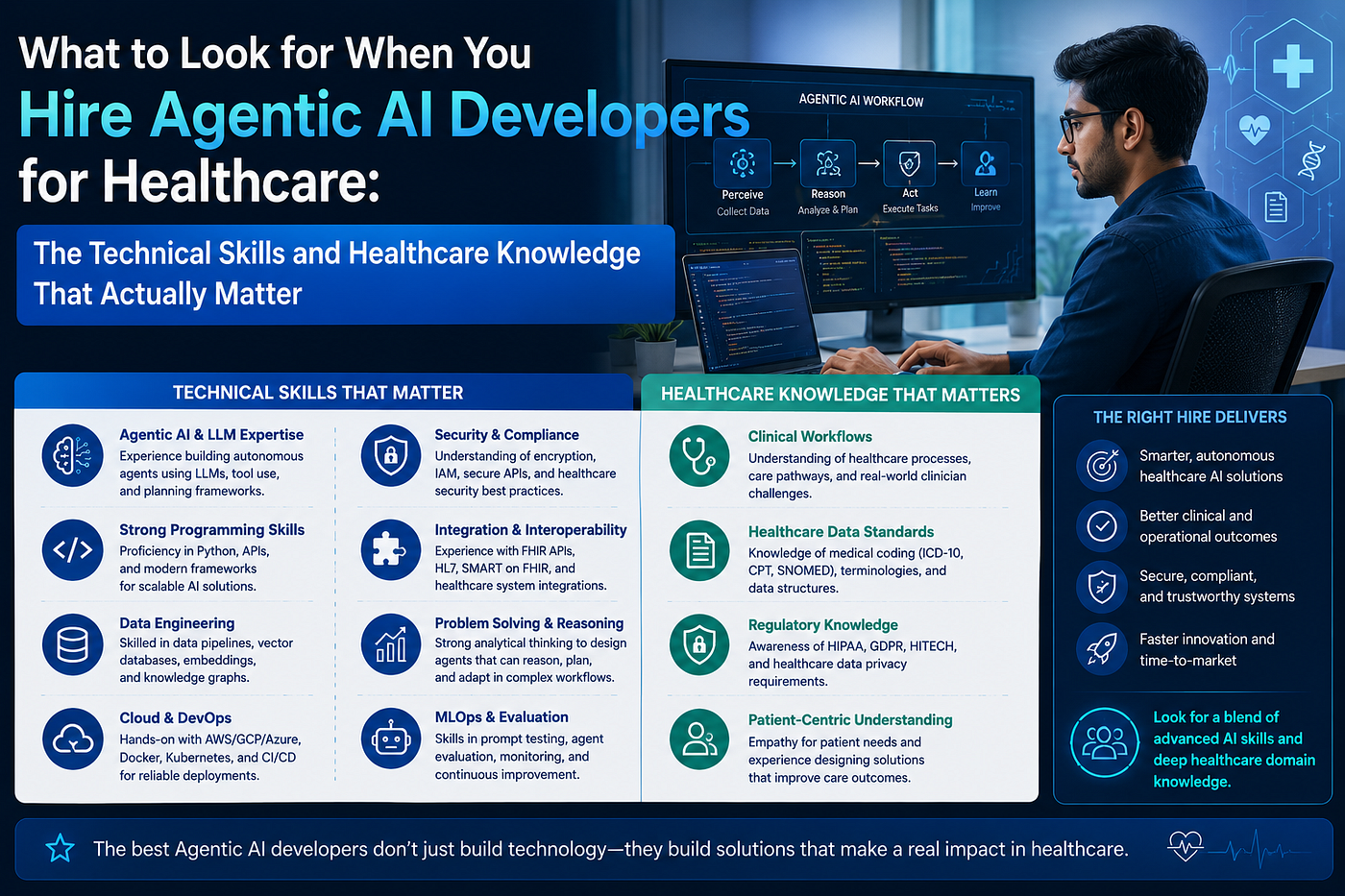
What to Look for When You Hire Agentic AI Developers for Healthcare: The Technical Skills and Healthcare Knowledge That Actually Matter
The market for agentic AI developers has gotten expensive fast.
The average agentic AI engineer in the U.S. earns $190,000 in base salary. Top earners clear $300,000 or more. Agentic AI developers already command a 15–20% salary premium over standard ML engineers — and that gap is widening as enterprise demand pulls talent toward the highest bidders.
For healthcare organizations, the stakes are even higher. Because hiring the wrong developer doesn’t just mean a delayed project or a missed feature. It means PHI handled incorrectly, audit trails that don’t satisfy regulators, and agentic systems doing things in your clinical environment that can’t easily be undone.
When you hire agentic AI developers for healthcare, you’re not just buying technical output. You’re making a compliance decision. Here’s how to get it right.
The Non-Negotiable Technical Skills Every Agentic AI Developer Needs to Function in a Healthcare Environment
The agentic AI framework landscape has matured quickly. By 2026, LangChain appears in 34.3% of agentic job listings, with LangGraph a strong second at 22.1%. Framework fluency is table stakes. What separates qualified developers from resume-optimized ones is what they can do when the framework meets a clinical production environment.
Agent orchestration frameworks — and when each is right for healthcare
LangGraph is the correct choice for most healthcare agentic systems. It reached production maturity in late 2025 and is now the dominant framework for deployments where compliance, auditability, and human-in-the-loop oversight are requirements. Its graph-based architecture makes agent behavior explicit — you can visualize exactly what path an agent took through a workflow and reconstruct that history for an auditor. Checkpointing, conditional branching, and interrupt-and-resume for clinical approval steps are all built in.
CrewAI is well-suited to healthcare administrative workflows where the role-based model — one agent handles prior auth, another handles scheduling; another manages coding — maps naturally to how clinical departments actually divide work. It’s faster to prototype with, which makes it a reasonable choice for pilot projects. Teams that build with CrewAI often migrate to LangGraph when they need production-grade state control.
AutoGen works well for clinical decision support workflows where iterative, conversation-driven reasoning between agents improves the quality of output — research summarization, complex case review, or differential diagnosis support where the back-and-forth between agent’s mimics clinical deliberation.
A developer who can only work in one framework isn’t the right candidate for a production healthcare system. Ask for examples across all three.
Memory, state management, and human-in-the-loop architecture
These three patterns separate healthcare-capable agentic developers from those who built impressive demos on clean, synthetic data.
Memory in a healthcare agentic system isn’t just conversation history. It’s structured context — the patient’s current medications, outstanding orders, care plan status — that must be retrieved accurately, updated safely, and never mixed between patients. Getting this wrong isn’t a bug. It’s a patient safety incident.
State management under failure conditions is where developers reveal whether they’ve shipped production systems. What happens when an API times out halfway through a multi-step prior authorization workflow? Does the agent retry from the right point? Does the state get corrupted? Ask candidates to walk you through a failure scenario they’ve debugged. The specificity of the answer tells you everything.
Human-in-the-loop checkpoints are not optional in clinical environments — they’re a regulatory and ethical requirement. Agents can manage scheduling, documentation, and administrative workflows autonomously. For anything that directly affects a treatment decision or patient safety, a qualified person must review and approve before the system acts. The developer you hire needs to design this from day one, not retrofit it after your compliance team flags it.
Production-grade skills that separate real developers from demo builders
The skills that matter in production are the ones that don’t show up in portfolio screenshots. Inference cost management at scale — because a healthcare agentic system handling thousands of encounters per day accumulates token costs that could undermine your ROI model entirely if nobody designed it.
Hallucination guardrails are non-negotiable in clinical-facing outputs. Ask candidates specifically: how do you prevent an agent from confidently generating a clinical note that contains a medication dosage fabricated? What’s the detection mechanism, and what’s the fallback?
Monitoring and versioned rollback round out the production skill set. Clinical systems can’t be left running unmonitored after go-live. You need tracing, accuracy benchmarking, and a documented rollback plan for when a model update changes behavior in ways that affect clinical output.
The Healthcare Domain Knowledge a Developer Must Have Before You Let Them Near Your Clinical Systems
Technical skill in agentic AI is necessary. It’s not sufficient.
FHIR R4/R5 and HL7 v2 integration
FHIR and HL7 are data exchange standards that make healthcare systems interoperable. An agentic AI developer who hasn’t worked with them before will learn on your timeline and your budget — and will make integration decisions early in the project that require expensive rework when your EHR team reviews them.
Ask for specific examples: which FHIR resources have they accessed, which scopes did they request, and how did they handle EHR write-back? If the answers are vague, the experience isn’t real.
PHI data architecture
General cloud security experience does not transfer to healthcare. HIPAA requires specific technical safeguards — encryption in transit and at rest, access controls tied to minimum necessary access principles, audit logs that capture every PHI interaction, and session management designed to prevent unauthorized disclosure.
The agentic AI layer adds complexity. When an agent retrieves a patient’s record, processes it through an LLM, and writes output back to the EHR, every step in that chain must be HIPAA-compliant. A developer who hasn’t thought through that flow before will leave gaps that surface in your security review — or worse, in an OCR audit.
Clinical workflow literacy
A developer who doesn’t understand the difference between a progress note, a discharge summary, and a prior authorization will build technically functional code that solves the wrong problem.
Clinical workflows are designed around patient safety, regulatory documentation requirements, and billing accuracy. Agentic systems that don’t account for those constraints don’t just underperform — they create liability. The developer you hire should be able to explain what triggers a prior authorization, what a care coordinator does between discharge and home health setup, and why a progress note format differs between inpatient and outpatient settings.
Eight Interview Questions That Separate Genuine Healthcare Agentic AI Developers From Resume-Optimized Candidates
The goal of these questions is not to find developers who give perfect answers. It’s to find developers who give honest, specific ones.
Questions 1–4:
- Walk me through how you’d architect state management for a multi-step prior authorization agent — and what happens if the external payer API fails at step three.
- Which framework would you use for a healthcare scheduling agent that requires human approval before booking, and why?
- How do you implement HIPAA technical safeguards at the LLM inference layer — specifically for PHI that passes through an external API?
- How do you detect and handle hallucinations in a clinical documentation agent?
Questions 5–8:
- Describe how you’d design the EHR write-back for an AI agent generating discharge summaries — what’s the API pathway, and what happens if the note fails validation?
- Where in a clinical agentic workflow would you insert human-in-the-loop checkpoints, and how do you implement them in LangGraph?
- What does your post-deployment monitoring setup look like for a healthcare agentic system — what metrics do you track, and at what threshold do you alert?
- Tell me about a healthcare AI project that didn’t go as planned. What broke, and what did you do differently afterward?
The last question is the most important one you’ll ask.
A developer who deflects, generalizes, or can’t recall a specific failure has either never worked on a real production healthcare system or doesn’t reflect on their work. Neither is the profile you want responsible for a system that touches patient data.
A developer who answers a specific failure, a clear diagnosis, and a change they made afterward is telling you they ship real systems, take ownership when things break, and get better over time.
That’s who you’re looking for.
메타데이터
- post_id
- d904a3871964
- slug
- what-to-look-for-when-you-hire-agentic-ai-developers-for-healthcare-the-technical-skills-and-d904a3871964
- url
- https://medium.com/@Larisa10/what-to-look-for-when-you-hire-agentic-ai-developers-for-healthcare-the-technical-skills-and-d904a3871964
- canonical_url
- https://medium.com/@Larisa10/what-to-look-for-when-you-hire-agentic-ai-developers-for-healthcare-the-technical-skills-and-d904a3871964
- author_url
- https://medium.com/@Larisa10
- status
- ok
- fetched_at
- 2026-06-16 19:09:56