Zionism as Decolonization — How I Went From Anti-Zionist to Zionist
As a former anti-zionist, I often get asked what changed my views on this very heavy, complex, and emotive subject.
Zionism as Decolonization — How I Went From Anti-Zionist to Zionist
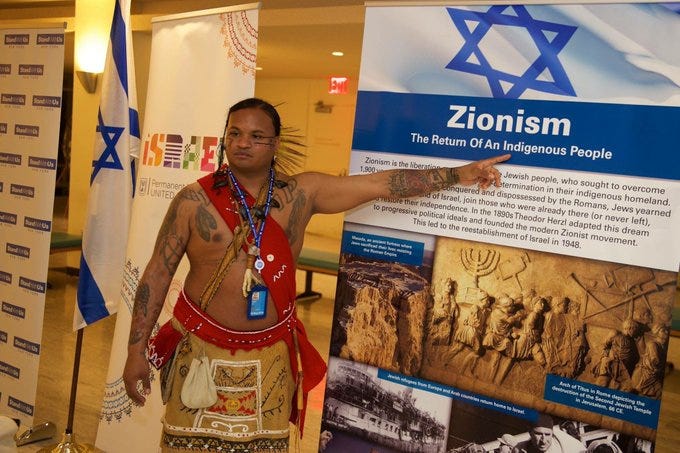
As a former anti-zionist, I often get asked what changed my views on this very heavy, complex, and emotive subject.
Ironically, it was the same question that got me out of anti-zionism that got me into it — what relationship do Jews have to the land?
The lens through which we view this question colours the entire conflict — the history, events, and dynamics involved, what they are, and to what extent they are moral or immoral.
For a number of years, I opposed the existence of Israel and everything to do with it. A matter of principle. Like most other anti-zionists, it was seemingly obvious that Jews are foreign to the land, that they are just white settler-colonizers from Europe who were using the Jewish religion as a racist excuse to steal the land of a vulnerable brown indigenous population. Anyone with a moral conscience would be opposed, no?

Because of this pretext, anti-zionism presupposes that everything else Israel does must therefore be in service of settler-colonialism — When Israel causes civilian causalities, it can’t be self-defense, it must be genocide. When Arabs get displaced due to a war that Arabs started (and lost), Israel must have ethnically cleansed them. When Israel puts up a wall to stop suicide bombers, it must be apartheid, etc.
So, everything Israel does (exist, defend itself, maintain national security) is unjustifiable, because the premise of Israel is unjustifiable. And conversely, everything the Palestinians do is justifiable, because they are innocent native people resisting the evils of colonization. The Jews are foreigners who took the land from the natives, just like here in North America, right? Right!?
Wrong. As someone with an academic background in Anthropology and Indigenous studies, who also spent many years as a decolonial advocate focused on indigenous rights, I was inclined to agree. However, when I started seeing the argumentation for Jews being Indigenous (from Ryan Bellerose, Rudy Rochman, Thomas Gallezot, StandWithUS, among others), I was skeptical yet curious, and sought to investigate further. If my beliefs were true, they would hold up to scrutiny, I thought.

Upon actually reading about Jewish history, linguistics, archaeology, and genetics, and also Arab history, and the history of the conflict, it turns out, my opinions were very much rooted in ignorance. Everything clicked into place and my worldviews came crashing down (although accepting it was a gradual process).
Jews are not just white people with a Jewish religion, they are a displaced Levantine people. Arabs are not just innocent natives, they are the descendants of Caliphates that colonized the entire MENA region. Israel is not acting in service of settler-colonialism, it is acting in service of decolonization. There was so much more that I was never told, and so never considered. I was lied to.
I couldn’t justify perpetuating things I knew to be false. And it irked me to see others, people I respected, continue to repeat the same fallacies I was believing. Ever since, I’ve felt compelled to set the record straight.
There came a point, it was May 2021 during a flare up between Israel and Hamas, where I saw familiar anti-zionist misinformation circulating everywhere I looked. I spoke up publicly and talked about my change in views, and naturally, took massive blowback, public shaming, and a lot of blocks on social media. However, credit to the people who respect my difference in views, and are still willing to have a civil dialogue on the subject.
That said, I often find discussing the war (and thus claims of genocide, apartheid, etc) to be unproductive. People are less inclined to think critically about the conflict, if the premise of the conflict is unjustifiable to them (eg. settler-colonialism).
So instead, I find it far more productive to go to the root, to the same things that led to me changing my mind, that is, understanding indigeneity as it applies here.
So here we are now: what determines indigeneity?
It all comes down to ethnogenesis.
What is Ethnogenesis?
Ethnogenesis means the formation of a people in a particular land, whereby they develop all the components of a distinct collective identity which separate them from all other peoples. People are indigenous to the place where the ethnogenesis event happened, not to where their predecessors came from beforehand, or where they end up migrating to later or are displaced to, or to the places where they might acquire admixture from.
Example: Metis
I am a Metis Nation citizen. The earliest frameworks with which I came to understand ethnogenesis, were from within my own nation.
For those who aren’t familiar, Metis aren’t just a racial category of mixed people with both Indigenous and European ancestry. Rather we became a distinct ethnic group and nation through ethnogenesis, coalescing as a people in the Red River Settlement (now Winnipeg) and spreading throughout the prairies as our collective identity was in its formative stages (roughly 1812–1870). Our ancestors experienced distinct cultural components, language, kinship structures, historical events, etc that emerged and defined Metis as being separate from other peoples (both First Nations and Europeans) and united as our own people.

Metis Nation homeland
This experience of ethnogenesis was inextricable from the specific land wherein it all took place.
Therefore, we are not indigenous to France, England, Scotland, the shores of Hudson Bay, the whole of Canada, nor anywhere else, because our ethnogenesis events did not happen in these other places, even if we had ancestors from there, or ended up there later. We also do not lose our Metis-ness or our indigeneity by intermarrying with non-Metis or by moving out of the homeland.
The same can be said for any group that has an indigenous relationship to a land.
Also ethnogenesis (and thus indigeneity) is not determined solely by living in a land for a long time, by conquering Indigenous people, nor having genetic similarity with or ancestry from Indigenous peoples. Only by having a distinct identity that formed uniquely on the land in situ, can a people be indigenous and all Indigenous people’s identities are ultimately defined by their ethnogenesis and emergent relationship to land.
Aren’t Jews “just a religion”?
A piece of misinformation I frequently encounter is “but Jews are just a religion! How can a religion be indigenous!?”
Thing is, Jews aren’t a religion. Jews are an ethno-religious group, i.e. an ethnic group with a religion. When a Jewish person stops following Judaism, they are still Jewish, unlike followers of Christianity, Islam, or other religious affiliations. This isn’t unlike Indigenous groups who are distinct ethnic groups, but also have distinct spiritual systems that essentially function as mini-religions (albeit existing very differently than say Christianity or Islam). E.g. If a Cree person stops following Cree spirituality and starts following Christianity (which happened a lot after colonization), they are still Cree.
Given that Jews are an ethnic group, this is also why you can be born Jewish even if your family is secular, and also why DNA testing can detect Jewish ancestry. Because Jews are an ethnic group, they also have a verifiable origin as a people in a certain time and space, just like the example of Metis used earlier.
Jews began forming as a people around 1000 BCE in Judea/Israel, as an offshoot of local Canaanite tribes. The exact dates are a bit fluid since the process was gradual and multiple events were involved, but put loosely the widest figures are between 1300 BCE and 500 BCE.
Later on, most (but not all) Jews underwent displacement (by colonial forces no less) into different parts of the world and acquired admixtures from the local populations but still formed as a people in Israel/Judea. Indigeneity, like colonial status, never expires.
Most of the major observances in Judaism are directly aligned with the ecology, seasons, and agriculture cycles of the Levant (rather than Eastern Europe or other exile loci), caring for the land etc. Jewish culture simply adapted to fit the foreign geographies into which they were displaced, and through ceremony they remember their origins and aspire for the return to their home.
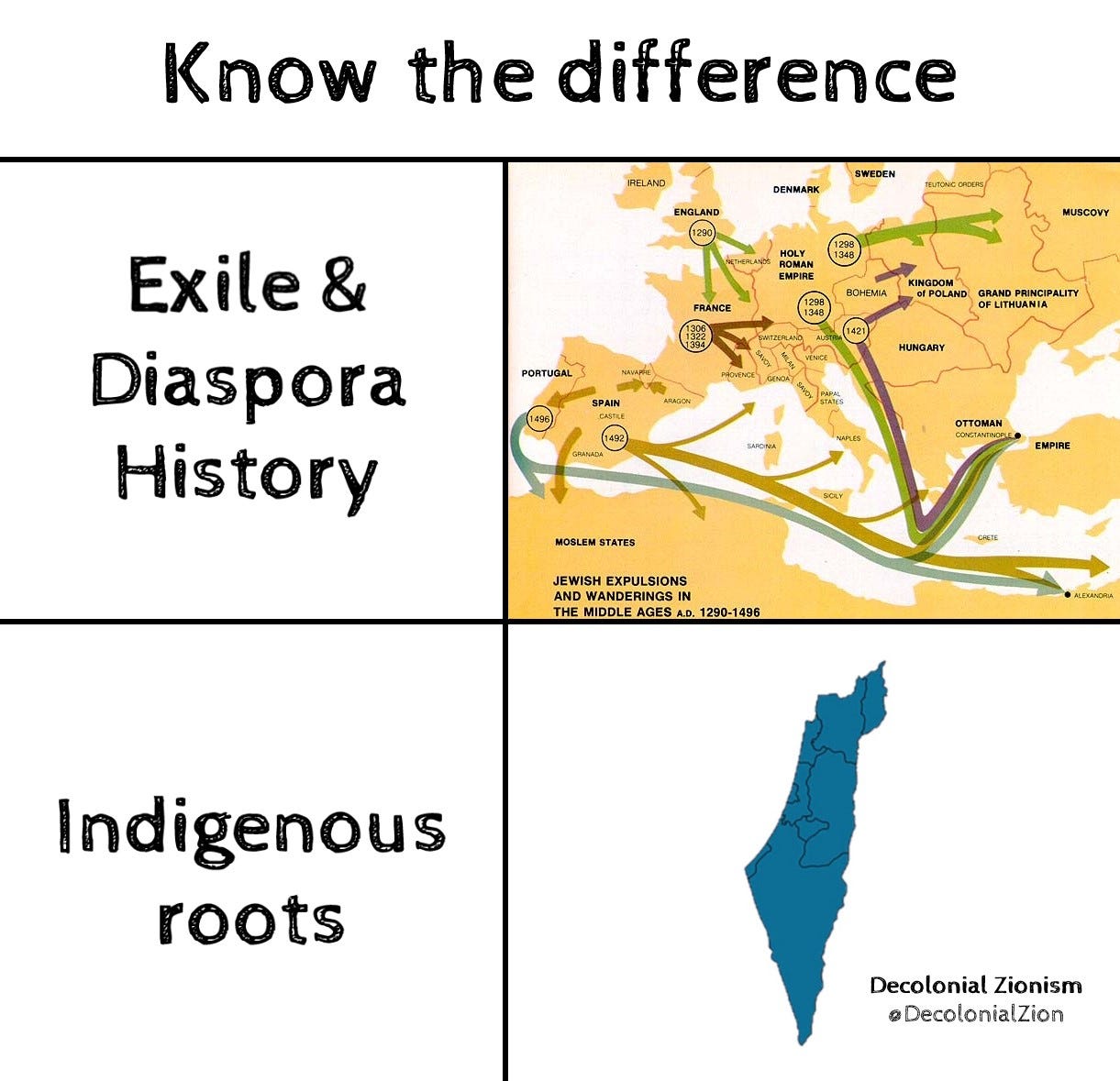
I am going to preempt another point, which is the claim that Jews in ancient times “colonized and genocided the Canaanites”. In reality, this doesn’t line up with the archaeology, and Jews and Canaanites weren’t exactly separate peoples. When Jews underwent ethnogenesis, the Canaanites were the very people they were splitting off from, i.e. the parent population, not unlike the relationship between Swedes to Norse, or Italians to Romans.

Are Jews Settler-Colonial?
Further to this point, to be settler-colonial, Jews have to be foreign. That is, having undergone ethnogenesis in a place other than the land they are claiming. Jews became a people in the land of Israel. Logic follows that an indigenous people cannot colonize their own homeland, not in ancient nor in modern times.
Jews have also had a constant presence in the land for 3000 years. Yes, many or most Jews were exiled and displaced from the land (by colonial forces no less), but there has always been a presence of resilient Jews there who were never expelled and never left.
Additionally, the majority of Jews in Israel aren’t even Ashkenazi (Jews with an exile history in Central/Eastern Europe), but rather Mizrahi and Sephardi, who interestingly, the “settler-colonial” proponents are not likely to consider “white foreigners”. Though I would stress that this doesn’t actually lend any legitimacy to the claim, since Ashkenazi Jews are just as legitimately Middle Eastern as Mizrahi Jews are, given they come from the same ethnogenesis event. The only difference is that one was displaced to Europe, and the other was displaced to other parts of the Middle East.
Are Jews White?
Jews being in Europe for a long time does not make them white Europeans. What it makes them, is displaced Levantines who adapted and adjusted their culture to fit a foreign environment. Some may try to make the argument that Jews in Europe absorbed European ancestry and that makes them white, but this logic is curiously never applied to other groups that absorbed European ancestry (African-Americans, Roma, Latinos, Metis, among others).
In fact, having also a background in genetic genealogy, I co-wrote another article in 2024 about Ashkenazi Jewish genetics, and how there is an undeniable continuity with their ancestors from the Middle East. Roughly half the Ashkenazi genome (or possibly more) is derived from the Middle East, their genomes being far closer to other Jewish and MENA populations than to European host populations.
Nazi race propaganda poster “The Jew is a bastard”
As for being white, I think there is a fair point to be made that Jews, including Ashkenazi Jews, are not white. In my conceptualization of whiteness, it means being in an unracialized state, that is, experiencing the racial default, racial power, and racial privilege. Clearly, Jews have been racialized over and over again historically, with demonstrably little racial power or privilege — stereotyped with racialized traits, and today continue to face highly disproportionate levels of hate crimes and racialized violence. The Nazi genocide of six million Jews for explicitly racial reasons I believe speaks for itself, especially when we consider that during WWII, it was the Palestinian leadership that was collaborating with the Nazis to decide how to implement the Holocaust in the Middle East, an interesting context of dynamic that is worth considering, when Israel was not yet founded as a state.
Grand Mufti Amin Al-Husseini with Adolf Hitler
Are Palestinians Indigenous?
Palestinians self-identify as Arabs. While they have had a presence on the land for centuries (which must be respected) and mixed with local populations, their ethnogenesis took place in Arabia (hence the name), not the Levant. Notwithstanding a few small early/proto-Arab nomadic tribes that migrated outwards, Arab identity spread out of Arabia with the Arab conquests of the 7th century shortly after the foundation of Islam and the establishment of the Arab Caliphates. Very quickly these empires colonized and dominated the rest of the Middle East and North Africa, subverting and/or replacing the indigenous peoples of those lands. In effect, the indigenous peoples were either marginalized or forced to give up their indigenous tribal religions and convert to Islam, Jews included. Today there are over 20 Arab states.

There are still many native peoples in Arab countries such as Jews, Copts, Assyrians, Kurds, Berbers, Samaritans, and others. They still have their own Indigenous languages and identities and their own self-determination movements akin to Zionism (the Kurds being one of the more prominent examples). Jews under Arab rule were forced to live in a 2nd class status called Dhimmitude and were repeatedly massacred or expelled.
Some may say, “The Palestinians (Arabs) have been there for thousands of years, surely that means they are indigenous too!”. For one thing, a likely majority of Palestinians actually descend from recent influxes of Arabs from surrounding Arab countries during the British Mandate and late Ottoman periods, though they do descend from a deep Arab presence as well.
However more importantly, it is not the length of time that a group spends on a land that makes them indigenous. Once again, indigeneity is about ethnogenesis. If that group had an ethnogenesis event that occurred elsewhere, they are not indigenous to the land, and if they acquired that land through force, especially if they subverted the native peoples of that land, then they are in fact colonizers. If longstanding presence were the only criteria for indigeneity, then white people in the Americas would also be indigenous, which is a frankly absurd proposition.
Some may argue that Palestinians have Canaanite blood, and therefore they are indigenous. This is also not true. Blood, while it is a factor in indigeneity, it cannot be reduced to blood. Indigeneity is about ethnic identity, culture, and formation on a land. Neither is it individual, it is collective. It is belonging to a collective identity that is indigenous to that land because it formed there, distinctly from other groups. Palestinians are a geographic/national subset of Arabs. They did not have ethnogenesis in Israel. As Ryan Bellerose puts it, “blood alone does not grant you indigenous status, otherwise all colonizers would need to do is force marriage and rape for a single generation and they would then qualify.”
So while both Jews and Arabs have legitimate historical relationships with the land of Israel, they don’t have the same relationships to the land, and I believe one of the requirements for lasting peace is the acknowledgment and acceptance of the Indigenous relationship of Jews to the land.
What is Zionism?
There are all kinds of false notions of what Zionism is. I hear things like “it means the killing of all non-Jews”, “it means taking away all the land”, “it means Jewish supremacy and apartheid”.
It actually means none of these things. The literal definition is the right of Jews to self-determine in their homeland (i.e. for the state of Israel to exist). Zion is another term of Jerusalem, because this was the ancient capital for the Jews.
But of course, like I said, the lens through which we view the indigeneity of Jews colours our perception of the conflict. If we already view Jews as foreign colonizers, then of course Zionism is going to mean to us things like killing, land theft, supremacy, etc. because Jews have no right to be there, and no right to militarily defend their presence there.
Zionism as Decolonization
Contrary to what I used to believe, Zionism is not colonization. It is decolonization. Given that Jews have an indigenous relationship to the land, Zionism can be classified as an indigenous rights movement.
I realize this is an inconvenient thing to accept, when it upends all of our understandings of the conflict, geopolitics, and concepts of belonging. And we can debate all the ins and outs of the war if we want, but it doesn’t change the basics — Jews are not foreigners. They are an indigenous people who were colonized by others (Romans, Arabs, Ottomans, British) and displaced.

UN Partition Plan, 1947
While some may claim Zionism is violent, it is not. It is true that the establishment of Israel was violent, although this isn’t because Zionism is violent. There was a peaceful plan for coexistence offered in 1947, the UN Partition Plan, whereby both Jews and Arabs would get equal divisions of land, and would live in two states. This was rejected by the Arabs who instead launched a war on the Jews, leading to the displacement of hundreds of thousands of Jews and Palestinians. None of that needed to happen. In fact, massacres against Jews (by Arabs) was something repeatedly happening for decades, centuries before the formation of Israel.
Meanwhile, anti-zionism is not a peaceful ideology. It seeks to violently overthrow the existence of Israel, and force the Jews into either exile or submission to an Islamic Arab nationalist state whose proponents have already codified the intent to destroy the Jews as a people, and already begun acting upon it.

Image credit: StandWithUs
If Jews remain in the places into which they were exiled, they are not decolonizing nor are they experiencing self-determination — they are occupying the Indigenous lands of others. If Jews stay in Brooklyn, they are occupying Lenape land. If they go back to Poland, they are occupying Polish land. Only in Israel are Jews on Jewish land.
Hence, establishing and returning to Israel is decolonization. The only way the conflict can ever move forward, is if all parties accept this fact. To Jews, this is non-negotiable. The alternative — that Jews remain in exile, only to be murdered and subjugated for another 2000 years — is simply unacceptable.
For those of us who value Indigenous rights and decolonization, we need to ask ourselves if it is something that matters in all contexts. We need ask ourselves if Indigenous rights matter, even when inconvenient. Unless Indigenous rights matter to everyone, Indigenous rights matter to no one.
If I can lend any word of advice — answer your questions, but also question your answers. Question your questions. Put aside political implications. Examine all sides before taking a position. Be willing to be wrong.
메타데이터
- post_id
- d90aff8f15f9
- slug
- indigeneity-ethnogenesis-jews-and-arabs-why-zionism-is-actually-decolonial-d90aff8f15f9
- url
- https://medium.com/@tony.masiuk/indigeneity-ethnogenesis-jews-and-arabs-why-zionism-is-actually-decolonial-d90aff8f15f9
- canonical_url
- https://medium.com/@tony.masiuk/indigeneity-ethnogenesis-jews-and-arabs-why-zionism-is-actually-decolonial-d90aff8f15f9
- author_url
- https://medium.com/@tony.masiuk
- status
- ok
- fetched_at
- 2026-06-17 08:20:12