Data Normalization: Unlocking Efficiency and Integrity in Your Database
In the world of database design, data normalization is essential for organizing data, minimizing redundancy, and ensuring data integrity…
Data Normalization: Unlocking Efficiency and Integrity in Your Database
In the world of database design, data normalization is essential for organizing data, minimizing redundancy, and ensuring data integrity. Data normalization is a critical process in database design that ensures data integrity, reduces redundancy, and improves efficiency. It’s like organizing your closet — getting rid of unnecessary clutter and arranging things logically for easier access. This process involves structuring a database into tables following specific rules called “normal forms,” which help maintain consistency and optimize storage. Let’s explore the first three normal forms (1NF, 2NF, and 3NF) and understand their benefits and trade-offs.
What is Data Normalization?
Data normalization is a technique to structure data in a way that minimizes redundancy (duplicate data) and dependencies, making the database efficient to store, update, and retrieve information. Each normal form builds upon the previous one, introducing additional rules to make the data more atomic and interrelated.
Data normalization involves organizing a database in such a way that it adheres to certain rules known as normal forms. Each normal form addresses specific types of redundancy and ensures that the database structure is logical and efficient. The primary goal of normalization is to eliminate duplicate data, ensure data dependencies make sense, and facilitate easier querying.
Why Normalize Data?
Imagine a database where customer information is scattered across multiple tables, leading to:
- Redundancy: The same data might be stored in multiple places, wasting storage space.
- Inconsistency: Changes to one copy of the data might not be reflected in other copies, leading to errors.
- Update Anomalies: Updating data in one place could require updating multiple tables, increasing the risk of errors.
Data normalization addresses these issues by:
- Minimizing redundancy: Storing each data item only once.
- Enforcing data integrity: Ensuring consistency and accuracy.
- Improving query performance: Reducing the amount of data to process.
Normal Forms: Stepping Stones to Optimality
Data normalization follows a series of normal forms, each building upon the previous one. Let’s look at the most common ones:
1NF (First Normal Form)
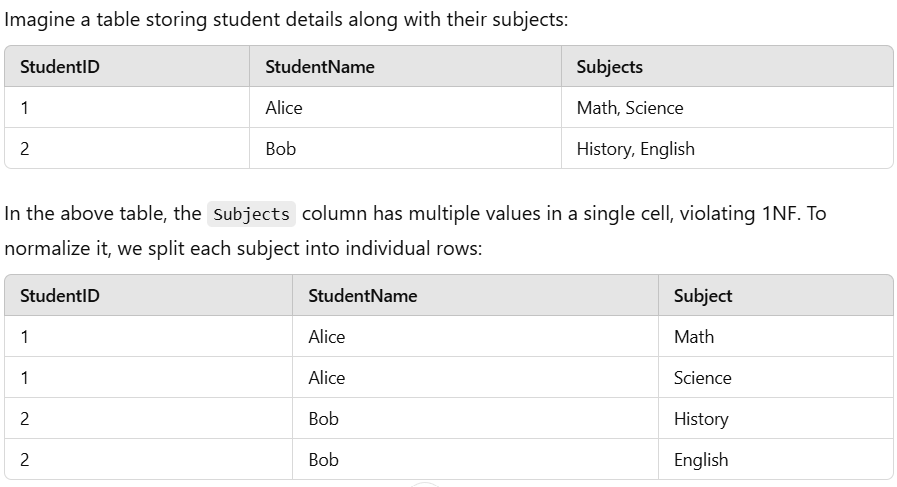
Definition: In 1NF, each table cell must contain a single value, and each record needs to be unique. This form ensures that all columns contain atomic data, meaning that each column only stores one piece of information without repeating groups.
- All columns contain atomic (indivisible) values.
- Each column contains values of a single type.
- Each entry in a column is unique.
Problem: The “Subjects” column contains multiple values, violating the atomic value rule.
Solution: Create a separate table for Subjects, with a foreign key linking it to the Student table.
Example:
Benefits of 1NF:
- Reduces redundant data by splitting repeating groups.
- Makes querying simpler by using a standardized format.
2NF (Second Normal Form)
Definition: 2NF addresses partial dependency, where a non-key attribute is dependent on only part of a composite primary key. A table is in 2NF if it is in 1NF and all non-key attributes are fully functionally dependent on the entire primary key.
- It is already in 1NF.
- All non-key attributes are fully functionally dependent on the primary key.
Problem: “Course Name” depend on “Course ID,” not the entire primary key (“Student ID”).
Solution: Move “Course Name” and “Course ID” to a separate “Course” table, linked by “CourseID.”
Example: Consider a table with the following columns:

Now, each table contains only data that is fully dependent on its primary key.
Benefits of 2NF:
- Reduces data redundancy.
- Ensures data is organized based on unique key dependencies.
3NF (Third Normal Form)
Definition: A table is in 3NF if it is in 2NF and contains no transitive dependency, where a non-key attribute depends on another non-key attribute.
- It is already in 2NF.
- There are no transitive dependencies; that is, non-key attributes do not depend on other non-key attributes.
Problem: “Instructor Name” depends on “Course ID,” which is a non-key attribute.
Solution: Create a separate “Course” table with “Course ID” as the primary key, and link it to the “Enrollment” table.
Example: Consider an extended version of our enrollment table:

Now, InstructorName is stored in the Courses table, achieving full independence from non-key attributes in the Enrollments table.
Benefits of 3NF:
- Ensures all non-key attributes are only dependent on the primary key.
- Reduces update anomalies by eliminating indirect dependencies.
Differences Between 1NF, 2NF, and 3NF

Differences Between Normal Forms
The differences between the First, Second, and Third Normal Forms can be summarized as follows:
1NF vs. 2NF:
- 1NF addresses atomicity and uniqueness of entries.
- 2NF focuses on eliminating partial dependencies of non-key attributes on primary keys.
2NF vs. 3NF:
- 2NF removes partial dependencies but may still have transitive dependencies.
- 3NF eliminates transitive dependencies among non-key attributes.
Pros and Cons of Data Normalization
Pros:
- Reduces Redundancy: Eliminates duplicate data, saving storage space.
- Improves Data Integrity: Ensures consistent and accurate data.
- Easier to Maintain: Simplifies updates by ensuring data is stored only once.
- Flexible Queries: Well-structured tables make querying data efficient.
- Improved Query Performance: Faster retrieval of data.
- Enhanced Data Management: Easier to update and maintain data.
Cons:
- Complex Queries: Normalization can require complex joins for querying, impacting performance.
- Decreased Performance in Some Cases: Highly normalized data may need multiple tables to be joined, which can slow down retrieval.
- Difficult to Implement in Some Scenarios: When data doesn’t fit neatly into a normalized form, designing the schema can be challenging.
- Increased Complexity: More tables and relationships to manage.
- Potentially Slower Joins: Queries involving multiple tables can be slightly slower.
- Increased Storage: Potentially requires more storage due to the creation of additional tables.
When to Normalize and When Not To?
- Normalize when data integrity, consistency, and efficient storage are critical.
- Denormalize in high-speed applications, such as data warehouses, where quick data retrieval is a priority, even if it means some redundancy.
Balancing the Trade-off:
The choice of normal form depends on the size and complexity of your database and the performance requirements. While higher normal forms (3NF and beyond) provide greater integrity and efficiency, they might increase complexity. For smaller databases, 3NF is often a good choice. For large databases with complex relationships, consider a more denormalized structure to improve performance.
The Takeaway:
Data normalization is a key aspect of database design that promotes data integrity, reduces redundancy, and enhances performance. By understanding the different normal forms and weighing the pros and cons, you can create an optimized database that meets your specific needs and enables efficient data management.
Conclusion
Data normalization is an essential practice in database design that helps maintain data integrity and efficiency by organizing data into structured forms. Understanding the different normal forms — 1NF, 2NF, and 3NF — enables database designers to create systems that minimize redundancy and improve accessibility. While normalization has its advantages and disadvantages, it ultimately plays a crucial role in ensuring that databases remain reliable and efficient for analysis and reporting purposes.
In summary, data normalization up to 3NF is a key strategy in database design, striking a balance between data integrity and efficient retrieval. It’s essential for managing complex datasets and is an invaluable tool for anyone working in data management and analysis.
메타데이터
- post_id
- d94bdcc74cf0
- slug
- data-normalization-unlocking-efficiency-and-integrity-in-your-database-d94bdcc74cf0
- url
- https://medium.com/@ajayverma23/data-normalization-unlocking-efficiency-and-integrity-in-your-database-d94bdcc74cf0
- canonical_url
- https://medium.com/@ajayverma23/data-normalization-unlocking-efficiency-and-integrity-in-your-database-d94bdcc74cf0
- author_url
- https://medium.com/@ajayverma23
- status
- ok
- fetched_at
- 2026-06-27 23:56:40

