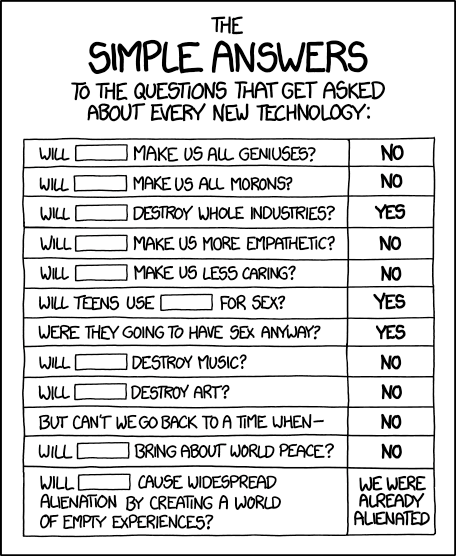
So I was playing around with ChatGPT for shits and giggles…
I have been researching GPT3 and its applications this week.
So I was playing around with ChatGPT for shits and giggles…
I have been researching GPT3 and its applications this week.
It has been difficult to find something useful to say about it beyond seeking to explain to the ‘AI Naive’ that the new application of the GPT 3 model, ChatGPT, is no more than a next-token-prediction program, that “ChatGPT is based on a language model, which assigns a probability distribution over sequences of words. A rough way to think about it: Given the start of a sentence, it will try to guess the most likely words to come next.” (Smerton, 2023). John Naughton uses ‘the first person to land on the moon…’ as an example:
it responds with “Neil Armstrong”, that’s not because the model knows anything about the moon or the Apollo mission but because we are actually asking it the following question: “Given the statistical distribution of words in the vast public corpus of [English] text, what words are most likely to follow the sequence ‘The first person to walk on the moon was’? A good reply to this question is ‘Neil Armstrong’.” (Naughton, 2023)
I do find that this kind of talk moves people away from attributing agency or understanding to a computer program, and can also help to moderate what Naughton describes as “the squeals and cries” from different stakeholders with an agenda:
squeals of delight and cries of outrage or lamentation. The delighted ones were those transfixed by discovering that a machine could apparently carry out a written commission competently. The outrage was triggered by fears of redundancy on the part of people whose employment requires the ability to write workmanlike prose. And the lamentations came from earnest folks (many of them teachers at various levels) whose day jobs involve grading essays hitherto written by students.
Or as Charles Seiffe sums up it up in his excellent article “The Alarming Deceptions at the Heart of an Astounding New Chatbot”:
…the chatbot, on some level, is little more than a souped-up version of the autocomplete feature on your phone.
I highly recommend reading his article and following up his links for a funny, informed, critical and optimistic view of this technology. It also concisely flags up an important truth that is often obfuscated by the media hype: that the “mere simulacra of understanding language can exist without real comprehension”.
I do not want to minimise the human ingenuity that has gone into writing such a program. The applications are many as are opinions and views about its value now, and in the future. For a balanced 5 minute overview of ChatGPT with resources to explore, go here.
There is an app for that
Yet, aside from the interesting theorising about ChatGPT’s impact, capabilities and potential for changing the future of education and work, there is something more immediate in my mind: Students have had access to different applications using this kind of technology since, at least, 2018 when OpenAI released their “Improving Language Understanding with Unsupervised Learning”. How many applications? Just ask Youchat, a “chatGPT3-like application” that, at least, cites its paltry and biased sources:
Or ask JasperAI but you will need to sell yourself a little to get access (it requires an account like many of these apps do). Or maybe you just want to talk it through with a friend? Well, those in the know have had the option to create a Replika of themselves since 2017, at least.
Many of our students use these applications without any critical thinking.
There are many stable and paid applications which use GPT3 to support writing. SudoWrite is an example, a paid application that claims to “bust writer’s block with [their] magical writing AI.” Magical. Milk the mystique (or people’s ignorance), why don’t you? It’s just a souped up version of autocorrect, remember? Yet, some very experienced educators are positive about its potential, even as they acknowledge limitations. If you would like to see a timeline of AI based applications, going back to 2015, feel free to take a look at There is an AI for That.
Here is a joint collaboration blogpost with a disclaimer at the start: “The poritions (sic) of this episode in Italics have been generated by GPT-3 from OpenAI.” The post is from 2020, and at least this post had a disclaimer; CNET was in the news recently for using AI in this way, not disclosing its use, and publishing factually incorrect articles that could harm those relying on its content. As the article itself says, Associated Press has been using AI natural language processing programs since 2014, but they are explicit about its uses, and have a clearly published strategy.
I got found out
What I find noteworthy about some of these examples in the mainstream, is the lack of criticality around its use. The thorniest (…and I jest) ethical issue that seems to be considered is one that students everywhere recognise: “I put my name to something I did not write, and got found out. What should I do?” In the case of CNET, pause the AI project for now and wait for the bad press to die down. The level of engagement with this technology in mainstream media is rather lacking in AI literacy, and is not dissimilar to our students using an app that helps them get an output quickly without critically interrogating its provenance or limitations.
I spent last evening on Reddit (yes, I may well need to get a life) where students hang out for ‘shits and giggles’ sharing stories about their [add expletive] professors and the use of GPT3. I say GPT3 purposefully because students (in my evening sampling, at least) seem very aware of applications beyond just ChatGPT that can help them write assignments, and not be found out. Furthermore, they seem to know more about the ethics and shortcomings of these tools than many academics I have spoken to recently. Some students are using the shortcomings to their advantage, such as querying assessments when they are found out on the basis of the technical shortcomings of detections tools universities use.
It seems some academics are already using AI detection tools and taking its results as evidence of AIgiarism or AI assisted plagiarism. Let me put this plainly: the current models are all “a ‘Research Preview’ and […]the owning company, OpenAI, could decide to take it down or turn it into a paid product at any time.” (College Unbound current AI tools use policy)
The situation is precarious at best.
We need ways of faculty and students collaborating to find a way to deal with this type of application in an educationally sound manner. If you need an example of what this may look like, take time to read and learn from “How to cheat on your final paper: Assigning AI for student writing”. And if you are in an admin position seeking guidance on updating policy, take a look at “College Unbound — AI Generative Tools Policy Development Plan” a collaborative evolving project to determine sound policy over time which has included a student survey to gather data about use to understand the issue from their perspective. Alternatively, you can take the easy route and just ban the app from your site; it will expedient and you can tell yourself you have taken action, even if it will make no difference to how it is being used by students.
And in case you are tempted to “pop a bit of their writing” into Open AI’s new detection tool just to check…for the love of all you hold dear, remember that you have no right to use their private data in this way without their consent. Open AI is experimenting with watermarking the program’s output to help the problem, but this may not be immediate.
Ian Linkletter explains the new detection tool well: “OpenAI released a tool which purports to detect AI-generated text. At the highest end of detection, it labels text “possibly” or “likely” AI-generated. 21% of human-written text falls under “possibly” and 9% of “likely” does. That’s 3 in 10 students being defamed and/or harmed.”
He is focussed on the student harm caused by surveillance tools and understands that these models are limited and flawed, that even though OpenAI itself tells us today that it “should not be used as a primary decision-making tool” the shortcomings can easily be forgotten in the name of expediency with predictable consequences.
As I said earlier, many students know more about this technology than their professors, students are used to seeking help from each other in places like Reddit, whatever opinions some educators may hold about the site.
In one evening of paying attention to students outside the constraints of their university, I learnt more about how to use GPT3 applications for writing assignments, than in many a “serious academic” article I have read in the last couple of weeks: did you know that it is possible to put ChatGPT output through an app that makes it ‘more like human writing’? Or that students have been using Essay Pal to autocomplete their writing in their own style for a while now? Or that there are many complex strategies I can use to challenge a professor saying my assignment was AIgiarism which include using their own writing and putting it through something like ChatGPTZero to show its burstiness and perplexity scores? Yes, students are discussing burstiness and perplexity scores through the lens of how to turn AI generated text into more human-like text to cheat on their assignments. How do you respond to that? With curiosity? A clever plan to find them out and punish them? I have always started with trusting my students and learning from them.
And if you feel curious enough to get a flavour for what is actually happening whilst you sit in that admin room deciding on your new academic integrity statement which will incorporate citation or special formatting of AI assisted writing, please take time to read this thread. It shows students can have depth of understanding of the issues, it shows this is not new to them, it shows that the ‘shits and giggles’ of playing with tech is more important to some than actually learning anything, but that others see that the tool hype hides something more profound:
“So much of academia has become just memorization for test taking and no actual involvement from professors to actually find out if you understand the concepts. Professors are going to actually have to have discussions, debates, etc. with students if they want to find out if a student understands a subject more then what a regurgitation of ai can do”
Those of us in academia reading this, recognise its truth, and know the precarity our teaching efforts are embedded within these days. We see how we are all participating in a system that prioritises commercial interests over and above creating a context where time for dialogue with our students can once again be seen as core to our work.
Do you know your students well enough to recognise when their writing voice is replaced by “writing [that] is polite, without specific details, [uses] fancy and atypical vocabulary, impersonal, and […] does not express feelings?” (Mitrovic et al, 2023)
Why I err on the side of “tell them”
Mostly because they already know!
I also checked the professor’s side of this story on Reddit. I will say that the kind of cat and mouse game that I saw being played with students and colleagues made me a little queasy. What if I ask for handwritten essays? What if I try to write my next grant application with it? Can I confess that I used it to write feedback to my students? Should I tell my provost that I am using it to make my work easier? Why doesn’t everyone use google docs and require students to answer assignments there where all edits are saved?
Ugh. What if Microsoft used ChatGPT panic to get schools to mandate use of Word Online? I foresee a worse future where students are required to type every word in Word so their revision history can be scrutinised by surveillance AI. Use of accessibility tools would be flagged. (Linkletter, 2023)
The “Shitty Technology Adoption Curve” is strong in this application.
And we are all part of the problem, normalising the technological oppression of our students driven by panic and ignorance; some professors (anonymously on Reddit, so let’s take it with a pinch of salt) have actually spent hours in a forum talking about what might have ‘tipped them off’ that some student text was AIgiarism using actual sample texts. I will say no more about misuse of student data here.
Hours which may have been better spent learning about the many tools students are already using to generate form rather than substance as answers to assignments in ways that cannot be detected as easily as some professors would like to think. These include the detectors that offer to detect AI generated text for free online (free now, but not for long).
I read posts from students explaining how the text is scored by different applications and how it can be ‘beaten’ by changing elements of the language used — the burstiness and perplexity, I mentioned earlier. One comment states “Ha, we just need to introduce bad grammar, repetition, and spelling mistakes! It will score it as a human!”
The whole spirit of this conversation is combative on both sides, a win-lose ethos that is not a quality I recognise in good teaching and learning. Yet, here we are. This is partly driven by the powerful human bias to attribute agency and truth to computer output. And partly driven by a system teaching students that, given the nature and quantity of disposable assignments that make up their studies, shortcuts and efficiency are a valid way to get a qualification if not to learn.
For me the name of the game is not to win but to educate.
So, I err on the side of “tell them” as many other experienced educators do, and if you follow links in this article you will find highly creative examples of the actual magic that can happen when we really put students at the centre of our work. This holds true when thinking about ChatGPT and any other elements of our teaching.
In what follows I conclude with some specific ideas on how we engage with this new tool in a collaborative rather than punitive manner.
The rise of artificial intelligence software and potential risks for academic integrity — A Briefing
Whilst I dislike the framing of AI as a threat to academic integrity, it feeds the combative framing with its war metaphors I criticised earlier, I do think that the latest briefing from the QAA (the Quality Assurance Agency for Higher Education) has a lot to offer. They say:
QAA has published a briefing note to support members in tackling challenges to academic integrity which have been brought about by the rise of artificial intelligence tools. It has been produced following widespread concern that new software tools like ChatGPT could be used by students to generate work on their behalf without correctly acknowledging or attributing their use.
I love the framing “could be used without acknowledgement”, as if this was a new technology rather than one that they have just found out about!
You can download the briefing from the website. It is short and offers useful insights for institutions wanting to refine their academic integrity statements in light of GPT3 applications becoming mainstream.
Below are key summary points I take from the briefing and how I plan to use them in my own briefings,
- Output generated is different each time even if same question is asked
- It is, therefore, a challenge to identify text generated by these applications as plagiarism and usual tools will not pick the text out as having high similarity scores with other existing material
- They ask: “What actions can providers take to support the integrity of existing assessments, protect standards and inform future practice?” This highlights the need for action in the present and the need for ongoing collaborative inquiry as College Unbound, referred to above, are doing
- Communicate with students early, and teach them about the tools as is indeed our job as educators. They particularly highlight a critical approach to this education: “provide information about the capabilities and limitations of AI software tools’’. This Critical AI approach to literacy is indeed needed. This resource: “Adapting College Writing for the Age of Large Language Models such as ChatGPT: Some Next Steps for Educators” has extensive and detailed resources for educators to interrogate their own practice in the light of this technology. (Mills and Goodlad, 2023) with specific actions and further curated reading.
- Ways of helping students understand limitations matter in this context, and speak to how we tackle the use of these tools in a collaborative manner with students and staff: The tools are biassed and embroiled in difficult censorship issues, they do not cite sources for their content, and they invent references in order to sustain the illusion of agency. This is the kind of AI literacy learning technologists can offer to enable wise choices.
- A specific and simple thing: You cite your sources, you cite any AI assisted help. Earlier, I gave an example of a blog post that used formatting to indicate elements written by the AI program, some version of this could become a standard way to mark AI assisted text.
- They suggest that institutions be cautious about using AI text detection tools as these are not tested and generate errors. As I said earlier, I would go much further and say “do not use”. Text generated by GPT3 applications cannot be reliably assessed by existing detection tools.
They suggest many of the things I have discussed in this article, actively engaging with students, including AI literacy into any digital skill development work we do, and doing this through a ‘whole community approach’. We can learn to work with this technology together on the basis of trust and choose not to spend money on experimental software that does not deliver authentic education. Overall, it is a briefing that could easily be used to engage in dialogue about practices that incorporate Large Language Model applications in education. And it is short!
My recurring question about all this had been: why now? And why this particular application? Because Profit. As Open AI released the “research preview” of ChatGPT, the public was not widely aware of Microsoft’s investment in the company. We were just playing with a new fun toy for ‘shits and giggles’. Well, not many of us would admit this as our main motive, I know. Whatever the motivation, we offered our free labour to OpenAI, by training its application further. Microsoft invested even more billions.
The cat is now out of the bag.
Here are my not so ‘Mystic-Meg’ predictions. You can expect the “research preview” to disappear and ChatGPT4 to come out, this time as a paid application. As I write this, things are moving quickly. OpenAI with a huge Microsoft investment, will see its application integrated in most Office 365 applications. A Ghostwriter Add-in for Word is being released, a ChatGPT-powered Teams Premium is on the cards, and Bing powered by ChatGPT-4 will also be released soon. And there is the detection tool being developed which will add to their revenue.
The Microsoft marketing machine is in full force with its ‘magic, new, unique, infallible’ tool which is none of the above. All our ramblings as educators, students, humans, will be forgotten easily as the money starts to be counted by the few. Microsoft created the problem, a biassed program that some experts see as little more than “a souped up version of autocorrect”, and sells it as an application with a kind of agency.
Microsoft will now charge for creating the problem educators and students must solve (and watch the free API also disappear soon…oops, it has already). And just in case that was not profitable enough, they are also creating the detection tool which will be sold, just like Turnitin (don’t get me started on Turnitin), for astronomical sums to well meaning administrative staff who want to ‘stop students cheating’, but who have no understanding of what the technology can actually do. As educational institutions buy the new ChatGPT detection tool, we will all have forgotten the questionable manner in which the tool came to be or the fact that it barely does what it says on the tin, and will enter into the collective fantasy that AI has once again revolutionised education.
On the one hand, OpenAI appears to be adopting a classic mode of technological solutionism: creating a problem, and then selling the solution to the problem it created. But on the other hand, it might not even matter if either ChatGPT or its antidote actually “works,” whatever that means (in addition to its limited accuracy, the program is effective only on English text and needs at least 1,000 characters to work with). The machine-learning technology and others like it are creating a new burden for everyone. Ian Bogost
And by 2049 we humans will be bragging about how we have developed the human meta-skill of being “expert prompt designers” something GPT18 still cannot do well. My long-winded-sentence-writing will be reduced to a search for sentences to get the right paragraph out of a computer program.
I can do no better than end with a favourite quote from a book I read long ago,
‘People have begun to think of themselves as objects able to fit into the inflexible calculations of disembodied machines: Machines for which the human form-of-life must be analysed into meaningless facts, rather than a field of concern organised by sensory-motor skills. Our risk is not the advent of superintelligent computers, but of subintelligent human beings’ Hubert Dreyfus In ‘What Computers can’t do’, 1979.
We are nearly there, Hubert, nearly there.
Resources that did not make it into article
- Announcing stable attribution — a tool which lets anyone find the human creators behind a.i generated images
- ChatGPT isn’t a great leap forward, it’s an expensive deal with the devil
- Creating a collection of 101 creative ideas to use AI in education
- GPT could centralise power online like nothing we’ve seen
- We come to bury ChatGPT, not to praise it
- ChatGPT and the Ethics of Deployment and Disclosure
- A series of concise pieces on ethical issues generated by ChatGPT
- Elicit is a research assistant using language models like GPT-3 to automate parts of researchers’ workflows.
- Roses are red, Violets are blue and GPT-3 doesn’t quite get this poem structure
- A classic on Wishful Mnemonics which should be a must read for anyone considering using this program.
메타데이터
- post_id
- d9517cd912aa
- slug
- so-i-was-playing-around-with-chatgpt-for-shits-and-giggles-d9517cd912aa
- url
- https://medium.com/@mdvfunes/so-i-was-playing-around-with-chatgpt-for-shits-and-giggles-d9517cd912aa
- canonical_url
- https://medium.com/@mdvfunes/so-i-was-playing-around-with-chatgpt-for-shits-and-giggles-d9517cd912aa
- author_url
- https://medium.com/@mdvfunes
- status
- ok
- fetched_at
- 2026-07-26 04:48:36