Forward Deployed Engineers: What Pharma needs to know about Tech’s fastest growing role
AI tools are getting better but getting them to work inside pharma’s regulated systems is a different problem entirely
Forward Deployed Engineers: What Pharma needs to know about Tech’s fastest growing role
AI tools are getting better but getting them to work inside pharma’s regulated systems is a different problem entirely

Every large pharmaceutical company today has an AI initiative. There are pilots for case processing automation, narrative generation, signal detection, literature screening, and a growing list of workflows where someone has demonstrated that an AI model can do the job faster. Demos work and POCs are successful. And yet, most of these pilots never make it into production.
This is not a pharma-specific failure. Across industries, the pattern is the same: enterprise AI pilots stall at the point where the technology has to connect to real systems, real data, and real operational constraints. But in pharma, the problem is sharper. Here, the systems are validated and workflows are governed by SOPs that exist for good reason. Getting an AI capability from “it works in a sandbox” to “it runs reliably inside our Argus environment” is an engineering problem and not a configuration task.
The technology industry has been dealing with this same gap for years, and it has produced a role specifically designed to close it. That role is the Forward Deployed Engineer. FDE job postings grew over 800% in 2025. OpenAI, Anthropic, Palantir, Google Cloud, Salesforce, and SAS are all actively hiring for it. OpenAI now has a dedicated Life Sciences FDE team that partners with pharma companies, biotech firms, and CROs. It is becoming one of the most consequential roles in enterprise AI.
If you work in pharmaceutical operations, safety, regulatory, or technology, this role is worth understanding. This article breaks down what an FDE is, how it differs from the techno-functional consultants pharma already relies on, and what it means specifically for the pharmacovigilance and drug safety world.
The problem before the role
Every pharma company runs a stack of validated systems that talk to each other in specific ways.
Argus feeds case data into aggregate reporting.
Empirica runs signal detection off the safety database.
EVDAS connects to EudraVigilance.
Each was implemented over years, validated under GxP, and governed by change control that moves deliberately.
Now drop an AI capability into this environment. Say you want to automate first-pass triage of incoming ICSRs with a language model. The model works. You’ve tested it, and you are satisfied with the accuracy. But making it operational means connecting it to your intake pipeline, mapping it to your MedDRA conventions, making the outputs audit-trailable, handling cases where the model is uncertain, and doing all of it without disrupting the validated state of everything around it.
This is where most AI initiatives stall. The technology works but the integration doesn’t.
Pharma usually has two kinds of people to throw at this. Domain experts who understand the workflows but don’t write production code. And IT teams who write code but don’t know why expedited and non-expedited cases are handled differently, or why the clock-start date changes how you’d design an automation. The gap between these two groups is where pilots go to die.
This gap predates AI. It showed up in every Argus migration and signal system upgrade where complex technology had to land inside a regulated environment. But AI widens it for one reason: traditional systems behave identically once configured. AI systems don’t. The same model gives different outputs on different runs, and it degrades as data shifts. You can’t write a complete spec upfront, because you don’t know how the system behaves until it runs against real data in the real environment.
So the old model of “write requirements, build to spec, validate, deploy” breaks down. Someone has to be present during deployment, watching how the system behaves and adjusting as it goes. That someone is the Forward Deployed Engineer.
What a Forward Deployed Engineer actually is?
A Forward Deployed Engineer is a software engineer who embeds inside the customer’s environment, writes production code that runs in the customer’s systems, and stays until it works.
“Embedded”: The FDE doesn’t work from a vendor office and ship recommendations over email. They sit inside the customer’s world, often with access to the customer’s actual systems and data. In a pharma context, that means working alongside the safety team, inside their validated environment, learning how their case flow actually operates rather than how the SOP says it operates.
“Writes production code” : This is the line that separates the FDE from most customer-facing technical roles. They are not advising on what should be built. They are building it, in the customer’s environment, to a production standard. When the language model triaging ICSRs hits a case format nobody anticipated, the FDE writes the handling for it. When the audit trail needs a specific field captured, they implement it.
“Stays until it works” : The FDE owns the outcome, not the handoff. The job isn’t done when the demo passes or the contract is signed. It’s done when the system is running reliably in production and delivering the result it was meant to deliver.
The FDE carries learnings back to the product team. When they discover that every pharma client struggles with the same MedDRA mapping problem, that insight flows back and shapes the product. The role is a two-way channel between the messy reality of customer environments and the team building the core technology.
Who employs the FDE?

FDE role was pioneered by Palantir and OpenAI scaled it. However currently there can be 3 models that exist:
Vendor model — The AI company employs the FDE and sends them into a customer to deploy the vendor’s models. The feedback loop runs back to the vendor’s product roadmap. This is what OpenAI’s Life Sciences team does.
In-house model — A large pharma company hires its own FDEs to deploy AI inside its own operations. No external vendor, the engineer embeds with internal business units. A few big sponsors are starting to build these teams.
Services model — A CRO or consulting firm employs the FDE, who embeds with the firm’s pharma clients to build and deploy AI inside the client’s environment. The firm sells this as a capability. The feedback loop runs back into the firm’s reusable accelerators and delivery playbooks rather than a software product.
That third model is where the role gets interesting for the pharma services world, and it carries an advantage the vendor model doesn’t. An FDE arriving from a foundation-model company has to learn what an ICSR is, why expedited cases are handled differently, and how a validated environment constrains what you can change. A services FDE from a PV firm already knows all of that. Domain fluency is the hard part to acquire and the easy part to already have.
How it relates to, and differs from, techno-functional consulting?
But pharma has had people doing this for years. The techno-functional consultant who configures Argus, writes the PL/SQL behind a reporting workflow, builds the Spotfire layer, and understands the PV process those tools serve. They embed with the client, they write working code, they navigate validated environments. Swap “Oracle” for “language model” and the job looks the same. So why a new title?
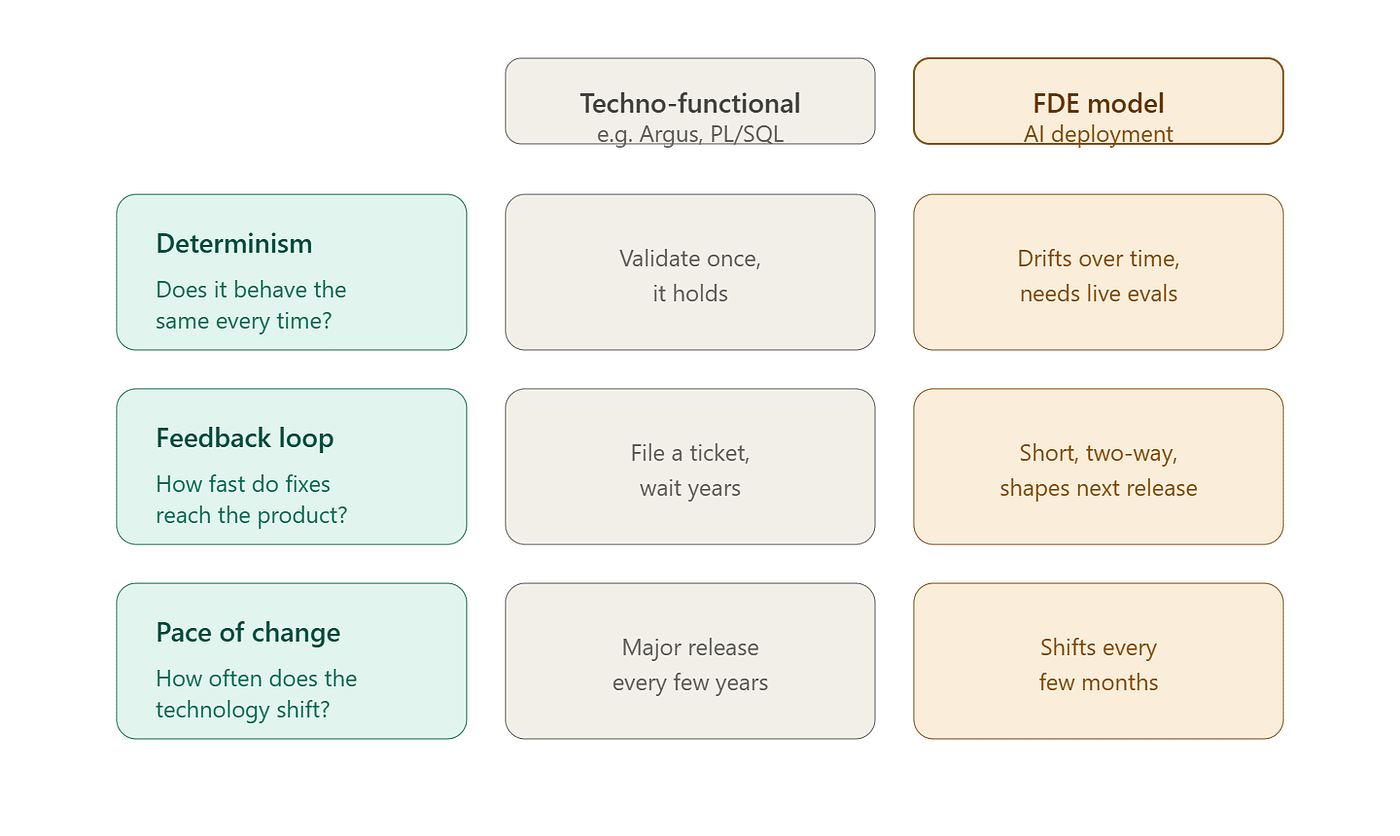
The honest answer is that the FDE has real ancestry in techno-functional consulting. The best PV FDEs will probably come from exactly this background. But three things change once the technology underneath is AI, and together they change the working model enough to matter.
Determinism — A configured Argus instance behaves the same way every time. You validate it once against a defined spec, and it holds. An AI system doesn’t work like that. The same input can produce different outputs. Performance drifts as the data it sees shifts away from what it was tested on. This means you can’t fully specify the system upfront, and validation isn’t a one-time gate. The FDE has to build evaluation harnesses that keep checking the system’s behavior in production, watching for the regression that a traditional configured system would never produce.
Feedback loop — A techno-functional consultant implements a vendor’s product as it exists. If Argus doesn’t support something, you log an enhancement request and wait, possibly years. An FDE working with a fast-moving AI capability is expected to feed problems straight back and influence what gets built next. The loop is short and bidirectional by design, not a ticket in a queue.
Pace — Argus ships a major release every few years. AI capabilities shift every few months. A new model lands and suddenly something that was impossible last quarter is now trivial, or something you built around is now obsolete. The FDE is implementing a moving target into a stable environment, which is a fundamentally different rhythm than implementing a stable product on a defined timeline.
So, a FDE is techno-functional consulting adapted to a technology that is non-deterministic, fast-moving, and improves through a tight feedback loop. For a PV firm, this is good news. The hard-won domain knowledge transfers directly. What has to be added is the engineering discipline around evaluation, monitoring, and iteration that AI demands.
Why this role is exploding now?
The pattern isn’t new. Palantir built its company around forward deployed engineers more than a decade ago, calling them “deltas” internally. For a stretch, it had more of them than traditional software engineers. The logic was structural: complex software can’t be deployed into complex institutions from a distance. Someone has to live inside the customer’s reality.
What’s new is that AI turned this from one company’s playbook into an industry-wide hiring wave. FDE postings grew more than 800% in 2025. OpenAI, Anthropic, Google Cloud, Palantir, Salesforce, and SAS are all building these teams. OpenAI has a dedicated Life Sciences FDE group working with pharma, biotech, and CROs, and the job description reads almost exactly like the problem this article opened with: define launch criteria for regulated contexts, enforce auditability and inspection readiness, build evaluation suites tied to acceptance thresholds.
The reason is simple. The bottleneck in enterprise AI moved. For a few years the constraint was model capability, so the race was to build better models. That race largely resolved, the models are now good enough for a huge range of real work. The constraint shifted to deployment. An estimated 95% of enterprise AI pilots never reach production, and the cause is almost never the model. It’s the last mile: the integration, the data plumbing, the regulatory constraints and the organizational friction.
For pharma, the timing matters. The AI vendors are deploying FDEs into drug discovery and clinical development right now. Post-market safety and pharmacovigilance are further back in the queue. That lag is worth paying attention to!

The FDE skillset, decoded
FDEs are scarce because the role demands three capabilities that rarely sit in one person. Any two are common. All three together is the hard part.
Engineering — Production-grade software skill, not notebook prototyping. In the AI era this includes a new discipline: evaluation engineering, building the harnesses that catch when a model drifts or regresses before it reaches production. At the leading labs, failing to design a proper regression eval is the most common reason candidates wash out in the final interview.
Domain fluency — Knowing why a duplicate check has to account for case versioning, why expedited reporting clocks can’t be approximated, why a statistically interesting signal might be clinically meaningless. A generalist can learn this, but the learning curve is where projects slip.
Judgment — Customers describe symptoms, not causes. Someone says “the AI is inaccurate” and a weak engineer tunes prompts for an hour while a good FDE checks data definitions, retrieval quality, and where the tool sits in the workflow. The job also means holding a technical line across stakeholders who each want something different.
For a PV firm, two of the three legs already exist. SMEs bring the domain. Seniors bring the judgment. The engineering layer, especially evaluation, is the piece to build.
The pharma perspective
The AI vendors are deploying their FDEs into drug discovery and clinical development. Look at OpenAI’s Life Sciences postings and the workflows named are target identification, molecular design, trial design, biostatistics. Post-market safety and pharmacovigilance are barely mentioned. The vendors are starting where the research dollars and the headline science are. Safety operations are further back in the queue.
That lag is the opening. PV is, in many ways, a better-suited domain for the FDE model than discovery, because the problems are concrete, repetitive, and sitting in systems that already exist. Consider what a PV FDE engagement actually looks like.
Case Narrative example — A sponsor wants to use a language model to draft ICSR narratives from structured case data. The model can write a fluent narrative. The hard part is everything around it. The narrative has to pull from the correct case fields, follow the company’s narrative conventions, handle the cases where data is missing or contradictory, and produce output that a medical reviewer can trust and an inspector can trace. The FDE sits inside the safety operation, connects the model to the case processing system, builds the evaluation set that checks narrative accuracy against gold-standard human-written examples, and iterates until the quality is reliable enough for the workflow. Then they instrument it so drift is caught when the next model update subtly changes the output.
Signal Management example — A team wants to triage EVDAS and FAERS outputs faster by having a model do a first pass on which disproportionality signals warrant human review. This is not a configuration of Empirica. It’s a system that has to ingest the signal outputs, apply logic that reflects how this specific team prioritizes, explain its reasoning in a way the signal management scientist can audit, and never quietly suppress something that should have been escalated. Building that, inside a validated environment, with the audit trail intact, is FDE work.
An FDE arriving from a foundation-model company is brilliant at the engineering and naive about the domain. They don’t know that a case lock date isn’t a detail, that aggregate reporting timelines are unforgiving, that a signal review screen configuration carries regulatory weight. They have to learn all of it on the client’s time. A PV firm’s FDE walks in already fluent. The domain knowledge that takes a generalist months to absorb is the firm’s starting position.
This is the strategic point for any PV consultancy or CRO. The capability you’d be building is not “we use AI tools.” Every firm will claim that. It’s “we can put a person inside your safety operation who understands your domain and can ship production AI against your validated systems.” That’s a harder thing to assemble and a more durable thing to sell. The firms that build it become the bridge between what AI can do and what regulated safety operations can actually adopt, which is precisely the gap this article opened with.

Who should pay attention?
If you’re a PV professional with technical instincts, this is a career path worth watching. If you already understand the domain and you’ve taught yourself to build, even browser-based tools and automations, you are closer to this role than most software engineers will ever be. The gap to close is real engineering discipline, especially evaluation, but you’d be building on a foundation that takes others years to acquire. The signal-management scientist who learns to ship code is a far rarer and more defensible profile than the engineer who tries to learn signal management.
If you’re a pharma sponsor, this is something to ask your vendors and partners for directly. When a consultancy pitches you on AI, the question isn’t whether they have access to good models. Everyone does. The question is whether they can put someone inside your environment who understands your workflows and can deliver a production system that survives an inspection. If they can’t, you’re buying a demo, not a deployment.
What this means going forward?
As AI capability becomes commodity, the advantage moves to whoever can deploy it inside real, constrained environments. That fact isn’t going away, and in pharma it’s sharper than almost anywhere else, because our environments are more regulated, more validated, and less forgiving than most.
The AI vendors have started in pharma, but they’ve started in discovery and clinical development. Pharmacovigilance is further down their list, which means there’s a window. The domain knowledge that a generalist FDE has to acquire on the client’s time is knowledge the PV world already holds. The question is whether the PV world adds the engineering layer fast enough to occupy that ground before someone else does.
None of this requires betting on a specific tool or a specific model. Tools will change, models will keep improving, and the particular automations that look impressive today will look ordinary in a year. What stays constant is the gap between what the technology can do and what a safety operation can actually adopt. The people and firms who can stand in that gap, fluent in the domain and capable of shipping, will have leverage regardless of which model is on top.
메타데이터
- post_id
- d95d1eb198ee
- slug
- forward-deployed-engineers-what-pharma-needs-to-know-about-techs-fastest-growing-role-d95d1eb198ee
- url
- https://medium.com/@gauravkantgoel/forward-deployed-engineers-what-pharma-needs-to-know-about-techs-fastest-growing-role-d95d1eb198ee
- canonical_url
- https://medium.com/@gauravkantgoel/forward-deployed-engineers-what-pharma-needs-to-know-about-techs-fastest-growing-role-d95d1eb198ee
- author_url
- https://medium.com/@gauravkantgoel
- status
- ok
- fetched_at
- 2026-06-09 15:37:30