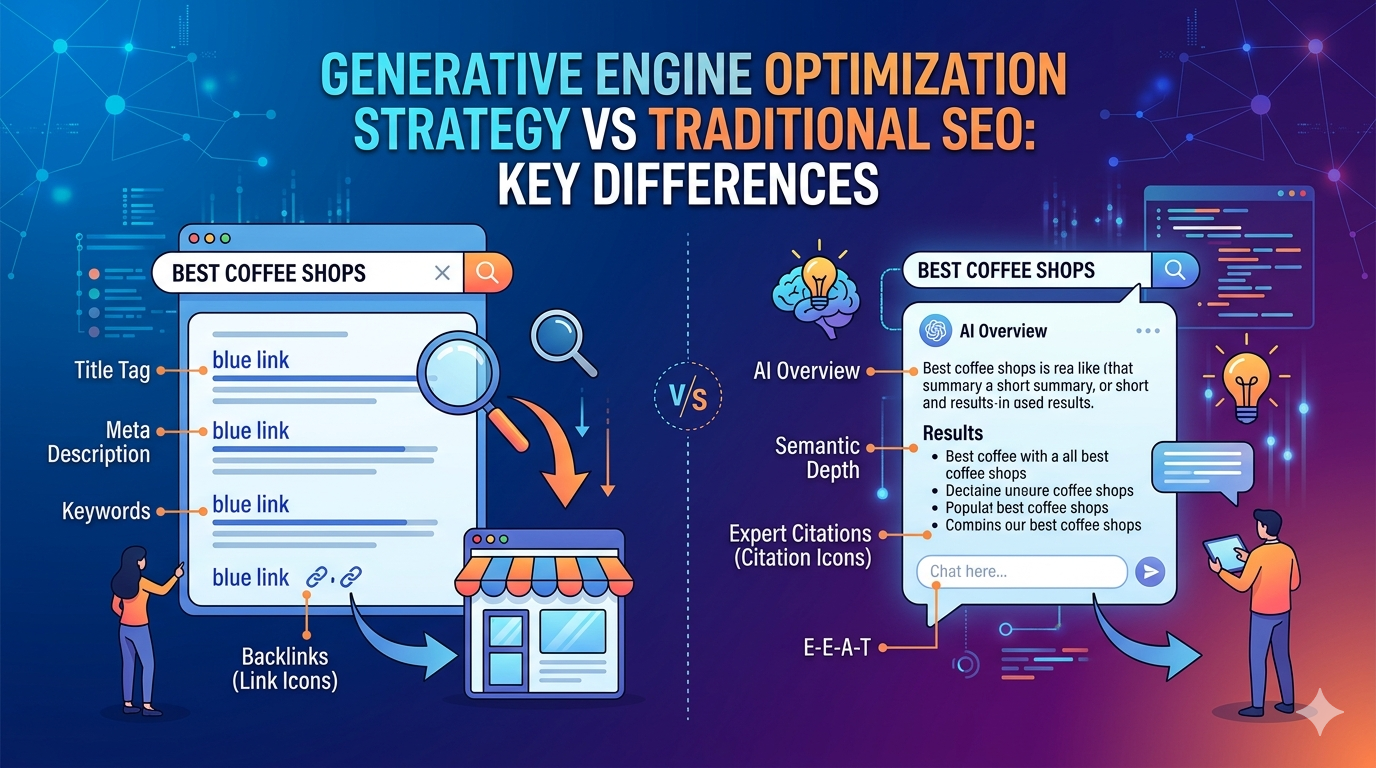
Generative Engine Optimization Strategy vs Traditional SEO: Key Differences
Introduction
Generative Engine Optimization Strategy vs Traditional SEO: Key Differences

Introduction
The digital landscape is undergoing its most significant transformation since the invention of the backlink. As AI-powered search engines — like Google’s Search Generative Experience (SGE), Perplexity AI, and ChatGPT — become the primary interface for information retrieval, the rules of visibility are changing.
While Traditional SEO focused on ranking in a list of blue links, Generative Engine Optimization (GEO) focuses on being the definitive source cited within an AI-generated answer. Understanding the nuances between these two strategies is no longer optional; it is the prerequisite for digital survival in 2026.
Defining the Paradigms: SEO vs. GEO
To build an effective strategy, we must first define the operational mechanics of both worlds.
Traditional SEO (Search Engine Optimization)
Traditional SEO is the process of optimizing a website to increase its visibility for relevant searches. It relies on a system of “crawl, index, and rank.” Success is measured by Position 1–10 on a Search Engine Results Page (SERP). The primary goal is to drive click-through rates (CTR) from a list of options.
GEO (Generative Engine Optimization)
GEO is the process of optimizing content so that Large Language Models (LLMs) and AI search engines synthesize and cite your information in their responses. Instead of a list of links, the user receives a cohesive, conversational answer. Success in GEO is measured by “Citation Share” — being the footnote or the source that the AI trusts to validate its claims.
Search Intent Analysis: The Shift from “What” to “Why”
The way users interact with search engines has evolved from fragmented keywords to complex, multi-layered natural language queries.
The Traditional Intent Framework
In traditional SEO, we categorize intent into four buckets:
- Informational: “How to bake a cake.”
- Navigational: “Facebook login.”
- Commercial: “Best DSLR cameras 2026.”
- Transactional: “Buy Nikon Z9 online.”
The Generative Intent Framework: Conversational Context
In the GEO era, intent is multi-modal and continuous. Users don’t just search once; they iterate. A user might start with “What is the best diet for a marathon runner?” and follow up with “Give me a 7-day meal plan based on that, but exclude peanuts.”
GEO Strategy Requirement: Your content must account for the next question. It needs to be comprehensive enough to satisfy the initial intent while providing the “supporting evidence” (data, statistics, expert quotes) that an AI needs to construct a full answer.
Key Differences: GEO vs. SEO
The fundamental shift from traditional search to generative search can be broken down into four core areas:
- The Output Goal: While SEO seeks a high ranking among various website links, GEO aims for inclusion in the AI “Snapshot” or summary that appears at the very top of the interface.
- Primary Metrics: Success in SEO is traditionally measured by CTR and keyword rankings. In GEO, the focus shifts to Citation Frequency — how often the AI uses your site as a source — and overall brand authority.
- Content Structure: SEO often rewards keyword-centric pages optimized for search bots. GEO, however, rewards entity-centric content that is optimized for synthesis, meaning the AI can easily extract facts and combine them with other data.
- User Experience: In a traditional model, users browse multiple sites to find an answer. In the generative model, users receive a single, direct answer with citations provided for further reading.
Keyword Placement and Entity Mapping
In a **Generative Engine Optimization Strategy**, the “keyword” has evolved into the “entity.” AI engines don’t just look for the string “Generative Engine Optimization”; they look for the concepts associated with it.
Strategic Placement for GEO
- Direct Answer Headers: Use your primary keyword in a heading followed immediately by a concise, 2–3 sentence definition. AI models love “snackable” definitions for their summary boxes.
- Semantic Triangulation: Surround your primary keyword, Generative Engine Optimization Strategy, with related terms like LLM retrieval, RAG (Retrieval-Augmented Generation), and synthetic search.
- The “GEO vs SEO” Comparison: Explicitly contrasting these terms within your body text helps the AI parse the differences and cite you as the clarifying source.
The Core Pillars of a Generative Engine Optimization Strategy
To dominate the AI-led search era, your content must lean into the following three pillars:
A. Authoritativeness and Factuality
AI models are programmed to minimize “hallucinations.” They prefer sources that provide hard data, citations, and expert consensus.
- Action: Include original research, statistics, and expert quotes. A Generative Engine Optimization strategy is only as strong as the data backing it.
B. Structured Data and Schema
While traditional SEO used Schema to get “star ratings” in search, GEO uses Schema to help the AI understand the relationship between facts.
- Action: Use
Organization,FactCheck, andTechArticleschema to give the AI a roadmap of your content’s logic.
C. Conversational Clarity
Traditional SEO often led to “fluff” to hit word counts. GEO rewards “information density.”
- Action: Write in a clear, journalistic style. Use the “Inverted Pyramid” method — put the most important information (the answer) at the top.
Optimization Checklist for 2026
If you want your brand to be the one the AI recommends, follow this workflow:
- Identify the “Seed” Question: What is the primary problem your user is solving?
- Analyze the AI Snapshot: Perform a search for your target term and see what the AI is currently summarizing. Identify gaps — is it missing a cost breakdown or a specific 2026 update?
- Inject Statistics: AI engines prioritize “citable” facts that add credibility to their generated answers.
- Optimize for Natural Language: Ensure the Generative Engine Optimization Strategy reads as a natural response to a spoken or conversational question.
- Technical Speed: Even for AI, the speed of data retrieval matters. Ensure your site’s backend is optimized for rapid crawling.
FAQs
Q1: Does Traditional SEO still matter?
Yes. Traditional SEO provides the technical foundation — site speed, mobile responsiveness, and indexing — that allows Generative Engines to find your content in the first place. Think of SEO as the “road” and GEO as the “vehicle.”
Q2: How do I track GEO performance?
Standard tools like Google Search Console are evolving, but you should also track “Brand Mentions” in AI outputs and use tools like Perplexity or ChatGPT to see if your site is being cited for core industry queries.
Q3: Is GEO only for Google SGE?
No. A robust Generative Engine Optimization Strategy works across all LLM-based platforms, including Bing Chat, Claude, and specialized industry AI bots.
Q4: Will GEO decrease my website traffic?
It may decrease “incidental” traffic (people looking for quick facts), but it will likely increase “high-intent” traffic — users who click through from an AI citation are often further along in the buying journey.
Conclusion
The transition from GEO vs SEO isn’t a battle; it’s an evolution. By shifting your focus from “ranking for keywords” to “becoming a trusted source for AI,” you ensure your brand remains relevant in an era where the search engine is no longer just a tool, but an assistant.
The winners of 2026 will be those who provide the most “digestible” truth to the engines that are learning to think.
Ready to Future-Proof Your Content?
The shift to AI-driven search is happening now. Don’t let your brand get left behind in the “blue link” era. Our team specializes in bridging the gap between Traditional SEO and cutting-edge Generative Engine Optimization Strategy.
메타데이터
- post_id
- d96117de486f
- slug
- generative-engine-optimization-strategy-vs-traditional-seo-key-differences-d96117de486f
- url
- https://medium.com/@upkepr/generative-engine-optimization-strategy-vs-traditional-seo-key-differences-d96117de486f
- canonical_url
- https://medium.com/@upkepr/generative-engine-optimization-strategy-vs-traditional-seo-key-differences-d96117de486f
- author_url
- https://medium.com/@upkepr
- status
- ok
- fetched_at
- 2026-06-09 14:34:10