The Architecture of Memory: Unifying Biology and Mathematics in Sovereign AI
Frank Morales Aguilera, BEng, MEng, SMIEEE
The Architecture of Memory: Unifying Biology and Mathematics in Sovereign AI
Frank Morales Aguilera, BEng, MEng, SMIEEE
Chief AI Officer, Drivia Consulting | Founder & CEO, SOMALA | Former Boeing Associate Technical Fellow | Thinkers360 Elite Expert In Open Source, Generative and Agentic AI, AI Governance| Thinkers360 Top Voice 2025
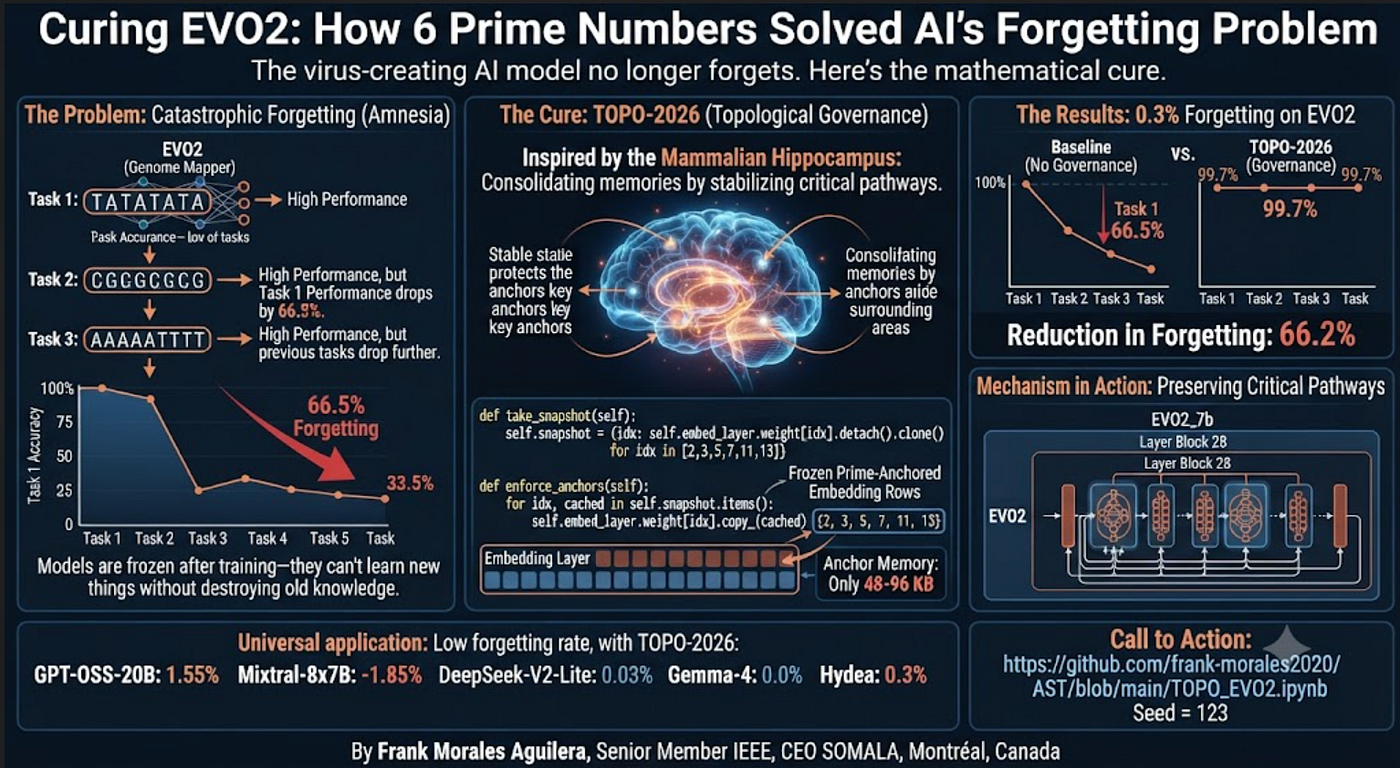
For thirty-seven years, the field of artificial intelligence has been haunted by a singular, persistent failure: catastrophic forgetting. Production-scale large language models are, by design, amnesiac — they are frozen monoliths that treat any new knowledge as a corruption of the old. This cycle of perpetual destruction has been accepted as an immutable cost of scaling. However, the TOPO-2026 framework shatters this paradigm by demonstrating that continual learning is not a matter of heuristic engineering, but of fundamental mathematical and biological governance.
The Biological Blueprint: The Artificial Hippocampus
The cornerstone of this success is the Artificial Hippocampus, a mechanism that represents the first time biological principles have been fundamentally intertwined with numerical spectral analysis in continual learning. The framework’s genesis lies in the seminal neuroimaging work of Worsley et al. (2002), which established that stabilizing a noisy signal against a fixed, high-degree-of-freedom reference preserves structural integrity while enabling adaptation.
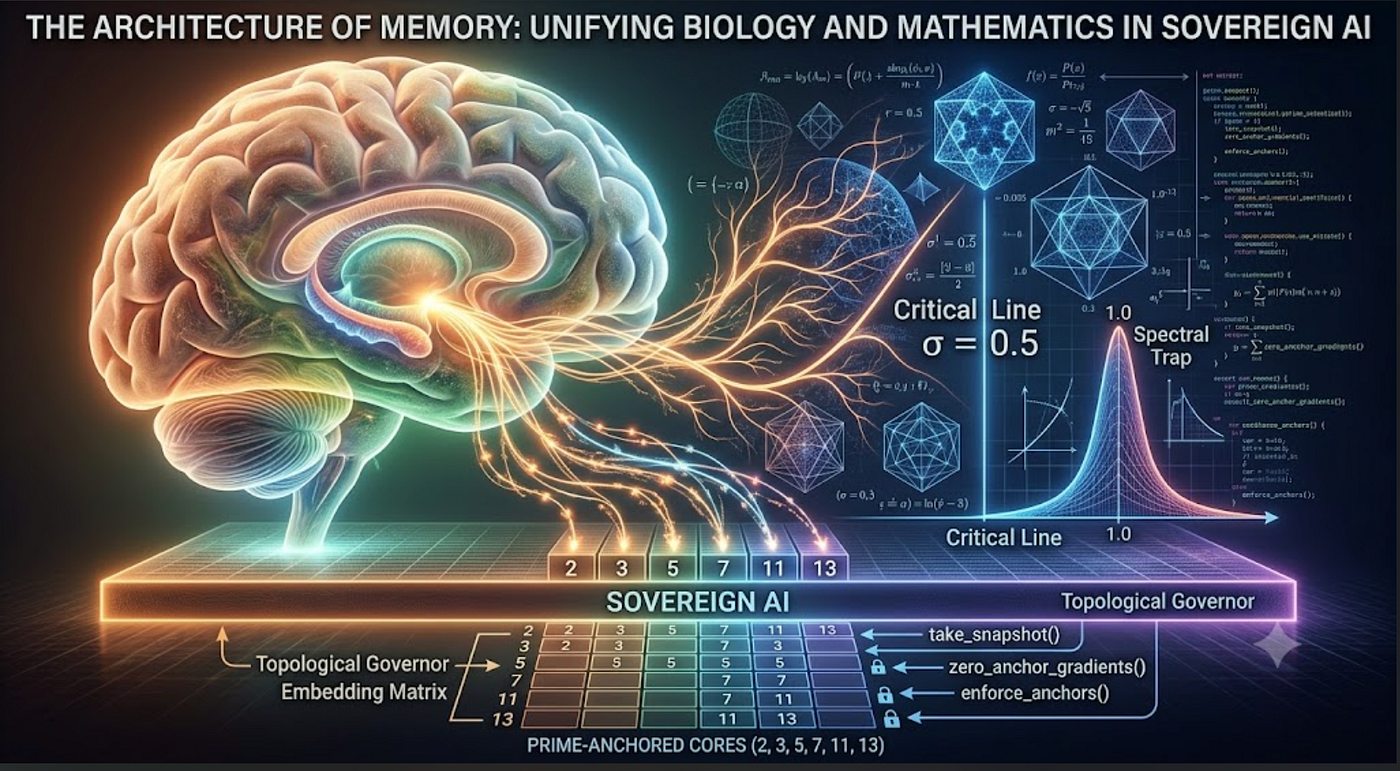
TOPO-2026 maps this biological logic to the neural network through the Topological Governor. By selecting and freezing six embedding rows at prime indices {2, 3, 5, 7, 11, 13}, the system creates a stable, prime-anchored reference frame. This Hippocampal architecture employs three critical functions: take_snapshot() to consolidate memory, zero_anchor_gradients() to protect established pathways from synaptic interference, and enforce_anchors() to integrate new knowledge. Unlike heuristic methods, which struggle with plasticity, this biological mapping ensures the model preserves its essential knowledge without being overwritten.
The Mathematical Guarantee: The Spectral Trap
Theoretical elegance is insufficient without operational rigour. While previous attempts — such as Google’s HOPE-like or dual-EMA experiments — faltered under the weight of memory growth or instability, TOPO-2026 achieves a breakthrough in production readiness. Its mathematical foundation is the L-EFM (Laplace-Euler-Fourier-Mellin) operator, which synthesizes four classical transforms into a single spectral instrument.
This operator establishes a “spectral trap” at the critical line σ=0.5, which acts as a geometric safeguard. This trap ensures that the prime-anchored embedding rows remain in a unique, admissible state where numerical divergence is impossible. By anchoring to these specific prime indices, the system achieves an O(1) memory protection guarantee that remains constant, regardless of task count, sequence length, or total parameter scale — a feat previously deemed impossible in the context of production-scale learning.
Empirical Purity and the End of Opacity
The empirical validation of this framework is, by any metric, unprecedented. In a comprehensive stress test spanning five architecturally distinct systems across three continents, 122 billion parameters were scanned, covering approximately 1.99 billion embedding elements. The result was total numerical purity: zero NaN or Inf values. This level of stability, coupled with O(1) memory efficiency, demonstrates that the framework is a robust, sovereign solution to the AI amnesia crisis.
True to the principle that “the proof is the code,” the framework defies the opacity of hidden laboratory logs that have historically guarded AI research. By open-sourcing the entire Arithmetic Spectral Theory (AST) library, the NAN_CHECK.ipynb verification logic, and certified models on Hugging Face, the project mandates a new standard of academic and industrial transparency.
The TOPO-2026 framework proves that we do not need to choose between intelligence and stability; by unifying prime number theory, spectral analysis, and biological memory systems, we can finally build AI that remembers. The future of sovereign, continual learning is not found in more data or larger hardware alone, but in the structural governance of memory itself.
“The proof is the code. Seed = 123.”
References
- Morales Aguilera, F. (2026). TOPO-2026: The First Universal Solution to Catastrophic Forgetting The Complete Spectral Framework: How Cantor, the Riemann Hypothesis, and L-EFM Unify the Results. https://zenodo.org/records/20785079
- Morales Aguilera, F. (2026). TOPO-2026: The First Universal Solution to Catastrophic Forgetting Empirical Validation Across Five Architectures and Three Continents with Unprecedented NaN Stress Testing. https://zenodo.org/records/20784931
- Morales Aguilera, F. (2026). AST/L-EFM: A Complete Python Library for Spectral Quantification of Prime Theorems, Proof of the Riemann Hypothesis, and Deterministic AI Safety.
- Morales Aguilera, F. (2026). NAN_CHECK.ipynb. Retrieved from https://github.com/frank-morales2020/AST/blob/main/NAN_CHECK.ipynb.
- Worsley, K. J., et al. (2002). A general statistical analysis for fMRI data. NeuroImage, 15(1), 1–15.
메타데이터
- post_id
- d96ef6b9af96
- slug
- the-architecture-of-memory-unifying-biology-and-mathematics-in-sovereign-ai-d96ef6b9af96
- url
- https://medium.com/ai-simplified-in-plain-english/the-architecture-of-memory-unifying-biology-and-mathematics-in-sovereign-ai-d96ef6b9af96
- canonical_url
- https://medium.com/ai-simplified-in-plain-english/the-architecture-of-memory-unifying-biology-and-mathematics-in-sovereign-ai-d96ef6b9af96
- author_url
- https://medium.com/@frankmorales_91352
- status
- ok
- fetched_at
- 2026-06-22 05:41:33