The Adventures and Misadventures of Taunton’s Sailing, Skiing Rector: J. Holland Beal
By Eric B. Schultz
The Adventures and Misadventures of Taunton’s Sailing, Skiing Rector: J. Holland Beal
By Eric B. Schultz
The boys’ club at Taunton’s St. Thomas Episcopal Church in the 1940s was known as the Knights of King Arthur, a “grand bunch of harum-scarum lads,” according to their rector, J. Holland “Skipper” Beal (1904–1981). When the first snow fell each year, these choir boys — literally — knowing their Rector’s fondness for the White Mountain slopes, began badgering Rev. Beal for a ski trip north.
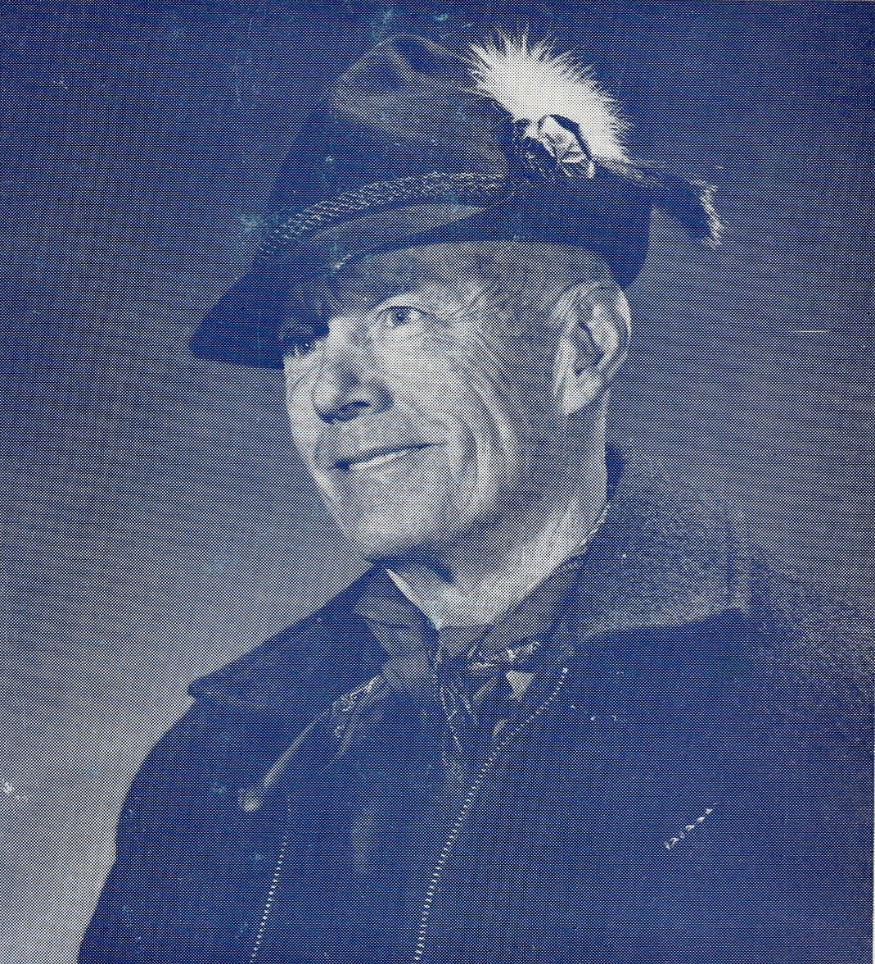
Rev. James Holland Beal (1904–1981), Rector of St. Thomas’ Church, Taunton, Massachusetts, from 1940 to 1958.
Heading to Cranmore Mountain in North Conway, New Hampshire, from Taunton Green today is a three-and-a-half-hour, 175-mile journey via Route 24 and I-93 to NH-16. It’s predictable and a little dull until the White Mountains appear. Cruise control and Dunkin’ stops make the trip as routine as the GPS warnings of speed traps in Hooksett.
In 1945, however, the same trip could take nine hours. I-93 didn’t exist until the late 1950s, so the route from Taunton to North Conway meant two-lane local and state roads through small towns in Essex County, to U.S. Route 3 through New Hampshire to Route 16. Cruising speed might sometimes reach 40 miles per hour, with white-knuckle driving in bad weather. In the years following World War II, a trip from the Old Colony to the slopes of Mount Cranmore could feel like a journey to another world.
Three chaperones, Rev. Beal, and more than a dozen of his young St. Thomas knights made it to North Conway without incident, spent a day and a half skiing, and began their drive home on Saturday at 4 p.m. Four vehicles started down Route 16 in moderate snow, hit a blizzard in Rochester, N.H., and were down to three vehicles by Portsmouth. Retreating a couple of miles, the knights used shovels and ropes to pull their fourth vehicle back onto high ground. Once their caravan hit the Newburyport Turnpike (Route 1), they were muscling through a foot of snow.
On a large hill in the Essex County town of Topsfield, traffic was blocked by a three-vehicle accident, so the good Reverend headed north with his flock to the comfort of St. Paul’s Church in Newburyport, which produced 15 army cots in their parish hall. Calls were placed to anxious parents in Taunton. Beal phoned the Topsfield police barracks every hour until, at 3 a.m., he received word that Route 1 was clear.
Cruising through Boston at dawn on the morning of Sunday, December 30, 1945, the four-vehicle convoy reached Taunton five minutes before the 8 a.m. service of Holy Communion at St. Thomas, to which four faithful parishioners had trudged through two feet of snow to attend. Beal showered and shaved at St. Thomas’s McKinstry House rectory and was ready for the 9:30 and 11:00 services later that morning.¹

The McKinstry House (1759), adjacent to the Church, was purchased in 1907 for use as a Sunday School. Today it serves as the rectory.
One of the choir boys on that 1945 ski adventure was Joseph Betz, a long-time Taunton banker (sometimes affectionately referred to as “the Loan Arranger”), and a director of the Old Colony History Museum from 1988 to 2006. “Skipper had a station wagon,” Joe recalled of his rector, “and he would remove the seats, and we’d all pile in — six to eight in a car — with the skis. Now, when I think about the liability . . .” Joe laughed, “but we had plenty of room because we boys didn’t take much luggage,” he added. “Maybe a clean pair of socks.”²
“You had to show up for choir practice and church,” Joe recalled. “That was your ticket to skiing and sailing. I learned so much from Skipper,” he added. “Not just how to ski and sail, but respect, looking after one another (“the buddy system”), and following instructions. He was a positive influence on many of us.”
The Rev. James Holland “Skipper” Beal (1904–1981) was formed in the classic mold of mid-20th century Episcopal clergy. Born in Nahant, he graduated from Harvard in 1927 and worked at the tail end of the Roaring ’20s, selling stocks and bonds for Kidder, Peabody and Company in Boston. Until the 1929 Crash, Beal wrote, “all you had to do to make money was spit on the ticker tape, purchase the stock so designated, and watch it go up in value.”³
Kidder sent Beal on an initial assignment to Providence, where his first bond sale was to Brown University psychology professor Edmund Delabarre, who wrote extensively in the early 20th century to support his theory that the carvings on Dighton Rock were Portuguese in origin. “As far as I could see,” Beal wrote, “the markings on Dighton Rock looked more like the doodlings on a telephone pad,” not realizing in 1929 that he would soon make his home and his own “markings” on the Old Colony just a few miles north.⁴
Skipper’s father, William Field Beal (1870–1939), had negotiated the sale of the old Waldorf Astoria Hotel site on which the Empire State building now stands. Skipper’s grandfather founded the Second National Bank of Boston.⁵ The Beals of Nahant were a sailing, skiing, outdoorsy clan wired into old Northeast money and families, including the Adams and Roosevelts. Skipper’s maternal great-uncle Will, for example, had married “Aunt Rosie,” who happened to be the daughter of New York Governor Samuel Tilden, who lost the US presidency to Rutherford B. Hayes by one electoral vote. Beal’s Great-Uncle Will was better known as Willis Seaver Paine (1848–1927), appointed by Grover Cleveland to be New York’s State Banking Superintendent and subsequently President of State Trust Company, “before resigning,” his obituary noted, “to tour the world.”⁶ Skipper could trace his ancestry through his mother, Louisa (Adams) Beal (1836–1920), to Henry Adams (1583–1646) of Braintree, who was also the immigrant ancestor of John and John Quincy Adams. You get the idea.
However, the story of old money networks and patrician good fortune sometimes misses the accompanying sense of moral responsibility and obligation to public service. In Skipper’s case, his sense of gratitude, sharpened by the Panic and Crash of 1929, led him to the ministry. He graduated from theological school in Alexandria, Virginia, in 1934, and began as a Student Assistant at St. Thomas’ Church in Owings Mills, Maryland, and Epiphany Church in Washington, D.C.⁷
By 1936, Rev. Beal was the acting rector of Grace Episcopal Church in New Bedford, and from 1938 to 1940 served as rector at Emmanuel Church in Braintree. For 18 years, from 1940 to 1958, home for Skipper Beal, wife Georgette, and their four children was St. Thomas’s rectory, the beautiful and historic McKinstry House.⁸ However, Beal’s ministry was not his family’s first venture into Taunton.
Skipper’s great-uncle, Dr. Zabdiel Boylston Adams, Jr., (1829–1902) was likely the first of the extended Beal clan to plant roots in the Silver City when he was appointed resident physician of the State Lunatic Hospital in Taunton (later Taunton State Hospital) in 1855, shortly after its opening.⁹ His appointment just happened to coincide with Richard Upjohn’s design of Skipper’s future home, St. Thomas Church, where construction began in 1857.

St. Thomas Episcopal Church, Taunton, MA
Rev. Beal held a commission in the Coast Artillery for 15 years, and in March 1942, he was given a fond farewell by 250 members of the St. Thomas congregation as he temporarily transferred to the Quartermaster Corps as chaplain at Camp Lee, Virginia.¹⁰ Three years later, he helped to officiate a united service of churches at St. Thomas in memory of the late Franklin Delano Roosevelt, supported by the church’s “harum-scarum” boys’ choir, which also included Old Colony’s Joseph Betz.¹¹ That same year, he officiated at the wedding of Dorothy Kendall Russell and Commander David Longfellow Patten, who served on General MacArthur’s staff and was aboard the USS Missouri when Japan surrendered and was later awarded the Legion of Merit by MacArthur in Manila.¹²
Skipper Beal was a fixture in Taunton for nearly two decades, presiding over countless baptisms, marriages, and funerals, including the burial service for Superior Court Judge Joseph E. Warner, which included 500 mourners packed into St. Thomas on June 3, 1958, with large delegations from the Superior Court, the Massachusetts Trial Lawyers Association, and the Taunton Bar Association.¹³ Rev. Beal’s Dachshund, Weenie, also became a fixture at St. Thomas, attending services every Sunday seated at the back of the church as he “meditated on what it was all about but never made evident a canine presence.” Weenie also went on every parish call with Rev. Beal, ensuring that no visit lasted longer than 20 minutes before he would bark his (and their) way to freedom.¹⁴

A view of St. Thomas Episcopal Church, Taunton, MA ca. 1950 at the time when Skipper Beal served as minster.
While Taunton and St. Thomas were central to Skipper Beal’s activities, and skiing the White Mountains brightened every winter, the sea — as his nickname implied — was never far from his thoughts. Beal was an accomplished sailor, plying the waters around his hometown of Nahant and along the shores of Buzzards Bay and Cape Cod at every available opportunity. In August 1943, cruising off the coast of West Yarmouth, for instance, he rescued two girls learning to swim near Great Island, and recovered the body of a third who drowned.¹⁵ Several years later, Beal salvaged a bell that had warned sailors away from Dumpling Rock, off South Dartmouth, for half a century. “Dumpling Rock lighthouse and the bell were flung into the sea by the hurricane of 1938,” one report noted, but “Mr. Beal had kept an acquisitive eye on the submerged bell ever since.” Along with “a crew of husky youngsters,” Rev. Beal hauled the bell ashore, confirmed with Dartmouth that “finders are keepers,” and toted its half ton to Taunton, where he had blacksmiths fit it with a new clapper. His goal was to hang it in the belfry atop St. Thomas, providing a “strangely familiar sound” to any mariners visiting the Silver City.¹⁶
One of Skipper’s sea adventures occurred early in his career off the coast of Nahant when he decided to sail to the wedding of his friend, James Roosevelt. Also in attendance that day were President Roosevelt and his family, which meant a large complement of U.S. Navy and Coast Guard personnel surrounded Nahant. After being informed that the town was closed, followed by explanation and much pleading, Rev. Beal found his 28-foot sloop, “Plum Duff,” heading to a mooring near the church with a coast guard escort on either side. Decades later, on the morning of August 31, 1954, Beal found himself and a crew of three in a different sort of storm, this time aboard his sloop in Plymouth Harbor, riding out Hurricane Carol.¹⁷
Skipper’s adventures on slope and sea continued after his retirement from St. Thomas and until his death in 1981. Even today, however, he remains a bright presence in Taunton, not just in the memories of choir boys such as Joe Betz, but also in the beautiful stained-glass windows that memorialize him, his wife, and his mother, that grace the chapel of his beloved St. Thomas Church.

Interior of the chapel of St. Thomas Episcopal Church, Taunton, MA. To the left are the J. Holland Beal windows. To the right, Lillian Beal windows.

Details of the J. Holland and Lillian Beal windows in the chapel of St. Thomas Episcopal Church, Taunton, MA.
J. Holland Beal left two amusing books about his exploits, both written in the style of short, secular sermons, “White Mountain Yesteryears” and “The Mountains, The Man and Members of Our Tribe.” St. Thomas will celebrate its 300th anniversary in 2028.

Notes
[1] For more on the McKinstry House, see “Basely Murthered”: The Shocking Death of Elizabeth McKinstry | by Old Colony History Museum | Medium.
[2] This story is told with great humor by the Rev. J. Holland Beal in White Mountains Yesteryears (North Conway, NH: The Reporter Press), 1966, 53–55. Thanks to Joseph Betz for speaking with the author on February 6 and 22, 2026, and for permission to quote him. Joe was a good friend of my father, Richard Schultz, another of the choir boys caught in this snowstorm. The Blue Hill’s “greatest snowstorms” list includes the Dec 29–30, 1945 storm at 18.8 inches total snowfall, which, rounded up (as folks tend to do), was two feet of snow. See bluehill.org/Data/2011/january/jan14.txt. The Taunton Daily Gazette (December 29, 1945) reported that Skipper and his skiers found a place to sleep at the Newburyport Y.M.C.A., “where they were royally treated.” They arrived in Taunton at 8:05 a.m., not 7:55 a.m., minor if less dramatic differences in Beal’s recollection from 20 years later.
[3] J. Holland Beal, The Mountains, The Man and Members of Our Tribe (North Conway, NH: The Reporter Press), 1969, 140.
[4] Ibid, 140.
[5] “The Lewiston Daily Sun,” Lewiston, Maine, Tuesday, January 24, 1939, 7.
[6] “W.S. Paine, Banker, Dies at Age of 79,” New York Times, Thursday, April 14, 1927, 27.
[7] “Accepts Call to Braintree,” The Standard-Times, New Bedford, Monday, June 15, 1936, 4. Also, the dust jacket of White Mountain Yesteryears.
[8] “Rev. James Beal, 77 was Taunton minister,” The Boston Globe, Boston, MA, Wednesday, December 9, 1981, 75.
[9] See https://biographies.framinghamhistory.org/zabdiel-boylston-adams/ for more about “Zab.”
[10] “Rector Leaves for Army Post,” The Standard-Times, New Bedford, Massachusetts, Tuesday, March 24, 1942.
[11] “Present Holy Cantata at St. Thomas Church,” Taunton Daily Gazette, 1945.
[12] Captain David Longfellow Patten (1894–1981) — Find a Grave Memorial. See also “Navy Officer To Wed In Dartmouth,” The Standard-Times, New Bedford, Massachusetts, Sunday, October 28, 1945.
[13] “Bench, Bar, Civic Officials Attend Warner Services,” The Boston Globe, Wednesday, June 4, 1958, 23. We also have Warner to thank for compiling a history of St. Thomas, held in the archives of OCHM.
[14] Beal, The Mountains, 77.
[15] “Rector Rescues Two Girls From Water and Recovers Body of 3rd,” Montpelier Evening Argus, Montpelier, Vermont, Wednesday, August 25, 1943, 7.
[16] “Church Has Light Bell,” The Standard-Times, New Bedford, Massachusetts, Sunday, December 2, 1945. The author finds no evidence that this bell was hung or rung according to Beal’s plan, nor does St. Thomas have a belfry. Still, it’s a good story.
[17] We told this harrowing story in an earlier blog post. See Fire and Ice: Some Calamities of the Old Colony: Part III | by Old Colony History Museum | Medium.
메타데이터
- post_id
- d9908652ece8
- slug
- the-adventures-and-misadventures-of-tauntons-sailing-skiing-rector-j-holland-beal-d9908652ece8
- url
- https://medium.com/@ochm/the-adventures-and-misadventures-of-tauntons-sailing-skiing-rector-j-holland-beal-d9908652ece8
- canonical_url
- https://medium.com/@ochm/the-adventures-and-misadventures-of-tauntons-sailing-skiing-rector-j-holland-beal-d9908652ece8
- author_url
- https://medium.com/@ochm
- status
- ok
- fetched_at
- 2026-06-09 18:16:15