Pathways to Regeneration: Exploring Mental Models of Traditional Food Systems
At the Agroecology Forum in Malmö, we — Maria Chiara, Chaima, and Roxane, three PhD students from the Universities of Göttingen and Kassel—…

Mediterranean pastoralism: Sheep grazing between olive trees in Morocco. Photo by Laura Kmoch.
Pathways to Regeneration: Exploring Mental Models of Traditional Food Systems
At the Agroecology Forum in Malmö, we — Maria Chiara, Chaima, and Roxane, three PhD students from the Universities of Göttingen and Kassel— hosted a workshop on how people conceptualize food systems. In this article, we want to share our reflections and experiences from this workshop.
This article was jointly written by Chaima Mobarak, Maria Chiara Camporese and Roxane Bradaczek.
Because this aspect often remains invisible in food systems research, we wanted to understand how people think about food systems and how these perspectives reveal key elements, feedback loops, and possible futures of food systems. We explored this using the method of “Mental Models”. In line with our research interests in food systems sustainability, we chose to focus especially on elements of resilience in traditional food systems.
Traditional food systems, shaped over centuries through local knowledge, social-ecological interactions, and cultural practices, are increasingly under pressure from climate change, biodiversity loss, migration, globalized markets, and policy neglect. In our workshop “Pathways to Regeneration”, we used mental models to explore participant’s understanding of resilience in these systems.
In social‑ecological and food systems research, the mental models method can be used to elicit and analyze how different actors understand a system, including its key elements, relationships, feedback loops, and possible leverage points for change.


Left: The traditional corn soup “Jagung bose” with papaya flowers and leaves — one of the staple foods of Timorese communities in Indonesia. Photo by Khant Sandar Htet. Right: Lunch invitation from a farmer in Imegdal in the High Atlas of Morocco. Photo by Claudia Heindorf.
Agroecology is increasingly being proposed as a viable solution for sustainable food systems, as it is based on principles spanning from soil health to reducing waste and more. Agroecology is also often intertwined with traditional ecological knowledge and the biocultural diversity of many rural areas worldwide.
Because of this, we thought that the Agrecology Forum in Malmö could be the ideal place to discuss how sustainable and traditional food systems are understood. Beyond our inputs the forum also provided opportunities to experience and taste sustainable food systems, through delicious meals made with local ingredients and excursions to local farms.


Impressions from the visit to the local agroecological farm. Photos by Maria Chiara Camporese.
The Agroecology Forum hosted farmers, NGO’s, and researchers from different disciplines — so we expected a diverse group of attendees. To set the mood and introduce the participants to each other, we began our session with a simple icebreaker question:
What’s one food that reminds you of your childhood?
Before discussing resilience of transformation, we wanted to reconnect with food memory, place, and identity. The question also invited our participants to build a personal connection to our topic.
Next, we introduced the idea of mental models: the assumptions, values, and causal links that people hold — often unconsciously — to make sense of complex systems. Rather than treating food systems as abstract structures, mental models place the human element at the center. They can help us understand how a system is perceived by an individual or how it is collectively understood by a group.
Our ultimate aim was to (a) understand how participants saw the linkages between elements of these traditional food systems, and (b) identify sources of resilience, or leverage points, within them. We prompted participants to identify system elements, map causal links, and reflect on how changes in one part of the system affect others.

The flow of our workshop, from abstract ideas to practicing the method. Figure created by Maria Chiara Camporese.
Our participants chose to co-create mental models of Milpa systems in Guatemala (9 group members), and pastoralism in Mediterranean areas (9 group members). Using flipcharts and markers, they worked in two groups of diverse participants (researchers, local activists, agribusiness owners, high school teachers, farmers), guided by us as moderators.
What emerged were no single answers, but discussions and networks of relationships:
- Who really are the relevant actors in the respective food system
- To what extent do they need to be differentiated (e.g. is it enough to write “retailers” or are there different types and groups?)
- Feedback loops such as between land and identity
- Leverage points connecting actions on the field level with community-level transformations

The two mental models created by the two groups: Milpa systems (left), and Mediterranean Pastoralism (right). Figure created by Maria Chiara Camporese.
It was a joy for us to watch each group engage in deeper debates, especially inspired by their diverse geographical and professional backgrounds and the different experiences they brought to the table.
The number of elements and connections suggests that the Milpa group engaged more in broad and philosophical discussions, which made it harder to identify specific nodes. By contrast, the Mediterranean pastoralism group started with concrete examples and more easily identified patterns they could agree on.
Resilience was discussed, and rarely framed as purely ecological. Instead, participants emphasized social ties, cultural continuity, craftsmanship, and knowledge transmission. Many highlighted that regeneration does not mean returning to the past, but selectively carrying forward what still matters — while adapting to new realities.
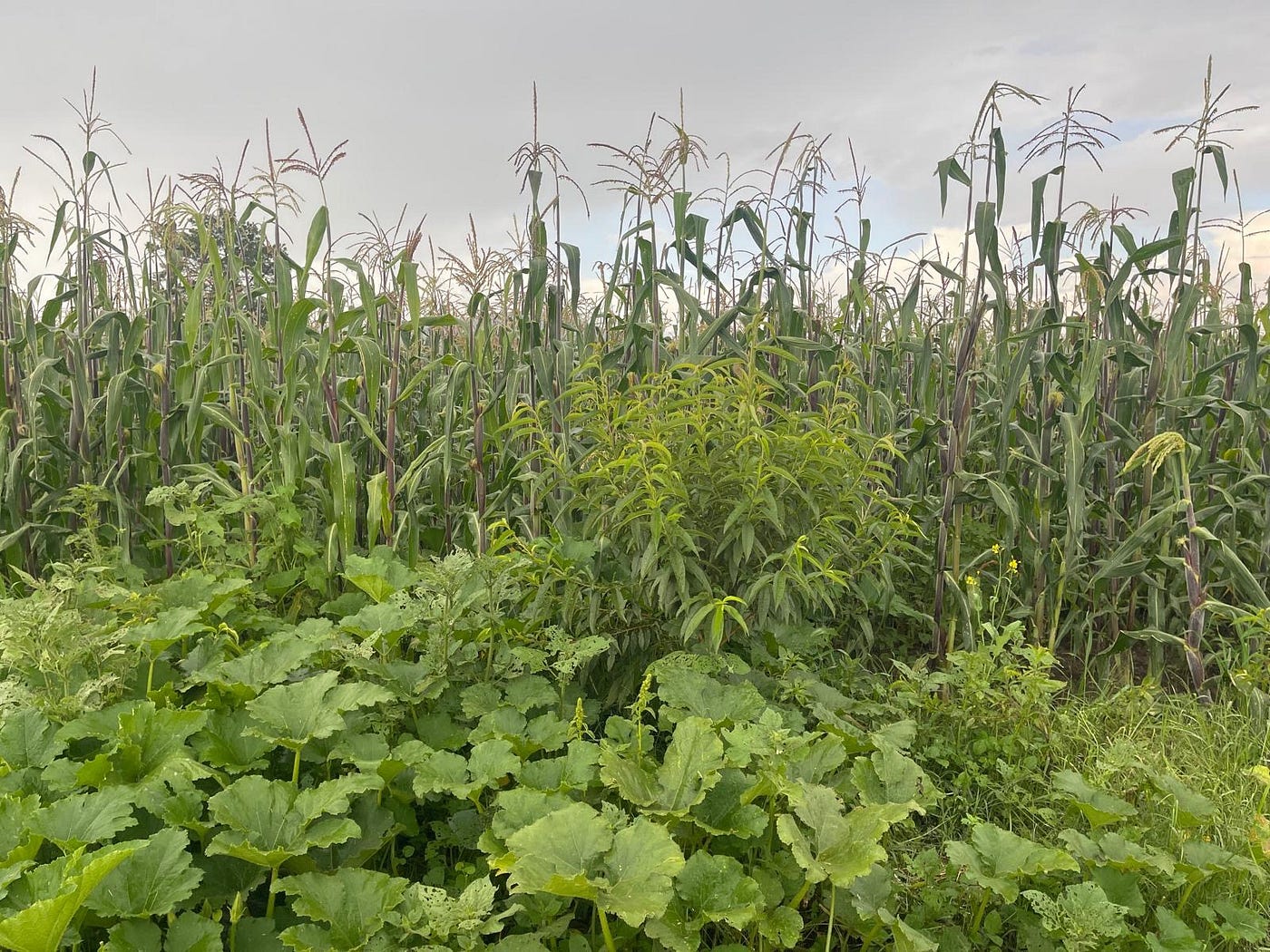
Milpa as a traditional farming system in Veracruz, Mexico. Photo by Claudia Heindorf.
Mental models helped surface disagreements, blind spots, and shared visions, but also different approaches in understanding and defining elements of the food system. They also revealed how many more elements and links come to light when a diverse group works together, and how differently people understand “traditional” or “resilient”, depending on their experiences and positionalities.
At 1 hour and 45 minutes, our workshop was long enough to demonstrate the method and spark meaningful discussion, but far too short to fully map the selected food systems and their sources of resilience. The insights participants identified, therefore, remained partial, reflecting the time limits of a conference setting. Nonetheless, and of equal value to us, they held many interesting conversations about their different entry points to food systems, and the challenges of clearly defining system boundaries and actor groups.
Thoughts, reflections and conclusions
Participatory methods like mental models do more than collect data. They create dialogue, redistribute expertise, and make space for reflection. In a context where food system transitions are often driven by top-down solutions, this approach reminds us that people are not passive recipients of change — they are thinkers, innovators, and stewards.
“Testing the method outside the classroom was especially interesting because it showed how differently people from different backgrounds perceive a food system. I was also struck by how differently the two groups approached the exercise — one in a more open and seemingly chaotic way, the other through clear categories from the start — yet both arrived at meaningful connections and even identified possible leverage points. For me, this was a valuable reminder that a messy process can still lead to insightful understandings of complex systems.” (Maria Chiara)

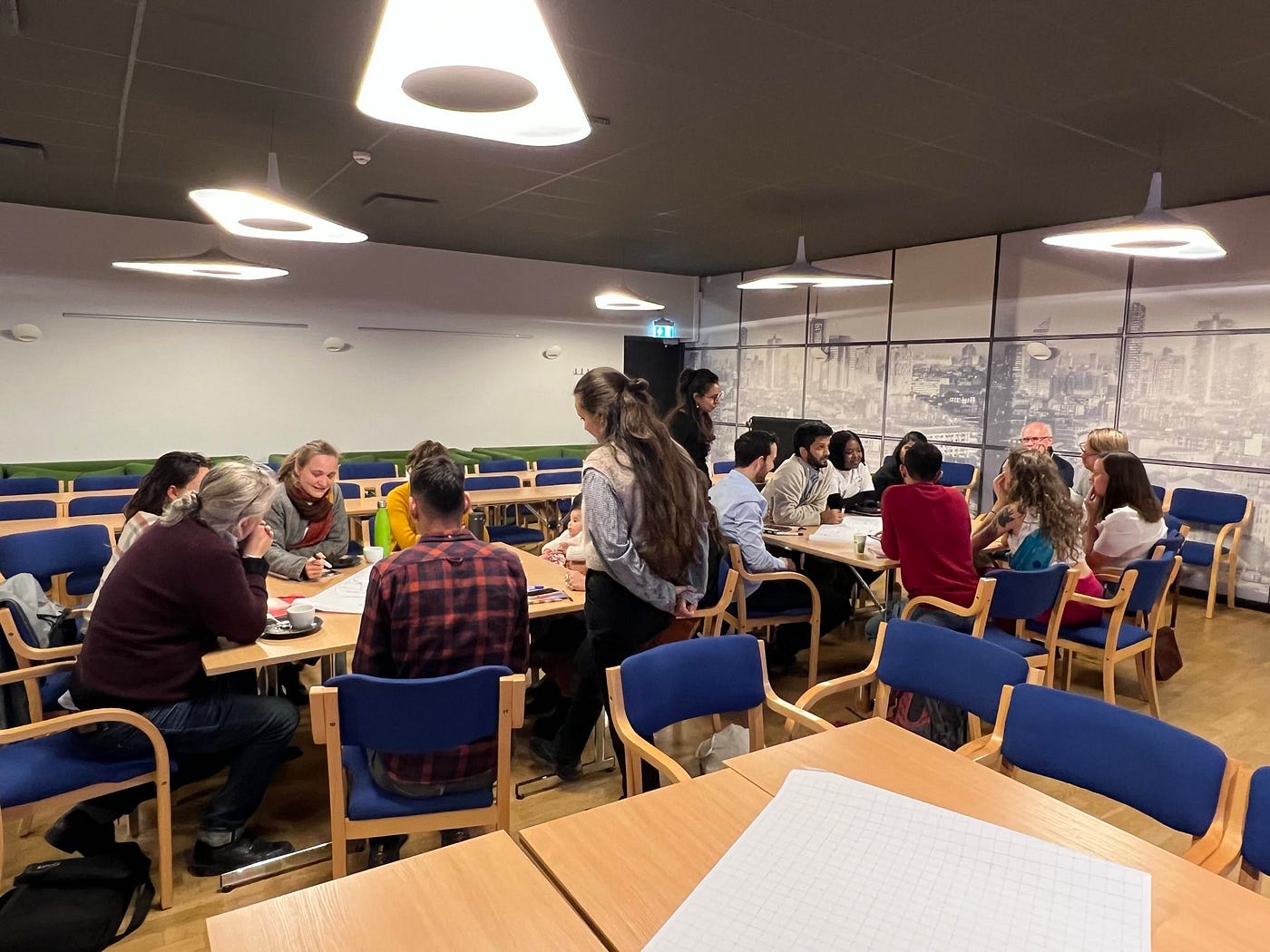
Impressions of our workshop session. Photos by Maria Chiara Camporese (left) and Roxane Bradaczek (right).
“Watching public debates, and seeing many good ideas of sustainability improvement fail in practice is making me increasingly aware of the implicit differences in understanding that people often inherently hold — while trying to work on a common solution. This workshop helped me to visualize the relevance of group constellation of targeted discussion and allowed me to watch the process of developing a shared understanding of a complex system. The curiosity and engagement of our participants were encouraging, even if the time constraints limited the level of detail in which elements could be discussed.” (Roxane)
It should be noted that most of our workshop participants also came in some way from “outside” the system, not being food producers, food processors, retailers, or consumers in the respective system. Instead, they were researchers, policy makers, and area managers. This implies a specific angle of perception of the participants and — naturally — an incomplete picture of its functioning.
Ideally, mental models are developed with people who engage with a system in their daily lives and have built a deep understanding of how it functions over time. In our case, we were interested in group mental models: shared understandings within a community that shape not only individual actions, but also social exchange, resource management, and common norms and values.
“What I found especially powerful about mental models is their ability to make these often implicit understandings visible without reducing them to predefined categories. I was fascinated by how quickly discussions moved beyond technical aspects of production towards questions of identity, belonging, power, and continuity. It reminded me that resilience is not something that simply exists in a system, but something that is constantly negotiated through people’s perceptions, choices, and values. The workshop also allowed me to reflect on my role as a moderator such as creating a safe space for disagreement among a diverse group of participants.” (Chaima)
We hope this workshop has inspired our participants to contribute to ongoing conversations on where diverse systems hold resilience — starting from how we understand them, because food system transformation is critically dependent on our values and mental models.
Further reading on mental models:
Moon, K., Guerrero, A., Adams, V., Biggs, D., Blackman, D., Craven, L., Dickinson, H., & Ross, H. (2019). Mental models for conservation research and practice. Conservation Letters, 12. https://doi.org/10.1111/conl.12642
Read more on participatory research methods for sustainability:
메타데이터
- post_id
- d993faab5d63
- slug
- pathways-to-regeneration-exploring-mental-models-of-traditional-food-systems-d993faab5d63
- url
- https://medium.com/people-nature-landscapes/pathways-to-regeneration-exploring-mental-models-of-traditional-food-systems-d993faab5d63
- canonical_url
- https://medium.com/people-nature-landscapes/pathways-to-regeneration-exploring-mental-models-of-traditional-food-systems-d993faab5d63
- author_url
- https://medium.com/@chaima-mobarak
- status
- ok
- fetched_at
- 2026-06-15 20:49:13