They Spray Painted “Trump” and “DeSantis” on Black Graves in Florida
Old Memphis Cemetery is one more example of how America notices Black graves too late.
They Spray Painted “Trump” and “DeSantis” on Black Graves in Florida
Old Memphis Cemetery is one more example of how America notices Black graves too late.
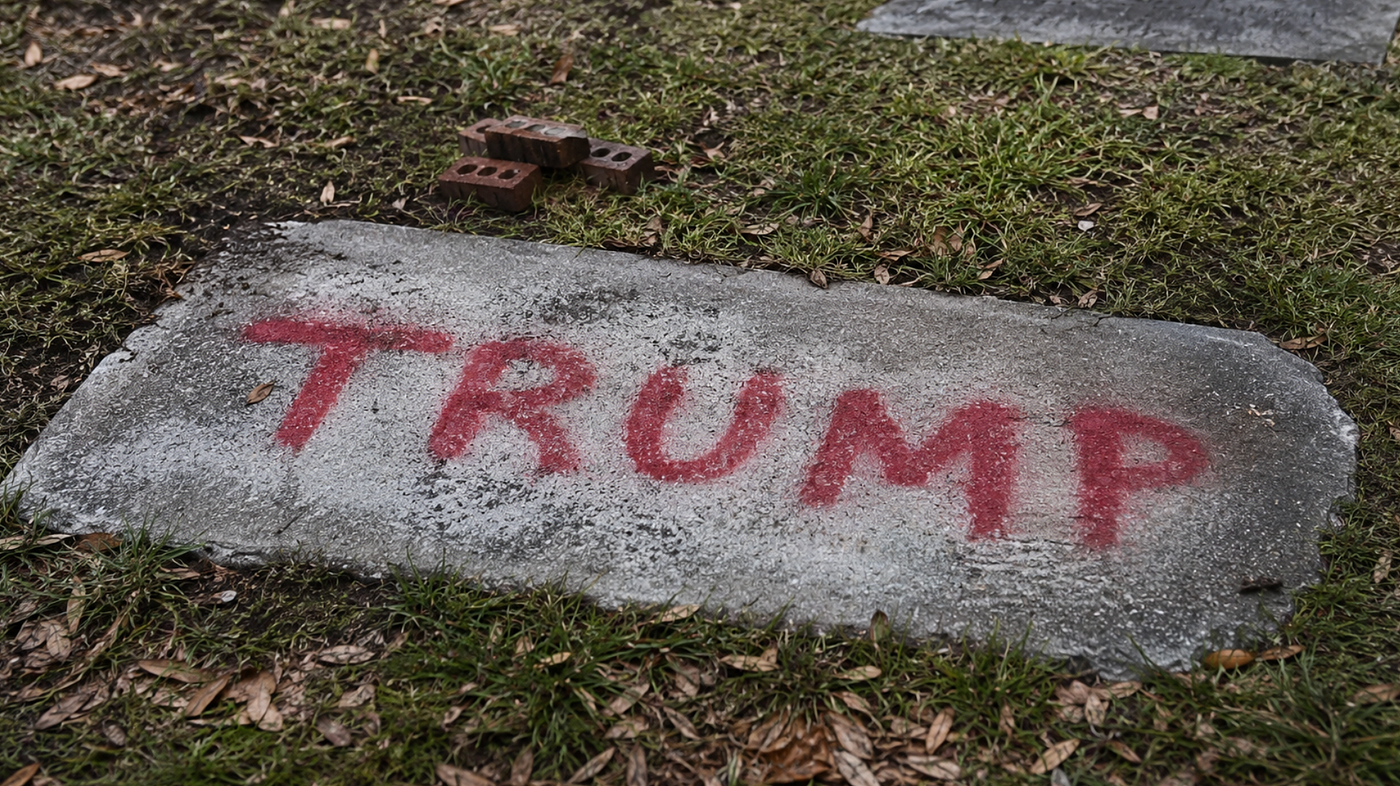
Illustration by the author. I used this recreated image because the original photo is copyrighted. You can view the real photos of the incident here.
By the time relatives walked into Old Memphis Cemetery in Palmetto, Florida, the damage had already made national news. The local officials found 17 vandalized gravesites on May 12, 2026. Headstones had been knocked down, and red paint marked tombs with “Trump” and “DeSantis.”
The families still had to go there in person and check whether their loved ones were still where they had been left. No arrests have been reported so far, and the case remains under investigation.
Edrena Love Freeman found that her father’s gravestone had been moved. He was a World War II veteran who died in 1970. The names painted on the graves made headlines. The real question was how a historic Black cemetery remained so easy to violate. Across the country Black burial grounds have been built over or lost in records, forcing families to prove the land was never empty.
Old Memphis Was a Working-Class Black Record
Old Memphis Cemetery belongs to the history of Palmetto’s Memphis neighborhood, a Black community plotted in 1904. The earliest marked grave dates to 1907. A 1923 deed shows the land passing to the Trustees of the Memphis Cemetery Committee.
That deed does more than confirm ownership. It gives the cemetery a legal voice in a country that often treated Black memory as rumor. A headstone can also do work no database can do. It can preserve the spelling a family used, even when a census taker got it wrong. For descendants, Old Memphis gives names a place to stand.
The state historical marker says many people buried at Old Memphis worked in Palmetto’s farm economy, especially tomatoes, celery, cabbage and citrus. Those crops helped build local wealth. The cemetery holds the workers behind that economy as families with graves someone still visits.
A military marker can make a life look officially recognized, as if service guaranteed dignity after death. Then a daughter arrives and finds the stone moved.
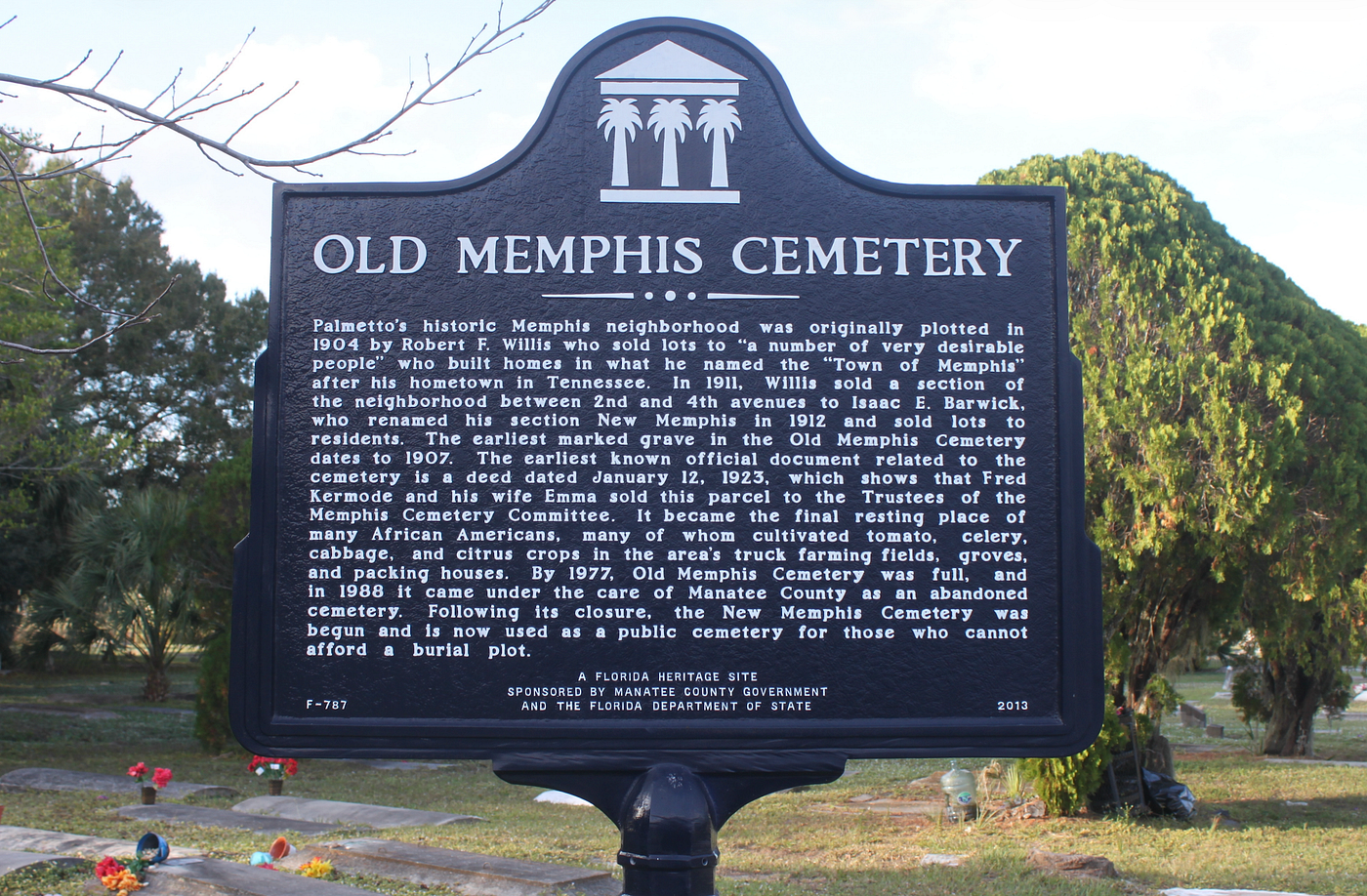
The state historical marker at the at Old Memphis cemetery | Image Source: HMBD (No Known Copyright Restrictions) Courtesy of Tim Fillmon
The Fence Came After the Damage
After the vandalism, volunteers brought flowers and flags, cleaned headstones, and helped with repairs. Manatee County later approved $100,000 for fencing and security. The money helps but the families had already walked through the cemetery looking for broken stone.
Florida knew this problem before Palmetto made national news. In 2021, the state created the Abandoned African American Cemeteries Task Force. Its job was to study unmarked or abandoned Black burial grounds, identify their locations, and recommend ways to preserve them with dignity.
University of South Florida researchers found 45 unmarked cemeteries and burial grounds in the Tampa Bay area during a two-year study. Fourteen were classified as African American, Afro-Cuban, or “colored.” Three had both white and “colored” sections. Nearly half of Florida’s 3,580 cemeteries are considered abandoned, while most unmarked burial grounds remain outside that figure because they are largely undocumented.
Cities Keep Building Over What They Don’t Count
Old Memphis Cemetery made news because the damage sat above ground. Many Black burial grounds have been harmed in ways that look ordinary from the street.
The African Burial Ground in Lower Manhattan held more than 15,000 free and enslaved Africans between the 1690s and 1790s. Development and landfill covered the site until workers rediscovered it in 1991 during excavation for a federal office building. The excavation revealed 419 human remains and more than 500 artifacts. New York’s Black beginning had been sitting under the machinery of modern government.
Tampa carries its own map of buried places. Zion Cemetery, established in 1901 as Tampa’s first all Black cemetery, disappeared from public view by the late 1920s. Tampa Bay Times reporters later found that more than 800 people had been buried there. Today, parts of that land sit under public housing and warehouse property. Ground penetrating radar found nearly 200 graves and researchers expected more.
Then came Ridgewood Cemetery under King High School. Records pointed to a pauper cemetery on campus land. Radar showed at least 145 graves still there. Most of the people buried in that one acre cemetery were African American.
Erasure can enter daily life without announcing itself. A student can walk to class on land a death certificate once named as a burial place. Nearby, a truck backs toward a warehouse door.
“Forgotten” Hides Who Had the Power to Remember
The word “forgotten” sounds too gentle for many of these cemeteries. It makes the loss feel like bad luck, poor storage, or a clerical mistake.
Descendants often carried the knowledge long after offices stopped carrying the record. Church elders and local researchers asked why an old death certificate named a burial ground that nobody in authority could point to anymore. The question is why their knowledge needed radar before it became official.
The National Trust has warned that thousands of African American cemeteries have already been destroyed by development. Other sites survive in bad condition or remain vulnerable to flooding, dumping and vandalism. Segregation shaped where Black families could bury their dead in the first place. Many local bans on Black burial in historically white cemeteries stayed in place until the civil rights era.
The disappearance involved far more than weeds or weather. It was tied to who could buy land, whose graveyards received maintenance, which communities got split by highways, and which neighborhoods were cleared for renewal projects.
The Tallahassee golf course sale brought that logic into 2025. City officials voted 3 to 2 to sell a 178 acre golf course which was built over burial grounds tied to enslaved people. It was sold to a once-segregated country club for $1.255 million. Archaeologists had identified what they believed were 23 unmarked graves and 14 possible graves near the seventh hole. Under the deal, about $98,000 was set aside for a memorial, with public access allowed as long as visitors avoid interfering with an active golf game.
America Pays for Ancestors While Black Families Search the Ground
Genealogy is now a major American business. Ancestry says it has more than 3 million paying subscribers, over 150 million family trees, 70 billion records online, and more than 30 million people in its consumer DNA network. People pay because the hunger is real. They want a name on a screen to become a person again.
The genealogy boom became real money, then real risk. In 2025, 23andMe filed for bankruptcy after building a database of genetic information from 15 million customers. Reuters reported that the company had once been worth nearly $6 billion. A 2023 breach exposed data tied to almost 7 million customers, and California’s attorney general later urged users to delete their genetic data if they wanted out.
Millions of Americans suddenly had to think about family history as an asset someone else might control. For many Black families, the older problem was harsher. The record was never safely kept in the first place.
Genealogy sites can help when someone kept the record. They can’t do much when the cemetery itself is gone. A death certificate may name a burial place no one can find now. Relatives may know whose grave belonged there and still be treated like they’re guessing. A subscription can open billions of records, but it cannot give a family the grave someone paved over.
After 23andMe’s bankruptcy, customers were told they could delete data, revoke permissions and worry about who might control their genetic profile. That language assumes a record exists somewhere to control. A bulldozed cemetery leaves nothing to download.
For some families, the missing file is still in the ground.
Sources
https://projects.tampabay.com/projects/2019/special-reports/missing-tampa-cemeteries-map/
https://savingplaces.org/stories/recovering-and-preserving-african-american-cemeteries
메타데이터
- post_id
- d99878f802fc
- slug
- they-spray-painted-black-graves-in-a-country-that-keeps-building-over-them-d99878f802fc
- url
- https://medium.com/lessons-from-history/they-spray-painted-black-graves-in-a-country-that-keeps-building-over-them-d99878f802fc
- canonical_url
- https://medium.com/lessons-from-history/they-spray-painted-black-graves-in-a-country-that-keeps-building-over-them-d99878f802fc
- author_url
- https://medium.com/@sal
- status
- ok
- fetched_at
- 2026-06-14 13:58:26