The SDK for the Data Product Economy version 0.1.3 Released
Open Data Products SDK 0.1.3 turns the OpenDataProducts.org standards family into practical Python, CLI, and MCP workflows for developers…
The SDK for the Data Product Economy version 0.1.3 Released
Open Data Products SDK 0.1.3 turns the OpenDataProducts.org standards family into practical Python, CLI, and MCP workflows for developers and AI agents.

The OpenDataProducts.org standards family has been moving from a single specification toward a wider operating model for the data product economy. ODPS defines the product. ODPC organizes products, use cases, objectives, KPIs, and signals into catalogs. ODPG connects those objects into graphs. ODPV gives the shared vocabulary that keeps humans, platforms, and AI agents aligned.
The release of Open Data Products SDK 0.1.3 is important because it moves this work from specifications into execution. It gives developers and AI agents a practical Python SDK, command-line interface, and MCP server for working with the standards family.
This is not the final destination. It is a solid beginning.
From standards to working tools
Open standards need more than good documentation. They need tools that make adoption easier. A team should not need to manually wire schemas, examples, reference files, validation logic, graph traversal, summaries, vocabulary helpers, and contract checks before they get value from a standard.
That is where the SDK fits. With one package, developers can start validating, explaining, summarizing, searching, and traversing data product standards. The package name is simple:
pip install open-data-products
After that, a data product file can be validated from the command line. A catalog can be explained. A graph can be traversed. References can be inspected. Contract links can be resolved. These are small commands, but they point toward a larger shift.
The SDK starts to turn the Open Data Products standards family into an execution layer.
Why this matters now
The data product discussion is changing. It is no longer enough to say that data should be treated as a product. That statement has been repeated for years. The harder question is how data products become structured enough to be managed, governed, connected, exchanged, and understood by AI agents.
This is where the standards family matters
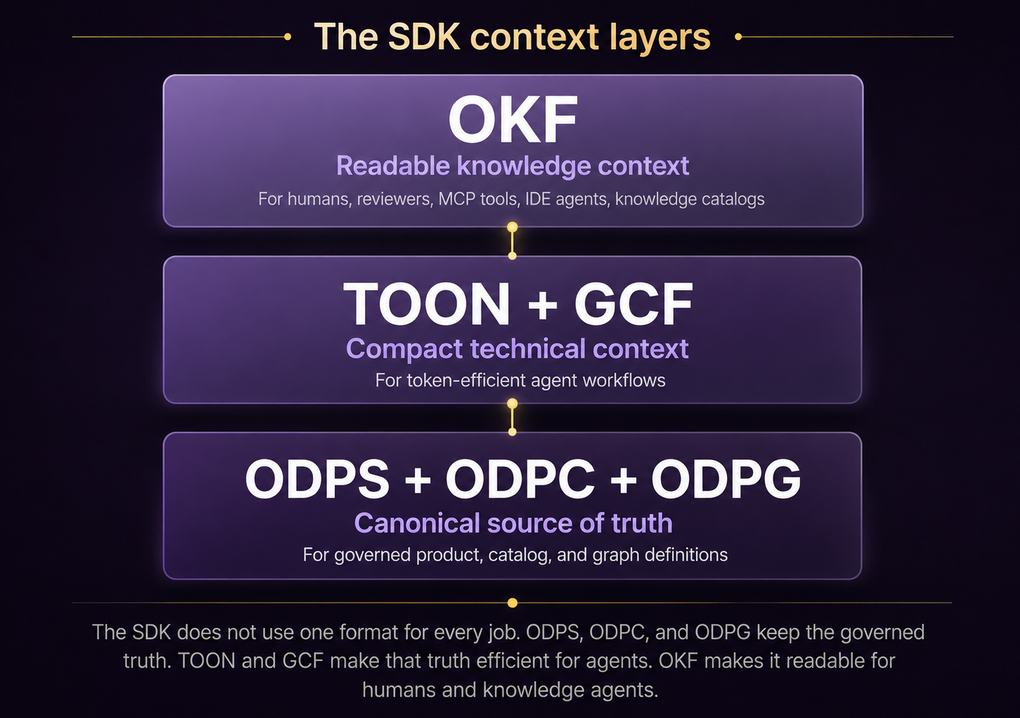
ODPS gives the product structure. ODPC gives the catalog structure. ODPG gives the relationship structure. ODPV gives the vocabulary structure. The SDK brings these parts into a practical developer workflow.
That is important because AI agents do not work well with vague context. If an agent receives loose descriptions, disconnected metadata, and inconsistent terms, it starts guessing. If it receives structured product specifications, catalogs, graphs, vocabulary files, and safe tools, it has a better foundation for useful work.
This is the purpose of the SDK. It gives AI agents the context layer they need for data product work.
AI Agent First, but useful beyond agents
The SDK has an AI Agent First design, but that does not mean it is only for agents. The same structure that helps agents also helps developers, data product teams, platform teams, governance teams, and training workflows.
A developer can use the SDK in Python. A product team can use the CLI. An AI coding tool can use the MCP server. A platform team can build validation into a pipeline. A course instructor can use the commands to teach practical data product workflows.
This is why MCP support matters. The SDK does not only describe what an agent should do. It exposes tools that an agent can use. Through the MCP server, agent hosts can work with the standards through a controlled interface instead of guessing from raw files.
That is a practical step toward agent-ready data product governance.
Local LLMs and provider-based generation
Version 0.1.3 also opens the path toward LLM-assisted generation. This matters because many teams do not start from clean ODPS, ODPC, or ODPG YAML. They start from notes, documents, use cases, strategy statements, data descriptions, signals, and fragmented business context.
The SDK direction is to help turn that material into structured artifacts.
For the early releases, Qwen 2.5 is a good local model choice because the first generation tasks are practical and bounded. The aim is not to produce creative long-form text. The aim is to create useful structured outputs that fit the standards family. That means local LLM workflows are realistic, even on machines without heavy infrastructure.
At the same time, the SDK is not limited to local models. It also supports provider-based patterns with services such as Claude, OpenAI, and OpenRouter. That gives organizations a choice. Some teams want local control. Others prefer managed providers. The SDK should support both paths while keeping the output aligned with the standards.
The important point is not the model itself. The important point is the outcome: structured data product artifacts that can be validated, connected, searched, and reused.
Graphs make the product context visible
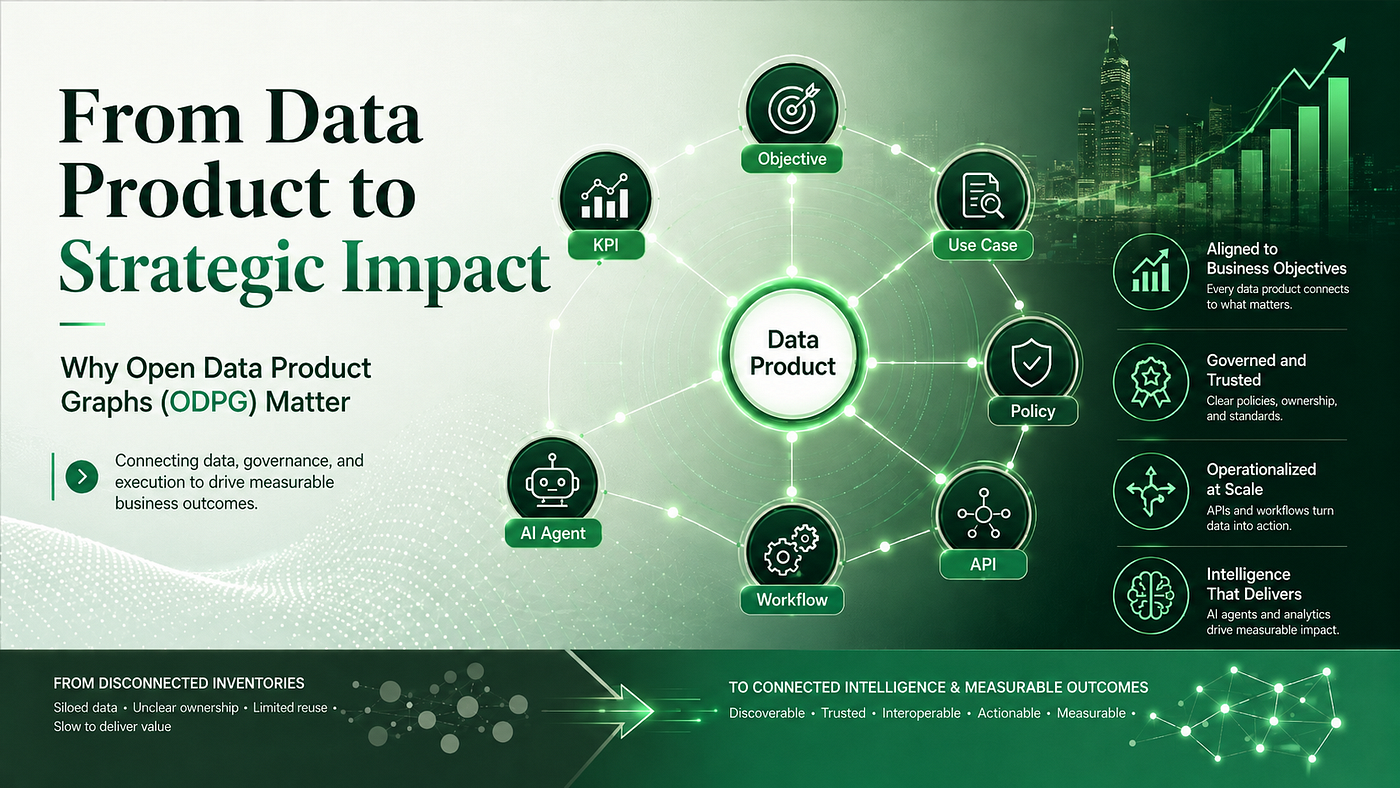
One of the most important ideas in the standards family is that data products should not live as isolated records in a catalog. A product exists because it supports use cases, objectives, KPIs, policies, signals, and other products. Those relationships are often where the real value sits.
ODPG gives a graph model for those relationships. The SDK makes that graph model easier to use.
This is a major difference from a traditional catalog. A catalog may tell you that a data product exists. A graph helps explain why it exists, what it supports, what depends on it, and where it connects to business value.
That matters for humans. It matters even more for agents.
An agent that only sees a product description has limited context. An agent that sees the product inside a graph has more room to reason. It can follow links from product to use case, from use case to objective, from objective to KPI, and from signals back into product planning.
This is how the SDK begins to support more advanced data product workflows.
Data contracts belong in the same story
The SDK also brings data contract support into the product workflow. That matters because a data product is not only a description. It also needs promises, interfaces, expectations, and quality boundaries.
Data contracts help define technical expectations. ODPS gives the broader product context. Together, they create a better bridge between engineering and product management.
The SDK supports product-level contract references, contract resolution, static alignment checks, and optional integration with Data Contract CLI. This helps teams move from scattered governance artifacts toward a more connected model.
The product description, the contract, the catalog, and the graph should not live as separate islands. They should work together.
What 0.1.3 represents
Open Data Products SDK 0.1.3 represents the first real shape of the tool layer around the OpenDataProducts.org standards family.
It supports validation, explanation, summaries, search, references, graph traversal, MCP tools, data contract support, bundled resources, and LLM-assisted generation. It works as a Python SDK, a CLI, and an MCP server. It gives developers practical entry points while giving AI agents structured tools for data product work.
The release is early. Some parts will evolve. More examples, tests, documentation, and workflows will be needed. That is normal for this stage.
What matters is the direction
The data product economy needs more than ideas. It needs shared standards, machine-readable structures, working tools, and agent-ready context. SDK 0.1.3 moves the Open Data Products standards family in that direction.
ODPS defines the product. ODPC organizes the portfolio. ODPG connects the value. ODPV gives the shared language. The SDK gives these standards a practical execution surface.
That makes 0.1.3 a solid beginning.
메타데이터
- post_id
- d99d9451dbd2
- slug
- the-sdk-for-the-data-product-economy-version-0-1-3-released-d99d9451dbd2
- url
- https://blog.opendataproducts.org/the-sdk-for-the-data-product-economy-version-0-1-3-released-d99d9451dbd2
- canonical_url
- https://blog.opendataproducts.org/the-sdk-for-the-data-product-economy-version-0-1-3-released-d99d9451dbd2
- author_url
- https://medium.com/@dr.jarkko.moilanen
- status
- ok
- fetched_at
- 2026-06-12 18:14:10