The Mazda Way: Built by People Who Can’t Stop Thinking About Cars
For many people, the ND-generation MX-5 Miata was the car that made them look at Mazda differently.
The Mazda Way: Built by People Who Can’t Stop Thinking About Cars
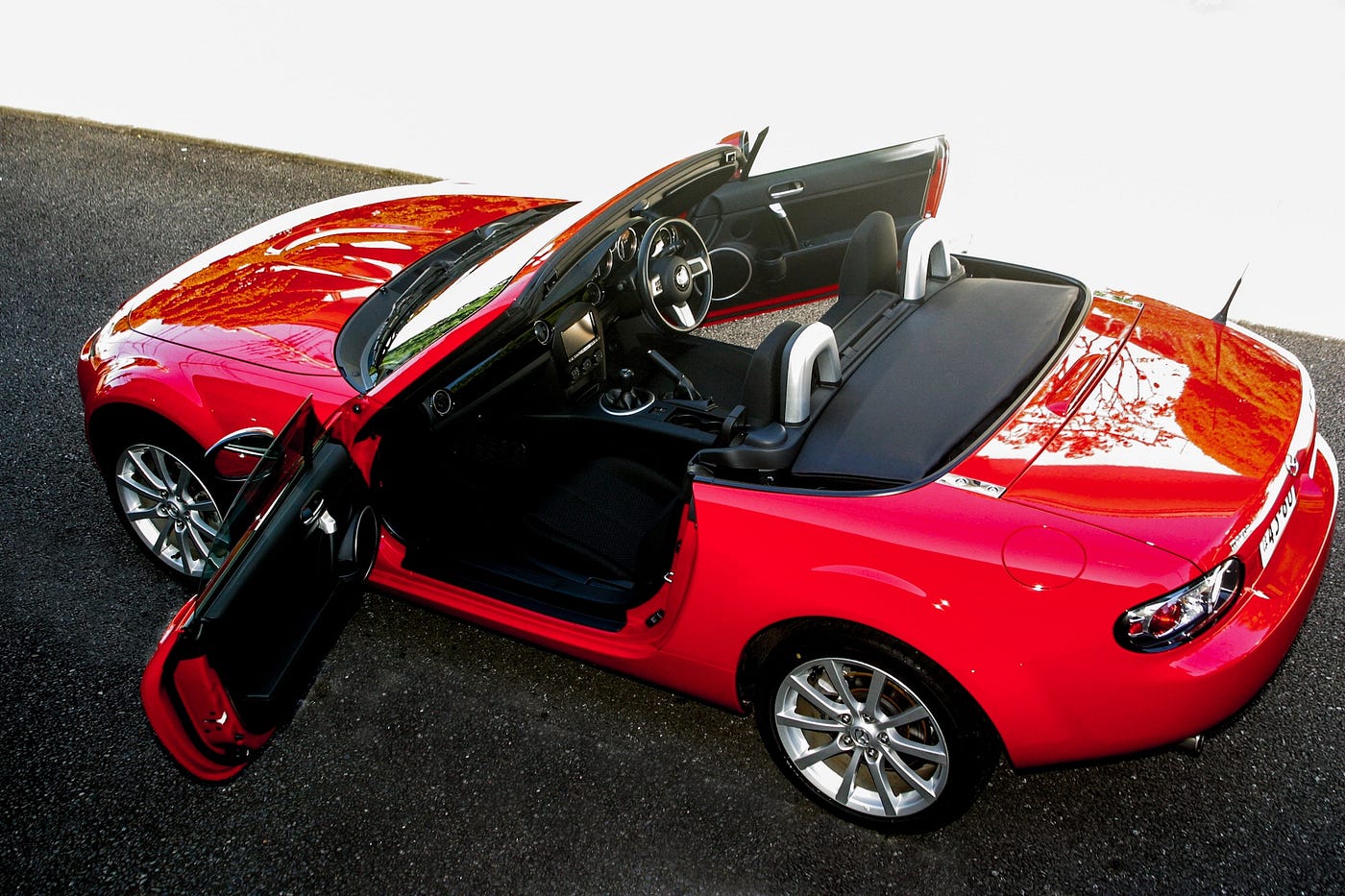
For many people, the ND-generation MX-5 Miata was the car that made them look at Mazda differently.
The sixth generation of Mazda vehicles — beginning with the CX-5 and built around the SKYACTIV philosophy — introduced the company to a much wider audience. Their combination of engineering integrity, distinctive design, and a uniquely human-centered driving experience attracted countless buyers who had never before considered owning a Mazda.
Few people symbolize that chapter in Mazda’s history better than Kiyoshi Fujiwara, the executive who became widely recognized through a famous advertising image. Sitting behind a steering wheel surrounded by automotive components, he represented Mazda’s belief that a car should be a carefully integrated collection of technologies built around the driver. There is no doubt that Fujiwara-san was one of the key leaders who guided Mazda through that remarkable period. Yet what continues to fascinate me in 2025 is something deeper. The determination that shaped Mazda’s sixth-generation cars did not suddenly appear. It had been flowing through the company for decades.
That is one of the reasons I decided to launch Mazda-dan. In this publication, I hope to share stories about Mazda’s past, present, and future — not simply through products, but through the people who created them.
The article that follows is based on an interview I conducted for driver magazine in 2005, shortly after the launch of the third-generation MX-5 Roadster (known as the NC generation). At the time, the magazine’s theme was “sportiness.” What surprised me was that the words I heard from Mazda’s engineers were not primarily about performance figures or lap times. Instead, they spoke about originality, human-centered engineering, and creating cars that respond honestly to their drivers. Twenty years later, those same ideas would become the foundation of the Mazda renaissance that captivated the world.
For this feature, I interviewed Hiroyuki Shinokura, then General Manager responsible for vehicle dynamics development across Mazda’s product range. Looking back now, I realize I wasn’t simply interviewing an engineer. I was being introduced to the soul of Mazda. Twenty years later, I am struck by how familiar his words still sound. This is the story I wrote in Hiroshima in the summer of 2005.
Better to Be a Company of Car Nuts Than the Sales Leader

The original 2005 driver magazine feature that inspired this article.
By the height of summer, Hiroshima becomes a special place in the eyes of the world. When we visited Mazda in early August, the heat rising from the ground felt almost historical. It was the kind of heat that made you instinctively look for shade, as if walking through a memory preserved from sixty years earlier. As we prepared our interview equipment in the parking lot in front of Mazda’s headquarters, I looked up from my bags and saw two examples of the new Roadster, not yet on sale, parked in a corner of the lot. They were sitting one space apart, with an empty parking space between them. Both already wore Hiroshima license plates with consecutive numbers. “How impatient,” someone on the editorial staff joked. We went inside to pick up our visitor passes. As we were doing so, a Mazda employee drove in with yet another Roadster and parked it neatly between the two cars. Under the blazing sun, he stood for a moment chatting with colleagues. Then he climbed into the next Roadster, which must have been as hot as a steam bath inside, and drove away.
Hiroyuki Shinokura smiled when I mentioned the scene.
“Our development people are really car nuts,” he said. “Many of them are quiet types. So quiet, in fact, that sometimes I wish they would promote themselves a little more. But before you know it, they are out driving development cars. Once something starts bothering them, even something very small, they can’t let it go. The Roadsters you saw in the parking lot are Japanese-spec cars. Now that they have license plates, I’m sure they are out checking something on public roads. Even if I told them, ‘Maybe that’s enough,’ they wouldn’t listen. Right up to the last moment — actually, if we left them alone, forever — they would keep working on the cars, trying to get them to 100 percent. They are serious people. Almost too serious. But maybe that is what makes Mazda Mazda.”
At the time, Shinokura-san was one of the key engineers overseeing Mazda’s vehicle development as a whole. Each individual model had its own program leader. But Shinokura-san’s role was broader. He was responsible for gathering those efforts together and shaping the overall character of Mazda cars. In a sense, he was one of the guardians of Mazda’s driving taste.
“I joined the company in 1972,” he told me. “Back then, Mazda was still called Toyo Kogyo. My first assignment was in the testing department, so I suppose I was just like the engineers you saw today — driving development cars day and night. But at Mazda, the testing department did not simply drive prototypes. We evaluated competitors’ cars. We helped set development targets for new models. We studied how to achieve those targets and coordinated with many different departments. The range of work was very broad. Still, that atmosphere among the engineers — being almost too serious — has not changed very much from those days to now.”
That summer, Hiroshima would again attract the attention of the world for more than one reason. And when the third-generation Roadster stepped onto the public stage, I felt certain that it too would carry the soul of Mazda.
The Essence of a Mazda: Pleasant to Drive
I used the phrase “the soul of Mazda.” It is true that Mazda cars share a certain atmosphere. If you have the chance to drive many Mazda models back to back, you can feel it quite clearly. There is a strong personality running through them. But “the soul of Mazda” is still an abstract phrase. So I asked Shinokura-san to explain it more concretely.
“The characteristic shared by Mazda cars,” he said, “is that they respond very linearly to the driver’s controls. In other words, when you turn the steering wheel by a certain amount, you can easily understand how the car will move. When you press the accelerator by a certain amount, you can easily understand how the car will accelerate. The car responds honestly to the driver’s inputs. Of course, Mazda is not a manufacturer specializing only in sports cars or only in sedans. So if you ask whether the Roadster and Mazda’s MPV minivan shared exactly the same concept, of course they did not. Each car has its own purpose and its own environment of use. In development, we must consider the time, place, and occasion for each model. But when it comes to focusing on the pleasure of moving a car, and never betraying that pleasure, there is a common Mazda character.”
Then he spoke about a word that defined Mazda in those days.
“There is the keyword Zoom-Zoom. It represents the direction of Mazda’s car-making. When you were a child, perhaps you pushed a toy car around and made a ‘Zoom-Zoom’ sound with your mouth. You remember that excitement, that feeling of being completely absorbed in moving the car. Zoom-Zoom is our way of saying that we want to create cars that never forget that feeling. As I said, every model has qualities it must fulfill. Handling stability, comfort, functionality, and many other things. We examine all of those carefully in our development. But especially when it comes to creating pleasant driving — the kind of feeling expressed in the Japanese phrase jinba ittai, or horse and rider as one — we want to build cars that lose to no one.”
Was this, then, the driving feel shared by all Mazda cars?
“Yes,” he said. “Let me be a little more specific. Among driving performance qualities, our mission is to achieve class-leading handling, cornering, and braking for each model, and top-class acceleration. If people feel that a Mazda is sporty, I think they are probably feeling those qualities. But what matters here is that we do not believe sportiness means a car turns sharply with the slightest movement of the steering wheel, slows dramatically the moment you touch the brake pedal, or accelerates violently with the smallest movement of your foot. That is not our idea of sportiness.”
He paused, then continued.
“Extremely powerful acceleration may indeed surprise and excite someone the first time they drive a car. But a car that moves against the driver’s intention will never give the pleasure of control. A car should accelerate faithfully according to how much the driver presses the accelerator. It should turn faithfully according to how much the driver turns the steering wheel. It should slow down exactly according to how much the driver presses the brake. That is what gives the driver the pleasure of jinba ittai. We must never forget that the main character is the driver. What matters is how properly the car responds to the driver’s intention. For that, it is very important that 100 percent of the driver’s input becomes 100 percent of the car’s movement. That is where the dialogue between human and machine begins.”
A Car Should Not Be a Mobile Suit
A car that gives the joy of control is not a machine that artificially amplifies the driver’s intention like a robot suit. If 100 percent of the driver’s input becomes 150 percent of the car’s response, the driver may be surprised. But surprise is not the same as wanting to keep driving forever. That philosophy, Shinokura-san suggested, runs through all Mazda cars.
“It is easy to create a momentary trick,” he said. “A dramatic first impression is easy. But creating a linear feeling is technically very difficult. The first thing that matters is the body structure. The engine and suspension are all mounted to the body. If the body lacks rigidity, nothing you do afterward will work properly. So ensuring extremely high body rigidity is the first step in creating a Mazda-like car. It is an absolute requirement. When you have a highly rigid body, the suspension can move accurately and smoothly according to its design. That natural, immediate response when you turn the steering wheel begins with a strong body. Yet that is only part of the story.
“When the structure is solid,” he explained, “vibrations coming from the tires, the engine, and other parts of the car can be absorbed in a very supple way. The ride does not become rough or clumsy. Instead, it feels firm and precise. When you drive over a manhole cover or an expansion joint on the highway, you feel a clean, pleasant thump. If the car responded with a harsh bang and crash, the driving pleasure would disappear in that instant. That is why Mazda cars place such importance on the quality of the body above all else.”
Have you ever looked underneath a Mazda? One thing that has always surprised me is the amount of cost and attention Mazda spends around the suspension. Aluminum lower arms, large rubber bushings the size of a clenched fist mounting them to the body — these are the kinds of components that, not long ago, you expected to find only on high-performance European cars built to run at more than 200 km/h on the Autobahn.
“Once you have created a good body,” Shinokura-san continued, “the next step is designing the suspension and the rubber bushings that attach it. As you know, while the car is moving, the suspension receives inputs from every possible direction. It moves up and down, forward and backward, and in many other ways. We must decide how it should move and how that movement should be controlled. We are not building extremely expensive cars. Our development budgets are limited. But we also know there are areas where we absolutely cannot cut corners. Some things can be solved through design. But other things require the use of expensive parts.”
He gave one example. “The rear bushing that mounts the front lower arm to the body has a major influence on handling and comfort. If all you want is a car that simply moves, you could use a smaller and cheaper part. But every Mazda engineer knows how boring the completed car would become if we did that. When we decide to create a Mazda-like car, we cannot overlook things like that. When we say, ‘Let’s create Zoom-Zoom,’ we already share an understanding of what methods we must choose. And this is not limited to the suspension. Please imagine that such details exist everywhere throughout a Mazda. You open the door, sit in the seat, start the engine, and begin to drive. Eventually you arrive at your destination and step out of the car. From beginning to end, we want the car to have a pleasant, consistent rhythm. That is the kind of car we want to build.”
The Final Touch Is Human Power
It is not always easy for beginners to find a favorite car by sensing its rhythm, rather than by reading catalog specifications or being attracted by new technology. The ability to recognize a car’s flowing rhythm comes more easily after you have driven and compared many cars. That said, there are times when a car simply speaks to you the moment you see it — or the moment you drive it.
“Mazda has the rotary engine as an item that gives people a sporty image,” Shinokura-san said. “But the rotary engine is not essential in order to feel the joy of control. How people should perceive a particular model is, in some ways, a matter of sales strategy. If you build a very sharp-edged car, it may be easier to create attention-grabbing advertising copy. But Mazda has a strong image of being serious. We build technology step by step. We refine the balance carefully. That may seem modest, but I think it also leads to trust in Mazda.
People often say, ‘You understand how good it is once you drive it.’ You drive it and find that it is easy, enjoyable, and pleasant. You feel, ‘What a nice car.’ This may sound vague, but for people who love cars, driving itself is a pleasure. Even if we do not loudly advertise how many horsepower a car has, I think it is enough if people drive it, genuinely like it, and want to keep it for a long time. Mazda has no intention whatsoever of becoming the company that sells the most cars in Japan. Rather than aiming in every direction and creating thin, diluted cars, the company’s policy is to remain a manufacturer that is pure in its engineering.”
As he said this, I remembered the engineer I had seen earlier, sweat on his forehead, driving the soon-to-be-released Roadster out onto public roads.
“Yes,” Shinokura-san said. “ In every process of car development, the power of human beings has a very large influence. No matter how advanced the computers used to create a car may be, the final area of tuning — the area that truly gives the car its taste — can only be completed by human sensitivity. So how to develop human feeling, human sense, is one of our major themes. Technical ability is an absolute requirement for an engineer. But technical ability alone cannot create a wonderful car that touches the heart.
Sometimes, when a young engineer puts me in a development car and asks for my opinion, I give only the outline and intentionally avoid making detailed comments. I wonder what he will do. Then, a few days later, he comes back with the car greatly improved and asks, ‘How is it now?’
At moments like that, I feel very happy. I think, ah, he really does understand the exciting Mazda driving feel.”
Interview with Hiroyuki Shinokura Then Principal Engineer, Vehicle Dynamics Development Group, Mazda Motor Corporation
메타데이터
- post_id
- d9bd9b4d52e2
- slug
- the-mazda-way-built-by-people-who-cant-stop-thinking-about-cars-d9bd9b4d52e2
- url
- https://medium.com/mazda-dan/the-mazda-way-built-by-people-who-cant-stop-thinking-about-cars-d9bd9b4d52e2
- canonical_url
- https://medium.com/mazda-dan/the-mazda-way-built-by-people-who-cant-stop-thinking-about-cars-d9bd9b4d52e2
- author_url
- https://medium.com/@yamaguchimunehisa
- status
- ok
- fetched_at
- 2026-06-25 16:53:31





