On the Wound of the World (A Franciscan Call to Shared Resurrection)
“Blessed are the peacemakers, for they shall be called the children of God.” (Matthew 5:9)
On the Wound of the World
A Franciscan Call to Shared Resurrection
“Peace I leave with you, My peace I give to you; not as the world gives do I give to you. Let not your heart be troubled, neither let it be afraid.” (John 14:27)
“Blessed are the peacemakers, for they shall be called the children of God.” (Matthew 5:9)
Amnesty International staging a silent vigil outside Downing Street, in solidarity with civilians in Rafah (Marie-Anne Ventoura, 14/02/2020)
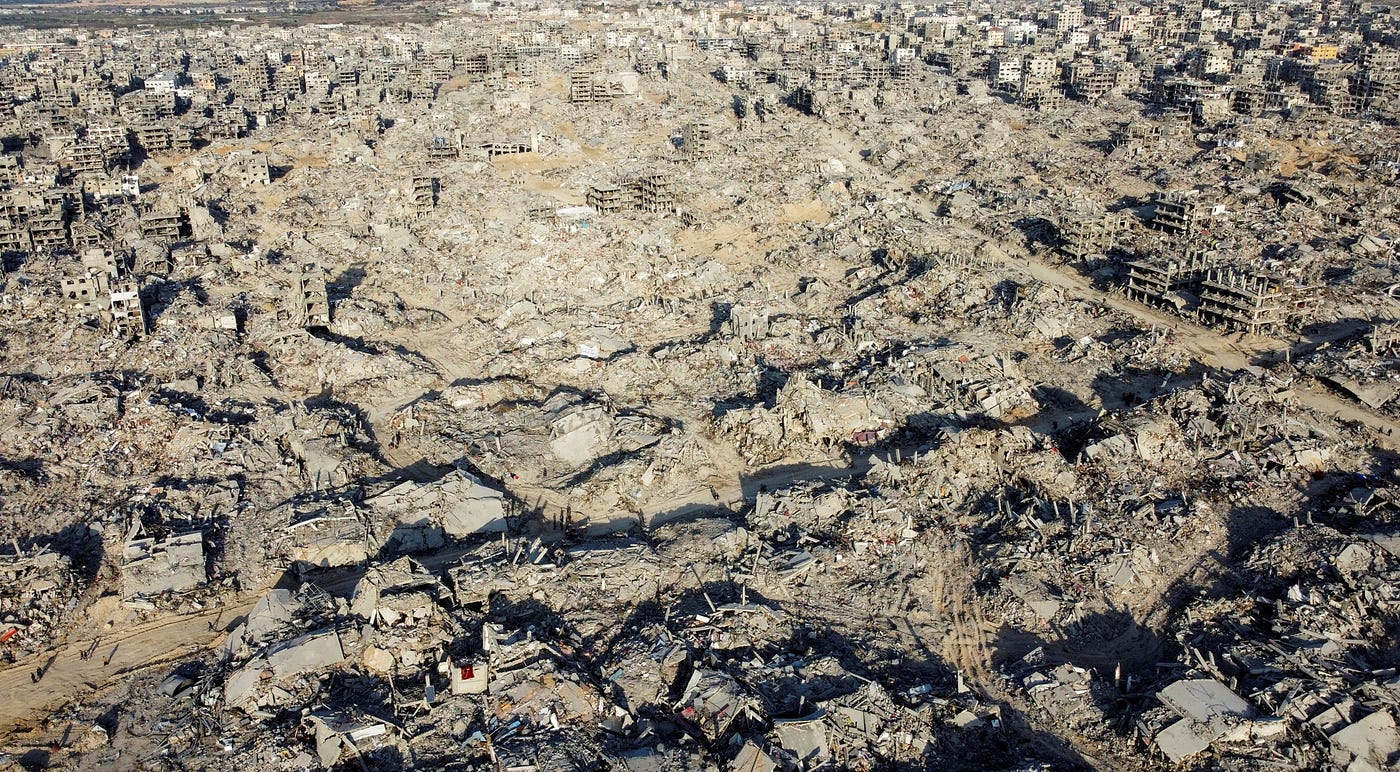
There comes a point when words of outrage are no longer enough; when silence — even prayerful silence — becomes a form of complicity. The land of the Old Covenant — particularly that narrow Gazan strip — cries out, its stones bearing witness, its hospitals crumbling to powder, and its children becoming the grave-markers of our world’s collective failure. Over two years on from the seventh of October, I can no longer write of Gaza in the language of distance or diplomacy.
The land itself weeps. The air tastes of ash and fear. The screams of children have become the underscore of our moral decay.
In some of my earlier reflections — particularly *On the Second Anniversary of the 7th of October, [“Generational Slaughter”](https://medium.com/@rhodriwilliams92/generational-slaughter-cd2b7a74ddbd), and [A Franciscan’s Plea for Justice](https://medium.com/@rhodriwilliams92/a-franciscans-plea-for-justice-on-welcoming-president-herzog-selling-combat-proven-weapons-89c4b689409a)* — I wrote that we cannot simply pass by the suffering of a child without becoming complicit in their collapse of hope. I still stand by that, though I feel its weight more fiercely now, for the suffering has not merely continued, but metastasised; normalised and sanctioned by governments who have learned that the world’s conscience can be worn down by simple repetition.
The Boast of Bombs
Benjamin Netanyahu (Middle East Monitor)
When Israel’s Prime Minister, Benjamin Netanyahu, boasted that the Israeli Occupation Forces (a more accurate name than the “IDF”, for there is little “defence” in their actions) had dropped 153 tons of bombs on Gaza in a single strike — doing so during what was ostensibly a cease-fire — he was not speaking as a leader defending his nation: rather, he was confessing, before the watching world, to a breach of both morality and law.
There are moments in history when words themselves become indictments.
For all the language of “security” and “defence,” the campaign in Gaza has revealed itself as something far darker: the calculated annihilation of a people rendered voiceless, homeless — hopeless. The IOF’s actions — striking hospitals, aid convoys, shelters, and schools — no longer even pretend to the distinction between combatant and civilian.
Gaza has become a testing ground for the world’s moral indifference, transformed into a laboratory of impunity where international law is tested to destruction, and where human decency is treated as an optional extra. Electricity, water, food — the very elements of life — are wielded as weapons and instruments of control. Children are buried beneath the rhetoric of “precision.” And when a government boasts of the tonnage of bombs dropped, it speaks not the language of military necessity, but of desecration.
To call this war is to lend it a dignity it does not deserve.
It is not war. It is the systematic dehumanisation and destruction; an unmaking and erasure of humanity. It is the militarisation of survival itself; a campaign whose purpose seems not to be Hamas’ punishment, but instead the wholesale eradication of Palestinian life — past, present, and future.
A Rogue State Backed by Rogues
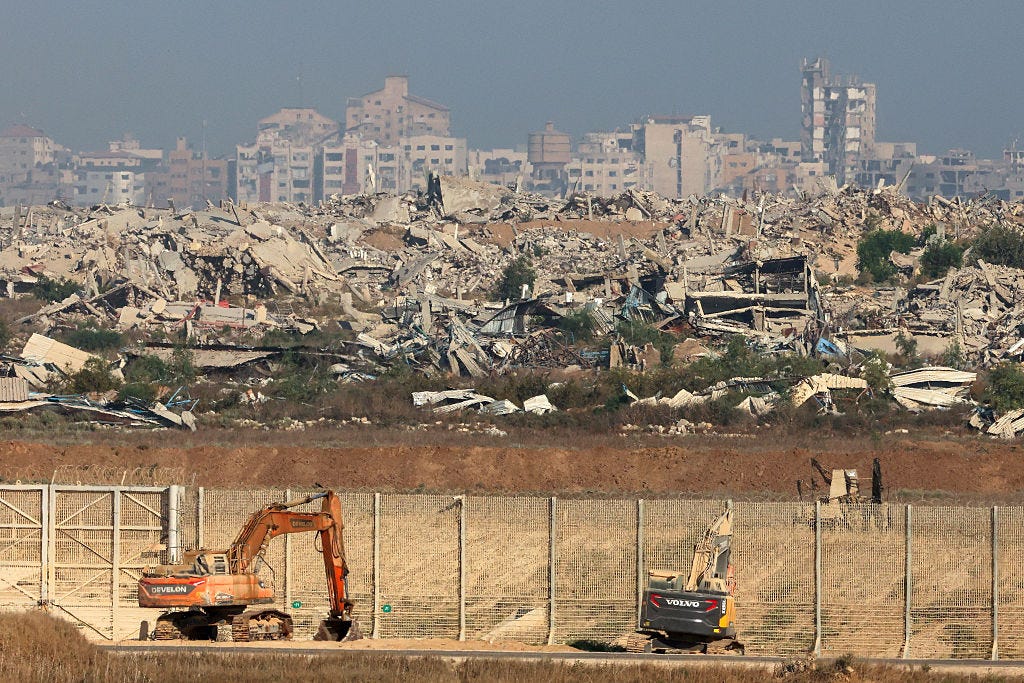
The UN estimates that the destruction of Gaza has left between 55- and 60-million tonnes of rubble (The New Arab/Getty)
When a nation openly boasts of its bombs, violates cease-fires, dumps the waste of its settlements into the land it occupies, and sneers at international condemnation, it forfeits any claim to moral legitimacy. Israel — or rather, the apparatus of its current government — has become what might be termed a “rogue state,” propped up by those who profit from its chaos, or who fear the loss of their own geopolitical leverage.
The image of the IOF tipping truckloads of rubble and refuse across the border into Gaza is a grotesque metaphor made literal. It reveals what the regime truly believes about the people it governs by force: that they are refuse, fit only to be buried beneath the detritus of occupation. To dehumanise a people so thoroughly that even their soil becomes a dumping ground is to commit not only a political crime, but a spiritual blasphemy.
Israel’s leaders have turned cynicism into statecraft. Their rhetoric is no longer about defending a homeland, but about demonstrating dominance — raw, punitive, theatrical power. It is the idolatry of nationalism, masquerading as patriotism: a false religion demanding ceaseless sacrifices upon its blood-soaked altar.
Those who stand by and call this necessary are not neutral. They are complicit.
The Case for Judgment
As one who has seen what violence does to flesh and spirit alike, I cannot pretend that such crimes can be excused as strategy.
Palestinians mourn relatives killed in an Israeli strike on a U.N.-run school in the Nusseirat refugee camp, outside a hospital in Deir al Balah, Gaza Strip, 06/06/2024 (AP Photo/Abdel Kareem Hana)
I have watched breath leave the body. I have washed the blood of strangers from my hands and clothes. I have heard the sounds of grief rend the very fabric of survivors’ reality.
So when I hear of the deliberate bombing of hospitals, of children dying for want of medicine, of the calculated withholding of aid, I recognise not the fog of war but the clarity of evil.
Netanyahu and his government must be brought before international courts — not out of vengeance, but because justice itself demands it. The International Criminal Court and the International Court of Justice exist precisely for such times as these: to remind the powerful that no one stands above the law, and that the shedding of innocent blood has consequences. If Hamas is (rightly) condemned as a terrorist organisation for targeting civilians, then Israel’s government must be held to the same moral standard, for the deliberate destruction of civilian life, the starvation of entire populations, and the weaponisation of humanitarian aid are acts of terror by another name; to call them “self-defence” is to mock the very concept. A Franciscan heart cannot delight in punishment, but it must *insist on truth*. To allow such crimes to pass unchallenged is to bless the instruments of death with our silence.
The Ceasefire of Shadows
UNICEF warns that even the so-called cease-fire offers only a vital chance for one million children in need.
A displaced Palestinian child holds a doll outside her family’s tent at a displacement camp in Gaza City, 19/10/2025 (Reuters)
One million children. One million souls poised between life and oblivion.
That this “chance” is treated as conditional, temporary, and negotiable exposes the hollowness of the international response. Humanitarian aid trickles in like alms tossed to beggars, while the machinery of destruction continues unimpeded, the ceasefire functioning less as a reprieve than as a pause for logistical recalibration — a breath between bombardments.
The International Dilemma

Palestinians moveamid the rubble of destroyed buildings in Sheikh Radwan, Gaza City, 22/10/2025 (Omar Al-Qattaa/AFP via Getty Images)
Recent statements from Western and Arab leaders speak of deploying “international stabilisation forces” into Gaza and its environs; yet across the chancelleries of power the same refrain echoes: no large-scale, boots-on-the-ground deployment. The United Kingdom’s role is deliberately symbolic — a handful of planners, embedded within a US-led task-force, there to advise without entanglement. Their terms: assist, plan, stabilise — but not occupy.
Jordan, whose demographic heart is largely Palestinian, has declared it will not send soldiers into Gaza, for to do so would risk repeating the tragedy of occupation under a different flag. The Kingdom knows the cost of compassion, as its soil has sheltered millions of displaced Palestinians since 1948, and its monarchy walks the tightrope between empathy and survival — a cautionary sign of what large-scale displacement or international policing might invite.
This matters.
The reason the international community refuses full ground intervention is not just logistical — it is existential. To step into Gaza as an occupying stabiliser would be to assume the burden of life and death for millions; to risk becoming part of the very machinery it seeks to repair. The world is unwilling to replace one occupation with another; to be peace-keepers would mean becoming partners in the suffering. And so, the stubborn hope of Gaza is left in limbo: needing peace, but deprived of the power to enact it.
The world stands, hands half-raised, proclaiming peace, but unwilling to pay the price of proximity. Peace has become a concept managed from afar, rather than embodied on the ground, and until nations are willing to risk their privilege for the sake of the powerless, it will remain a prayer whispered into rubble.
The False Binary

And yet, even here, compassion demands honesty: antisemitism remains a cancer within the soul of humanity, and it must be resisted with the same fervour as Islamophobia or anti-Arab bigotry. To stand with Gaza is not to stand against Israel’s people. To love Palestine is not to hate the Jewish people.
Nor does compassion for the oppressed require blindness to Hamas’s own cruelties: its ideology of vengeance is an affront to the very justice it claims to serve. But Hamas’s crimes do not justify the collective punishment of millions of innocents: to say this plainly is not bias — it is moral coherence.
The Forgotten Church of Palestine
Amid this horror, another grief lies hidden: the plight of Palestinian Christians.

Mourners attend the funeral ceremony for victims of Israel’s bombing of St. Porphyrius’ Church, Gaza City, 20/10/2023 (Ali Jadallah/Anadolu via Getty Images)
Long before the current war, the indigenous Christian communities of Palestine — Greek Orthodox, Catholic, Anglican, Lutheran — lived as bridges between worlds: Arab and Jewish, Eastern and Western, ancient and modern. They are the descendants of the first followers of Christ, still praying in the language he spoke. Bethlehem, Nazareth, Jerusalem are not symbols to them — they are home. Their numbers have dwindled from more than 10 % of the population a century ago to scarcely 1 % today. Emigration, discrimination, despair: all have hollowed out the cradle of Christianity. In Gaza itself (where fewer than 1,000 Christians remained before the war), the ancient Church of Saint Porphyrius — one of the oldest in the world — was bombed whilst sheltering families. In the West Bank, Bethlehem sits behind walls, its holy streets patrolled by occupiers.
And yet, they endure — tending hospitals, teaching children, praying forgiveness into the ruins. They are the living Gospel: unarmed, unyielding, crucified, and still forgiving. Their survival is not sentimental nostalgia: it is a moral barometer. If Christianity cannot endure in the land of Christ, then something in all of us will have died.
The Franciscan Witness

St. Francis of Assisi (Musei Vaticani)
Saint Francis of Assisi crossed barefoot battle-lines both physical and metaphysical, seeking not to convert but to commune. He called every creature brother or sister — even the wolf that threatened the flock, and the Sultan who fundamentally opposed his very ethos. His way was not neutrality; it was radical fraternity.
I try — however falteringly — to follow that path.
I will not call Israelis my enemies, nor Palestinians my cause: they are my kin.
The tears of a Jewish mother in Ashkelon and the sobs of a Palestinian father in Rafah rise to the same heaven. But to love both is not to equate them. Love without justice is sentimentality; justice without love is brutality. The Franciscan way holds them in holy tension.
My Own Lament and Hope
Every time I hear an ambulance siren, I think of those in Gaza for whom no ambulance comes. Every time I assist with the Eucharist, I think of the mothers there who have nothing left to offer but dust and tears. Every time I write music, I pray it might one day be played not in lamentation but in celebration — for the day when peace is more than a ceasefire, and justice more than a slogan.

Icon of Christ’s Harrowing in Hell (Chora Church/Kariye Mosque, Istanbul)
Despite everything, I still believe in resurrection, for the earth is not beyond redemption: The olive trees will bear fruit again; The bells will ring again, in churches, mosques, and synagogues alike: not as calls to war, but as notes of reconciliation; The laughter of children will drown out the thunder of bombs.

Even from the rubble, the olive tree remembers the sun (Said Khatib)
The Franciscan call is not to despair, but to stubborn hope: hope that holds governments to account and still believes in the humanity of their victims; hope that dares to say enough.
In God’s eternal light — may Gaza, Israel, and this trembling earth be remade. May our lament become music. May our music become prayer. And may our prayer become peace.
A Prayer for the Children of the Earth
God of Abraham, of Isaac and Ishmael, God of Miriam, Mary and Aisha, Your children bleed beneath one sky.
Grant us courage to say: Enough. Grant us humility to see our own complicity. Grant us love to recognise one another as kin, not foe. And grant us vision to imagine a world where the only bombs are of laughter, and the only fire is the coming dawn’s holy blaze.
Heddwch, a phob bendith. Pax et bonum.

St. Francis of Assisi
메타데이터
- post_id
- d9c86e451e22
- slug
- on-the-wound-of-the-world-a-franciscan-call-to-shared-resurrection-d9c86e451e22
- url
- https://medium.com/@rhodriwilliams92/on-the-wound-of-the-world-a-franciscan-call-to-shared-resurrection-d9c86e451e22
- canonical_url
- https://medium.com/@rhodriwilliams92/on-the-wound-of-the-world-a-franciscan-call-to-shared-resurrection-d9c86e451e22
- author_url
- https://medium.com/@rhodriwilliams92
- status
- ok
- fetched_at
- 2026-07-16 01:47:33