Reinforcement Learning Demystified: Key Algorithms and Concepts Explained
Reinforcement Learning (RL) is a captivating and powerful subfield of machine learning. It’s been instrumental in training agents to beat…
Reinforcement Learning Demystified: Key Algorithms and Concepts Explained
Reinforcement Learning (RL) is a captivating and powerful subfield of machine learning. It’s been instrumental in training agents to beat world champions in Go, controlling robots, and more recently, fine-tuning large language models like ChatGPT. But despite its growing popularity, RL can feel like a black box to many. In this blog, I’ll try to explain RL in a natural, conversational way, as if I’m sharing what I’ve learned with a curious friend over coffee.
What is Reinforcement Learning?
At its heart, Reinforcement Learning is about learning from interaction. Imagine a digital agent placed inside an environment — say, a marketing platform. The agent can take actions, like showing ads or offering discounts, and gets feedback in the form of rewards — like conversions or clicks. Over time, the agent tries to figure out what actions bring the best rewards.
There are a few key ingredients in RL:
- Agent: The learner or decision-maker
- Environment: The world the agent interacts with
- Action: What the agent does (e.g., sending a discount email)
- State: The current situation or context (e.g., customer browsing behaviour)
- Reward: The feedback (e.g., whether the customer made a purchase)
This framework is known as a Markov Decision Process (MDP).
How is RL Different from Other Types of Machine Learning?
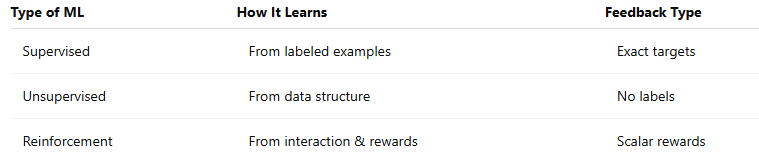
Let’s take a step back. Most people are familiar with supervised learning, where we train models using labeled data — like predicting house prices from square footage. In unsupervised learning, we find hidden patterns, like clustering customer segments.
RL is different. There’s no fixed dataset. The model learns from the consequences of its actions in a dynamic environment. It’s trial and error, but smart trial and error.
Q-Learning: The Classic Starting Point
Q-learning is often the first RL algorithm people learn, and for good reason. It’s intuitive yet powerful. It’s all about learning the Q-values — how good it is to take a certain action in a certain state.
Imagine you’re managing a marketing campaign. Each customer is in a different “state” based on their past interactions — visited a page, opened an email, added to cart, etc. You can choose actions like sending a discount code or recommending a product. Over time, you observe what actions lead to purchases.
The Bellman Equation
The core of Q-learning is the Bellman Equation:

Here’s what’s going on:
- You’re in state s, take action a
- You get a reward r and land in a new state s′
- You update your Q-value for (s, a) based on the reward and the estimated future rewards
- α is the learning rate, and γ is the discount factor (how much we care about future rewards)
Exploration vs Exploitation
One of the most human-like dilemmas in RL is: should the agent stick to what it knows (exploitation) or try something new (exploration)? In our marketing example, do we always send a discount email (known to work) or try a new personalized message?
We often use an ϵ-greedy strategy: with probability ϵ, we explore; otherwise, we exploit.
When Q-Tables Don’t Cut It: Enter Deep Q-Networks (DQN)
Q-learning stores Q-values in a table. That’s fine for simple problems, but what if your state is a massive vector of customer features or even raw images (like in games)?
Deep Q-Networks (DQN) fix this by using a neural network to approximate the Q-function.
Here’s what makes DQN work:
- Experience Replay: Instead of learning from one experience at a time, we store many in memory and sample mini-batches to learn. This breaks correlation and improves stability.
- Target Network: We use a separate, slowly-updated network to compute target Q-values. This avoids oscillations during training.
Example in Marketing
Imagine training a DQN to optimize a customer journey on an e-commerce site. The state could include browsing history, time spent, cart items, and the action could be showing a recommendation, offering free shipping, or a promo. DQN helps learn which action leads to the best outcome — like making a purchase — without having to program it explicitly.
Dealing with Continuous Actions: Deep Deterministic Policy Gradient (DDPG)
Sometimes, actions aren’t discrete. In a marketing context, instead of deciding whether to give a discount, we may want to decide how much discount to offer (say, 5% to 25%). That’s a continuous action space.
DDPG is designed for such scenarios. It uses two networks:
- Actor: Suggests the best action for a given state
- Critic: Estimates the Q-value of that action
These networks work together and are trained using a method similar to Q-learning but adapted for continuous spaces. DDPG also uses experience replay and target networks.
Stability and Simplicity: Proximal Policy Optimization (PPO)
PPO is a favourite in many real-world applications because it’s relatively simple and stable. It belongs to the family of policy gradient methods. Instead of learning Q-values, it directly learns the policy (i.e., the mapping from states to actions).
PPO avoids large policy updates using a clipped objective, which prevents the new policy from deviating too much from the old one. This makes training more stable.
Example in Marketing
Let’s say you’re training an agent to adjust the timing and content of notifications for user engagement. PPO can be used to continuously improve this policy in a way that avoids jarring changes that might confuse users.
RLHF: Reinforcement Learning from Human Feedback
Now let’s talk about the frontier — Reinforcement Learning from Human Feedback (RLHF). It’s a method used to fine-tune large language models (LLMs) like ChatGPT.
Here’s how it works:
-
Pretrain a model on a large dataset
-
Show multiple outputs to humans and collect preferences
-
Train a reward model that learns to predict human preferences
-
Use that reward model with an RL algorithm (often PPO) to fine-tune the model
This way, we guide models to respond more helpfully and ethically — aligned with human expectations.
DPO: Direct Preference Optimization
Direct Preference Optimization (DPO) is a recent alternative to RLHF. It skips training a separate reward model and directly optimizes model parameters from pairwise preferences.
Why use DPO?
- It simplifies the pipeline
- Reduces computational cost
- Still gets great results
DPO is gaining popularity because it makes the RLHF process leaner and more efficient — without sacrificing quality.
Final Thoughts
Reinforcement Learning is a rich and evolving area. From classic algorithms like Q-learning to cutting-edge techniques like RLHF and DPO, there’s a lot to explore. Here’s a quick summary:
- Q-learning: Perfect for understanding the basics of action-value learning
- DQN: Makes RL work in complex, high-dimensional spaces
- DDPG: For continuous control problems
- PPO: Reliable and efficient policy optimization
- RLHF/DPO: Bringing human judgment into the loop
If you’re working in a dynamic environment — whether it’s marketing, robotics, or AI models — these tools are worth adding to your toolbox.
Thanks for reading! If any part of this sparked your interest or raised a question, let’s continue the conversation in the comments.
메타데이터
- post_id
- d9f2bf0a0db0
- slug
- reinforcement-learning-demystified-key-algorithms-and-concepts-explained-d9f2bf0a0db0
- url
- https://medium.com/@sudheerkumarreddy50/reinforcement-learning-demystified-key-algorithms-and-concepts-explained-d9f2bf0a0db0
- canonical_url
- https://medium.com/@sudheerkumarreddy50/reinforcement-learning-demystified-key-algorithms-and-concepts-explained-d9f2bf0a0db0
- author_url
- https://medium.com/@sudheerkumarreddy50
- status
- ok
- fetched_at
- 2026-06-26 03:39:16



