The Quiet Renaissance: Why Piezoelectric Materials are the Real Backbone of the Autonomy Age
The Global Piezoelectric Materials Market is forecast to grow at a CAGR of 6.3%, reaching USD 2.27 billion in 2031 from USD 1.67 billion in…
The Quiet Renaissance: Why Piezoelectric Materials are the Real Backbone of the Autonomy Age
The Global Piezoelectric Materials Market is forecast to grow at a CAGR of 6.3%, reaching USD 2.27 billion in 2031 from USD 1.67 billion in 2026.
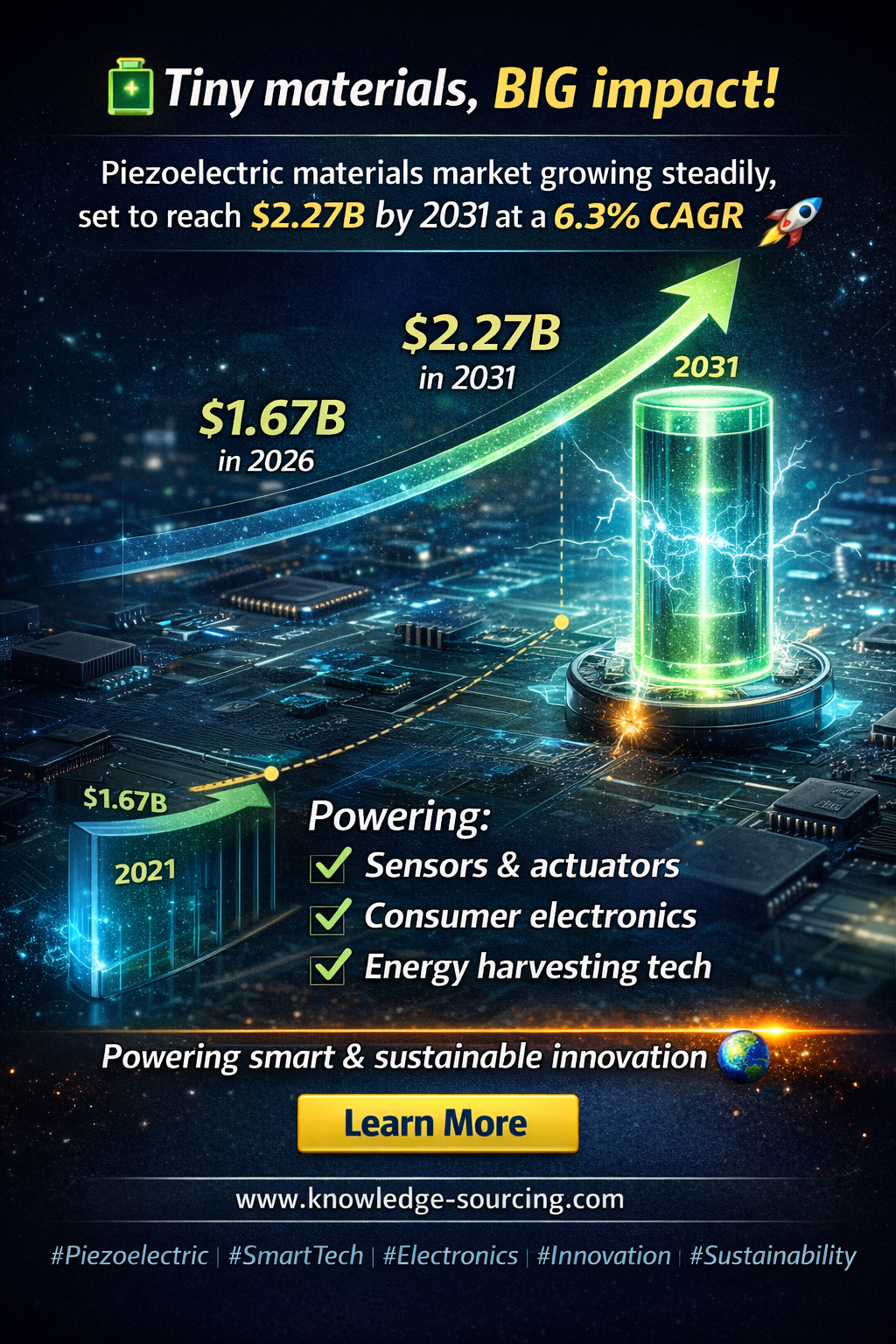
Piezoelectric Materials Market
The sheer ubiquity of piezoelectricity is perhaps its most overlooked trait. We live in a world where the squeeze of a crystal translates into a digital pulse, yet the materials science behind this phenomenon is often relegated to the “solved science” bin of the late 20th century. To view piezoelectric materials as a mature, stagnant market is a fundamental miscalculation. What we are witnessing today isn’t just a linear growth curve; it is a structural pivot.
The global piezoelectric materials market is currently navigating a transition from “functional commodity” to “enabling tech.” While the legacy applications, quartz watches, ultrasound transducers, and basic igniters, provide a stable floor, the ceiling is being lifted by the relentless drive toward miniaturization and the “sensing-everything” ethos of modern industrial design.
The Lead-Free Elephant in the Room
If you talk to any materials scientist worth their salt, the conversation inevitably drifts toward the PZT (Lead Zirconate Titanate) dilemma. For decades, PZT has been the undisputed king. It’s cheap, its electromechanical coupling is fantastic, and we know how to manufacture it at scale. But the regulatory noose is tightening.
Europe’s RoHS (Restriction of Hazardous Substances) exemptions for lead in electronic ceramics won’t last forever. The industry is currently in a high-stakes race to find a lead-free alternative that doesn’t compromise on performance. We’re seeing significant movement in Potassium Sodium Niobate (KNN) and Bismuth Sodium Titanate (BNT) systems. However, the “analytical truth” is that no lead-free material currently matches PZT across all performance metrics. The market is effectively split: high-end medical and aerospace applications are clinging to PZT via exemptions, while consumer-facing IoT startups are aggressively prototyping with lead-free alternatives to future-proof their supply chains. This tension is creating a bifurcated R&D environment that is actually accelerating innovation rather than stifling it.
Automotive: Beyond the Fuel Injector
Historically, the automotive sector’s interest in piezo-ceramics was limited to diesel fuel injectors and parking sensors. That’s changing. As we move toward Level 4 and Level 5 autonomy, the vehicle is essentially becoming a giant, rolling sensor suite.
Solid-state LiDAR is a prime example. Traditional mechanical LiDARs with spinning mirrors are bulky and prone to mechanical failure. Piezoelectric MEMS (Micro-Electromechanical Systems) are enabling the development of mirrors that can tilt at incredibly high frequencies with zero friction. This isn’t just a minor upgrade; it’s the difference between a $10,000 sensor and a $500 sensor.
Furthermore, the rise of Electric Vehicles (EVs) has introduced a new problem: silence. Pedestrian safety regulations now require EVs to emit artificial sound. Piezoelectric speakers are lighter, thinner, and more energy-efficient than traditional electromagnetic coils, making them the darling of EV weight-reduction programs. We expect the “grams-per-vehicle” of piezoelectric material to triple by 2030, driven not by the engine, but by the cabin experience and the safety stack.
The Medical Frontier: Surgery without Scalpels
In the medical device space, we’re seeing a shift from diagnostic imaging to therapeutic intervention. High-Intensity Focused Ultrasound (HIFU) is the “killer app” here. By using piezoelectric transducers to focus ultrasound waves with pinpoint accuracy, surgeons can ablate tumors or treat neurological tremors without making a single incision.
The margin profile in the medical piezo market is substantially higher than in consumer electronics. This is where the real money is being made. Companies aren’t just selling ceramic disks; they are selling integrated sub-assemblies that require extreme biocompatibility and reliability. We are also seeing the emergence of piezoelectric “thin films” in wearable health monitors. Imagine a patch that monitors your pulse not through an optical LED (which eats battery) but through the mechanical pressure of your blood flow against a thin piezo-polymer film (PVDF). This shift from power-consuming sensors to self-powered or low-power mechanical sensors is the next big leap in med-tech.
Energy Harvesting: Hype vs. Reality
Let’s address the energy harvesting “hype.” For years, we’ve been promised floors that power buildings when people walk on them and roads that harvest energy from passing cars. In reality, the ROI on large-scale piezoelectric energy harvesting remains shaky. The power density just isn’t there for grid-scale applications.
However, where energy harvesting is winning is in the “fit and forget” sensor market. In a massive industrial plant, wiring a sensor to a power source can cost ten times the price of the sensor itself. Replacing batteries in 5,000 sensors every two years is a maintenance nightmare. A piezoelectric harvester that captures vibrations from a pump or a motor to power a Zigbee or LoRaWAN transmitter? That’s a value proposition that CFOs actually understand. The market is moving away from “saving the planet” grandiosity toward “reducing OpEx” pragmatism.
Regional Shifts and Supply Chain Sovereignty
Geopolitically, the piezoelectric materials market is as sensitive as the semiconductors it supports. China currently dominates the raw material processing and the lower-end ceramic production. However, Japan, home to giants like Murata and TDK, retains a firm grip on the high-end multi-layer piezoelectric actuators.
We’re seeing a quiet but firm movement toward “near-shoring” production for aerospace and defense applications. The US and Europe are realizing that depending on a single geography for specialized ceramics used in missile guidance systems or sonar is a strategic vulnerability. This is leading to localized “centers of excellence” in regions like Germany and the US Midwest, focusing on high-purity synthesis and specialized sintering techniques.
The Role of 3D Printing (Additive Manufacturing)
Perhaps the most exciting technical development is the marriage of piezoelectric ceramics with 3D printing. Traditionally, piezo components were “press and fire” or “cast and cut.” This limited engineers to simple geometries, disks, rings, and plates.
Additive manufacturing allows for the creation of “lattice” structures. By controlling the architecture of the ceramic at a microscopic level, we can create sensors that are sensitive in only one specific direction or transducers that have a much higher bandwidth than solid ceramics. This “architected matter” is where the next decade of intellectual property will be fought. It allows for a level of customization that turns a commodity material into a highly proprietary component.
The Analyst’s Verdict
The piezoelectric materials market is often characterized as “stable,” but that’s a misnomer. Underneath the surface, there is a frantic churn driven by the transition to lead-free chemistries, the demands of autonomous mobility, and the miniaturization of medical devices.
We aren’t just looking at a market for “rocks that make sparks.” We are looking at the fundamental interface between the physical and digital worlds. As we demand more “haptic” feedback from our devices, more “intelligence” from our infrastructure, and more “precision” from our surgeons, the reliance on piezoelectricity only deepens.
Investors and industry players shouldn’t be looking for the next “big thing” in piezo; they should be looking at the companies that are successfully integrating these materials into complex sub-systems. The value is migrating from the material itself to the integration logic and the specialized manufacturing processes, like thin-film deposition and additive manufacturing.
In short, the squeeze is on, and the pulse of the market has never been stronger. The companies that will thrive are those that stop viewing piezo as a component and start viewing it as the primary language through which machines “feel” the world.
메타데이터
- post_id
- d9f7e6edaecc
- slug
- the-quiet-renaissance-why-piezoelectric-materials-are-the-real-backbone-of-the-autonomy-age-d9f7e6edaecc
- url
- https://medium.com/@abhi.knp82/the-quiet-renaissance-why-piezoelectric-materials-are-the-real-backbone-of-the-autonomy-age-d9f7e6edaecc
- canonical_url
- https://medium.com/@abhi.knp82/the-quiet-renaissance-why-piezoelectric-materials-are-the-real-backbone-of-the-autonomy-age-d9f7e6edaecc
- author_url
- https://medium.com/@abhi.knp82
- status
- ok
- fetched_at
- 2026-07-13 06:23:13




