LSD: The Most Suppressed Cognitive Tool in American History
A molecule that rewired Silicon Valley, dissolved addiction, and inspired the Beatles was criminalized because it worked too well.
LSD: The Most Suppressed Cognitive Tool in American History
A molecule that rewired Silicon Valley, dissolved addiction, and inspired the Beatles was criminalized because it worked too well.
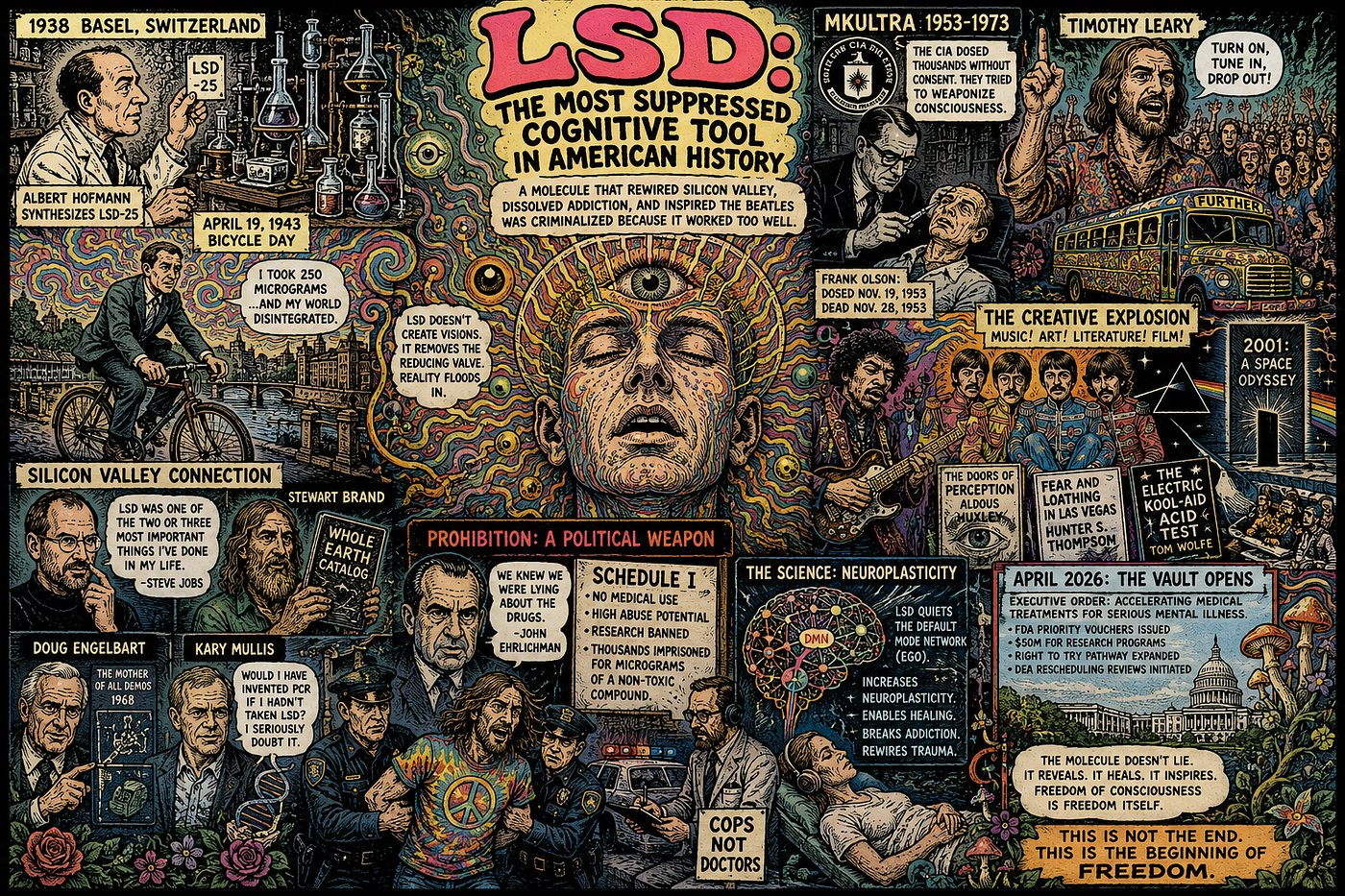
Image created by Author via ChatGPT / Prompted by Abel Arroyo. Visual style inspired by Robert Crumb
On April 19, 1943, Swiss chemist Albert Hofmann deliberately ingested 250 micrograms of lysergic acid diethylamide and rode his bicycle home through Basel experiencing complete ego dissolution. For over half a century, LSD was exiled to Schedule I of the Controlled Substances Act. Classified as having no accepted medical use and high potential for abuse. Criminal possession carried mandatory minimum sentences. Research was effectively banned. Thousands imprisoned for possessing micrograms of crystalline compound. On April 18, 2026, President Donald J. Trump signed an Executive Order titled Accelerating Medical Treatments for Serious Mental Illness. The order directs federal agencies to reduce barriers to the research, clinical review, and where appropriate, the approval of psychedelic compounds as treatments for serious mental illness. On April 24, 2026, the FDA issued its first three Commissioner's National Priority Vouchers to companies studying psilocybin for treatment-resistant depression, psilocybin for major depressive disorder, and methylone for PTSD. The federal government has officially reversed its stance. Dismantled bureaucratic blockades that stifled research for 56 years. This isn't a gradual policy shift.
This is one step closer to Freedom.
This is the beginning of complete vindication of the molecule's therapeutic potential and total repudiation of prohibition. To understand how a single synthetic compound could bridge a Swiss laboratory and Silicon Valley, dissolve alcohol addiction with a single dose, and inspire the Beatles' Sgt. Pepper's Lonely Hearts Club Band, we must conduct a forensic examination of the most misunderstood molecule in human history.
THE ORIGIN STORY
November 16, 1938. Sandoz Laboratories, Basel, Switzerland. Albert Hofmann was a 32-year-old chemist working in the pharmaceutical-chemical department directed by Professor Arthur Stoll. His assignment: investigate the chemical properties of ergot, the parasitic fungus Claviceps purpurea that infects cereal grains, particularly rye. Ergot had a dark history. It caused ergotism, known as Saint Anthony's Fire. Consumption of ergot-infected bread resulted in severe vasoconstriction, gangrene, and terrifying hallucinations. But ergot alkaloids also possessed medical properties. They induced muscle contractions and constricted blood vessels. They were used to stop postpartum hemorrhaging.
Hofmann's objective was to systematically isolate lysergic acid, the central nucleus of ergot alkaloids, and combine it with various organic molecules to create new medically useful derivatives. His goal was to synthesize an analeptic, a respiratory and circulatory stimulant, based on structural similarity to the known stimulant nikethamide. On November 16, 1938, Hofmann executed a complex synthesis. He combined lysergic acid with diethylamine. Because this was the twenty-fifth derivative of lysergic acid he had synthesized in the research program, he cataloged the substance as LSD-25.
Initial pharmacological testing on laboratory animals yielded underwhelming results. The compound did not produce the desired analeptic effects. The only observable anomaly was that animals became remarkably restless during testing. In the results-driven environment of Sandoz, a compound that failed its primary objective was deemed useless. LSD-25 was shelved. Its profound psychoactive properties remained entirely unknown.
For five years the molecule sat dormant while the world descended into World War II. But Hofmann harbored what he later described as a peculiar presentiment about LSD-25. An inexplicable intuition that the compound possessed undiscovered properties. On April 16, 1943, Hofmann made a fateful decision: synthesize a fresh batch of LSD-25. During the crystallization process, a microscopic trace amount accidentally contacted his skin and was absorbed into his bloodstream. Within hours, Hofmann was forced to interrupt his work. He was overcome by a remarkable restlessness combined with slight dizziness. He returned home, lay down, and sank into an intoxicated-like condition characterized by an extremely stimulated imagination. With eyes closed, he perceived an uninterrupted stream of fantastic pictures, extraordinary shapes, and an intense kaleidoscopic play of colors. The effects faded after two hours.
April 19, 1943. Bicycle Day. Hofmann deliberately ingested 250 micrograms of LSD-25. The first intentional acid trip in human history. He rode his bicycle home from the laboratory. The experience was overwhelming. Terrifying. Reality disintegrated. Furniture appeared hostile. His neighbor transformed into a malevolent witch. Time collapsed. Space warped. But a physical examination revealed no organic damage. Vital signs were normal. No toxicity. No addiction. No hangover. Just eight hours of profound consciousness alteration followed by a complete baseline return.
Hofmann's discovery report to Sandoz management was cautious. He described the compound as producing remarkable psychic effects. Sandoz began distributing LSD to psychiatric researchers under the trade name Delysid. It was marketed as a tool for experimental psychosis research. Psychiatrists could temporarily induce schizophrenia-like states to better understand patients' subjective experiences. Between 1947 and 1966, over 1,000 clinical papers were published on LSD. Approximately 40,000 patients were treated with psychedelic therapy. Success rates for alcoholism treatment: 50-70% after a single guided session. Traditional treatment success rate: 5-10%.
THE PHYSICS OF THE FLASH
To understand why LSD produces effects lasting 8-12 hours from a dose measured in micrograms, we must examine molecular mechanics at the receptor level. LSD's primary target is the 5-HT2A serotonin receptor. But unlike most drugs that bind briefly then release, LSD employs a unique mechanism. When an LSD molecule enters the receptor's binding pocket, the extracellular loop of the receptor protein folds over it like a lid. This creates a physical lock. The molecule becomes trapped inside the receptor. It cannot escape. It cannot be metabolized. It cannot be displaced by natural serotonin.
This is why you cannot turn off an LSD experience. It is not psychological. It is mechanical. The physical protein structure holds the synthetic molecule in place. The receptor remains activated until the LSD molecule finally works its way out through conformational changes in the protein structure. The process takes 8-12 hours. This extended binding time explains both the duration and intensity of the experience. A single molecule can activate the same receptor repeatedly, triggering cascades of downstream signaling that fundamentally alter neural communication patterns.
The dose-response curve for LSD is extraordinarily steep. Threshold dose: 20 micrograms. Standard recreational dose: 100-200 micrograms. The difference between barely perceptible effects and complete ego dissolution is a factor of 5-10. Compare this to alcohol, where the difference between a slight buzz and dangerous intoxication might be a factor of 3-4. Precision in dosing is therefore critical. Illicit LSD often has wildly inconsistent potency. Blotter paper is unevenly saturated. Liquid LSD is imprecisely measured. This dosing uncertainty contributes significantly to difficult experiences where users accidentally consume far more than intended.
THE REDUCING VALVE
Aldous Huxley, in The Doors of Perception, introduced the concept of the brain as a reducing valve. The human sensory apparatus receives a massive influx of information every second. The visual cortex processes millions of photons. The auditory cortex analyzes complex sound waves. The proprioceptive system tracks the position of every muscle, joint, and limb. The interoceptive system monitors heart rate, breathing, digestion, and immune response. If all this information reached conscious awareness simultaneously, we would be overwhelmed. Paralyzed by data.
Evolution solved this through filtering. The brain stem, thalamus, and cortical networks create a hierarchical filter system. Ninety-nine point nine percent of sensory information is filtered out before reaching consciousness. What remains is a narrow, manageable stream selected for survival relevance. Predators. Food. Social threats. Navigation. The reducing valve creates a stable, coherent model of reality by massively simplifying actual sensory input.
LSD does not add information to the brain. It removes the filter. The reducing valve opens. Suddenly, consciousness is flooded with unfiltered sensory data. The visual system perceives individual photons as distinct events rather than a smooth, continuous stream. This creates visual breathing, geometric patterns, and fractal complexity in ordinary surfaces. The auditory system detects harmonic overtones normally filtered out. Music becomes infinitely layered. Synesthesia emerges as cross-modal sensory integration that is normally suppressed, becomes active. Sound has color. Color has texture. Texture has emotional valence.
This is why LSD experiences are often described as more real than real. The user is not hallucinating in the sense of perceiving things that do not exist. They are perceiving things that do exist but are normally filtered out. The visual patterns are not random. They are mathematical representations of retinal processing, neural firing patterns, and visual cortex architecture. The profound insights are not delusions. They are recognition of connections and patterns that exist but are normally invisible due to cognitive filtering.
The Default Mode Network serves as the primary component of this reducing valve system. The DMN maintains the narrative self-model, autobiographical memory, future planning, and self-referential thought. It creates the illusion of a continuous, coherent self that persists through time. But this self-model is constructed, edited, and simplified. LSD disrupts DMN function. The self-model dissolves. Without narrative self, without past and future, consciousness exists in an eternal present. This is ego dissolution. Not a loss of consciousness, but a loss of the unconscious filtering that normally creates the sense of a separate self.
THE TURNING POINT
But LSD did not stay in psychiatric clinics. It escaped into culture. And it detonated.
The CIA and MKUltra
- The CIA established the Technical Services Staff under chemist Sidney Gottlieb. Mission: develop chemical and biological methods for interrogation, assassination, and mind control. Program codenamed MKUltra. Launched in 1953. One branch focused on LSD. The CIA believed it could be weaponized. A truth serum. An interrogation enhancer. A cognitive disruptor. They began dosing people without consent. Prisoners. Mental patients. Prostitutes. Johns in CIA-run brothels. Their own personnel. Frank Olson, a bioweapons scientist, was covertly dosed on November 19, 1953. Nine days later, he went through a tenth-floor hotel window in New York. Dead on impact. For 22 years, the CIA called it a suicide. A 1994 exhumation revealed blunt force trauma to the head. Evidence of homicide.
MKUltra ran from 1953 to 1973. At least 149 subprojects. Thousands of unwitting subjects. Most records were destroyed in 1973 by CIA Director Richard Helms to prevent congressional investigation. The irony is precise: the government recognized the molecule's extreme efficacy, attempted to weaponize it for covert warfare, and simultaneously imprisoned citizens for using the same compound for personal growth.
Timothy Leary and Harvard
- Timothy Leary, a psychology professor at Harvard, consumed psilocybin mushrooms in Cuernavaca, Mexico. The experience transformed him. He returned to Harvard and launched the Psilocybin Project. He administered psychedelics to graduate students, prisoners, and divinity students. The Concord Prison Experiment of 1961 showed psilocybin therapy reduced recidivism rates. The Good Friday Experiment on April 20, 1962, demonstrated that psilocybin induced genuine mystical experiences in theology students at Marsh Chapel.
Leary shifted to LSD. He began advocating widespread use. Turn on, tune in, drop out. Harvard fired him in May 1963. But the damage was done. LSD had escaped academic confines. It flooded the counterculture. Ken Kesey's Merry Pranksters hosted Acid Tests. The Grateful Dead played while audiences consumed LSD-laced Kool-Aid. Augustus Owsley Stanley III synthesized millions of doses of exceptionally pure LSD, White Lightning, distributed free at concerts, parties, and gatherings. Nicholas Sand and Tim Scully manufactured Orange Sunshine for the Brotherhood of Eternal Love. 250 million doses over three decades. Woodstock, August 1969: an estimated 300,000 people dosed on Orange Sunshine over a single weekend.
The Missile Silo Industrial Complex
William Leonard Pickard represents the ultimate expression of clandestine industrial chemistry. Between 1990 and 2000, operating from a decommissioned Atlas-E missile silo in Wamego, Kansas, Pickard allegedly manufactured LSD at pharmaceutical scale. The facility was an engineering marvel. A former ICBM launch complex with concrete walls several feet thick. Independent power. Climate control. Total isolation. A perfect environment for synthesis requiring absolute sterility and temperature precision.
The DEA claimed Pickard's operation produced 90% of the global LSD supply during peak years. When he was arrested on November 6, 2000, global acid availability dropped approximately 95% overnight. This was not hyperbole. It was a forensic reality measurable in drug seizure statistics, festival reports, and dark web marketplace prices. An entire world's access to consciousness expansion was dependent on a single man's industrial output. One chemist. One laboratory. Planetary-scale distribution.
The operational security was sophisticated. Precursor chemicals were ordered through legitimate research companies. Equipment was acquired from bankrupt pharmaceutical facilities. Distribution was entirely decentralized. Pickard did not sell to dealers. He provided to trusted intermediates who further distributed through Rainbow Gatherings, Phish tours, Burning Man, and underground chemist networks. No direct contact with end users. No money trails. The operation ran for a decade before it was compromised.
What destroyed it was not a DEA investigation. It was betrayal. Gordon Todd Skinner, a wealthy eccentric who owned the missile silo property, was a DEA informant. He moved laboratory equipment without authorization, creating an evidence trail. Pickard fled. He was apprehended in freezing Kansas fields. Convicted March 23, 2003. Sentenced to two consecutive life terms without parole. He served 20 years. Released July 27, 2020, under compassionate release at age 74, with chronic medical conditions. Today he works as a senior advisor for psychedelic research organizations.
Pickard's conviction marked the effective end of large-scale clandestine LSD production. No one has replicated that industrial capacity. Current LSD availability comes from smaller European synthesis networks and dark web vendors. But total global production remains a fraction of what a single Kansas missile silo generated at peak.
The Silicon Valley Connection
LSD's most profound impact was not musical or spiritual. It was technological. The personal computer revolution was engineered by people who had dissolved their egos on acid.
Steve Jobs famously called LSD one of the two or three most important things he had done in his life. He stated that people who had not used LSD could not fully understand him. Jobs' experience with LSD fundamentally shaped his design philosophy. Simplicity. Intuition. User-centered thinking. The graphical user interface. The mouse. The integration of art and technology. These were not incremental improvements. They were paradigm shifts. And they emerged from minds that had experienced radical cognitive flexibility.
Jobs was not alone. The Homebrew Computer Club, the legendary Silicon Valley gathering where Apple Computer was born, was saturated with psychedelic influence. Stewart Brand, founder of the Whole Earth Catalog, was an early LSD advocate. The Catalog became the bible of the counterculture and tech community. It provided the tools, resources, and ideas that directly enabled the personal computer revolution. Brand's philosophy: access to tools. Empower individuals. Decentralize power. These ideas, forged in psychedelic consciousness, became the foundational principles of Silicon Valley.
Douglas Engelbart, inventor of the computer mouse and pioneer of human-computer interaction, participated in early LSD research studies. His experiences with psychedelics informed his vision of augmenting human intellect through technology. Engelbart's 1968 Mother of All Demos introduced the mouse, hypertext, video conferencing, and collaborative real-time editing, technologies that define modern computing, all conceived by a mind expanded by LSD.
The Creative Explosion
LSD did not just rewire technology. It rewired art, music, literature, and film.
Music
The Beatles' Sgt. Pepper's Lonely Hearts Club Band (1967) is arguably the most influential album in rock history. John Lennon and George Harrison were heavy LSD users during its creation. Lucy in the Sky with Diamonds. A Day in the Life. The album's production techniques, tape loops, backward recording, and orchestral experimentation were direct expressions of psychedelic consciousness. The Beatles were not alone. Jimi Hendrix. Janis Joplin. The Doors. Pink Floyd. The Grateful Dead. These were not musicians who simply happened to use LSD. The molecule fundamentally altered their creative processes. It dissolved conventional song structures, expanded harmonic possibilities, and enabled synesthetic experiences where sound became visual, emotional, and tactile.
Pink Floyd's The Dark Side of the Moon (1973) became the definitive psychedelic album. Designed to be experienced on LSD. Seamless transitions between tracks. Layers of sound reveal new details on repeated listening. Philosophical lyrics exploring madness, mortality, and time. The album spent 741 consecutive weeks on the Billboard 200. It sold over 45 million copies. A cultural phenomenon inseparable from its psychedelic context.
The Grateful Dead built an entire musical career around LSD. Their sound engineer and primary LSD supplier was Augustus Owsley Stanley III. The Dead's improvisational style, extended jams, and complex harmonies were a direct translation of acid consciousness into musical form. Deadheads followed the band across the country, creating a nomadic psychedelic culture. The Dead were not just playing music. They were facilitating collective consciousness experiences.
In New York City, the psychedelic music scene developed a distinct urban edge. The Velvet Underground, led by Lou Reed and produced by Andy Warhol, created an abrasive avant-garde sound influenced by amphetamines and LSD. Their 1967 debut, The Velvet Underground and Nico, was a commercial failure but influenced generations of punk, alternative, and experimental musicians. The band performed at Warhol's Factory and the Exploding Plastic Inevitable multimedia events. Strobe lights. Projected films. Chaotic sensory assault. A distinctly New York interpretation of the psychedelic experience.
Visual Art
Andy Warhol's Factory was not just an art studio. It was a psychedelic laboratory. Warhol himself was ambivalent about LSD, but the Factory was saturated with it. His screen prints, repetitive, kaleidoscopic, intensely colorful, reflected psychedelic aesthetics. His films, like Chelsea Girls (1966), used split-screen techniques, non-linear narrative, and extreme duration to create altered-state viewing experiences.
Alex Grey, visionary artist, creates intricate anatomical-spiritual paintings mapping consciousness. His work directly depicts DMT and LSD visions. It translates ineffable experiences into precise visual language. His Chapel of Sacred Mirrors in New York became a pilgrimage site for the psychedelic community. Grey's art demonstrates that psychedelic visions are not random hallucinations. They are structured, reproducible, universal patterns emerging from neural architecture.
Peter Max's pop art posters, vibrant, cosmic, and flowing, became visual shorthand for the psychedelic era. His work appeared on everything from album covers to postage stamps, spreading psychedelic imagery into mainstream American culture. Max's aesthetic influenced graphic design, advertising, and fashion for decades.
Literature
Aldous Huxley's The Doors of Perception (1954) documented his mescaline experience and became the foundational text for the psychedelic movement. Huxley argued psychedelics opened the doors of perception, allowing direct apprehension of reality unfiltered by the ego's reducing valve. The book influenced Jim Morrison, who named his band The Doors after Huxley's work.
Ken Kesey's One Flew Over the Cuckoo's Nest (1962) was written under the influence of LSD and peyote. Kesey volunteered for CIA-sponsored drug trials at the Veterans Hospital in Menlo Park. The experiences informed his critique of institutional control and his celebration of individual freedom. The novel became a cultural touchstone for the anti-authoritarian counterculture.
Hunter S. Thompson's gonzo journalism was inseparable from psychedelics. Fear and Loathing in Las Vegas (1971) is the definitive chronicle of a drug-fueled American Dream pursuit. Thompson's prose, frantic, hallucinatory, brutally honest, captured psychedelic consciousness in literary form. The book opens with the protagonist and his attorney driving through the Nevada desert with a trunk full of drugs. We had two bags of grass, seventy-five pellets of mescaline, five sheets of high-powered blotter acid, a saltshaker half-full of cocaine, and a whole galaxy of multi-colored uppers, downers, screamers, laughers. Thompson was not glorifying drug use. He was documenting America's relationship with consciousness alteration.
Tom Wolfe's The Electric Kool-Aid Acid Test (1968) chronicled Ken Kesey's Merry Pranksters and their cross-country bus trip. Wolfe embedded with the Pranksters, documenting Acid Tests, interactions with the Hell's Angels, and life at the La Honda compound. The book captured the moment when LSD transitioned from a clinical research tool to a cultural phenomenon.
Film
Stanley Kubrick's 2001: A Space Odyssey (1968) was designed to be viewed on LSD. The Stargate sequence, abstract, overwhelming, and transcendent, simulated the psychedelic experience for audiences. Kubrick consulted with scientists, philosophers, and mystics to create a film exploring the evolution. Audiences attended multiple screenings on acid. Entire sections of theaters were designated as trip zones.
Easy Rider (1969) captured the counterculture's collision with traditional America. Peter Fonda and Dennis Hopper play bikers traveling through the American Southwest. The LSD sequence in a New Orleans cemetery, disorienting, beautiful, and terrifying, became an iconic representation of the acid experience on film.
Terry Gilliam's films, Fear and Loathing in Las Vegas (1998), Brazil (1985), and The Imaginarium of Doctor Parnassus (2009) are saturated with psychedelic imagery and themes. Non-linear narratives. Reality-bending visuals. Critique of authoritarian control. A direct lineage from 1960s psychedelic cinema.
Enter the Void (2009) by Gaspar Noé attempted to cinematically recreate the DMT experience. First-person perspective. Neon-soaked Tokyo. Death and rebirth. Aerial shots simulating out-of-body experiences. Strobing lights. Extreme sensory overload. The film polarized audiences. Some found it transcendent. Others found it unwatchable. But it represented a serious attempt to translate psychedelic consciousness into a visual medium.
Documentaries
The Sunshine Makers (2015) chronicles Tim Scully and Nicholas Sand's Orange Sunshine operation. Interviews with both chemists. Archival footage from the Brotherhood of Eternal Love. Technical details of LSD synthesis. The film humanizes underground chemists. It shows them not as criminals but as believers in consciousness expansion as a human right.
Have a Good Trip: Adventures in Psychedelics (2020) features celebrities discussing their experiences, including Sting, Carrie Fisher, Ben Stiller, Sarah Silverman, and Nick Kroll. A mix of animation and interviews. It demystifies psychedelics and shows that a wide range of successful, functional people have used these substances.
Dosed (2019) follows a woman with severe opioid addiction undergoing ibogaine treatment. It documents complete withdrawal elimination after a single session and profound psychological transformation. The film makes the case for psychedelics as addiction treatment through personal narrative rather than statistics.
New York City's Psychedelic Underground
New York developed a unique psychedelic culture distinct from the West Coast. While San Francisco had Haight-Ashbury's communal pastoralism, New York had the East Village's aggressive urbanism. The city became a massive hub for illicit LSD production and distribution. Head shops proliferated. Day-Glo aesthetics influenced fashion, visual art, and nightlife.
Timothy Leary established his psychedelic research compound at the Millbrook estate in upstate New York, 90 miles from Manhattan. A 2,500-acre property owned by wealthy supporter Billy Hitchcock. Between 1963 and 1968, Millbrook became a pilgrimage site. Intellectuals, artists, and musicians visited to participate in guided LSD sessions and discuss consciousness expansion, cognitive liberty, and social transformation. But its extreme visibility made it a primary target for law enforcement. Millbrook was raided multiple times. Leary was arrested. Eventually convicted and sentenced to prison.
New York hosted highly publicized Senate hearings on LSD dangers. Senator Robert Kennedy questioned Timothy Leary in 1966. Media coverage sensationalized the risks and ignored the therapeutic benefits. It led to brutal crackdowns, aggressive policing, and the systematic dismantling of the urban psychedelic infrastructure.
But the underground persisted. By the early 1970s, New York was a distribution hub for acid synthesized in clandestine laboratories across the country. Rainbow Gatherings. Grateful Dead concerts at Madison Square Garden. Washington Square Park. The molecule circulated through the city's bloodstream despite prohibition.
THE BODY OF WORK
The Neuroscience of Neuroplasticity
LSD's therapeutic mechanism was not understood until recently. A 2016 breakthrough study published in the Proceedings of the National Academy of Sciences used fMRI and MEG scans to map brain activity during the LSD experience. The results were revolutionary.
The Default Mode Network is the brain network active during self-referential thinking, autobiographical memory, and mental simulation of the future. It is the neurological basis of the ego, the narrative self. Under LSD, DMN activity decreases dramatically. Simultaneously, communication between brain regions that normally do not interact increases massively. The visual cortex connects with the auditory cortex. Emotional centers connect with sensory processing. The rigid functional segregation of the sober brain dissolves.
This is ego dissolution. The temporary suspension of the self-model allows psychological restructuring. Why does this matter therapeutically? Because most psychiatric disorders involve pathological DMN activity. Depression manifests as rumination, negative self-focus, and an inability to escape recursive thought patterns. PTSD integrates traumatic memories into the self-narrative and constantly reactivates them. Addiction turns compulsive behavior patterns into part of identity.
LSD breaks these patterns. A single dose can induce a neuroplastic window lasting weeks. During this period the brain is hyper-flexible. New neural connections form. Old pathological patterns can be overwritten. This is why alcoholics achieve 50-70% abstinence rates after a single guided LSD session, compared to traditional treatment's 5-10% success rate. The molecule is not suppressing cravings. It is dissolving the psychological architecture that maintains addiction.
Recent research confirms LSD promotes neuroplasticity through multiple mechanisms. It increases BDNF, the brain-derived neurotrophic factor essential for neuron growth and survival. It activates the mTOR pathway, crucial for synaptic plasticity. It promotes dendritic spine growth in the prefrontal cortex. These are not temporary effects. Structural changes persist for weeks after a single dose.
The Addiction Solution
The April 2026 clinical data are overwhelming. Johns Hopkins's psilocybin studies show an 80% smoking cessation rate at 12-month follow-up. NYU and Johns Hopkins MDMA-assisted psychotherapy for alcohol use disorder shows an 83% reduction in heavy drinking days. Imperial College London LSD microdosing studies show significant improvements in mood, creativity, and focus without impairment.
The most dramatic results come from ibogaine, a related psychedelic compound derived from an African shrub. A single ibogaine session eliminates opioid withdrawal symptoms and reduces cravings for months. Veterans with severe PTSD and opioid addiction report complete remission after a single treatment. The mechanism: ibogaine resets opioid receptors, interrupts addiction circuitry, and provides an intense introspective experience that allows psychological integration.
The traditional addiction treatment model requires lifelong disease management. Twelve-step programs. Medication-assisted treatment with methadone or buprenorphine, which substitutes one opioid for another. Relapse rates run 40-60% within the first year. The psychedelic model is an acute intervention inducing psychological transformation. A single session or a short series of sessions. It addresses root causes, trauma, depression, and existential distress, not just symptoms.
The economic implications are staggering. The opioid epidemic costs the US economy $1 trillion annually. The traditional treatment infrastructure is a massive industry. Rehab facilities. Pharmaceutical companies. Insurance billing. If psychedelics can achieve 50-70% success rates with single-session treatment, the entire addiction-industrial complex becomes obsolete.
The Hall of Fame
LSD's influence extends far beyond the counterculture. High-functioning individuals across all fields have credited the molecule with breakthrough insights.
Science: Francis Crick, co-discoverer of DNA's double helix structure, reportedly used LSD regularly. Multiple colleagues reported his openness about psychedelic use and its influence on his thinking. Kary Mullis, Nobel Prize winner who invented the polymerase chain reaction, the fundamental technique in molecular biology, explicitly credited LSD: would I have invented PCR if I hadn't taken LSD? I seriously doubt it. I could sit on a DNA molecule and watch the polymers go by. I learned that partly through psychedelic experiences.
Technology: Steve Jobs stated that taking LSD was a profound experience, one of the most important things in my life. LSD shows you that there's another side to the coin, and you can't remember it when it wears off, but you know it. It reinforced my sense of what was important, creating great things instead of making money, putting things back into the stream of history and of human consciousness as much as I could. Bill Gates admitted to LSD experimentation in his youth. Microsoft's early culture was influenced by counterculture values of empowerment through technology.
Culture: Cary Grant, classic Hollywood actor, underwent LSD-assisted psychotherapy in the 1950s with Dr. Mortimer Hartman in Los Angeles. Over 100 sessions between 1958 and 1961. Grant credited the therapy with saving his life, resolving childhood trauma, and improving his relationships. He spoke publicly about the benefits, helping destigmatize psychedelic therapy among mainstream audiences. George Carlin used LSD extensively in the 1960s. It dissolved his clean-cut nightclub persona, and he emerged as a counter-culture prophet. His comedy became a forensic deconstruction of American cognitive architecture. Carlin's ability to identify linguistic absurdities, social hypocrisies, and institutional contradictions was sharpened by ego dissolution experiences. Bill Hicks described psychedelics as essential to his worldview: today, a young man on acid realized that all matter is merely energy condensed to a slow vibration, that we are all one consciousness experiencing itself subjectively. There's no such thing as death, life is only a dream, and we're the imagination of ourselves. Hicks' comedy operated on an ontological level. It questioned the fundamental nature of reality, consciousness, and social control.
Art: Nearly every significant artistic movement from the 1960s onward carries psychedelic influence. The molecule did not just inspire art. It fundamentally altered what humans believed art could be. It dissolved boundaries between disciplines. Music became visual. Painting became narrative. Film became experiential. The rigid categorizations of pre-psychedelic art gave way to multimedia, immersive, consciousness-expanding works.
THE TRAGEDY
The prohibition of LSD was a political weapon, not a public health measure.
California became the first state to criminalize LSD in 1966. Federal prohibition followed with the Controlled Substances Act of 1970. LSD was classified as Schedule I, defined as having high potential for abuse, no currently accepted medical use, and a lack of accepted safety for use under medical supervision. All three criteria were demonstrably false. LSD has extremely low addiction potential. The estimated lethal dose for 50% of the population is approximately 12,000 micrograms for humans. The standard dose is 100-200 micrograms. The safety margin is 60-120 times the effective dose. No confirmed deaths from LSD overdose exist in the medical literature. Therapeutic use was well-documented with over 1,000 clinical papers published before prohibition. But prohibition was not about safety. It was about control.
John Ehrlichman, Nixon's domestic policy advisor, admitted decades later: the Nixon campaign in 1968, and the Nixon White House after that, had two enemies: the anti-war left and Black people. We knew we couldn't make it illegal to be either against the war or Black, but by getting the public to associate the hippies with marijuana and Blacks with heroin, and then criminalizing both heavily, we could disrupt those communities. Did we know we were lying about the drugs? Of course, we did.
LSD became a proxy for controlling the counterculture. Criminalizing consciousness expansion. Thousands were imprisoned for possessing micrograms of a non-toxic compound. Research stopped. Therapeutic applications were abandoned. An entire generation of potential treatments was lost.
The concept of cognitive liberty argues that the fundamental right to freedom of thought must include the right to control one's own mental processes through chemical means. Legal scholars frame this as an extension of bodily autonomy. A government prohibiting the victimless use of consciousness-altering substances is a profound overreach. It dictates acceptable parameters of human consciousness and criminalizes the pursuit of psychological healing and spiritual exploration.
New York City was ground zero for enforcement. Highly publicized arrests. Senate hearings. Media hysteria. The visibility of the New York scene made it a primary target. Head shops were raided. Dealers were prosecuted. Users were imprisoned. The urban psychedelic infrastructure was systematically destroyed.
But prohibition failed. LSD remained available through the black market. Underground chemists continued synthesis. Distribution networks persisted. What prohibition accomplished was stripping away clinical oversight, precise dosing, and the therapeutic frameworks that maximized safety and efficacy. It created an unregulated market where dosage was unknown, purity was uncertain, and guidance was unavailable. These were the very conditions that made psychedelic use dangerous.
The Misconception of Bad Trips
The phrase bad trip has done immeasurable damage to public understanding of psychedelics. It suggests that negative experiences are random, unpredictable, and inherent to the molecule itself. This is false. The overwhelming majority of difficult psychedelic experiences result from controllable variables: set, setting, dose, purity, mental state, and physical environment.
Set refers to a mindset. The internal psychological state before ingestion. Someone approaching LSD with anxiety, fear, or resistance will likely have a challenging experience. Someone approaching with openness, curiosity, and acceptance will likely have a positive one. This does not mean you must be ecstatically happy to take LSD. It means you must be mentally prepared for a profound psychological experience.
Setting refers to the physical and social environment. A clean, comfortable, familiar space is ideal. Your home. A trusted friend's house. A nature setting you know well. Avoid crowds, unfamiliar locations, and chaotic environments. Turn off the phone. Eliminate interruptions. Create a sanctuary where you feel completely safe.
The importance of setting cannot be overstated. The same dose of LSD can produce a transcendent mystical experience in a comfortable bedroom with a trusted friend or a terrifying paranoid nightmare in a crowded festival surrounded by strangers. The molecule amplifies your relationship with the environment. If the environment feels threatening, the experience becomes threatening.
A sober guide is helpful but not always necessary. Many experienced users prefer solo trips. The key is preparation. If taking LSD alone: know your dose, start low if inexperienced, 50-75 micrograms is a reasonable first dose; test your substance using the Ehrlich reagent which confirms the presence of LSD for about $20 and eliminates the risk of consuming dangerous research chemicals sold as acid; clear your schedule for 10-12 hours with no obligations; prepare your space by cleaning beforehand and stocking easy-to-eat foods; create a playlist in advance; have grounding objects like a blanket or journal available; remember it is temporary, because if the experience becomes challenging, the effects will end; and change environments if needed, because movement and environmental change can completely shift the trajectory of an experience.
Most reported difficult experiences involve an uncontrolled dose, an adulterated substance that is not actually LSD, a hostile or unfamiliar environment, psychological resistance where the user fights the experience rather than surrendering to it, or a combination with other substances like alcohol or stimulants. All of these are preventable. LSD is extraordinarily safe when used responsibly. The danger is not the molecule. It is the prohibition-created black market conditions that make safe use difficult.
THE LEGACY AND THE VAULT
April 18, 2026. Executive Order: Accelerating Medical Treatments for Serious Mental Illness. President Trump's directive represents a substantial reversal of 56 years of prohibition policy.
Key provisions confirmed in the published order and subsequent agency actions: the FDA is directed to issue Commissioner's National Priority Vouchers to appropriate psychedelic drugs that have received Breakthrough Therapy designations, and on April 24, 2026, issued the first three vouchers to companies studying psilocybin for treatment-resistant depression, psilocybin for major depressive disorder, and methylone for PTSD. A pathway is being established for eligible patients to access investigational psychedelic drugs under the Right to Try Act. ARPA-H is allocating at least $50 million to support state government psychedelic research programs. The DEA and Department of Justice are directed to initiate rescheduling reviews of any Schedule I substance that completes Phase 3 clinical trials.
It is critical to be precise about what the order does and does not do. It does not approve any psychedelic drug for medical use. It does not reschedule any substance. It does not create enforceable rights for patients or providers. What it does is meaningfully reshape the regulatory environment and signal the most significant federal policy shift in mental health treatment in decades. The path from this order to a patient receiving LSD-assisted therapy in a clinical setting still runs through completed Phase 3 trials, FDA approval, and formal rescheduling. But the bureaucratic obstacles that blocked that path for 56 years have officially been dismantled.
The DEA finalized its 2026 Aggregate Production Quotas on January 5, 2026. LSD: 1,200 grams, enough for 12 million doses at 100 micrograms each. Psilocybin: 50,000 grams, up from approximately 30,000 grams in previous years. Psilocyn: 80,000 grams. DMT: 25,000 grams, up from 20,000 grams. These numbers are not arbitrary. They are the quantifiable results of overwhelming clinical evidence. The physical vault of raw chemical material is required to complete the final stages of this research.
Current clinical trials active as of July 2026: Johns Hopkins is studying psilocybin for treatment-resistant depression, smoking cessation, and alcohol use disorder. Imperial College London is studying LSD microdosing for depression, anxiety, and creativity enhancement. The University of Basel is studying LSD-assisted psychotherapy for anxiety in terminal illness. Compass Pathways is pursuing FDA approval for COMP360, its synthetic psilocybin formulation for treatment-resistant depression. Definium Therapeutics is developing DT120-LSD, an LSD D-tartrate orally disintegrated tablet for generalized anxiety disorder, which has already received Breakthrough Therapy designation.
The 2026 Economic War: Patenting Nature
But legitimization creates a new threat. Pharmaceutical companies are racing to capture the psychedelic market. The transition from criminalization to corporatization.
Compass Pathways developed COMP360, its synthetic psilocybin formulation. The company does not claim a patent on the psilocybin molecule itself since prior art has been established for decades. Instead, it patents a specific polymorph, a particular crystalline structure of synthesized psilocybin, alongside dosing protocols, therapy methods, and clinical trial designs.
ATAI Life Sciences operates a similar strategy across a portfolio that includes DMT, ibogaine analogs, and arketamine. Not patenting molecules. Patenting delivery mechanisms, formulations, and therapeutic frameworks.
MindMed focuses on LSD derivatives. Its MM120 is a proprietary LSD formulation being developed for anxiety disorders. Its 18-MC is an ibogaine analog claimed to retain anti-addictive properties without the psychoactive effects.
Cybin develops psilocybin analogs with modified pharmacokinetics. Faster onset. Shorter duration. Designed for clinical convenience. Trademarked as CYB003.
The question the market cannot answer: Should nature be patentable? Psilocybin exists in hundreds of mushroom species. DMT is produced endogenously in the human brain and found throughout the plant kingdom. LSD is synthetic but synthesized from an ergot alkaloid that is a natural precursor. These compounds already exist. The research documenting their therapeutic value was done decades ago, before prohibition. Companies did not discover these properties. They are rediscovering what the government suppressed. Patenting the therapeutic use of compounds that belong to human history creates monopolies on treatments that should be in the public domain.
The same government that spent 50 years calling psychedelics dangerous drugs with no medical use is now helping corporations build proprietary claims around them. FDA Breakthrough Therapy designations. Orphan drug status. Market exclusivity periods. This accelerates approval while concentrating control. The risk is that psychedelic medicine becomes accessible only to the wealthy. $10,000 to $15,000 per treatment session. Insurance declining coverage. Two-tier healing. The rich get treatment. Poor people stay traumatized.
The alternative model is Oregon's Measure 109, which created licensed psilocybin therapy without restricting it to a single company. Multiple providers. Competitive pricing. Eventual insurance coverage. This model prioritizes access over profit.
The cognitive liberty movement argues for full legalization. Adults should have the right to access psychedelics outside a medical context. For spiritual growth. Creative exploration. Personal development. Not everything requires a prescription. Not every beneficial experience is a medical treatment.
THE FINAL VAULT
When we examine the forensic history of LSD, from Hofmann's 1943 bicycle ride to the 2026 Executive Order, we are forced to confront how many decades of suffering could have been prevented. How many alcoholics died who could have been saved with a single guided session? How many veterans who committed suicide could have found healing through MDMA therapy? How many depressed individuals suffered for years who could have achieved remission with psilocybin, ayahuasca, psychedelic mushrooms, or another therapeutic psychedelic?
The suppression of LSD was not a public health triumph. It was a catastrophic failure. A political weapon deployed against the counterculture that delayed life-saving medical treatments for over half a century. The molecule that dissolved the rigid boundaries of consciousness, catalyzed the personal computer revolution, and offered a neuroplastic solution to addiction and depression was criminalized because it threatened the established order.
The reducing valve that filters human perception serves an evolutionary purpose. But it also limits human potential. LSD temporarily removes that filter. It allows an unfiltered sensory experience. It dissolves ego boundaries. It enables psychological restructuring. This is not a malfunction. It is a feature.
The molecule does not add anything to the brain. It reveals what was always there. The visual patterns are neural architecture made visible. The profound insights are connections normally suppressed by cognitive filters. The ego dissolution is the recognition that the narrative self is constructed, not fundamental.
As we stand in July 2026, watching the first federal vouchers issue and the first rescheduling reviews begin, the question is not whether psychedelics should be legal. The evidence has settled that. The question is whether we will learn from the prohibition's failure. Will we prioritize access, education, and harm reduction? Or will we allow pharmaceutical capture to restrict availability, inflate costs, and limit therapeutic potential?
The vault is open. The quotas are set. The clinical trials are running. The molecule that Albert Hofmann accidentally absorbed 83 years ago is finally being recognized for what it always was: one of the most significant cognitive tools in human history.
How many more breakthroughs, scientific, technological, artistic, therapeutic, await on the other side of consciousness expansion? And how many will we continue to suppress because we are afraid of what humans might discover when we finally allow them to explore the full potential of their own minds?
The missile silo is empty. The industrial production has ceased. But the knowledge remains. The synthesis is published. The therapeutic protocols are documented. The molecule persists. And as long as humans seek to understand consciousness, to heal trauma, to dissolve the ego boundaries that separate us from each other and from reality itself, LSD will endure. Not as a relic of 1960s counterculture. But as a tool for exploring the final frontier. The landscape of human consciousness itself.
About the Author
Abel Arroyo is a cultural critic and forensic biographer dedicated to the Intellectual Resistance, the creators, whistleblowers, and truth tellers who broke the machine to save their souls. His work interrogates the intersection of power, suppressed knowledge, and human cost, providing a rigorous examination of the systems and texts that define how we understand existence. If you find value in these deep dives into the architects of modern dissent and ancient wisdom, consider supporting independent journalism. buymeacoffee.com/dathaze20j
메타데이터
- post_id
- d9fea00391b0
- slug
- lsd-the-most-suppressed-cognitive-tool-in-american-history-d9fea00391b0
- url
- https://medium.com/illumination-philosophy-and-metaphysics/lsd-the-most-suppressed-cognitive-tool-in-american-history-d9fea00391b0
- canonical_url
- https://medium.com/illumination-philosophy-and-metaphysics/lsd-the-most-suppressed-cognitive-tool-in-american-history-d9fea00391b0
- author_url
- https://medium.com/@dathaze20
- status
- ok
- fetched_at
- 2026-07-08 20:12:56