Product Operating Model: Bridging the Gulf of Execution and Evaluation
Closing the gap between strategy and perceived value starts and ends with the human at the center
Product Operating Model: Bridging the Gulf of Execution and Evaluation
In over a decade of leading product and experience strategy, I have observed a recurring disconnect between digital investment and business outcomes. While ‘Digital Transformation’ often leads to a modernization of the tech stack, it frequently fails to modernize the operating model. The machinery is upgraded, but the way decisions are made, teams are organized, and value is perceived by leadership remains unchanged.
The fundamental goal of a Product Operating Model is to shift an organization from an Inside-Out orientation, driven by departmental priorities, to an Outside-In orientation driven by the human at the end of every process. In essence, the Product Operating Model is human centricity in practice.
This shift is necessary to bridge two psychological and operational gaps originally identified by Donald Norman in the context of human machine interaction, and which apply with deliberate force to modern organizations:
The Gulf of Execution: the distance between a business objective and a team’s ability to determine the correct solution.
The Gulf of Evaluation: the distance between a team’s effort and the C-Suite’s ability to perceive the actual value created.
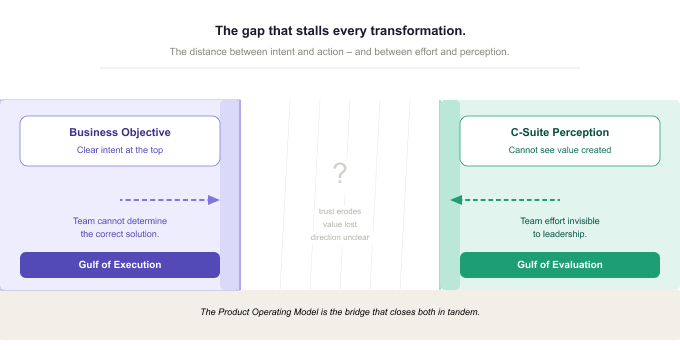
In Norman’s original context, these gulfs described the friction between a person and a poorly designed tool: the gap between what someone intends to do and what the system allows, and between what the system does and what the person can perceive. The same structural breakdown applies with equal force to how organizations operate.
Note that Norman’s original framing addressed individual interaction with tools and systems. The extension of these concepts to organizational strategy is a deliberate one. The same cognitive gaps that prevent a person from operating a poorly designed machine prevent a leadership team from steering a poorly structured organization. When both gulfs are wide, trust erodes. Teams default to shipping volume over impact. ‘Feature Factories’ emerge, organizations running at full speed with no clear direction.
This article examines the most common failure patterns in transformation, and the disciplines required to close both gaps together.
The Budget Trap: Over-Engineering and Hiring Without Vision
One of the most expensive mistakes in any transformation is what I call the ‘Scaling Mirage.’ Organizations attempt to solve a lack of product vision by flooding departments with high-priced talent and investing in complex technical architecture before the core value proposition has been validated.
The reality is that without a clear Product Vision and Strategy, this hiring spree quickly exhausts the budget. You end up with a massive engineering engine running at full speed, disconnected from any steering mechanism. The result is over engineered systems and a burn rate that consumes the available investment before the first unit of customer value is delivered.
The antidote is sequencing: North Star and vision before structure, validated value before scale. Teams that get this right fund discovery before they fund delivery, and in doing so begin to close the Gulf of Execution.
The Legacy Anchor: Beyond the ‘Big Bang’ Migration
Moving away from legacy systems remains the greatest operational hurdle for established global brands. As highlighted in Marty Cagan’s Transformed, the trap is the ‘all-or-nothing’ rewrite: the belief that the organization must complete a full migration before any new value can be delivered.
The fix is to stop treating technology migration as a backend project and instead migrate the Operational Value Stream. This means building the new stack around the user journey: prioritizing releases around the primary jobs customers need to get done, and replacing legacy components incrementally as each one becomes a barrier to a specific customer outcome. This approach ensures the transformation delivers measurable ROI during the migration, not only at the end of it.
Structural Logic: From Work Streams to Value Streams
Many organizations define ‘Value Streams’ based on their org chart, with structures like ‘B2B Digital,’ ‘Pricing,’ or ‘Logistics.’ These are Work Streams in practice, regardless of what they are called. Labeling them differently does not make them value streams.
A true Value Stream infuses the Operational Value Stream (the end-to-end human journey) with the Development Value Stream (the technical engine that enables it). Rather than aligning teams to departments, we align them to the continuous flow of value delivered to a specific customer. This is not a simple plug-and-play integration, and it would be a mistake to treat it as one. This transition requires deep operational discipline and contextual judgment: new team typology, new funding logic, new success metrics, and new rituals.
The structural change is the easy part. The behavioral and cultural change is where most transformations stall.
Leadership Logic: From Advocacy to Accountability
In most organizations today, prioritization works like this: leaders receive a mountain of disconnected requests from across the business: Digital wants a new platform, Supply Chain wants integration, Sales wants a configure price quote tool. These initiatives are then ranked against each other, with no common unit of value. The organization ends up choosing between departments rather than choosing between customer value outcomes. Digital versus Supply Chain versus Sales. Each initiative competes for budget as if it were independent of the others.
The Product Operating Model changes this entirely. C-Suite leaders move from managing a roadmap of initiatives to stewarding a Product Vision and Strategy. Prioritization shifts from ‘which department’s request do we fund this quarter?’ to ‘which human problem, if solved, generates the highest return across the full customer journey?’
Initiatives are evaluated against a shared customer context (Gulf of Evaluation), which stops the coordinating and starts the strategy.
One of the most common and most understandable dynamics in this environment is when the commercial roadmap becomes sales driven by default. Not because sales teams are wrong to advocate for what they are hearing from customers, but because no shared customer outcome framework exists to evaluate those requests against. Sales is responding rationally to the incentives the current operating model creates.
The Product Operating Model does not reduce sales input; it gives that input a structured home, connecting what sales hears in the field directly to the customer outcomes the product team is already working to deliver.
This reorientation is not a process change. It is a leadership development challenge that requires executives to hold customer outcomes and commercial return in the same frame simultaneously. Of all the variables in a transformation, none multiplies faster than C-level conviction: leadership visibly and repeatedly connecting the operating model to the strategic pillars of the business. When that signal is present, every other part of the system moves faster.
Having named the four failure patterns, the question becomes: What does closing both gulfs require in practice? The answer lies in four interconnected disciplines.
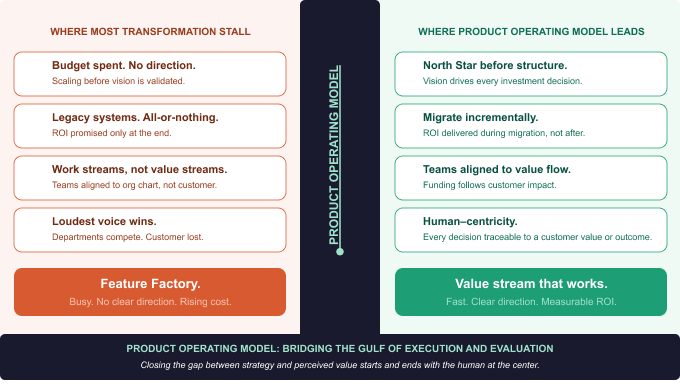
Recognizing the pattern is the first step. Closing it is the discipline.
The Path Forward: Closing Both Gulfs
To move from ‘being busy’ to ‘creating value,’ the Product Operating Model rests on four strategic disciplines:
User Journeys and Jobs to Be Done (JTBD). It starts with the human in mind: their specific goal they are trying to achieve, the job they need to get done, the experience they are navigating today. The key artifacts are not slide decks: they are JTBD statements that anchor the team in customer intent, current state journey maps that make friction visible, and value stream maps that trace how work flows through the organization. These artifacts do two things simultaneously. They expose the specific friction points costing the business money through churn or inefficiency, and they create a shared language that connects the team’s daily work to customer outcomes.
The Data and Technology Stack. The technical infrastructure must support realtime visibility into customer behavior and product performance. If a team cannot measure the impact of their changes within days, not quarters, they are flying blind. Instrumentation is not an afterthought; it is a precondition for learning.
Competence in Product Discovery. The model only works if teams are equipped to validate value and usability before engineering builds. Discovery is not a phase; it is a continuous discipline that sits alongside delivery. Teams that skip it don’t save time; they spend it building the wrong things.
Prioritization Based on Value and Impact. Every initiative is scored against expected value outcome versus cost of effort. This prevents the budget exhaustion that comes from prioritizing by noise rather than signal. Crucially, in a mature model, funding is adjusted by Value Stream, not by department. Resources flow to where customer impact is highest, not to where advocacy is loudest. This is one of the most powerful structural shifts in the model: it removes the departmental competition for budget and replaces it with a customer outcome driven investment logic.
The Contextual Pivot: Avoiding the Blueprint Trap
Before discussing measurement, it is worth naming a risk that sits across all of the above: the temptation to copy-paste.
The Product Operating Model is not a plug-and-play prescription. A significant risk in any transformation is the attempt to replicate a model from a Silicon Valley scale up or a large consultancy engagement without accounting for an organization’s unique customers, business model, regulatory environment, or internal culture.
Competence over dogma. Success does not come from memorizing frameworks. It requires what I call Contextual Intelligence: leaders who understand the principles behind the model well enough to adapt them to specific constraints. A global retailer migrating a 20-year-old commerce platform is not Spotify. A B2B enterprise with 18-month procurement cycles is not a consumer app.
True transformation is led by practitioners who can distinguish between universal product truths and the specific tactical needs of their environment, and who resist the consultant’s instinct to make everything look like the case study.
Connecting to the Profit and Loss (P&L)
The ultimate objective of the Product Operating Model is to accelerate innovation while increasing operational efficiency. These are not in tension; they are the same motion, when the model is working.
But before an organization can connect product work to the P&L, it must do something most skip: map where value is currently leaking. Many organizations react to high transformation spend by reducing talent and pausing programs before they understand where current value is being generated and where it is being lost. While it is a very natural and logical step, reducing without a North Star, a delivery map, and visibility into your current value delivery creates hidden costs: lost knowledge, stalled programs, rework, and systems that nobody fully owns. The discipline is to audit before you act. Find where energy, money, and effort are leaking across your value streams first. Then decisions about where to invest, pause, or stop become defensible and data driven.
Capital saved without value mapping simply becomes the cost of stalling and rebuilding later.
By adding a cost dimension to every value stream, we connect product work directly to the P&L. Value streams generate return from two directions: operational efficiency on one side, and faster route to customer value on the other. When we measure both against cost of effort, by value stream rather than by department, the operating model becomes a mathematically defensible investment strategy. This same lens also brings clarity to capital allocation: product work connected to value streams can be categorized with precision between innovation investment and operational expenditure, shifting budgeting from a subjective exercise to a financially accountable one.
The P&L lens closes the Gulf of Evaluation. It gives the C-Suite the visibility to perceive tangible value, not just activity. And it gives product teams the context to understand why their work matters commercially, not just operationally.
Conclusion
Before adopting any new framework, leadership must answer one question:
“Who is the human at the end of this value stream, and what is the measurable outcome if we improve their journey?”
The answer is never found in a department. It is found in the human journey that the organization exists to serve.
When the human journey and the company’s key objectives are aligned, the system of ROI and the operating model naturally follow. By placing the human at the center of our model, we are optimizing the organization’s most critical financial and operational engine.
To conclude: a Product Operating Model is not a canvas on a wall. It is the everyday discipline of narrowing the Gulf of Execution and the Gulf of Evaluation, in tandem.
To be continued in Part 2: “Product Operating Model in Practice: To Know Where You Are Going, You First Need to Know Where You Came From”
References
Cagan, M. (2024). Transformed: Moving to the Product Operating Model. Wiley.
Norman, D. (2013). The Design of Everyday Things (Revised and Expanded Edition). Basic Books.
Perri, M. (2018). Escaping the Build Trap: How Effective Product Management Creates Real Value. O’Reilly Media.
Gothelf, J. and Seiden, J. (2021). Lean UX: Designing Great Products with Agile Teams (3rd Edition). O’Reilly Media.
메타데이터
- post_id
- da01ac5e31f5
- slug
- product-operating-model-bridging-the-gulf-of-execution-and-evaluation-da01ac5e31f5
- url
- https://medium.com/@Pariiizad/product-operating-model-bridging-the-gulf-of-execution-and-evaluation-da01ac5e31f5
- canonical_url
- https://medium.com/@Pariiizad/product-operating-model-bridging-the-gulf-of-execution-and-evaluation-da01ac5e31f5
- author_url
- https://medium.com/@Pariiizad
- status
- ok
- fetched_at
- 2026-07-10 00:23:36