Lithium Iron Phosphate Batteries: The Honest Guide Nobody in the Solar Industry Wants to Write
No affiliate bias. No spec-sheet fluff. Just what you need to know before spending serious money on LiFePO4.
Lithium Iron Phosphate Batteries: The Honest Guide Nobody in the Solar Industry Wants to Write
No affiliate bias. No spec-sheet fluff. Just what you need to know before spending serious money on LiFePO4.
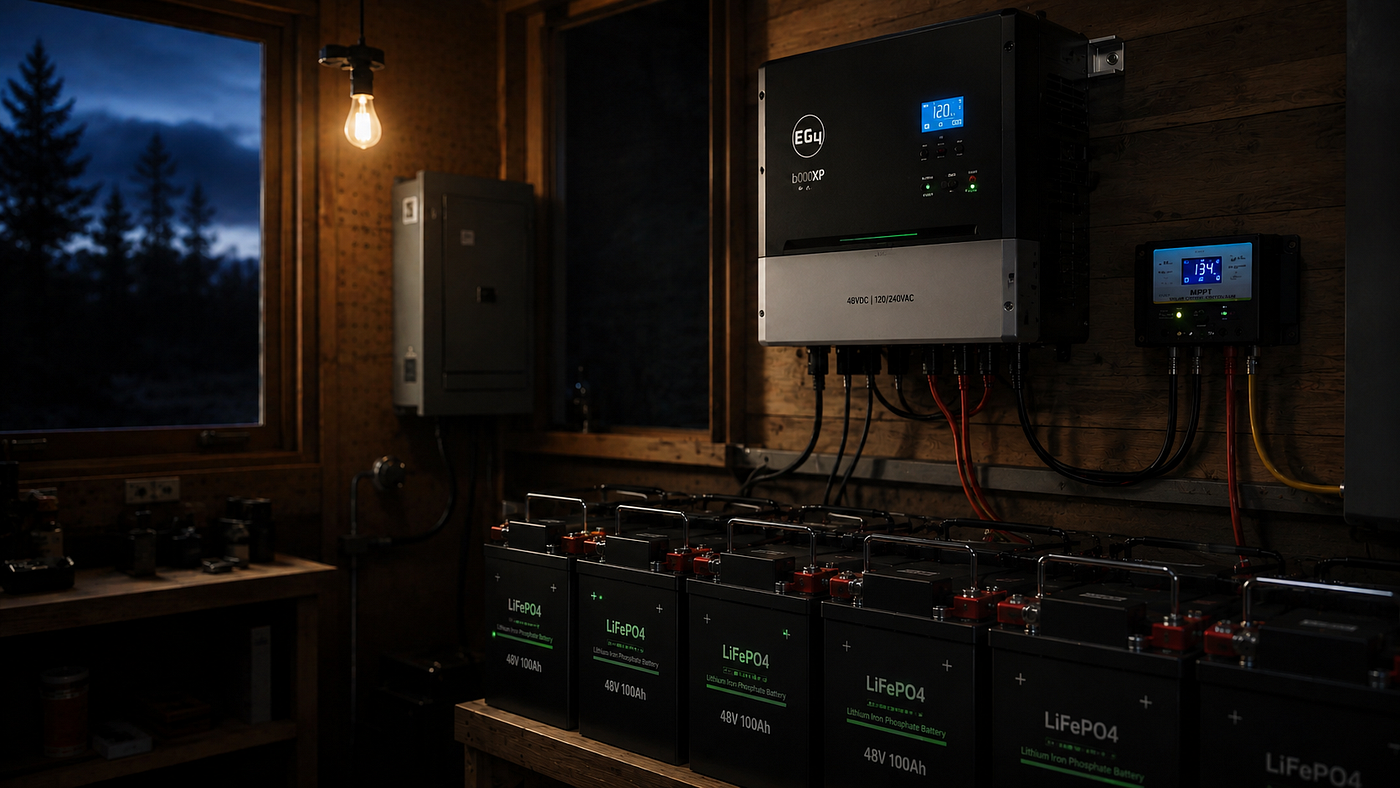
Every few years, a technology crosses the line from “enthusiast upgrade” to “obvious correct choice.” For off-grid energy storage, lithium iron phosphate batteries have crossed that line.
But the buying process is still a mess.
You’ve got manufacturers quoting cycle counts that assume laboratory conditions. Retailers comparing apples to oranges on capacity specs. Forum threads that are three years old and no longer accurate. And a price range so wide — from $200 to $4,000+ for nominally similar batteries — that it’s nearly impossible to know if you’re getting a deal or getting burned.
This guide exists to cut through that noise.
What Makes LiFePO4 Different From Other Lithium Batteries
Not all lithium batteries are the same. The “lithium” category includes several chemistries — NMC (nickel manganese cobalt), NCA (nickel cobalt aluminum), and LFP (lithium iron phosphate, or LiFePO4) being the most common.
The differences matter.
LiFePO4 vs. NMC at a glance:
NMC batteries offer higher energy density — they pack more watt-hours into a smaller, lighter package. That’s why they dominate electric vehicles where weight is critical. But they run hotter, degrade faster under deep cycling, and carry a meaningful thermal runaway risk.
LiFePO4 trades some energy density for dramatically better thermal stability, longer cycle life, and safer chemistry. The iron-phosphate bond is stronger than the cobalt-oxide structure in NMC, which means it doesn’t release oxygen when it breaks down — the primary mechanism behind lithium battery fires.
For a stationary off-grid application — a cabin, a van, a backup power system — you don’t need the absolute highest energy density. You need something that will quietly cycle 2,000–5,000 times without drama. LiFePO4 wins that application decisively.
The Spec That Actually Determines Lifespan
Marketing materials love to lead with cycle count. “3000 cycles!” “5000 cycles!” These numbers are real — but they require context.
Cycle count is always stated at a specific Depth of Discharge (DoD).
Most manufacturers quote cycle life at 80% DoD. Some quote at 100% DoD. A few quote at 50% DoD, which inflates the number dramatically.
A battery rated for 3,000 cycles at 80% DoD and another rated for 3,000 cycles at 50% DoD are not equivalent. The second one has meaningfully shorter real-world lifespan under typical use.
The formula that actually matters:
Usable Lifetime Energy = (Ah × Voltage × DoD × Cycles) / 1000 = kWh delivered over battery life
Run this calculation on any battery you’re comparing. It converts marketing language into an actual number you can evaluate.
BMS: The Component Nobody Talks About Enough
Inside every lithium iron phosphate battery pack is a Battery Management System. This is the electronic brain that:
- Monitors cell voltage balance
- Controls charge and discharge cutoffs
- Manages temperature protection
- Communicates state of charge to your inverter or display
A bad BMS will kill a good battery. A good BMS will protect a decent battery and give it a full lifespan.
What to look for in a BMS:
- Cell-level balancing (active or passive — active is better but more expensive)
- Low-temperature charge cutoff (critical if you’re in a cold climate — LiFePO4 cannot be charged below freezing without damage)
- High-temperature discharge protection
- Communication protocol (Bluetooth, RS485, CAN bus for compatibility with inverters)
- Short circuit and overcurrent protection ratings
Budget batteries often use generic BMS units with minimal protection. Premium units use purpose-built BMS with full communication capability. If your battery doesn’t publish BMS specs, that’s a flag.
Capacity Ratings: The Ah Number Is Only Half the Story
You’ll see batteries listed as 100Ah, 200Ah, 300Ah. These numbers mean something — but only in context of voltage.
Energy (Wh) = Voltage (V) × Capacity (Ah)
A 12V 100Ah battery = 1,200Wh A 24V 100Ah battery = 2,400Wh A 48V 100Ah battery = 4,800Wh
Same “100Ah” label, four times the energy. When you’re comparing batteries across voltage classes, always convert to watt-hours.
Also note: rated capacity is at a specific discharge rate (C-rate). A 100Ah battery rated at 0.2C (20A discharge) may deliver less actual capacity at 1C (100A discharge). For high-draw applications — large inverters, high-consumption appliances — check the capacity curve at your expected discharge rate.
Cold Weather Performance: The Often-Ignored Limitation
This catches people off guard more than any other spec.
LiFePO4 batteries can discharge in cold temperatures with modest capacity reduction. But they cannot be safely charged below 0°C (32°F). Charging a lithium iron phosphate battery in freezing conditions causes lithium plating on the anode — a form of permanent, irreversible damage that reduces capacity and, in severe cases, creates internal shorts.
If you’re in a climate where temperatures drop below freezing:
- Look for batteries with self-heating capability — a built-in heating element that warms the cells before allowing charge current
- Or design your system so charging only occurs after the battery has warmed up (solar + insulation can handle this in some climates)
- At minimum, store batteries somewhere that stays above freezing
This is not an edge case. For anyone in the northern US, Canada, or high-altitude installations, cold weather charging protection is a must-have spec, not an upgrade.
Buying Guide: What Separates a $400 Battery From a $1,500 Battery
The price range in this category is genuinely confusing. Here’s what the price difference usually represents:
Cell quality and sourcing Top-tier LiFePO4 cells come from a handful of manufacturers — CATL and BYD being the most reputable. Budget batteries often use B-grade cells or cells from less consistent producers. Cell quality determines both capacity consistency and long-term cycle performance.
BMS sophistication As covered above — the BMS determines how well the battery is protected and how much data it communicates.
Build quality and thermal management How cells are compressed, how heat is managed, how the enclosure handles vibration and moisture all affect real-world longevity, especially in mobile or outdoor applications.
Warranty terms A legitimate manufacturer backs their battery with 3–5 years minimum. Read the fine print — some warranties have clauses that void coverage for normal use patterns.
After-sales support Cheap batteries from unknown brands often have no effective warranty fulfillment. When they fail (and some will), you’re on your own.
For a curated selection of lithium iron phosphate batteries with specs clearly listed, Off Grid Stores is a solid starting point for comparison shopping across voltage classes and capacity sizes.
The Bottom Line
Lithium iron phosphate batteries are the right chemistry for off-grid energy storage. The technology is mature, the cycle life is proven, and the safety profile is excellent compared to other lithium chemistries.
But “LiFePO4” on the label doesn’t guarantee quality. The cell source, BMS design, cold-weather handling, and warranty all matter — and the price difference between products reflects those differences more than marketing would suggest.
Do the watt-hour math. Check the BMS specs. Understand the cold-weather limitations. And buy from a supplier who publishes real specs and stands behind their product.
Your system will thank you for it.
메타데이터
- post_id
- da0506c9595b
- slug
- lithium-iron-phosphate-batteries-the-honest-guide-nobody-in-the-solar-industry-wants-to-write-da0506c9595b
- url
- https://medium.com/@seo_43984/lithium-iron-phosphate-batteries-the-honest-guide-nobody-in-the-solar-industry-wants-to-write-da0506c9595b
- canonical_url
- https://medium.com/@seo_43984/lithium-iron-phosphate-batteries-the-honest-guide-nobody-in-the-solar-industry-wants-to-write-da0506c9595b
- author_url
- https://medium.com/@seo_43984
- status
- ok
- fetched_at
- 2026-06-09 15:37:30




