Business as Usual? Shaping Trade Policy amid Human Rights Violations
On April 20, 2026, twenty-four UN experts called on the European Union to immediately suspend the EU-Israel Association Agreement, arguing…
Business as Usual? Shaping Trade Policy amid Human Rights Violations
On April 20, 2026, twenty-four UN experts called on the European Union to immediately suspend the EU-Israel Association Agreement, arguing that suspension is a “minimum requirement” under international law. Since 2000, it has given Israel preferential access to the European market, including tariff advantages for agricultural and industrial products. The same agreement also contains a human rights condition. Article 2 provides that relations between the EU and Israel must be based on respect for human rights and democratic principles. That clause matters because it makes human rights part of the legal foundation of the trade relationship, not an optional moral preference the EU may invoke or ignore depending on political convenience.

Containers at Israel’s Port of Haifa. SOURCE: Wikimedia Commons
The UN experts’ call did not arise in a vacuum. It comes after decades of Israeli occupation and dispossession of Palestinians in the occupied Palestinian territory, including settlement expansion, restrictions on movement, land confiscation, unequal access to resources, and repeated military operations affecting civilian life. These conditions are not separate from economic policy. Land, roads, borders, permits, agricultural production, and export access determine who can build, farm, sell, move, and survive. When Israel’s settlement economy benefits from access to international markets while Palestinians face restrictions on land, movement, and trade, preferential trade treatment risks reinforcing the same structures that international law condemns.
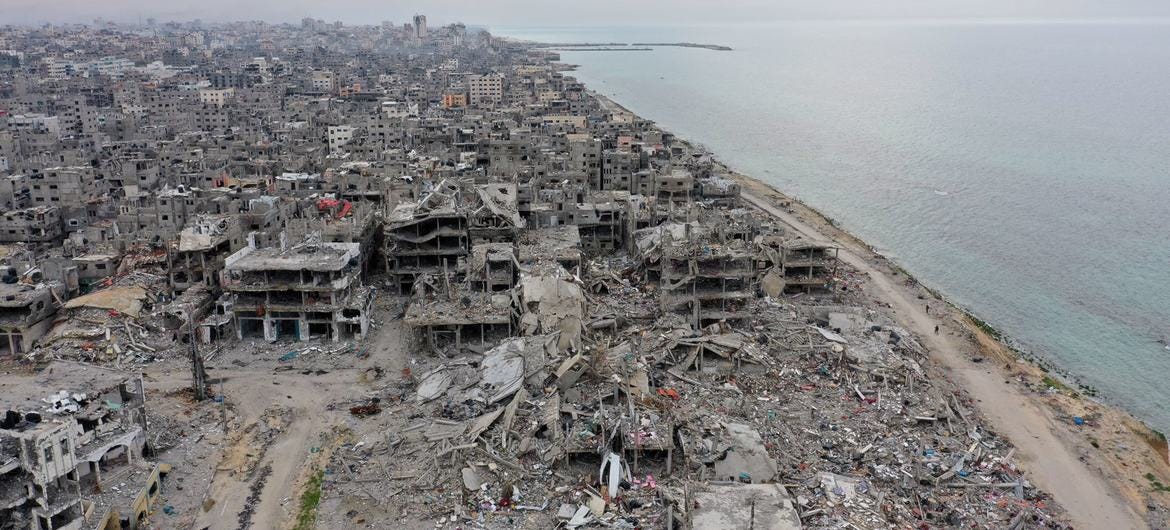
The legal context is now even sharper. Under the Genocide Convention, states undertake to prevent and punish genocide. That obligation is not limited to avoiding direct participation in atrocity crimes. It also requires states to consider whether their diplomatic, military, and economic relationships help sustain conditions in which genocide or other serious violations may occur. In January 2024, in the case brought by South Africa against Israel, the International Court of Justice ordered provisional measures after finding that at least some of the rights claimed by Palestinians in Gaza under the Genocide Convention were plausible. Those measures required Israel to prevent acts within Article II of the Genocide Convention, prevent and punish direct and public incitement to genocide, and enable urgently needed humanitarian assistance.
Later, in a July 2024 advisory opinion, the Court concluded that Israel’s continued presence in the occupied Palestinian territory is unlawful and that all states are under obligations not to recognize the situation as lawful, not to render aid or assistance in maintaining it, and to cooperate to bring it to an end. That matters for the EU-Israel Association Agreement because the preferential trade relationship confers legal and economic advantages to Isreal. If those advantages help sustain the unlawful situation, then the EU’s continued reliance on ordinary trade policy becomes difficult to separate from its own obligations under international law.

EU trade relations with Israel quantified. SOURCE: European Commission
The International Criminal Court has added another layer of legal accountability in November 2024 when it issued arrest warrants for Benjamin Netanyahu and Yoav Gallant for alleged war crimes and crimes against humanity in relation to Gaza. These warrants make it harder for governments to describe the situation as legally uncertain or merely political. The EU is dealing with a state whose senior leaders are the subject of international criminal process, whose occupation has been declared unlawful by the ICJ, and whose conduct in Gaza has triggered provisional measures under the Genocide Convention. Against that backdrop, Article 2 of the Association Agreement becomes a concrete legal tool to sever preferential trade relationships and align the EU’s trade policy with their human rights obligations.
The problem is the political habit of treating trade as if it sits outside conflict, occupation, and human rights law. Governments often separate humanitarian concern from economic relations, condemning suffering in one forum while preserving ordinary commercial advantages in another. But for Palestinians living under occupation, those categories collapse. Settlement expansion is a human rights issue, but it is also an economic project. Movement restrictions are a civil and political rights issue, but they also determine whether Palestinian farmers can reach land, markets, ports, and buyers. Trade preferences, customs treatment, and market access therefore cannot be treated as legally neutral when they operate within an unequal system of control.
If human rights clauses never affect economic benefits, then they function as decoration rather than law. Suspension is one tool, but it is not the only one. States can also further restrict imports of settlement goods, impose targeted sanctions, require human rights due diligence, regulate corporate investment, suspend preferential tariff treatment, condition procurement contracts, and restrict arms transfers. These are not abstract options. They are the kinds of measures the ICJ’s advisory opinion points toward when it requires states not to aid or assist the maintenance of Israel’s unlawful presence in the occupied territory.
The same logic extends beyond Europe. Over the past 10 years the United States has provide Israel with $38 billion in military assistance, including foreign military financing and missile defense funding. When a state provides weapons, financing, diplomatic protection, trade benefits, or institutional legitimacy to another state accused by international courts and UN experts of grave violations, the question is not whether it has some connection to the underlying conduct. The question is what it must do to ensure that its support does not facilitate violations or shield perpetrators from accountability.
Companies and institutions face a related responsibility. Businesses connected to settlements, surveillance systems, weapons production, infrastructure, reconstruction contracts, or logistics in Gaza and the occupied Palestinian territory cannot treat their work as ordinary commerce. The same is true for universities, pension funds, banks, and public institutions whose investments or procurement relationships may be tied to companies operating in or profiting from occupation, displacement, or military operations. The legal question is not only whether a company directly commits abuses. It is also whether its products, services, financing, or expertise help sustain the conditions under which those abuses continue.
The point is not that trade policy alone can deliver justice. It cannot. But trade policy is one place where legal commitments can become concrete. Human rights obligations can be enforced in this space beyond symbolic clauses through due diligence rules, arms restrictions, settlement product bans, and suspension mechanisms for ongoing violations. These obligations only become meaningful when they change the incentives and relationships that sustain unlawful conduct. Article 2 of the EU-Israel Association Agreement gives the EU a direct mechanism to do that. The Genocide Convention, the ICJ’s provisional measures, the ICJ’s advisory opinion, and the ICC arrest warrants supply the broader legal foundation for why inaction is not neutral.
If governments continue to invoke human rights while protecting the economic relationships that sustain dispossession, they will show the world that rights are negotiable when the violator is powerful enough. The EU’s decision on its trade relationship with Israel will therefore signal more than a regional policy choice. It will be the first indication of whether human rights clauses are enforceable legal commitments or merely language government keep in agreements until enforcement becomes inconvenient. In the face of well documented violations and binding legal obligations, business as usual is not a neutral choice.
Author Bio:
Gabriel Moura is a second-year J.D. candidate at Boston University School of Law and a clinical student in the International Human Rights Clinic. His work focuses on international human rights, refugee protection, and legal accountability for displaced and occupied communities.
메타데이터
- post_id
- da0579c6d62b
- slug
- business-as-usual-shaping-trade-policy-amid-human-rights-violations-da0579c6d62b
- url
- https://medium.com/@buslahr/business-as-usual-shaping-trade-policy-amid-human-rights-violations-da0579c6d62b
- canonical_url
- https://medium.com/@buslahr/business-as-usual-shaping-trade-policy-amid-human-rights-violations-da0579c6d62b
- author_url
- https://medium.com/@buslahr
- status
- ok
- fetched_at
- 2026-06-13 00:08:42