Identity
“Education makes a people easy to lead but difficult to drive; easy to govern, but impossible to enslave.” — Peter Brougham
Identity
“Education makes a people easy to lead but difficult to drive; easy to govern, but impossible to enslave.” — Peter Brougham
What is a blank paper and a pen to you? It is something with quiet, profound power which can turn over a person’s own life, make them empowered, make them someone who is capable of turning over the world. Because they are the tools to empower individuals. A responsible individual who is easy to guide and govern, yet smart enough to refuse enslavement or oppression.
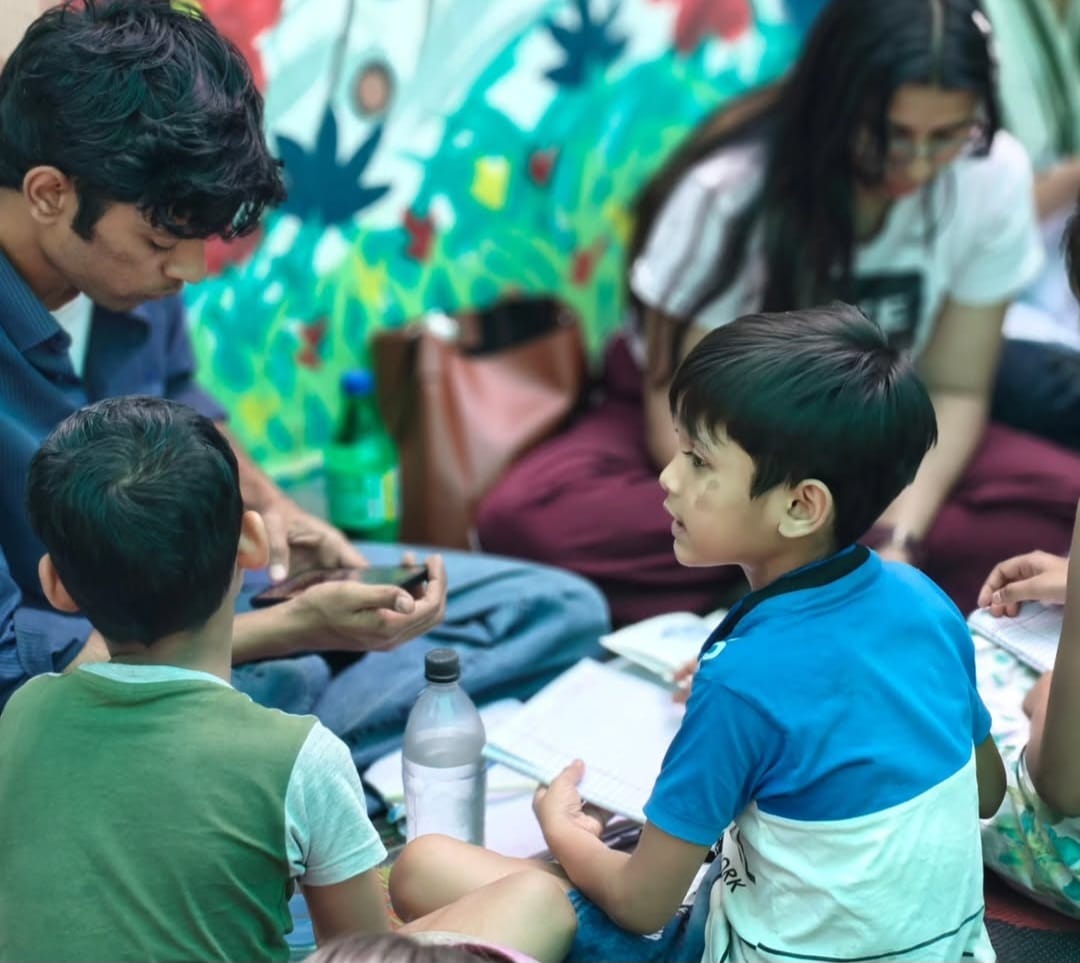
Inside one of the centres of Pehchaan The Street School, on a Saturday afternoon, a young student grips the pencil, and focuses on tracing the shape of the alphabets he has learned from his mentors. Taking a moment to gaze at his work after writing his name, smiling in satisfaction. If one looks at this exact moment, it might seem mundane, a not-so-special kind of activity. But if you consider it through the lens of generational history, it might seem nothing short of a revolution.
Why? Because the right to define one’s own identity has often been threatened by rigid social stratification. While historical evidence shows that learning was a widespread practice across diverse communities in pre-colonial India, later ideological shifts attempted to restrict this access. Powerful narratives in support of brahmanical orthodoxy emerged that argued for occupations to be the same as their parents. A farmer’s son would be a farmer as well. Because, education would only make them an outcaste in their own community.
When we look at the word Pehchaan, it literally translates to “identity”. For children growing up in the marginalised and economically insubstantial area of the bustling, and ceaseless city like Delhi, losing one’s identity by the society’s inherited label, is normal.
Yes. Normal.
But, should an identity be decided by the society as a life sentence just because of the circumstances of one’s birth?
Freedom
Let’s all dive deeper to understand the tapestry called education in pre-colonial India. First, we have to dispel a widespread historical misconception. The ability to read, write and mold one’s own identity was not an exclusive privilege of the ruling elite.
Before the colonial era, the subcontinent was home to a massive network of indigenous education. Many historical records reveal that across various regions, there were tens of thousands of vernacular schools where basic literacy was taught, not just to the privileged ones, but also to the vast majority of non-Brahmin students. They were made capable of defining themselves with the power of intellect, hard work and merit, raising their prestige in their community.
Basically.
Education was a tool for mobility.
Colonial Imposition of Identity
When we come to the onset of the Colonial era, we often assume that the British crown brought modern education to the masses, but, did it?
No.
Rather, it gave a severe setback to the fast moving advancement of the Indian subcontinent. Their goal was not to enlighten, but to control. The British crown sought to overrule indigenous Indian identity to serve the needs of their empire.
For the first 95 years of their rule, they avoided establishing their educational institution out of fear that they would empower the masses, who would later on overthrow the British rule.
It was actually the Indians who were the ones who sought after modern education. They did that by building the first modern educational institution in Asia, called the Vidyalaya in Calcutta. An institution which was built by the people of Calcutta, of both rich and poor backgrounds, who pooled their money to get access to English literature and modern sciences, because they realised that new knowledge was a vital tool for their future and especially, their capacity of self-determination.
It was only later, did the British administration decide to co-operate. This was led by none other than the British crown’s highly respected official, Lord Macaulay, with his seminal work Minute on Education (1835). He was a hard-headed colonial administrator who believed in Western superiority, thinking that Indians were in need of “Western education” all because the whole native literature of Orients were worth just one single shelf of a good European library. Aiming to create a class of people who were Indian in blood and colour, but English in taste, in opinions, in morals and in intellect.
And to achieve this, the colonial state implemented the “Downward Filtration Theory”. Instead of educating everyone, they decided to teach only a select few people from the upper classes, hoping they would act as intermediaries who would spread knowledge down to the ladder. But, instead, sadly, it divided the society into two groups: the educated elite people and the neglected uneducated masses.
Their modern school slowly, but surely, kept withering the traditional Indian schooling system. Their modern Western English-medium schools only strived to manufacture loyal indigenous officials, who would work under the British empire.
Now, their identity was not their to mold anymore. They were just a cog in the humongous machine, called the British empire.
Rebellion
But we should always remember, people are one of the unpredictable forces of nature.
As the British crown kept up their unequal and dominant ministries, they also accumulated an infamous and hateful fan base. Freedom fighters such as B.R Ambedkar, Bal Gangadhar Tilak and Lala Lajpat Rai used the very tools given by the crown.
They understood the importance of self-determination and identity, without which, they would always be under the rule of Britishers, and won’t be able to show their own potential on a world level, which is quite shameful to be honest. So, they took it upon themselves to re-establish the traditional egalitarian and powerful India from the ashes of its former glory in the pre-colonial period.
With education as their ultimate weapon, gradually, with time, they conquered ignorance, social and economic ills, and oppressive hierarchies.
One by one, they tackled the roadblocks on their way to self-sufficient, self-determined and sovereign country.
The Legacy Continues
At present, the war fought by our ancestors is still going on. And only the circumstances have changed.
Why?
Because the masses still look at the marginalized through the lens of wealth and occupation. Though it is not of the same intensity as in the past, it is still there.
But here at Pehchaan The Street School, they take responsibility for every child in their family on their journey, regardless of their background.
They don’t do this alone. They do it as a family. A found family purely made of volunteers, with the overwhelming support they win from people around them with their heartfelt work. Together, we are trying to break the stereotypes and hand them back their right to mold their identity as well as their bright future.

This year, in Pehchaan Ki Holi, a festive program on the occasion of Holi festival celebrated since the start of the organization for their dear students and the hard working volunteers, we successfully organized another unforgettable event.
Pehchaan Ki Holi is one such event which everyone awaits after the end of the celebration every year.
Because being the reason for the smiles upon the face of the youth, is something which sets your heart at ease.
Don’t you all agree?
And for them to keep living their youth and making them capable of molding their identity, Paperbaag supported Pehchaan The Street School by providing 500 registers in the Indraprastha center on March 1st.
They didn’t just provide them the means, their act also grounded the belief of education being a necessity and also showing the students that they are not alone, trying their best to keep their journey uninterrupted. Fully supporting the cause with their heartfelt support.
It’s not just them.
Festive Treasure by Jhalak gifted 3rd standard students were given 30 very thoughtful stationary kits with complementary snacks and holi colours to spread the warmth and the joyous excitement for the colorful environment of Holi.
As a member of the family of Pehchaan The Street School, I appreciate such thoughtful ways of supporting the students. Aside from the practicality of the gifts, it clearly showcases their support of the future generation who, because of being tight on their economic budget or the lack of guidance, are not able to achieve their dearly yearned dreams.
Not to mention, Pehchaan The Street School, with blood and sweat, is winning hearts from all around the world, with their values of Empathy, Inclusivity, Innovation and Responsibility. There are many foreign volunteers who were attracted to their values and were willing to support them, if not offline, then through online roles like Content creation, HR management, PR and Marketing, Fundraising, College Ambassador and many more.
From my journey, I’ve seen many such foreign students.
Though we haven’t talked so far, I feel great knowing that people are coming together, from all around the world, all for those who are not given many such opportunities to show their qualities and be useful for the development of not just their own, but of mankind.
I didn’t know that I would meet such amazing people in my internship, though I had a feeling. A very miniscule feeling of finding something worthwhile.
Want to know a little secret of mine?
I joined Pehchaan The Street School, all for my internship.
I knew that joining an NGO like Pehchaan The Street School, would be all about students and making them capable of achieving their dreams.
I WAS not interested in that.
All the work WAS for my own good.
Basically, I WAS indifferent to their cause.
Have you guys noticed the emphasis on WAS?
Yes, WAS.
When I started working with Pehchaan The Street School, I thought that I would only focus on my job as a Content Writer. I was basically, minding my own business.
And what was I even expecting?
I observed my team putting all their mind together to write such impactful articles that would touch the hearts of the readers. And I was one of the readers.
They sparked a fire inside me. The spark of competitiveness.
I want to be as great as them. That was the first thought that came to my mind after 1 week of my internship.
But, how can I compete with those who write from their heart? Only such heartfelt articles are worth the attention they receive.
I was just writing through the lens of logic and indifference.
So, what did I do next?
Obviously, I started to observe more. Not through the lens of cold logic, but through the lens of emotion. And I understood what I was not doing that others’ were doing.
Working in an NGO, requires looking through the perspective of the people they are working for and the process it takes to help them.
This was my intake in the first week of my internship, and hopefully I would learn more from the Pehchaan The Street School, as well as my mentors, to become a better person worth noticing.
Thank You, Pehchaan The Street School, for such a great lesson you are teaching, even remotely, to your interns as well. You are not just teaching the students, you are also teaching the masses who are not even directly connected to you, all with your hard-headed and hard-working efforts.
To help our cause, please do visit the website of Pehchaan The Street School. And if you want, you can also be a part of this found family, like I have.
Here are the relevant links for you to navigate:
Website: https://pehchaanstreetschool.org
Google: Pehchaan The Street School
Indraprastha Metro Station, Delhi 110001
097117 18972
Email ID: pehchaanschool@gmail.com
Instagram page link: https://instagram.com/pehchaanstreetschool?utm_source=ig_profile_share&igshid=181sger2fozl7
To Donate via Instamojo: https://www.instamojo.com/@pehchaanthestreetschool
To Donate via NEFT: https://pehchaanstreetschool.org/donation/
YouTube channel: https://www.youtube.com/channel/UCXd4gnTazJh3JugKENt5yog
Twitter: https://twitter.com/Pehchaan_School?s=09
LinkedIn: https://www.linkedin.com/company/pehchaan-the-street-school-trust/
메타데이터
- post_id
- da05fb693ecd
- slug
- identity-da05fb693ecd
- url
- https://medium.com/@bithikabasumatary06/identity-da05fb693ecd
- canonical_url
- https://medium.com/@bithikabasumatary06/identity-da05fb693ecd
- author_url
- https://medium.com/@bithikabasumatary06
- status
- ok
- fetched_at
- 2026-06-17 08:20:12






