Do UAP Flag New Physics?
On July 14, 1894, the first American to win the Nobel Prize in science, Professor Albert A. Michaelson, gave a speech at the dedication of…
Do UAP Flag New Physics?
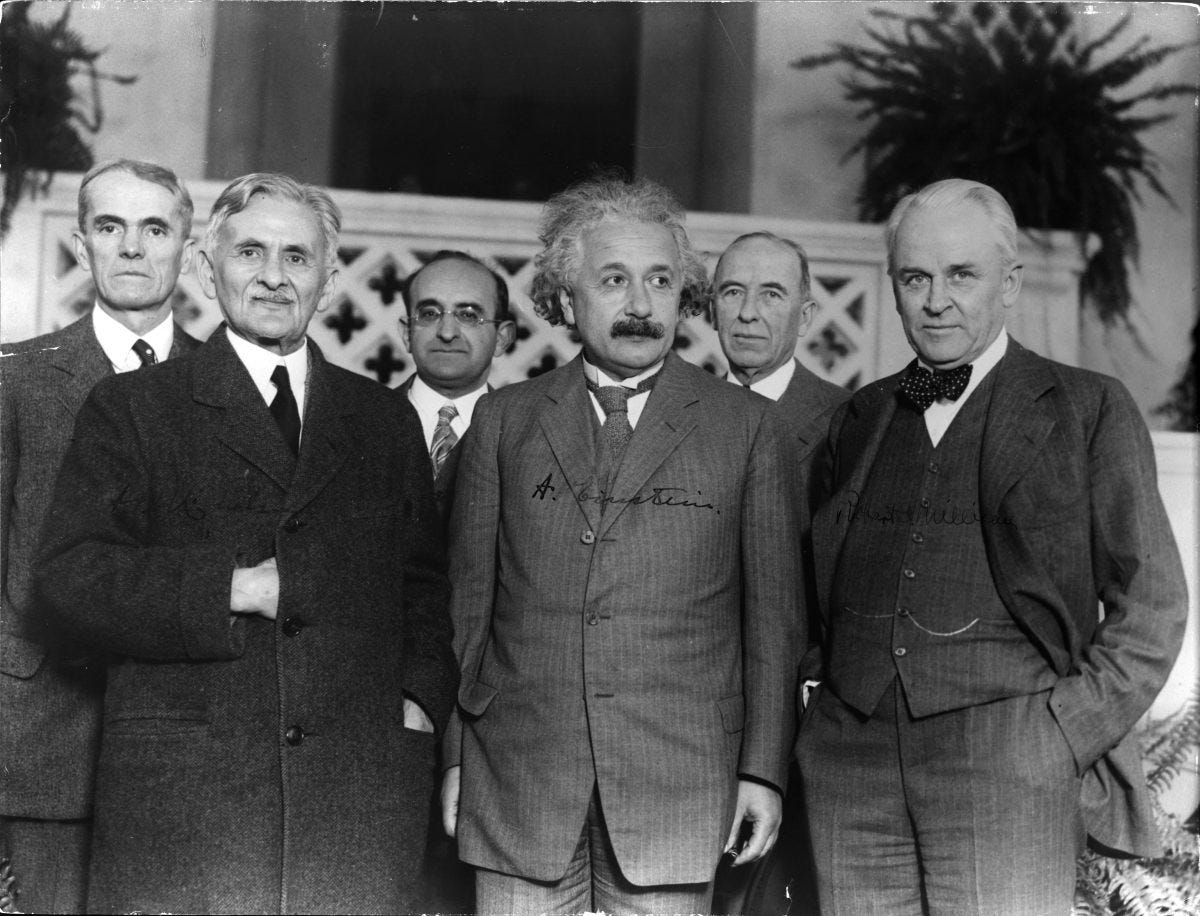
Three Nobel Laureates in Physics standing in front of the Athenaeum at California Institute of Technology (Caltech) in 1931. Front row from left: Albert A. Michelson, Albert Einstein and Robert A. Millikan. (Image Credit: AlbertMichaelson.com)
On July 14, 1894, the first American to win the Nobel Prize in science, Professor Albert A. Michaelson, gave a speech at the dedication of the Ryerson Laboratory in the University of Chicago, in which he said:
“The more important fundamental laws and facts of physical science have all been discovered, and these are now so firmly established that the possibility of their ever being supplanted in consequence of new discoveries is exceedingly remote…. Our future discoveries must be looked for in the sixth place of decimals.”
At that time, classical mechanics, Newtonian gravity, thermodynamics, and electromagnetism seemed to explain everything. This was a decade before Albert Einstein’s Special Relativity revolutionized our concept of spacetime, two decades before gravity was related through Einstein’s General Relativity to the curvature of spacetime, and three decades before Quantum Mechanics revolutionized the probabilistic way we view physical reality.
There are two lessons to be learned from Michaelson’s blunder. First, distinguished mainstream scientists attach past knowledge to their professional prestige and out of hubris avoid the humility to recognize the ocean of ignorance surrounding their island of knowledge.
Second, it is important to note that Special Relativity, General Relativity and Quantum Mechanics did not violate what was previously adequately described by classical mechanics, thermodynamics, and electromagnetism. In fact, Special Relativity reduces to classical mechanics at speeds that are much smaller than the speed of light, Einsteinian General Relativity reduces to Newtonian gravity at low-speeds and weak curvature of spacetime and Quantum Mechanics reduces to classical physics when the action of a system is vastly larger than Planck’s constant — as is the case for large objects, large quantum numbers or when the interaction with the environment destroys quantum coherence.
In other words, old physics applies extremely well in the regimes it was derived for, and new physics was discovered in new regimes that were not imagined before.
For this reason, the motion of a car can be well described by classical mechanics but the localization accuracy needed to reach a particular street address on a Global Positioning System (GPS) of satellites requires General Relativity. The Universe as a whole started with a small horizon size as a quantum system but today is described classically on large scales. Engineers use classical mechanics when designing bridges but they must use quantum mechanics in designing computer chips.
This is why it makes no sense for Silicon Valley entrepreneurs to invest all their money in quantum technologies and artificial intelligence, while at the same time letting fundamental science be defunded. They are watering the branches of the tree of knowledge while drying up its roots. Out of hubris, they are repeating Michaelson’s mistake by arguing that there is nothing important left to discover through fundamental science.
But the present-day stagnation in disruptive scientific breakthroughs is also a fault of the “consensus approach” for doing science by the mainstream of academia. Large communities tend to regress to the mean by the Central Limit Theorem in statistics. As a result, they sharply define their future priorities in federal funding with negligible support for alternative projects that explore innovative paths — not taken by the dominant majority. For that reason, the 2020 Decadal Survey in Astronomy and Astrophysics of the National Academies (published here) recommends allocating more than 10 billion dollars in the next two decades to the search for biological signatures of microbial extraterrestrial life, while sidelining any funding request for technological signatures of extraterrestrial intelligence.
A seminal 2023 study published here in Nature reveals that scientific research and patents have become increasingly incremental rather than disruptive. By analyzing over 45 million papers spanning six decades, it was found that the rate of work fundamentally redirecting science has declined significantly across all major fields.
What is the best path forward for discovering new physics?
The recipe for discovering new physics is simple: attend to anomalies!
On April 27, 1900, Lord Kelvin delivered a lecture titled “Nineteenth-Century Clouds over the Dynamical Theory of Heat and Light”. He stated that the sky of classical physics was generally clear, but obscured by two “dark clouds” (as discussed here). The first cloud was the failure to detect the ether — the hypothetical medium thought to carry light waves, which was later resolved by Einstein’s theory of Special Relativity. The second cloud was the failure of classical physics to correctly explain blackbody radiation. This anomaly, often referred to as the “ultraviolet catastrophe,” was eventually resolved by Max Planck and the birth of quantum mechanics.
Anomalies can be recognized by witnesses from the general public long before they are accepted as real by mainstream scientists. For centuries, scientists dismissed accounts of falling rocks as fantasy, but a spectacular event in 1803 fundamentally changed this perception. In the early 1800s, the scientific community widely believed that glowing fireballs were merely atmospheric gases and that stones could not possibly fall from the sky. This changed on April 26, 1803, when a massive meteor exploded, showering over 3,000 fragments across the town of L’Aigle, France. The French Academy of Sciences dispatched the young physicist Jean-Baptiste Biot to investigate. He meticulously interviewed witnesses and analyzed the physical stones, proving through sheer volume and concurrent testimonies that the rocks were identical and of extraterrestrial origin.
Similarly, ball lightning remained a mysterious phenomenon in atmospheric physics, reported for centuries and photographed rarely. Witnesses reported a luminous, roughly spherical object, typically of basketball size, lasting for a few seconds to a few minutes. The average ball lightning appears as a sphere with a diameter of 30 centimeters, a luminosity similar to a 100-Watt lamp, and a lifetime of about 10 seconds (as reported here). In rare cases, the ball lightning was reported to pass through glass windows or walls without causing apparent damage. It took centuries for the existence of the phenomenon to be regarded seriously as real by mainstream scientists because of its rare and transient nature. The most important development came in 2012, when a natural ball lightning event was accidentally captured on video with a spectrometer running during a field campaign studying ordinary lightning. The spectrum showed emission lines consistent with silicon, iron, and calcium, namely elements found in soil, supporting a physical model which associates ball lightning with silicon vapor (as discussed in a paper published here).
Are there similar anomalies reported by reliable witnesses now that are inappropriately dismissed by mainstream scientists?
Enter the case of Unidentified Anomalous Phenomena (UAP). The U.S. Department of War website (https://www.war.gov/ufo/) documenting the Presidential Unsealing and Reporting for UAP Encounters (PURSUE), released four batches of information over the past couple of months and received 2 billion views so far. The public is definitely intrigued by the reports and taxpayers fund science, yet mainstream scientists dismiss the significance of these reports.
Do UAP flag new physics?
We do not know. The only way to find out is to be open minded to all possibilities out of curiosity and the humility to learn. The nature of UAP can be resolved by higher quality data. Such data will help to decide whether UAP orbs (as reported here by the All-Domain Anomaly Resolution Office in the Pentagon and the Office of the Director of National Intelligence) represent a new atmospheric phenomenon (like ball lightning, as discussed here), human-made phenomena (like laser spots, as discussed here), or something out of this world.
New physics can only explain UAP if it applies to a new domain of reality that was not described so far. New physics cannot be associated with objects made of known materials moving through air in the 3+1 dimensions of the known spacetime. Our current knowledge and the publicly available data do not preclude new physics from explaining UAP. Nevertheless, we must keep in mind that UAP are recorded by cameras and therefore must interact with light. Collecting additional information on them through a new set of sensors (as recommended here) would unravel their nature.
We know that most of the matter in the universe is invisible, made of an unknown substance (and hence labeled dark matter’), and that the vacuum carries an energy density of an unknown origin (so-calleddark energy’). These are the known unknowns. But the most exciting discoveries of new physics will originate from unknown unknowns. These are things that we do not even know that we do not know.
The UAP Science Advisory Council (https://uapsac.com/) under my leadership, aims to analyze past data on UAP and encourage the U.S. government to collect new data that will reveal the nature of UAP. Stay tuned for future updates.
ABOUT THE AUTHOR

(Image Credit: Lotem Loeb, May 22, 2026)
Avi Loeb is chair of the UAP Science Advisory Council to the White House, Pentagon, FBI and intelligence agencies, director of the Galileo Project, founding director of Harvard University’s — Black Hole Initiative, former director of the Institute for Theory and Computation at the Harvard-Smithsonian Center for Astrophysics, and the former chair of the astronomy department at Harvard University (2011–2020). He is a former member of the President’s Council of Advisors on Science and Technology and a former chair of the Board on Physics and Astronomy of the National Academies. He is the bestselling author of “*Extraterrestrial: The First Sign of Intelligent Life Beyond Earth” and a co-author of the textbook “[Life in the Cosmos](https://www.hup.harvard.edu/catalog.php?isbn=9780674987579)”, both published in 2021. The paperback edition of his new book, titled “[Interstellar](https://www.harpercollins.com/products/interstellar-avi-loeb-1?variant=40982888415266)*”, was published in August 2024.
Professional website:
https://lweb.cfa.harvard.edu/~loeb/
Social media:
*https://avi-loeb.medium.com/ [https://www.youtube.com/@ProfessorAviLoeb](https://www.youtube.com/@ProfessorAviLoeb)*
*https://open.spotify.com/show/1zhndXkvSY2b8FdjspFpCd [https://x.com/ProfAviLoeb](https://x.com/ProfAviLoeb)*
메타데이터
- post_id
- da1074c50c74
- slug
- do-uap-flag-new-physics-da1074c50c74
- url
- https://medium.com/@avi-loeb/do-uap-flag-new-physics-da1074c50c74
- canonical_url
- https://medium.com/@avi-loeb/do-uap-flag-new-physics-da1074c50c74
- author_url
- https://medium.com/@avi-loeb
- status
- ok
- fetched_at
- 2026-07-21 08:25:23