The Balance of White and Black: Close Police–Boryokudan Relationships in Japan
In common sense, the police are the enemies of organized crime groups, whose duty is to repress the criminal activities of these groups…
The Balance of White and Black: Close Police–Boryokudan Relationships in Japan
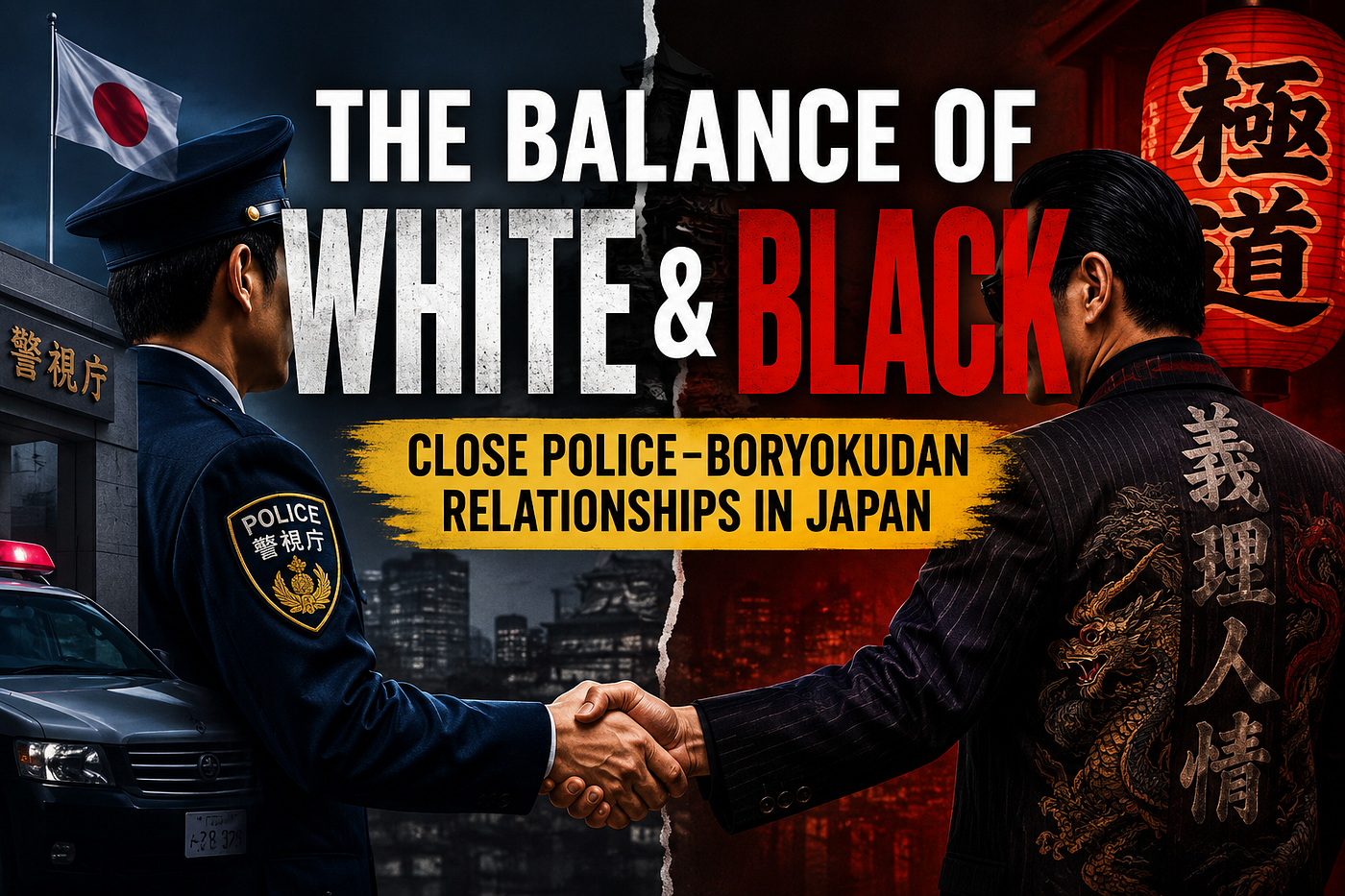
In common sense, the police are the enemies of organized crime groups, whose duty is to repress the criminal activities of these groups. However, in Japan, the police have informally shared a close relationship with the Yakuza. Some police officers wear flashy gangster attire on their days off, while some gangsters wear blue fatigues resembling riot police uniforms. In the past, the police even frequently appeared at gangster funerals and weddings. Some scholars have suggested that the Yakuza share ideological and historical connections through the samurai tradition, which emphasizes loyalty and duty (giri). People often refer to organized crime groups in Japan as the Yakuza; however, the accurate term adopted by the Japanese government and scholars is boryokudan. Despite the Japanese government making various efforts to repress the boryokudan, scholars have argued that the police did not really want to completely eliminate them for many reasons.
Yakuza/Boryokudan as Private Government
The Yakuza actually performed a necessary social function in Japan by providing protection and enforcing order in the underworld. As suggested by Gambetta (1993), the main product offered by organized crime groups is not violence, but protection. Violence is only the means to achieve the end — enforcing order in the underworld. The government does not have unlimited reach or policing resources; when state actors are unavailable, the Yakuza fill the gap and function as a private government. During the postwar era, the Yakuza helped maintain control over unorganized crime. The government even used the Yakuza to repress the rise of the left wing in the 1950s and 1960s.
Even the Japanese people have agreed that the Yakuza are useful to society to some extent. In one survey, some respondents argued that “the boryokudan is a necessary evil in society,” while others stated that “under some conditions they may ask the boryokudan to help them.” Thus, the Yakuza, as non-state actors, can help reduce crime whenever policing is impossible due to limited reach and resources.
Law Enforcement as Constant Negotiation
The close police–boryokudan relationship is “informal [so] as to prevent the courts and laws from becoming the supreme regulators of society.” As argued by Anselm Strauss, social order is continuously negotiated rather than simply imposed through formal rules. In reality, the police enforce the law selectively. Huang and Vaughn (1992: 50) argued “that although the police occasionally crack down on gangs when they appear to be growing too powerful or when they engage in activities that are not tolerated (such as drug and gun smuggling or injuring innocent civilians), no large-scale effort has been made to dissolve them because of their functional role in society.” Furthermore, the Yakuza may help political figures in their campaigns. This process of negotiation allows the police to make use of the Yakuza’s power in controlling the underworld, which ultimately results in police–boryokudan cooperation.
When the Police–Boryokudan Relationship Becomes Too Close: Police Misconduct
Selective enforcement can have fatal consequences by providing a loophole for the police to exploit. Police corruption is one of the most common and well-documented examples. The Yakuza’s gambling industry was highly profitable. To maintain the business, the Yakuza needed to minimize the risk of law enforcement. One of the best ways was to bribe the police. During the early 1980s, a huge police corruption scandal involving electronic gaming machines was uncovered, and more than 100 officers in Osaka were disciplined or dismissed.
In fact, there is no absolute distinction between white and black in maintaining social order. However, making use of organized crime groups is like playing with fire and may cost the police their reputation or even their effectiveness. The de facto strategy of using organized crime groups requires intensive supervision, which has been lacking in Japan.
References: Gambetta, D. (1993). The Sicilian Mafia: The Business of Private Protection. Harvard University Press.
Huang, F. F. Y., & Vaughn, M. S. (1992). A Descriptive Analysis of Japanese Organized Crime: The Boryokudan from 1945 to 1988. International Criminal Justice Review, 2(1), 19–57. https://doi.org/10.1177/105756779200200103
Strauss, A., Schatzman, L., Ehrlich, D., Bucher, R., & Sabshin, M. (1963). The Hospital and Its Negotiated Order. In E. Freidson (Ed.), The Hospital in Modern Society (pp. 147–169). Free Press.
메타데이터
- post_id
- da1b56eafcc2
- slug
- the-balance-of-white-and-black-close-police-boryokudan-relationships-in-japan-da1b56eafcc2
- url
- https://medium.com/@evie.sharing/the-balance-of-white-and-black-close-police-boryokudan-relationships-in-japan-da1b56eafcc2
- canonical_url
- https://medium.com/@evie.sharing/the-balance-of-white-and-black-close-police-boryokudan-relationships-in-japan-da1b56eafcc2
- author_url
- https://medium.com/@evie.sharing
- status
- ok
- fetched_at
- 2026-07-15 21:22:01