How to Keep Blueberries Fresh in Biodegradable Packaging
Biodegradable blueberry packaging is reshaping how growers and distributors think about freshness. But material sustainability and produce…
How to Keep Blueberries Fresh in Biodegradable Packaging
Biodegradable blueberry packaging is reshaping how growers and distributors think about freshness. But material sustainability and produce performance don’t always align by default.
We’ve had buyers come to us mid-season after a switching decision went wrong — fruit arriving soft, containers deformed, a retailer relationship on the line. Almost every time, the material wasn’t the problem. The validation step was.
Why Blueberries Are Different
Most fresh produce tolerates some packaging variation. Blueberries don’t.
After harvest, blueberries keep respiring — consuming oxygen, releasing CO₂ and moisture. This continues through every stage of the supply chain, and the rate depends directly on the environment inside the packaging.
Blueberries need 0–2°C and 90–95% relative humidity. Push CO₂ too high, or let humidity swing, and you accelerate softening, grey mold (Botrytis cinerea), and weight loss — often before any visible damage appears.
We’ve seen containers pass lab certification and still fail at the receiving dock. Usually because the ventilation spec was never validated against the actual route.
PLA vs PET: The Real Difference
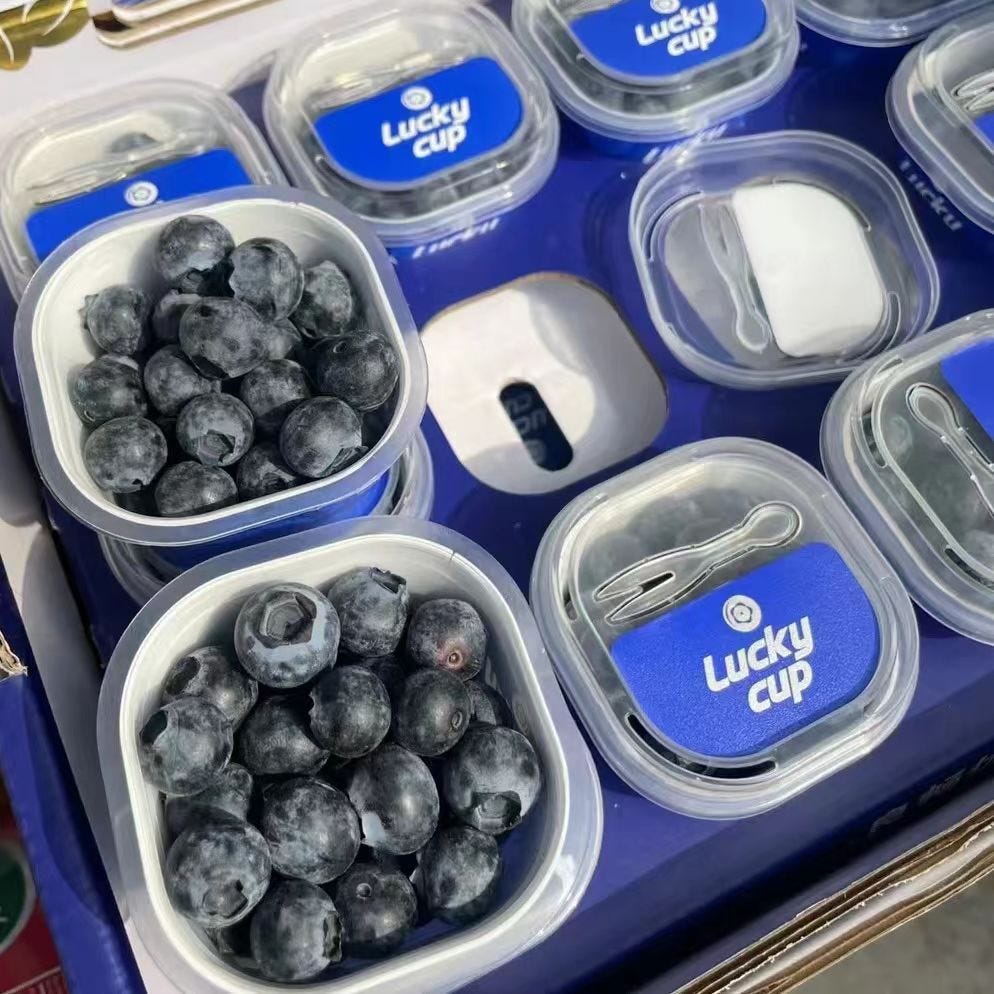
PLA has become the most widely adopted biodegradable option for produce punnets — comparable clarity to PET, reasonable rigidity, and compostability certification under EN 13432 and ASTM D6400.
But here’s what’s less talked about: PLA’s lower gas permeability lets blueberries build up a natural high-CO₂, low-O₂ microenvironment as they respire. This modified atmosphere suppresses Botrytis cinerea — without any active gas injection. PET clamshells with open vents can’t replicate this.
The condition that makes it work: consistent cold chain. At 0–4°C, the modified atmosphere stays stable. PLA starts softening above ~55°C — so any unrefrigerated transit leg, including a hot loading dock or ambient consolidation point, needs to be checked before committing.
Under standard refrigerated conditions, PLA performs comparably to PET for most blueberry routes — at roughly a 20–40% cost premium, which also needs to factor in certification, retailer approval, and label/film alignment.
The Three Numbers That Actually Matter
Most conversations about biodegradable packaging start with material certification. They should start here instead:
OTR/CTR (gas transmission rates) — determine how well the container maintains the modified atmosphere blueberries need. Surprisingly, ventilation hole placement often matters more than the base material’s permeability. A PLA container with poorly positioned holes can underperform a bagasse tray with optimized perforations.
WVTR (water vapor transmission rate) — too little and condensation builds up inside, accelerating mold. Too much and the fruit loses weight, arriving undersized. Always ask for WVTR data measured under cold-chain humidity (85–95% RH) — not ambient lab conditions. The difference is significant.
Stacking load under refrigerated, humid conditions — biodegradable materials respond differently to sustained compression than PET, especially under humidity. For 7–14 day export shipments, this is the variable that matters — not room-temperature crush resistance.
A Switch That Went Wrong — and How It Was Fixed
A distributor supplying a major UK grocery chain switched from PET to PLA ahead of peak season, based on certification alone. No cold-chain simulation. No pilot run.
By week three, defect rates at the receiving dock hit 11%. The cause: an unrefrigerated consolidation point in the route that no one had flagged. The PLA containers partially deformed under that ambient exposure, compromising seal integrity.
The following season, before committing to any material, we mapped their actual distribution route, identified the exposure point, and specified a higher-thermal-tolerance PLA structure. We ran a cold-chain simulation through their route profile before bulk production.
Defect rate that season: under 3%.
What 52 Days of Trial Data Showed
In our own cold-chain trials over 52 days, blueberries in optimized biodegradable packaging showed a 2.87% defect rate and 0.92% weight loss — compared to 13.69% defect rate and 8.43% weight loss in the unprotected cold-chain-only control group.
For a distributor shipping 10,000 kg per season, that gap is the difference between thousands of kilograms arriving sellable — or arriving as a claims conversation with your buyer.
Cold temperature alone doesn’t protect blueberries. The packaging enclosure determines microenvironment humidity, gas exchange, and physical protection throughout the journey.
Before You Switch: A Short Checklist
Most failed packaging switches don’t fail because the material was wrong — they fail because validation steps were skipped under seasonal time pressure.
Before bulk production, confirm:
- Compostability certification (EN 13432, ASTM D6400, or AS 5810) from an accredited third-party body — self-declarations aren’t sufficient for retail audits
- OTR and WVTR test reports for the specific container structure, not just the base material
- Cold-chain simulation data at 0–4°C and 85–95% RH
- FDA food contact compliance documentation where required
- A pilot run through your actual distribution route, measuring defect rate, weight loss, and condensation at each transition point
Keeping blueberries fresh in biodegradable packaging isn’t a single-material decision — it’s a system decision. Container material, ventilation design, moisture management, and cold-chain compatibility all need to work together for your specific route.
The growers and distributors who navigate this shift successfully aren’t the ones who switch fastest. They’re the ones who validate first.
We work on biodegradable blueberry packaging systems at YiTo Pack — PLA, cellophane, and kraft-paper based, with EN 13432, ASTM D6400, FDA, and ISO 9001 documentation, and cold-chain simulation testing before bulk production
메타데이터
- post_id
- da1d8ca3eef9
- slug
- how-to-keep-blueberries-fresh-in-biodegradable-packaging-da1d8ca3eef9
- url
- https://medium.com/@yitopackaging/how-to-keep-blueberries-fresh-in-biodegradable-packaging-da1d8ca3eef9
- canonical_url
- https://medium.com/@yitopackaging/how-to-keep-blueberries-fresh-in-biodegradable-packaging-da1d8ca3eef9
- author_url
- https://medium.com/@yitopackaging
- status
- ok
- fetched_at
- 2026-06-13 00:08:42