I Lost a Liberal Friendship Over One Word
How “genocide” became a loyalty test in the Gaza debate
I Lost a Liberal Friendship Over One Word
How “genocide” became a loyalty test in the Gaza debate
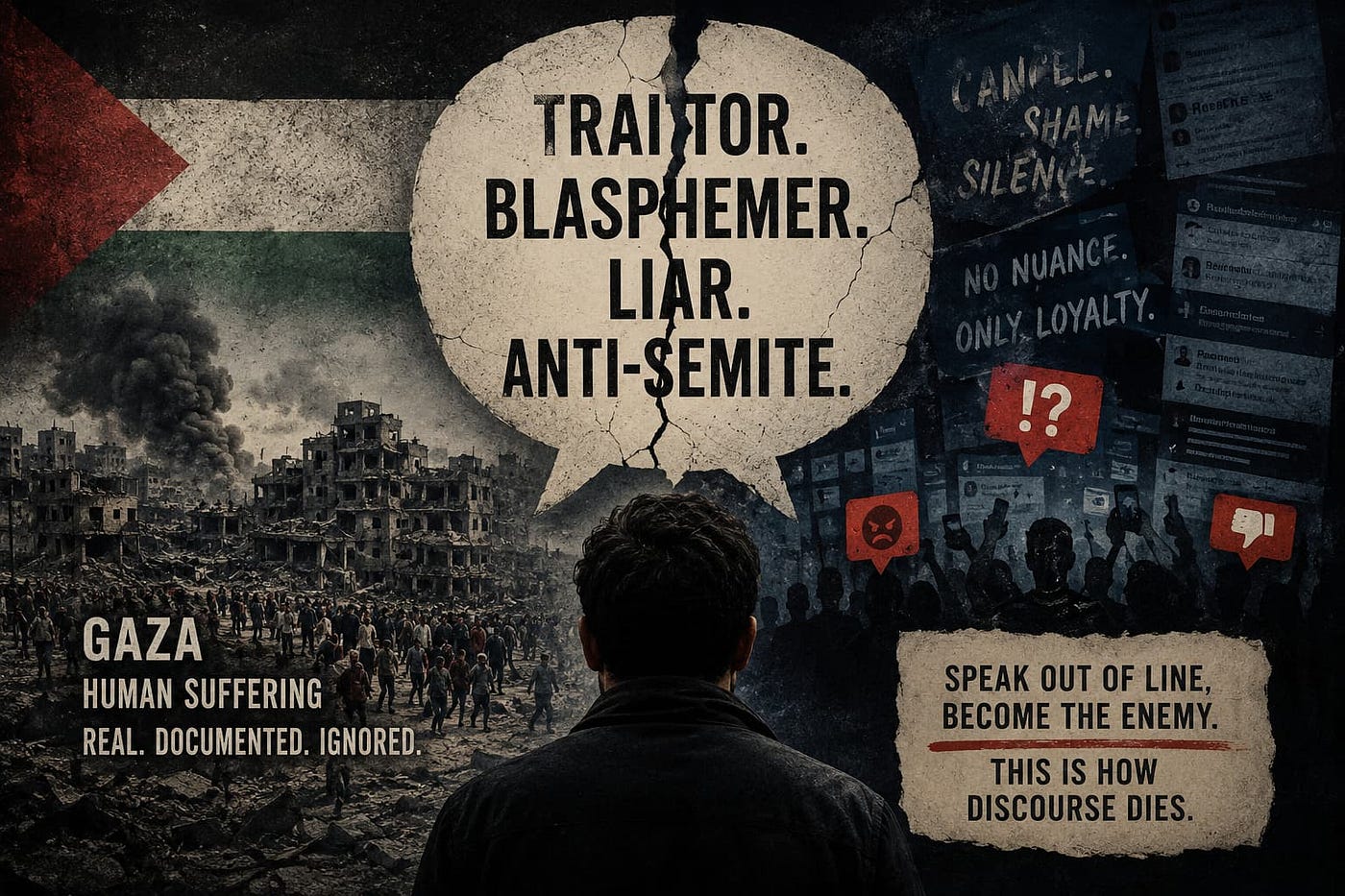
Political arguments around Gaza no longer collapse over facts alone. One word can redraw friendships, reputations, and moral belonging overnight.
The comment arrived after midnight. Karachi had gone quiet in the strange way large cities sometimes do during power stability, when the fans keep running and even the stray dogs seem tired. I was scrolling through Medium replies with one eye half open when I read her sentence twice.
“You always struck me as clear thinking and fair-minded.”
Not angry. Not abusive. Worse, honestly. Disappointed.
I had written that Israel was able to commit genocide because of American backing and support. I also wrote that the ideology shaping parts of the White House response to Gaza was dangerous. A Jewish writer named Ruchama replied soon after. Her objection was not limited to politics either.
She said the accusation hurt her soul and amounted to libel. She also pointed me toward another commenter who supposedly dismantled my argument, although the recommendation felt less important than the emotional wound underneath her reply. The emotional center of her response sat somewhere else though.
My use of the word itself had changed my status in her eyes.
Karachi teaches people early that certain words carry consequences long before facts enter the room.
Traitor” can erase twenty years of public service here. “Blasphemy” changes the temperature of a street very fast, faster than outsiders usually understand, because fear spreads before facts do.
Blasphemy” can turn gossip into a death sentence. Nobody waits for evidence once a moral accusation starts pulling crowds toward certainty and anger at the same time. I grew up watching language operate like a border checkpoint. Some people crossed safely. Others never returned from the accusation.
American liberals like imagining their discourse works differently. Gaza exposed the fantasy.
I noticed something odd over the past year. Large numbers of Western commentators accepted almost every visible fact about Gaza. Civilian deaths. Flattened neighbourhoods. Starvation warnings from aid agencies. Bombed hospitals. Displacement numbers climbing into the millions. United Nations officials speaking with visible exhaustion on camera. Human rights lawyers invoking international conventions that most television anchors had ignored for decades. None of those details fully shattered the conversation.
The word “genocide” did.
A strange inversion followed. People who spent months defending free speech suddenly treated one term as morally radioactive. Careers bent around it. Friendships cracked over it. Editors started measuring emotional tone more carefully than physical destruction. Online debates stopped revolving around dead civilians and started revolving around whether the dead could legally qualify for a forbidden noun.
I think many Western writers underestimate how visible this shift looks from outside the Atlantic world. From Karachi, I read Western commentary on Gaza and often feel like I am watching a legal drama where courtroom guards panic because someone uttered the wrong phrase while bodies remain stacked outside the building.Language discipline became more urgent than the war itself.
Some of the fear is understandable. Jewish history contains industrial extermination carried out in living memory. The Holocaust permanently altered the moral weight surrounding accusations of genocide against a Jewish state. Serious Jewish writers hear echoes inside the word that others do not. I understand that much. I also think many Palestinians hear another message entirely when powerful institutions declare the term unspeakable while Gaza burns on livestreams every night.
Moral vocabulary has become territorial now. Certain groups possess authority to define suffering. Others receive permission only to describe pain within tightly supervised moral boundaries that shift whenever politics demands it.
Step outside the approved phrasing and suspicion arrives fast. I saw the mechanism operating inside Ruchama’s reply almost immediately, especially in the way disappointment replaced argument before the actual evidence even entered the discussion.
Her disappointment did not emerge because I denied civilian suffering.Her disappointment emerged because I crossed a linguistic boundary that parts of polite Western discourse still patrol aggressively.
The second half of my original comment deserved criticism though. “Christians in the White House” was sloppy language. I was thinking specifically about Christian Zionist influence inside sections of American politics, especially movements that frame Israeli state power through biblical prophecy and civilizational struggle. Broad religious labeling weakens the argument. Bad wording gave people an easier escape route than the actual substance deserved.
American support remains the center of the matter for me. Israel did not conduct this war in diplomatic isolation. Washington transferred weapons, protected Israel repeatedly at the United Nations Security Council, and absorbed international anger on its behalf. Billions of dollars moved through institutional pipelines while entire districts inside Gaza disappeared. American officials occasionally expressed concern in press conferences, then approved another shipment.
The performance became grotesque after a while. I still keep returning to the sentence Ruchama used because disappointment often reveals more than open hostility during political arguments. “You always struck me as clear thinking and fair-minded.
A year ago, many online spaces still operated under the assumption that intelligent people could disagree over Gaza while remaining inside the same moral community. I do not think that assumption survived. Gaza rearranged social trust. Writers now scan each other for signs of contamination hidden inside vocabulary choices. One word can collapse years of intellectual goodwill. A single comment thread can suddenly feel like a border crossing interview.
My own hesitation faded somewhere around the images from Rafah. Burned tents. Children carried in pieces. Men digging through concrete with bare hands because machinery never arrived. I stopped caring whether elite discourse considered certain terminology impolite after enough mass death accumulated in public view. Cautious commentators still treat semantic restraint as evidence of seriousness. I no longer do.
Karachi has its own habit of emotional exhaustion. People continue buying fruit, arguing over mobile packages, rushing toward offices on Shahrah-e-Faisal while catastrophe fills television screens in the background. Daily life survives almost anything here. Gaza entered that rhythm too. Tea stalls discuss airstrikes between cricket arguments. Bank employees read casualty updates before processing remittance forms. Nobody fully leaves the subject anymore. The war hangs in the room even during ordinary conversation.
I cannot tell whether language still helps at this stage. “Genocide” hardens one audience against me instantly. Softer words feel dishonest after tens of thousands of deaths and the systematic destruction of civilian life.
Something inside public discourse broke during this war. I suspect many people already sense the fracture, especially during ordinary conversations that suddenly become tense the moment Gaza enters the room. Few want to admit how deep it runs.
메타데이터
- post_id
- da1e9421b44d
- slug
- i-lost-a-liberal-friendship-over-one-word-da1e9421b44d
- url
- https://medium.com/@munaeem/i-lost-a-liberal-friendship-over-one-word-da1e9421b44d
- canonical_url
- https://medium.com/@munaeem/i-lost-a-liberal-friendship-over-one-word-da1e9421b44d
- author_url
- https://medium.com/@munaeem
- status
- ok
- fetched_at
- 2026-06-09 15:37:30