Tracing Egyptian Roots in Malayalam
Ancient Egyptian was not a static language. It evolved over millennia, and often, the hieroglyphs did not change in appearance whereas…
Tracing Egyptian Roots in Malayalam
Ancient Egyptian was not a static language. It evolved over millennia, and often, the hieroglyphs did not change in appearance whereas their sound values did. One example is the butcher’s block hieroglyph 𓌨, found in the Egyptian word 𓌨𓂋𓏭 kheri, meaning “under,” “subordinate.”¹ It had different sounds in Egyptian: /ch/ and /kh/. The /ch/ sound evolved from an entirely different hieroglyph 𓈙 /sh/ sometime around the 26th century BCE. While the 𓈙 hieroglyph continued with its original /sh/ sound, the /ch/ sound of 𓌨 hieroglyph merged with /kh/ beginning in the first millennium BCE.²
These evolutionary processes are surprisingly found in Malayalam, in which these sounds evolved further: /kh/ flattened into /k/ whereas /ch/ (and /sh/) evolved into ച /ch/ and ത /t/. Consider Malayalam ചെറു cheru, ചെറിയ cheriya. These words have two different meanings “junior”, which likely derived from Egyptian 𓌨𓂋𓏭 cheri “subordinate;”³ and “small” “little,” which likely derived from another Egyptian word, 𓈙𓂋𓂋𓅪 sheri, meaning “small” “little.”⁴ Thus, the Malayalam words indicate that 𓌨𓂋𓏭 and 𓈙𓂋𓂋𓅪 may have been homophones in Egyptian as well, i.e., words with the same pronunciation but different meanings, showing that 𓌨 was indeed likely pronounced as /sh/ or /ch/ in Egyptian.
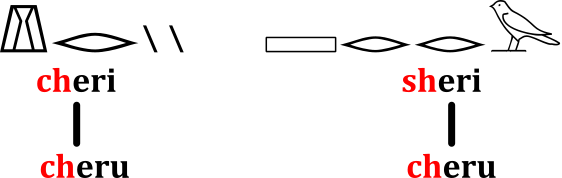
The Malayalam words താഴെ tazhe “under” and കീഴെ kizhe “under” show another evolutionary path. Both likely derive from the same Egyptian root 𓌨𓂋𓏭 “under,” with /r/ in the Egyptian root eliding into Malayalam ഴ /zh/. Interestingly, താഴെ tazhe means “under” in Malayalam, but not in Tamil, whereas കീഴെ kizhe means “under” in Tamil as well. Given that the Egyptian form evolved from cheri to kheri, it is likely that by the time kheri entered Dravidian usage, the earlier cheri variant had already fallen out of use in Egyptian. Thus, the presence of താഴെ tazhe in Malayalam may preserve evidence of an earlier borrowing, dating to a period before the 1st millennium BCE, when cheri was still current. Its absence in Tamil, alongside the shared form കീഴെ kizhe suggests that Tamil may have been influenced by Egyptian at a later stage, after the phonological shift in Egyptian had already taken place. Thus, 𓌨𓂋𓏭 entered Malayalam twice: before the 1st millennium BCE, evolving into താഴെ tazhe and again much later, sharing the word with Tamil and evolving into കീഴെ kizhe.
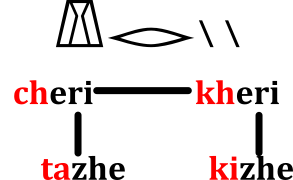
Thus, in Malayalam is preserved evidence of linguistic evolution in Egyptian itself: ചെറിയ cheriya evidencing the initial sound value of 𓌨 being /sh/ or /ch/; താഴെ tazhe and കീഴെ kizhe evidencing the evolution of 𓌨 from /ch/ to /kh/. Scholars of ancient Egyptian would do well to add Malayalam to their list of derivative languages for their linguistic evolution studies.
Notes
[1] https://thesaurus-linguae-aegyptiae.de/lemma/850794; https://thesaurus-linguae-aegyptiae.de/lemma/124220; https://app.vega-lexique.fr/?entries=w9067
[2] Carsten Peust, 1999, Egyptian Phonology: An Introduction to the Phonology of a Dead Language, 115 (Gottingen: Peust und Gutschmidt).
[3] https://olam.in/dictionary/malayalam/malayalam/ചെറിയ; See note 2, supra.
[4] https://dsal.uchicago.edu/cgi-bin/app/gundert_query.py?page=384; https://thesaurus-linguae-aegyptiae.de/lemma/600257
메타데이터
- post_id
- da28737cd653
- slug
- tracing-egyptian-roots-in-malayalam-da28737cd653
- url
- https://medium.com/@variyam-2021/tracing-egyptian-roots-in-malayalam-da28737cd653
- canonical_url
- https://medium.com/@variyam-2021/tracing-egyptian-roots-in-malayalam-da28737cd653
- author_url
- https://medium.com/@variyam-2021
- status
- ok
- fetched_at
- 2026-08-03 18:10:52