From Animation to Innovation: How Iwájú Sparks Tech Curiosity and Inspires Nigeria’s Next…
* AfricanFuturism * Inspiration starts with imagination and leads to action.
From Animation to Innovation: How Iwájú Sparks Tech Curiosity and Inspires Nigeria’s Next Generation (AfricanFuturism).
Introduction

Credit: Screen Rant
Think about the last time you watched an animated film. It was probably fun and full of adventure, but how many times do you ever really get to experience one that’s set in a futuristic Lagos of flying cars, cutting-edge technology, and endless possibilities? That’s what Iwájú provides. Meaning “the future” in Yoruba, it’s not just an animated series, it’s a vision of what can be.
As Uncle G, Tunde’s chauffeur, attempts to operate a self-flying car with autonomous capabilities, he laments, “These new cars. Every year, more screens, less knobs”. Inasmuch as this line is humorous, it portrays the rapid pace of tech and how individuals, like Uncle G, are forced to adapt. For Tunde, the “CTO of the only security company in Nigeria using blockchain and AI to eradicate crime”, tech hasn’t just changed his life, it’s transformed it.
Having watched Iwájú last year, I was not only impressed by the animation, but how deeply Nigerian it felt. The streets, the blend of Pidgin, English, and Yoruba, the unapologetic Nigerian accent — it was seeing Lagos in the future. The flying kekes and drone hawkers selling gala and suya created a world full of possibilities that made me reconsider technology, not as some abstract concept, but as something that had the potential to shape my reality.

Credit: Screen Rant
Tunde’s success story is a testament to how innovation can change lives. Reflecting on his experience, he says, “Once I get this job, everything go change. And not only for me, oh”. His work enriched him, and his decision to mentor Kole points to how much it matters to guide the next generation. “Good fix”, says Tunde as Kole fixes two robots, including Otin, seeing his potential. When Kole says, “I want to do wetin you dey do, sa”, Tunde replies, “Then let’s make that happen”, opening the path for him to join the world of technology.
As Iwájú unfolds, characters like Tola and Kole navigate a world of advanced technology, proving that technology is not only for adults. Tola’s experience with the robot Otin is one of metamorphosis, what she initially finds repulsive becomes a source of empowerment. This reflects the series’ theme: children are the architects of the future.
Through Tola and Kole, Iwájú demonstrates that Nigerian children are not only capable of using tech but also of developing it. Tola’s metamorphosis from frustration to curiosity is a testament to how, given the right tools and setting, children can be taught the potential of tech.
Tunde’s belief that “technology brings opportunity” is a central theme of Iwájú. To young audiences, the show isn’t just entertainment, it also sparks a debate about how technology can determine their futures.
Far from just being a cool animation, Iwájú plants the idea that technology is not solely in Silicon Valley. It says to African — and Nigerian — young people that “This could be your reality too”. The series doesn’t just entertain but provokes curiosity and shows that young Africans can be the ones to pen the future.
So, then, how does Iwájú create interest in technology and inspires Nigeria’s future, and who cares? Oya follow me make we check am.
The Power of Representation in Media

Credit: Screen Rant
For decades, most futuristic stories have centred around Western cities (New York, Tokyo, London) filled with towering skyscrapers, cutting-edge technology and intelligent robots. But what do African children learn when they never see themselves reflected in those narratives? It drills into their subconscious that innovation is “for other people”. That’s why Iwájú is groundbreaking. Setting its story in a high-tech Lagos flips the script. It tells Nigerian children, “You are part of the future. You can build the future”.
When young viewers see characters like themselves, Tola and Kole, navigating a world of advanced technology, it does more than amuse them, it sparks a sense of possibility. Children are likely to construct their aspirations on what they observe. If the media shows tech innovators exclusively as Westerners in white lab coats and boardroom settings, young Nigerians may not be able to imagine themselves filling such positions. That’s where Iwájú comes in. It places before us the idea that Africa also has the potential to be a technological hub.
Iwájú’s Futuristic Lagos
Credit: Screen Rant
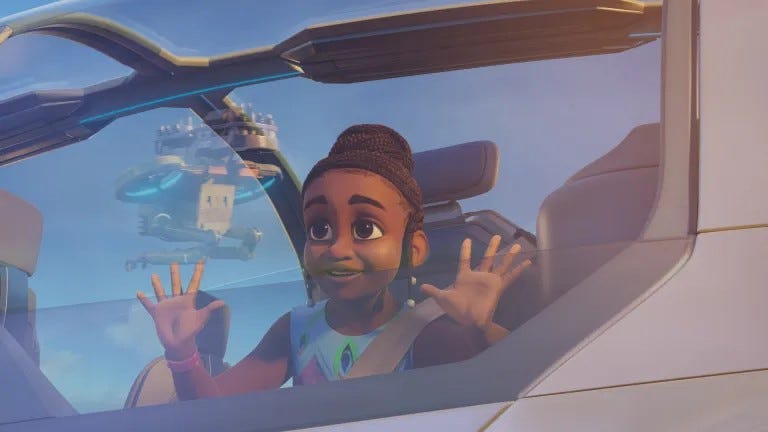
Just as Iwájú shows the power of representation, so does it show a vision of the future which is uniquely African, with Lagos as a backdrop for technological innovation.
The Iwájú Lagos is not only futuristic, it’s the familiar transformed. The series combines brilliant aspects of the city, such as its busy streets, the never-ending Lagos traffic, hawkers on the roads, the rich cultural heritage and so on, with advanced technology, showing a Lagos driven by innovation.
Imagine a world where houses are powered by renewable energy, where household chores are taken care of by robots powered by AI, and where cars drive themselves and are efficient. That is the world Iwájú presents to children, challenging them to ask, “What if this were possible?”
The portrayal of a tech-leading Africa shatters the prevailing perception of Africa as struggling to fight underdevelopment. Instead, it offers a vision of what is possible, which exists only if young minds today connect to technology and innovation.
Bridging Imagination and Real-World Tech

Credit: Animation World Network
While Iwájú is fictional, the technology portrayed in it is not far-fetched. Some of the futuristic aspects of the animation, such as smart transport, automation and digital innovation, are already a reality on the African continent.
- Renewable energy sources such as solar panels become increasingly prevalent in Nigeria to balance energy shortages.
- Fintech companies like Paystack and Flutterwave have placed Nigeria on the world map as far as digital innovation goes.
- Lagos’ technology hubs like Co-Creation Hub (CcHub) are incubating the next generation of software engineers and AI researchers.
By drawing the connection between Iwájú and real technological advancement, young audiences can understand that innovation is not futuristic, it is happening already. Even better, they can be part of it.
Inspiring the Next Generation of Tech Innovators

Credit: Screen Rant
Stories are powerful because they make the impossible feel possible. When a child watches Iwájú, they aren’t just watching an animation, they’re seeing a version of their world where technology is employed as a tool for change.
Suppose a child aged 10 sits down to watch Iwájú and is awestruck by the future technology. They start wondering: How does the computer function? How do they make the robots? That wonder could spill over into coding, engineering(like Kole), or AI.
Inspiration starts with imagination and leads to action. Breaking technology down into something simple and fun could make Iwájú the catalyst to get more Nigerian children into STEM.
Just as a child’s curiosity about technology can turn into a passion for STEM, Tunde Martins’ journey illustrates how technology can change lives, from being just an “Ajegunle boy” buying Agege bread on credit to a “Security Tech Genius” living in the most affluent part of Lagos. After joining Greenwood Tech, his life shifts dramatically as he develops technologies for the Islanders, acquiring wealth and representing a symbol of tech to uplift others.
Tola’s Journey

Credit: Screen Rant
Tola, Tunde Martins’ daughter, is at the center of Iwájú.
At first, Tola is not thrilled about the robot Otin, a tiny lizard-like protector made by her father. She thinks it is disgusting, a distraction at best from the attention and nurturing she craves from her father. Tunde, however, made a deal with her to consider Otin as her responsibility, promising that if she does, he will take her to the mainland, something she has always longed to see.

Credit: Screen Rant
Although Otin, the Greenwood Tech robot, was introduced to Tola by her father to protect her and to test the robot, it means that parents should introduce their children to technology. Initially, Tola did not know that Otin was a robot and that she could talk. As Tola got kidnapped and gained new experiences out of her sheltered life, she comes to accept Otin, she transitions from viewing the robot as an annoyance to recognizing its value in her life.
Kole’s Aspiration and the Mentoring Role

Credit: Screen Rant
Kole, the other central character, is the personification of the younger generation eager to tap into the world of technology. Throughout the series, Kole demonstrates a natural interest and ability in tech. At the end of Iwájú, Tunde finds Kole’s potential and takes him under his wing. This is the depiction of the importance of mentorship and how the right guidance can change the life of an individual.

Credit: Screen Rant
Tunde’s mentorship gives Kole not just advice but a pass into the world of technology, positioning him for success and changing the direction of his life and that of his family. Tech mentorship has the power to transform lives. It’s not just giving out knowledge; it’s giving out opportunities, cultivating creativity, and developing the future leaders in the tech space.
Overcoming Conventional Nigerian Values
The animation’s title, Iwájú, meaning “the future”, is especially fitting when one looks at the topics of innovation and progress in the series.
Iwájú subtly contrasts traditional Nigerian values, specifically the deep cultural emphasis on respecting one’s elders and parents, with a narrative that shows the potential and intelligence of young people. It shows how children as young as 10 can be creative, capable and always learning. This is an evident rebellion of the common mantra of placing unwavering trust in parental authority, instead offering a vision where children are seen as active participants in shaping their future.

Credit: Screen Rant
Kole fixing robots, such as the robot he fixed, which broke during grooming flowers, exhibits his intrinsic tech abilities.
When Tunde complimented him with “Good fix”, he sees in Kole a reflection of his younger self, a sign that this child has potential. Similarly, when Tola, at one point in the streets of Ajegunle, deceives Uncle G that her father allowed her to leave for Ajegunle with Kole, Kole reminds her, “And if your elder dey talk to you, no do lawyer for them, oh. Your only chance is to do what they say.” This displays the dynamic balance between youthful independence and the respect for the wisdom of elders.
The Need for Action: How to Sustain This Momentum
While Iwájú is a significant step forward, its impact will be lasting only if followed by tangible action. We all have a role to play here as different groups can help sustain the momentum, such as:
- Teachers: Iwájú can be utilized as a springboard for schools to expose their pupils to the STEM curriculum.
- Tech Communities: Tech start-ups and community technology can create programmes that engage teens and youths in coding and engineering.
- Parents/Guardians: Enabling the curiosity of children towards technology by exposing them to learning tools (STEM toys, education gadgets, and tech-related conversations).
- Media & Entertainment Industry: More African-centered, technology-inspired stories need to be created to reinforce this message.
- Policymakers & Investors: Governments and private actors can invest in technology education initiatives that equip young Nigerians with the skills to turn curiosity into innovation.

Credit: Screen Rant
Conclusion
Iwájú is more than an animated series, it is a blueprint for possibility. Showcasing Lagos as a city of the future, sparks interest in technology and dares youth to see themselves as the architects of the future. The power of representation cannot be overstated. When young Nigerians can imagine themselves in stories of innovation, it shifts the way they view what they can be. They begin to ask, “Why not me?”
Through its characters, themes, and captivating visuals, Iwájú encourages and motivates young minds to explore the world of technology and build the future they want to see. The message is clear: the future is not just for those in Silicon Valley, it’s for all. And the way to build that future begins with curiosity, creativity and a growth mindset.
And now the question is: How do we bring the inspiration of Iwájú to life in the outside world? If we nurture the curiosity sparked by Iwájú, then we can raise a generation of tech founders who will reshape the future, not just in animation, but in real life.
What are your thoughts? How can storytelling inspire the next generation of African tech leaders? Let’s discuss in the comments!
[embed]
메타데이터
- post_id
- da2cdac25f21
- slug
- from-animation-to-innovation-how-iwájú-sparks-tech-curiosity-and-inspires-nigerias-next-da2cdac25f21
- url
- https://medium.com/@giftegbonyi/from-animation-to-innovation-how-iw%C3%A1j%C3%BA-sparks-tech-curiosity-and-inspires-nigerias-next-da2cdac25f21
- canonical_url
- https://medium.com/@giftegbonyi/from-animation-to-innovation-how-iw%C3%A1j%C3%BA-sparks-tech-curiosity-and-inspires-nigerias-next-da2cdac25f21
- author_url
- https://medium.com/@giftegbonyi
- status
- ok
- fetched_at
- 2026-07-20 11:00:29