This Tool Listens to You Type to Prove Your Writing Is Human
OKHuman publishes a stamp to say your writing is human-written. The team is looking for newsrooms to test it.
This Tool Listens to You Type to Prove Your Writing Is Human
OKhuman listens to you typing and publishes a stamp to say your writing is human-written.
“Did AI write that for you?,” she texted me. I was crushed. I’d sent a heartfelt goodbye to a colleague I had worked with for years and would really miss. The interaction signified a genuine challenge we have to grapple with now: trying to discern what is written by AI and what isn’t and the consequences of getting that wrong.
This is playing out in newsrooms too. The CEO of Chicago Public Media Melissa Bell publicly apologized in May 2025 after a freelancer used ChatGPT to write a review of books. Only five of the 15 books actually existed. Freelance journalist Marco Buscaglia didn’t disclose that he had used ChatGPT and his editors didn’t know to check factual accuracy accordingly.
A new tool could go some way to help editors manage freelancers’ use of AI. OKhuman promises to monitor your typing and provide a stamp to verify your work is written by a human.
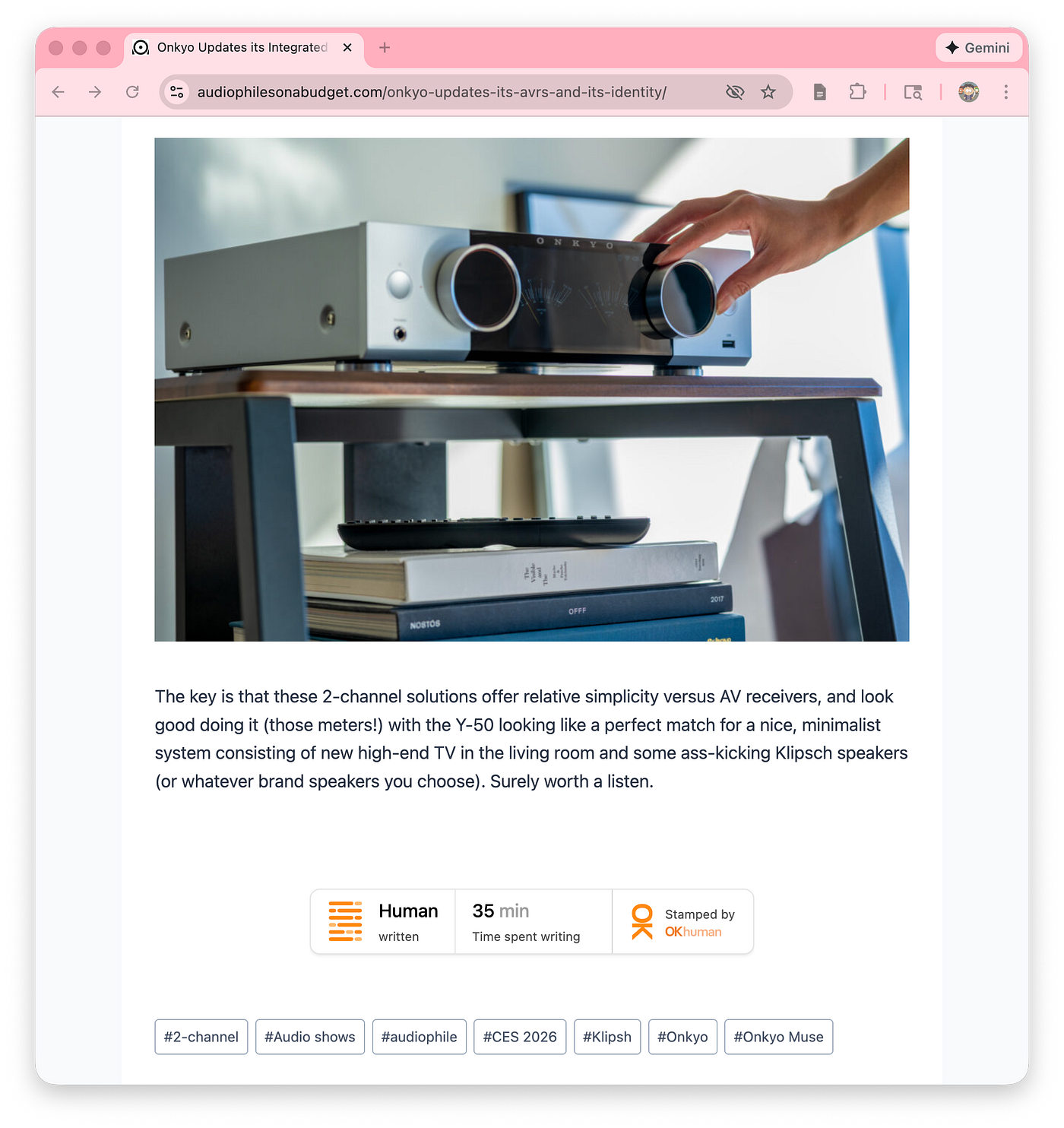
You can embed the stamp on your article to verify it is “human written”

Each stamp has a web page where you can see more details such as words written and the number of writers involved.
I tried out OKhuman on LinkedIn. I wanted to prove to my LinkedIn audience that I wrote a post myself. I chose the platform as the first test site as my feed has become a mountain of AI slop. I have noticed ex-colleagues’ posts become out-of-character in a cliched, positive, and hyperbolic tone. And then there are the wannabe “thought leaders”, clogging up my feed with the dreary dirge and meaningless drivel. If you can’t be bothered to write it, I can’t be bothered to read it, so the saying goes. I don’t want to add to that and would love to be able to signal to colleagues that my post may not be wasting their time in the same way.
The first step was to apply to sign up to OKhuman and wait to be approved. OKhuman is in what their documents describe as a “pre-release testing program” and you too can also apply and sign up to be part of this early stage if you are within the US. To sign up you have to agree to the terms of use and privacy policy. The description of OKhuman in the terms of use reveals a little about the team’s intention with the stamp. It introduces the idea of needing to “prove your human effort”. “OKhuman provides the human stamp for writing, allowing you to prove your human effort even when readers question what’s real. OKhuman stamps your original work — your ‘Made by Human’ label. A stamp lets you prove that your words are yours, using state-of-the-art technology to watermark your writing.”
The documents also reveal a little about how OKhuman monitors you and how it then determines that your work was written by a human. They say they collect: “typing/behavior metadata; internet/network status information for your device; and device data such as type, operating system, and usage statistics for permitted apps.” The documents go on to say “OKhuman collects various forms of data, including microphone input, keystroke pattern data, and network status. That data is used to verify content is human-created and generate your OKhuman Score”.
I sat down with the CTO and co-founder of OKhuman Mohit Vora and asked more about what OKhuman is listening to and how it uses that to certify that text is human written. He was reluctant to give away the recipe to his special sauce, saying little more than it is “the sound of the key strokes itself” which he uses to determine whether a human is writing. He did however emphasize that OKhuman is designed with strong privacy measures. “We are taking every measure to make sure that the audio signal we capture is not going to involve any private aspects. We also take extreme measures to try and capture as little of a signal as possible. We scrub out human voices for example.” A little more detail on this is revealed in the privacy policy: “The sensor data is processed on your device and on our servers to confirm human typing at the time text is entered into the application. Some sensor data, such as audio signals, are processed on your device to remove as much of the background noise — including human voices — as is reasonably possible. Other than a small initial excerpt used to identify and refer to a text document, OKhuman does not record or store the text content you create.”
After signing in and downloading OKhuman onto my computer, I followed a tutorial which made a bold claim about the value of the OKhuman stamp to my career as a writer: “For professional writers, an OKhuman stamp puts you in the premium tier by documenting the writing effort behind your words — time spent crafting and refining work that AI can’t replicate.” It later describes human written work as “premium value that justifies premium rates”. The tutorial then makes what seems to me like an attempt to reassure me that the level of surveillance is just enough to create the stamp but not more: “Your content stays private. We document your process, not your text.” The instructions promise me that “OKhuman works in the background while you write in Google Docs, Microsoft Word, Hemingway App, Apple Notes, Slack, Medium, and more.”
Once downloaded, the OKhuman icon appeared on the task bar on the bottom right of my computer. Before it would monitor my writing on LinkedIn, all I had to do was to open LinkedIn, click on the OKhuman icon and switch a toggle on. This was all pretty easy and I was impressed with how seamlessly it integrated into my workflow. Mohit told me that it will also work on a newsroom’s internal CMS, although I didn’t try this.
I was now set up to write my LinkedIn post. I noticed my behaviour changed: I prepared as if I was going to be speaking live on air. I was going to be performing my writing and I felt like I was being watched.
Here’s the LinkedIn post:

When I clicked on the OKHuman icon, it automatically added a URL with my human verified stamp onto my LinkedIn post
Once I had written the LinkedIn post, I clicked on the OKhuman icon on my task bar, it initiated the process of verifying whether a human had written the post. It added the URL to the post which correctly confirmed that a human had written the post. On the OKhuman site, I then added the LinkedIn post’s URL to that particular stamp. A reader of the post could then click through on the OKhuman stamp page to see the text the stamp is referring to, with the human written part highlighted in light purple. (For the record, I did also manually write the sentence which isn’t highlighted).

You can refer back to the original text and the parts OKHuman determines as written by a human are highlighted in purple
I looked back at my post and realised there was so much of it that could have been mistaken for AI. Firstly, the opening line felt derivative. “I thought I would jump on the 2016 nostalgia trend.” It didn’t feel like it was in my authentic voice but instead by AI. It was in fact written by me, I was just being lazy and didn’t rewrite it, partly because I didn’t want a shamefully long writing time for what was meant to be a casual LinkedIn post. In that sense, OKhuman changed the writing process itself. Okhuman verified the post as taking 13 minutes to write which was pretty embarrassing to me. That would have been too slow for a breaking news story.
The other reason that I was keen to show my audience that I wrote the post without AI was that the post was a summary of three articles. Summaries have been a popular use case for AI and I felt that my audience might assume I used AI because of that. However, I take the view that there is great value in a human summarizing information because they are able, in a way AI can’t, to make a judgement about the most pertinent points to a particular audience at a particular time.
Long time journalist Danya Henninger, acting as a consultant for OKhuman, sees many other reasons it could be valuable to newsrooms. The tool could ensure compliance with AI policies, it could help with working with external contributors including freelancers and verifying quotes from experts provided by PR companies, and it could help newsrooms and writers who want to disclose to audiences the extent of AI used in their work, she told me. But, above all, the value she sees for newsrooms is that OKhuman makes human work visible in order to monitor work in newsrooms. Newsrooms are increasingly adopting AI. However this adoption is intertwined with the writing workflow. This is making it stark that writing is “invisible work”. She argued that newsrooms need a way to make that manual writing visible. “OKhuman is the only way to show that invisible work,” she claimed. “What work did a human put in? Where did you use AI? OKhuman is a way to make that visible. Where did someone actually type something or edit it a lot?.” However, she sees limits for the extent of the positive impact OKhuman can have. “I don’t think we can say this is going to solve AI slop”.
Mohit’s team is still early in the process of developing and finding the user base for OKhuman. He told me they have some newsrooms trying the tool but declined to share who they were.
While OKhuman may not single-handedly solve the problem of AI slop, it may help us work out human authorship at a time when this is increasingly questioned. For newsrooms grappling with AI policies, freelancers, and audience trust, that signal may be useful though it comes with trade-offs. Turning the act of writing into measurable data changes how it feels to write and raises questions about surveillance and consent — will the journalists of the newsrooms of the future using OKhuman accept this? As AI text becomes cheaper and harder to distinguish from human work, OKhuman is betting that “human-made” will become a premium label and that writers, editors, and readers will decide that this is a price worth paying.
메타데이터
- post_id
- da3350fe02e2
- slug
- this-tool-listens-to-you-type-to-prove-your-writing-is-human-da3350fe02e2
- url
- https://generative-ai-newsroom.com/this-tool-listens-to-you-type-to-prove-your-writing-is-human-da3350fe02e2
- canonical_url
- https://generative-ai-newsroom.com/this-tool-listens-to-you-type-to-prove-your-writing-is-human-da3350fe02e2
- author_url
- https://medium.com/@clarespencer
- status
- ok
- fetched_at
- 2026-08-17 19:13:16





