Who gets easy ground?
You can’t convince me not to try to grow a plant. In water, in soil, from seeds, from cuttings. I am drawn to it in an almost inexplicable…
Who gets easy ground?
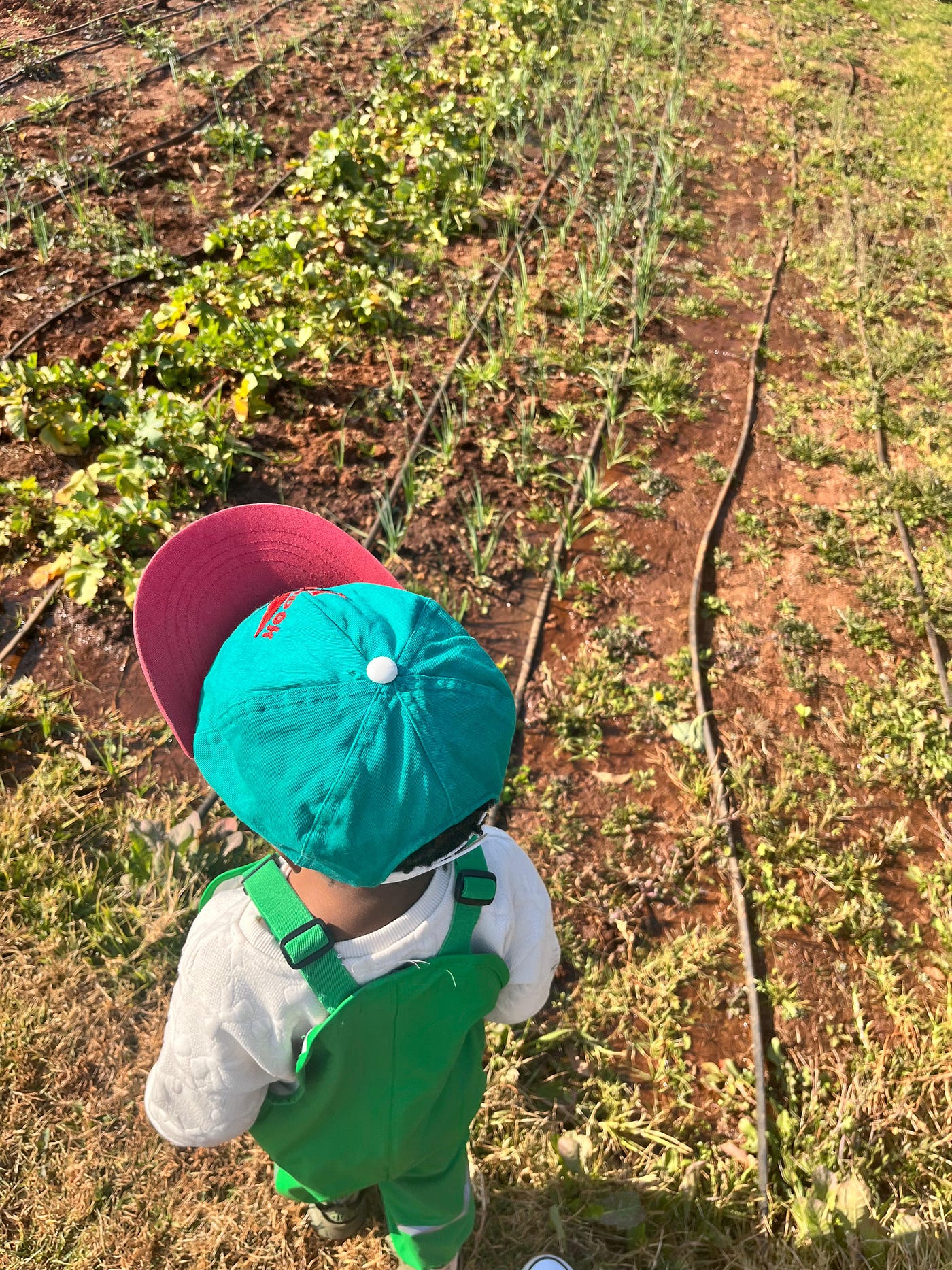
in image: my daughter at a small community farm
You can’t convince me not to try to grow a plant. In water, in soil, from seeds, from cuttings. I am drawn to it in an almost inexplicable way. It is my way of life. Last year I planted some potatoes in a small 2-by-1-meter rectangle of limited gardening space I had at the time. I threw some tomatoes on that same ground that were going bad in my kitchen, the same way I saw my mother do this for years, and we always had a garden, all the basics: onions, tomatoes, kale. If you walked to the back of the house, a full field of maize, beans, peanuts, and sweet potatoes. You couldn’t starve if you had land.
The potatoes I planted barely grew, lol. I didn’t know what I was doing, but I wanted to try. I got a few small heads out. What I noticed over the years from trying to grow food in this soil, on this land, is that it was so much harder. What seemed simple- my mother just throwing seeds on the ground, no fertiliser (just hopes and prayers) was almost impossible to replicate without a lot of effort: added nutrition to the soil, soil specifically packed for growing vegetables. I don’t remember us ever needing to buy soil for planting vegetables. I was curious about this, so I got to digging for information.
The soil in Johannesburg is quite different, more like clay in form. It tightly binds itself, almost in a cement-like way, trapping your seeds and seedlings from growing further. There are plenty of rocks you’ll encounter while digging, and these rock layers make it incredibly difficult for roots to thrive. So in case you’ve tried as well, you’re not alone. There’s something off about the soil, but there’s more. One frequent thing I keep mentally circling around is the wounds of the soil and how the history of the country affects it as well. Here’s what the history actually says, in the dry language history gets told in:
“The 1913 Natives Land Act and later the Bantustan/homeland system confined Black South Africans to about 13% of the country’s land, and that land was disproportionately the poorer, harder, more marginal soil, while fertile, well-watered land was reserved for white ownership. Around Johannesburg specifically, over a century of gold mining left the land scarred in a very literal sense: mine dumps, tailings, and acid mine drainage altered soil chemistry and hydrology across the Witwatersrand. The ground people till there today carries that industrial residue. Forced removals (District Six, Sophiatown, and hundreds of rural equivalents) severed people from soil they’d farmed for generations, breaking the accumulated knowledge, which fields flood, which hold moisture, how to read that particular ground, that gets passed down through continuous cultivation.”
The clay you’re fighting with a hoe in Joburg isn’t just geologically different from Bulawayo’s sandier ground. It’s land whose relationship to the people working it was interrupted and controlled by policy.
I keep coming back to that word: inherited. Both my father and mother grew up in the rural areas on land that belonged to their ancestors for decades. They inherited a knowledge of land the way you inherit a language, without ever sitting down to learn it. My father knows, without being taught in any formal sense, when the rains would come and how deep to dig to put a seed so it wouldn’t rot or dry out. He knows how long to wait for the rain, and when it’s time to support the seeds by watering them himself when the area was having a drought. He didn’t get this knowledge from a textbook; it was passed on from my great-grandparents to everyone down the line in his family, who’d farmed the same kind of ground their whole life, on land that had not been taken from them.
That’s the part I didn’t understand until I started digging, not just into the soil, but into the history. It’s not that my parents had some innate gift I don’t have. It’s that my mother was working land with an unbroken relationship to the people who worked it before her. Generations of the same soil, the same rains, the same mistakes made and corrected and made again, quietly, until the knowledge became instinct. It’s not just different soils. It’s continuity. And continuity is exactly what apartheid was designed to sever.
So we’re not just inexperienced gardeners; the land clenches its fists whenever we try because we are primarily on land that has no inherited memory attached to it. It is not because our families lacked the knowledge, but because that knowledge was built somewhere else, on land we no longer have access to, while this land was left to carry the weight of a different history: gold pulled from beneath it, chemicals leached into it, people moved off it and away from it until whatever memory it once held of being farmed gently, slowly, and correctly, was interrupted too.
Healing this ground, then, isn’t only a metaphor. It’s compost added by hand, load by load, to loosen what a century of mining and policy compacted. It’s slowly learning through failure, through those few small potato heads I did manage to pull out of bad soil and worse luck, what my mother never had to learn because it was already inside her. It’s building, from nothing, the same continuity that was taken from people like her, except now on ground that resists you at every turn.
I don’t know yet if you can out-compost a history like this. But I know I’m going to keep trying, the same way I can’t be talked out of trying to grow a plant in the first place. Some things you do not because you’re convinced they’ll work, but because the trying is itself a kind of repair.
This year I am transplanting my knowledge the best way I know how. I want to grow food and plants, not only for myself, but for my community, a community that deserves its inheritance: knowledge and land.
메타데이터
- post_id
- da33896a88cf
- slug
- who-gets-easy-ground-da33896a88cf
- url
- https://medium.com/@lushgreen/who-gets-easy-ground-da33896a88cf
- canonical_url
- https://medium.com/@lushgreen/who-gets-easy-ground-da33896a88cf
- author_url
- https://medium.com/@lushgreen
- status
- ok
- fetched_at
- 2026-07-18 09:10:59




