A $4 Billion Empire Broke Open Source. They Threatened One Developer. It Backfired.
They took open-source code for free, then threatened the lone developer who actually followed the license. The Internet had other plans.
A $4 Billion Empire Broke Open Source. They Threatened One Developer. It Backfired.
They took open-source code for free, then threatened the lone developer who actually followed the license. The Internet had other plans.

Image by Alexa from Pixabay
A 3D-printing giant vs. one coder after work.
One company owns close to a third of every 3D printer sold on Earth. It generates more than $250 million (¥2 billion) in annual profit; it is run by a founder who used to ship drones; and millions of people trust it in their workshops.
On the other side stands one man who writes code in his spare time and gives it away for free.
The company sent its lawyers after the developer. They should have real enemies like counterfeiters stamping out fake machines, rivals cloning their hardware, but no, they chose the volunteer developer.
The threat used heavy words.
Impersonation…
Unauthorized reverse engineering…
The company chose those words to scare the developer into taking his code down and giving up.
This is the story of a $4 billion company that took free code and built a business on it. It spent four years breaking the one condition that code came with. Then it sent its lawyers after the volunteer who kept the condition the company had broken.
The Update That Locked Owners Out
A customer pays under $2,500 for a Bambu Lab printer. For a year, it does the job. They send print jobs over their home network from whatever slicer they prefer, the program that turns a 3D model into machine instructions.
One day, a firmware update arrives. They install it because that is what you do. The next morning, they hit print from their usual software, and nothing happens. The machine sits there, but the third-party slicer can no longer reach the printer. They now have to route everything through a piece of Bambu’s software that sits in the middle and checks their permissions before they can print at all.
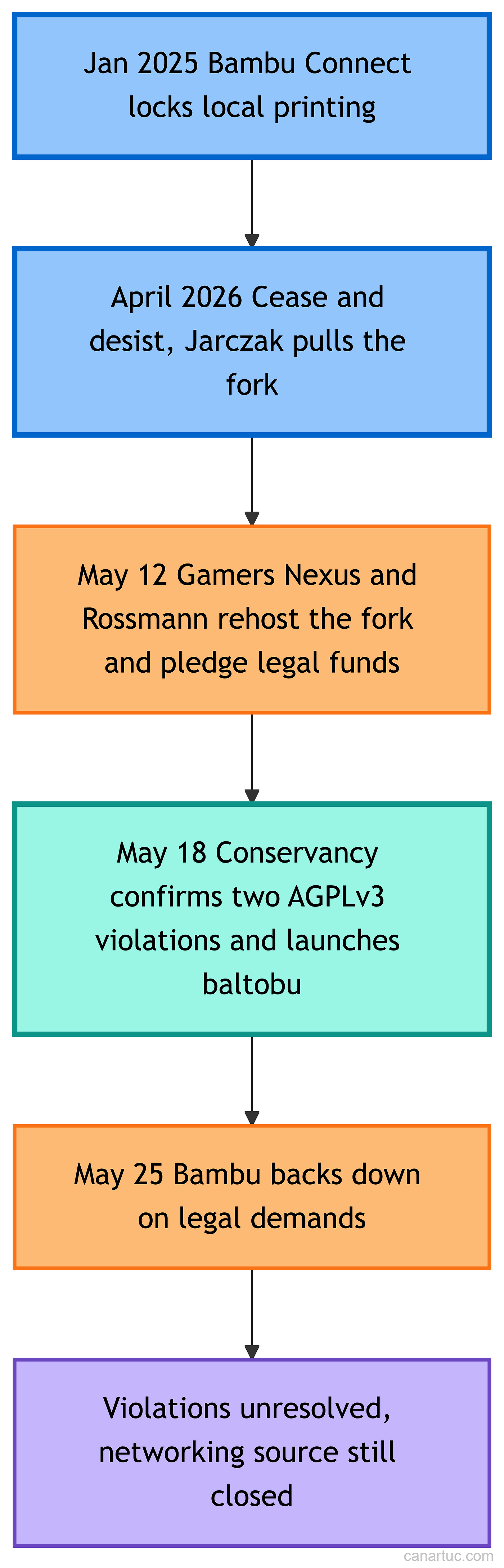
That middleware is called Bambu Connect. It landed in January 2025 and gated the things that make a 3D printer a printer: starting a job, moving the print head, configuring the multi-material unit, and upgrading the firmware. Owners woke up locked out of hardware they already owned.
Bambu’s own defense reveals how it views those owners. The company said its servers were being hit with roughly 30 million unauthorized requests a day. People printing on their own machines, over their own home networks, had become unauthorized traffic on Bambu’s books. The customer’s use of the thing they bought was reclassified as a load problem.
Paweł Jarczak, a Polish developer, did the obvious thing. On 23 April 2026, he published a fork of OrcaSlicer that let owners print over their own network again, with no subscription and no Bambu software standing in the path.
Until now, it reads like normal because companies can do such things. The Whoop band, a fitness tracker without a screen, does the same: without a subscription, it’s just an expensive accessory.
But in Bambu’s story, there is a catch…
Jarczak did not steal anything from Bambu. Bambu had not even written the code he used. The company took it from someone else years earlier, and that code came with a license. The license grants everyone the same rights to use, modify, and share it. Those were the exact rights Bambu was now trying to deny Jarczak.
Free Code Comes With One Rule. Bambu Broke It.
Every 3D printing slicer in this story descends from the same piece of free software.
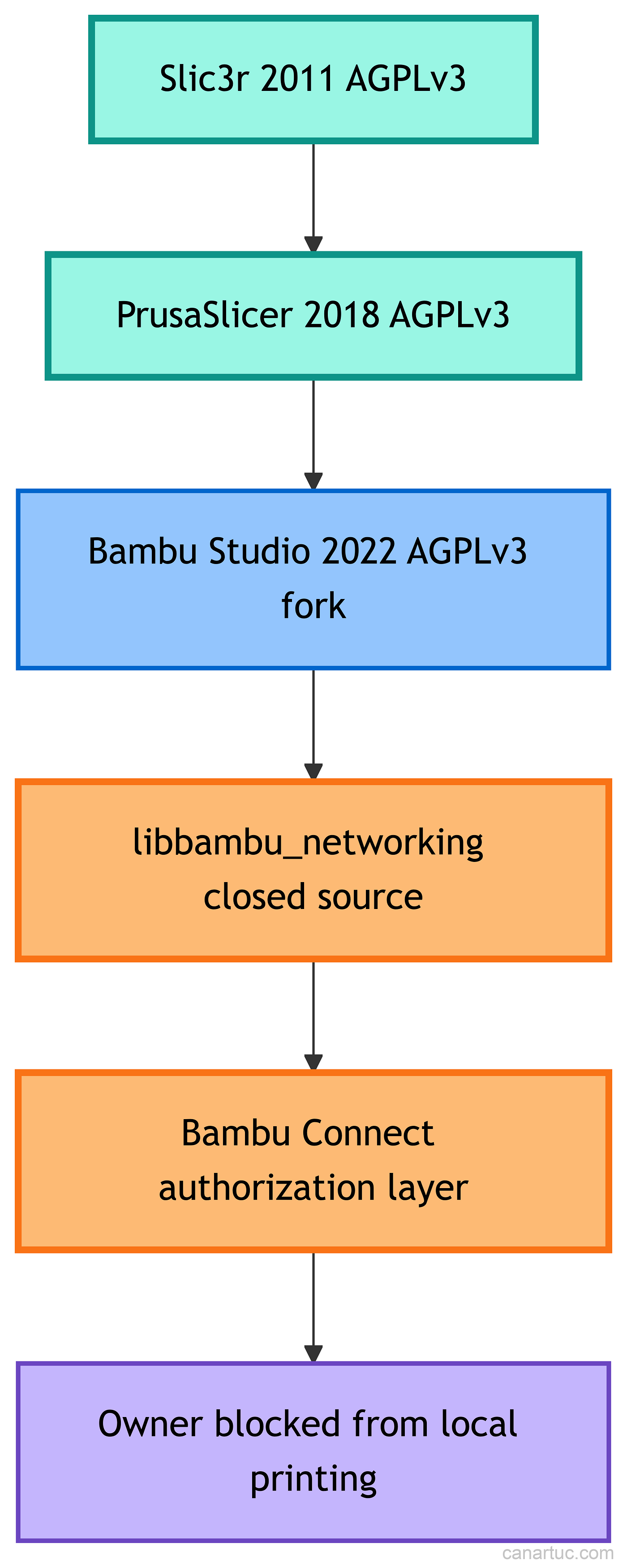
It begins with Slic3r, released in 2011 under the AGPLv3 license. The license is generous and carries one catch. Use the code, change it, sell it, build a business on it, all allowed. But if you give people software that contains this code, you give them the source too, and you do not bolt on locks that strip their freedom to use it.
In 2018, a Czech company forked Slic3r to create PrusaSlicer, under the same AGPLv3 license. In 2022, Bambu Lab forked PrusaSlicer to create Bambu Studio, under the same AGPLv3 license. Bambu’s own blog admitted the lineage.
Bambu Lab was founded by Dr. Ye Tao, a former DJI manager who shipped the Mavic Pro drone. The company built its slicer on years of other people’s free work. Around 10 million people a month use its 3D model platform. Free code carried Bambu the whole way.
Then it stopped honoring the contract in two separate ways.
The first break is four years old. Bambu Studio ships a closed-source networking library called libbambu_networking. It runs on Linux, Windows, and macOS and handles every conversation between the slicer and Bambu’s cloud. The AGPLv3 says that any code Bambu ships in Bambu Studio must include its source code, under the same license. Bambu never released the source for that library. The closed library sat in plain sight for four years while the company took the rest of the code for free.
Credit: Author, How open code became a proprietary lock in Bambu Studio
The Software Freedom Conservancy, the nonprofit that enforces this license, did not hedge. Bambu, it wrote, “has behaved badly for years and made multiple, provably false public statements regarding the AGPLv3.”
The Threat That Broke the License Again
The second break is the one that lit the fire.
Bambu Lab emailed Jarczak in April 2026 and told him to take the fork off GitHub. The email accused him of impersonation and unauthorized reverse engineering. It also claimed that Bambu’s terms of service overruled the open-source license Bambu had agreed to in the first place.
… What??? …
The contradiction is obvious when you trace what happened. Bambu accepted the AGPLv3 to use the code. The AGPLv3, in section 10, forbids adding “any further restrictions” on the people downstream of you. Bambu then told a downstream developer that its own terms of service canceled his rights under that license. The Software Freedom Conservancy was blunt about it: Bambu “falsely claims that their terms of service override the AGPLv3.” Sending the threat was itself a fresh breach of the contract Bambu was standing on.
Jarczak pulled the fork off GitHub. A man with a day job does not fight a $4 billion legal department, because losing costs money he does not have and his opponent will not feel. Most solo developers fold at exactly this moment, and most companies are counting on it.
If a $4 billion company threatening a volunteer over its own broken promise makes your blood run hot, clap, comment, or share this. The people holding open source together are watching who notices.
Then the Internet Turned on Bambu
Bambu had angered its own community before and ridden out the backlash. This time, the wrong people were watching, and they did not line up behind the $4 billion company.
Louis Rossmann, the right-to-repair advocate, watched the threat land and, in public, told Bambu Lab to go … (bleep) itself. He pledged $10,000 toward Jarczak’s legal defense, rehosted the banned fork on the GitHub of his own FULU Foundation, and dared Bambu to come after him instead.
Snapmaker, a competitor, sent Jarczak one of its U1 printers. It runs Klipper, open-source printer software. Bambu’s lockdown is meant to keep its customers away from open machines like that one. Other creators announced boycotts of Bambu. Bambu had tried to isolate Jarczak. Now he had a louder crowd behind him than Bambu had on its side.
Bambu had spent the spring treating its customers as a load problem. One of its biggest customers answered by taking its money to the competition.
Gamers Nexus, one of the most-watched hardware channels on the internet, published a piece bluntly titled “F*** You, Bambu Lab.” It pledged another $10,000 to the legal fund and hosted Jarczak’s code itself, with his blessing. Then the channel announced it was phasing out the Bambu printers it owned. It had already placed a $5,000 order with Prusa instead. Prusa is the open company whose slicer Bambu forked and then locked down.
The Conservancy Made It Official
On 18 May 2026, the Software Freedom Conservancy confirmed both violations in a formal report. It also launched a project called baltobu, built in three parts.
The first figure out how the closed networking library works, so it can be rebuilt in the open (reverse engineering).[1]
The second keeps Jarczak’s version of the slicer available and maintained, so owners can keep using it.[2]
The third, called viscose[3], is a clean replacement for Bambu Studio that follows the license Bambu broke. The Conservancy opened a $250,007 fundraiser to pay for the work. Donors have already given more than $114,000.[4]
Credit: Author, Timeline of the Bambu Lab AGPLv3 dispute from firmware lock to backdown
The result came fast. By 25 May 2026, Bambu Lab backed off its legal demands against Jarczak. The fork survived. The developer kept his code. A company worth more than $4 billion backed down from one unpaid coder, just a week after the Software Freedom Conservancy stepped in.
You Bought It. They Rented It Back to You.
The copyright lawyer Leonard French calls this pattern progressive enclosure.
You have lived this already without the label. Your printer rejects a third-party ink cartridge after an update, the way HP customers found out….
Your coffee machine refuses an off-brand pod, the Keurig move…
Your tractor throws an error and says only the dealer can fix it, the fight John Deere has had with American farmers for years…
The maker crowd felt this first, but the problem reaches far beyond them. It hits anyone who signs a purchase order for connected hardware, any CTO standardizing on a fleet, and any engineer who assumes that buying a machine means owning it.
Sorry for the Bad Press. Not for the Theft.
I have a toddler. As parents, we teach that everyone can make mistakes, but if those mistakes hurt others or cause unfairness, the civilized way is to apologize.
Bambu did not apologize.
The company said its reference to the terms of service, legal context, and a possible cease-and-desist “understandably came across as a legal threat,” and added, “That was not the outcome we wanted.” It said nothing about the four-year license break or the lawyers aimed at a volunteer. What it mourns is the bad press.
The violations are still live. The networking library is still closed. Bambu Connect still stands between owners and the machines they bought. The Conservancy’s committee on 3D printer software freedom is due in June 2026. The fundraiser is still climbing. Bambu still has not released the source code it has owed for four years.
The lawsuit went away, but the theft did not.
So the honest read is not that the good guys won. Enforcement worked exactly once because a right-to-repair advocate, a famous hardware channel, a nonprofit with lawyers, and a pile of furious customers all pointed in the same direction in the same fortnight. Most violated licenses never get that, and most threatened developers just delete the repository and vanish.
This is one of the reasons I write about Linux and open source. Bambu will not be the last. The same move is coming for a device you already own, for the next one you buy, for the software you rely on every day.
If you have ever bought a device that turned into a subscription after the sale, or your team runs Bambu printers right now, clap, comment, or share this with whoever signs your hardware contracts. They should read the license before the next update lands.
[1] Source code: https://f.sfconservancy.org/baltobu/reverse-networking
[2] Source code: https://f.sfconservancy.org/baltobu/orca-slicer-for-bambu
[3] Source code: https://f.sfconservancy.org/baltobu/viscose
[4] Donation: https://sfconservancy.org/donate/
Your contribution matters! Here is the map of possible actions you can take:
Medium Actions
메타데이터
- post_id
- da390a20bc1f
- slug
- a-4-billion-empire-broke-open-source-they-threatened-one-developer-it-backfired-da390a20bc1f
- url
- https://medium.com/@canartuc/a-4-billion-empire-broke-open-source-they-threatened-one-developer-it-backfired-da390a20bc1f
- canonical_url
- https://medium.com/@canartuc/a-4-billion-empire-broke-open-source-they-threatened-one-developer-it-backfired-da390a20bc1f
- author_url
- https://medium.com/@canartuc
- status
- ok
- fetched_at
- 2026-06-09 15:37:30