Teal Organizations: Self-Management, Wholeness, and Evolutionary Purpose
[Week 42, 2018] Teal organizations promote self-management, wholeness, and evolutionary purpose for enhanced workplace effectiveness.
Week 42, 2018
Teal Organizations: Self-Management, Wholeness, and Evolutionary Purpose
Photo by You X Ventures on Unsplash
Each week I share three ideas for how to make work better. And this week, I’ll put some closing thoughts to the discussion about consciousness and organizational development that have occupied the last couple of issues.
In w40 2018, we looked at three levels of consciousness. And we’ve seen how empathy expands as we transition from one level to the next — culminating with the Wordcentric view that extends compassion to all human beings regardless of race, color, or creed.
In w41 2018, we then connected each level of consciousness with certain types of organizations — culminating in Worldcentric “Green” organizations that distribute decision-making authority throughout the organization using an inverted pyramid structure.
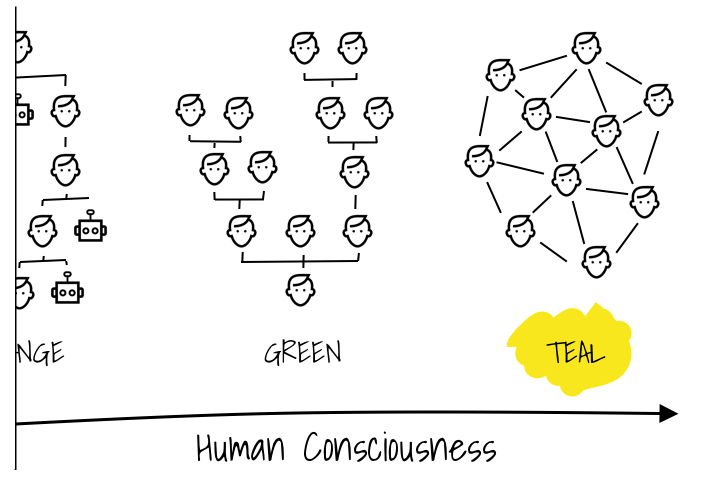
Beyond this paradigm lies the 4th level of consciousness: Kosmocentrism. Here, we expand empathy further to include all sentient beings. And here, we find “Teal” organizations and the three breakthroughs that they enable:
1. Self-Management
Teal organizations do away with traditional structures and hierarchies, relying instead on systems based on mutual trust. Workers are seen as reasonable people who can and will do the right thing if left to their own devices — negating the need for most rules and control mechanisms. Information is allowed to flow freely; teams are allowed to work autonomously, and people are free to take on whatever role and/or roles they deem necessary.
2. Wholeness
Teal organizations reject the principle of “professionalism”, preferring instead that workers bring their “whole selves” to work. In part, this is because human connections build trust. In part, it’s because traditional structures favor masculinity and extroversion — expressions that are but part of human experience. To combat this, Teal organizations provide safe and supportive work environments that allow employees to be themselves.
3. Evolutionary Purpose
Teal organizations are seen as having a life and a sense of direction of their own (see Complex Adaptive Systems on Wikipedia). And so while traditional organizations spend time and energy to predict-and-control the future, employees at Teal organizations are invited to listen in and continuously refine and shape the organizational purpose. The purpose of a Teal organization is therefore not static. Rather, it is allowed to evolve as the organization grows and adapts.
In his 2009 best-seller “Drive” (see w39 2018), author Daniel Pink explained that organizations must leverage Autonomy, Mastery, and Purpose if they hope to engage their employees. Frederic Laloux, author of “Reinventing Organizations” and my source for this issue, makes much the same argument: Self-management aligns with Autonomy, Wholeness and Mastery shares focus on personal growth, and Purpose is, well, Purpose — evolutionary or not.
Personally, I love it when differing sources converge like this. To me, its a sign of validity; that there’s a there there, so to speak. And so I hope to explore the intersection between Pink and Laloux further in a future issue of WM. But that’s for later. Next week we’ll switch topic and look at my three main takeaways from the book “It Doesn’t Have to be Crazy at Work”.
Cheers.

메타데이터
- post_id
- da3acfaeb5d3
- slug
- teal-organizations-self-management-wholeness-and-evolutionary-purpose-da3acfaeb5d3
- url
- https://medium.com/workmatters/teal-organizations-self-management-wholeness-and-evolutionary-purpose-da3acfaeb5d3
- canonical_url
- https://medium.com/workmatters/teal-organizations-self-management-wholeness-and-evolutionary-purpose-da3acfaeb5d3
- author_url
- https://medium.com/@andreasholmer
- status
- ok
- fetched_at
- 2026-07-19 17:00:11