Refractive vs.
Not all lazy eyes are the same. Learn the difference between refractive & strabismic amblyopia & why an accurate diagnosis is key to…
Refractive vs. Strabismic Amblyopia: Why Your Specific Diagnosis Is the Key to Your Treatment Success
In the world of eye care, “lazy eye” is one of the most widely recognized terms. Yet, this simple label masks a complex condition. Not all lazy eyes are created equal. While the outcome is the same, reduced vision in one eye, the underlying cause can be dramatically different. It’s much like having a fever; the fever is the symptom, but the cause, whether a virus or a bacterial infection, dictates the correct medicine.
The same is true for a lazy eye, known clinically as amblyopia. The two most common causes are a problem with eye alignment (strabismus) and a problem with focusing (a refractive error).
Understanding the distinction between strabismic amblyopia and refractive amblyopia is not just an academic exercise. It is the single most important factor in determining the right therapeutic path. A precise diagnosis is the non-negotiable first step for any successful amblyopia treatment plan, as the strategies to correct each type are fundamentally different.
The Common Ground: What Exactly is Amblyopia?
Before we explore the differences, let’s establish common ground. Amblyopia is a neurological condition. It is a disorder of sight that results from the brain and eye failing to work together properly. During the critical period of visual development in early childhood, if the brain receives a poor-quality image from one eye, it will learn to ignore, or suppress, that input. Over time, the neural pathways for that eye fail to develop, and its vision weakens, even if the eye is structurally healthy.
The key question is: why is the brain receiving a poor-quality image? The answer to that question defines the type of amblyopia and therefore the correct approach to amblyopia treatment.
Strabismic Amblyopia: The Alignment Problem
This is the type of lazy eye that people most often picture.
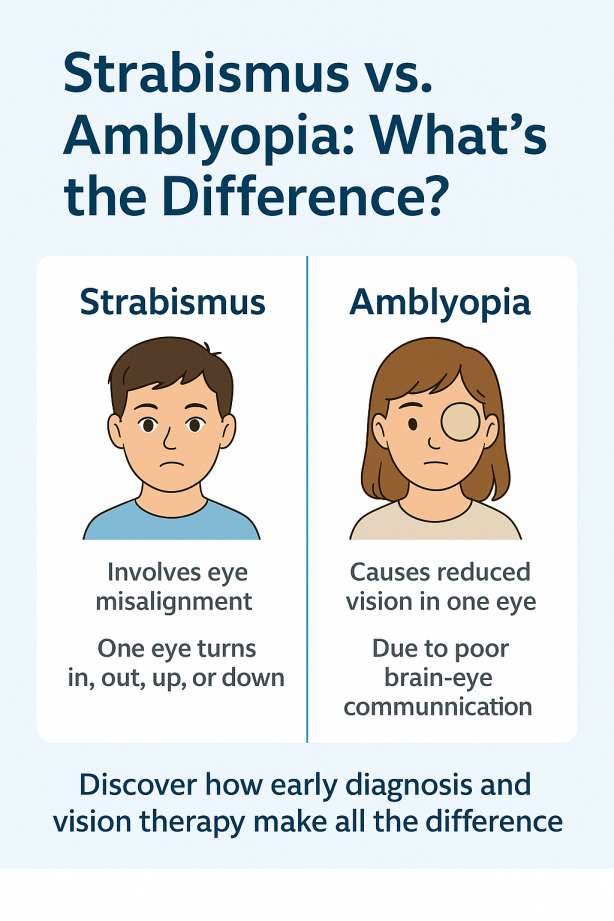
The Cause: Strabismic amblyopia is a direct result of strabismus, a condition where the eyes are misaligned. This can be an eye that turns inward (esotropia), outward (exotropia), or vertically. Because the eyes are pointing in different directions, the brain receives two completely different images. To avoid constant, disorienting double vision, the brain makes a choice: it suppresses the image from the misaligned eye.
The Telltale Signs: The most obvious sign is often the visible eye turn itself. However, this turn can be intermittent, appearing only when a child is tired or ill, making it easy for parents to overlook.
The Treatment Philosophy: A successful amblyopia treatment for this type must be two-pronged. It is not enough to simply improve the vision in the amblyopic eye (acuity). The treatment must also address the binocular vision dysfunction — the brain’s inability to use the two eyes as a team. The ultimate goal is to achieve both clear vision and proper eye alignment.
[Image showing the difference in alignment of the eyes in strabismus]
Refractive Amblyopia: The Focusing Problem
This is the “hidden” lazy eye, a silent condition that often goes undetected without a formal eye exam.
The Cause: Refractive amblyopia occurs when there is a large difference in prescription (refractive error) between the two eyes, a condition called anisometropia. For example, one eye might be perfectly fine while the other is highly farsighted or has significant astigmatism. The brain receives one sharp image and one consistently blurry image. Faced with this choice, it logically learns to favor the clear image and suppress the blurry one.
The Telltale Signs: There are often no obvious, visible signs. The child’s eyes are perfectly straight. They don’t complain because, to them, their vision is normal. They navigate the world successfully using their one good eye. This is why early childhood vision screenings are so critically important.
The Treatment Philosophy: The primary goal of amblyopia treatment here is to first provide the brain with a clear image from the non-preferred eye and then encourage the brain to start paying attention to it. The challenge is less about eye alignment and more about breaking the habit of suppression and integrating the newly clarified image.
Comparison: Strabismic vs. Refractive at a Glance
Strabismic Amblyopia
- Primary Cause: Eye misalignment (strabismus)
- Visible Sign? Often, a visible eye turn
- Key Challenge: Double vision and suppression
- First Line of Treatment: Corrective glasses, often followed immediately by patching and/or vision therapy to address alignment.
Refractive Amblyopia
- Primary Cause: Unequal prescription (anisometropia)
- Visible Sign? Rarely, eyes appear straight
- Key Challenge: A consistently blurry image from one eye
- First Line of Treatment: Corrective glasses are the most critical first step and can sometimes resolve the issue on their own.
Why a “One-Size-Fits-All” Approach Fails
Understanding the diagnosis is key because applying the wrong treatment strategy will lead to frustration and incomplete results.
- If a child with strabismic amblyopia is only given glasses, the underlying problem of eye teaming and suppression will remain. The brain still won’t know how to fuse the two images, even if they are clear.
- Conversely, if a child with refractive amblyopia is put into a therapy program without first having their prescription fully corrected, the therapy will fail because the brain is still receiving an impossibly blurry image.
The success of any lazy eye cure hinges on a therapeutic plan that precisely targets the root cause of the problem.
The Modern, Personalized Approach to Treatment
Modern eye care has moved far beyond generic protocols. A successful vision therapy for amblyopia program is highly personalized to the patient’s specific diagnosis, age, and visual goals.
For instance, a patient with strabismic amblyopia might require therapy focused heavily on breaking deep-seated suppression and improving fusional ranges, often using advanced dichoptic activities. Modern, software-based platforms can deliver these specific, game-like tasks in a highly engaging way. The ability for these cloud-based systems, like Bynocs, to be customized and monitored by a doctor from afar ensures the therapy is always perfectly matched to the patient’s evolving needs, whether the root cause is refractive or strabismic. This personalized approach is especially crucial for amblyopia treatment for adults, where visual habits are deeply ingrained.
Conclusion: An Accurate Diagnosis is Your Roadmap to Success
The label “lazy eye” is just the beginning of the story. It tells you what the problem is, but not why. Understanding whether the amblyopia is strabismic, refractive, or a combination of both is the key that unlocks the right treatment path.
Don’t settle for a generic approach. An accurate diagnosis is the foundation for a targeted and effective amblyopia treatment. Empower yourself or your child with a personalized plan that addresses the true root of the problem and unlocks the potential for clear, functional, binocular vision for a lifetime.
FAQs
Q1: Can a child have both strabismic and refractive amblyopia? Yes. This is called mixed-mechanism amblyopia. It occurs when a child has both a significant eye turn and a high refractive error. The treatment plan must address both issues simultaneously.
Q2: Is the treatment for refractive amblyopia usually faster? In some cases, yes. If the amblyopia is mild and caught early, simply wearing the correct glasses can sometimes resolve the condition over a period of months. However, more significant cases will still require additional therapies like patching or vision therapy.
Q3: If my child has a squint, does that automatically mean they have a lazy eye? Not automatically, but the risk is extremely high. A constant eye turn in a young child will almost always lead to amblyopia if left untreated. An alternating squint, where both eyes take turns deviating, may not. A professional evaluation is the only way to know for sure.
Q4: What is the most important first step for any type of amblyopia treatment? The most critical first step is a comprehensive eye examination with an eye doctor, which includes a cycloplegic (dilated eye) refraction. This allows the doctor to determine the full, accurate prescription and diagnose the underlying cause of the amblyopia.
More Related Blogs: 1: The Real Cost of Amblyopia Treatment in India: A Complete Financial Breakdown
2: How Lazy Eye Affects 3D Vision and Driving (And How Treatment Can Help)
메타데이터
- post_id
- da504cc79a2e
- slug
- refractive-vs-da504cc79a2e
- url
- https://medium.com/@kajalshetty1221/refractive-vs-da504cc79a2e
- canonical_url
- https://medium.com/@kajalshetty1221/refractive-vs-da504cc79a2e
- author_url
- https://medium.com/@kajalshetty1221
- status
- ok
- fetched_at
- 2026-08-15 10:56:09