Neurotransmitters and Spirituality: Where Brain Chemistry Meets Human Consciousness
“The brain may provide the biology of spiritual experience, but whether it fully explains spirituality remains one of humanity’s greatest…
Neurotransmitters and Spirituality: Where Brain Chemistry Meets Human Consciousness

“The brain may provide the biology of spiritual experience, but whether it fully explains spirituality remains one of humanity’s greatest questions.”
For thousands of years, spiritual traditions have described states of peace, compassion, transcendence, enlightenment, and unity with the universe. Long before neuroscience existed, mystics, yogis, monks, and philosophers explored the inner landscape of human consciousness through meditation, prayer, contemplation, and self-inquiry.
Today, neuroscience offers another lens.
It suggests that every thought, emotion, memory, and perception is accompanied by the activity of billions of neurons communicating through chemical messengers called neurotransmitters.
Does this mean spirituality is “just chemistry”?
Not necessarily.
A more nuanced perspective is that neurotransmitters may be part of the biological mechanism through which spiritual experiences are expressed, without settling deeper philosophical or religious questions about their ultimate nature.
The Brain: Instrument or Source?
Imagine a violin.
Music cannot emerge without the violin.
But the violin itself is not the music.
Similarly, many neuroscientists describe the brain as the biological instrument through which consciousness is expressed. Spiritual traditions often describe consciousness as something deeper than the brain. Science, by contrast, studies how brain activity correlates with conscious experience.
At present, neuroscience can explain many neural processes associated with spiritual practices, but it cannot determine whether consciousness is entirely produced by the brain or whether the brain participates in a larger reality. That question remains open to philosophy, spirituality, and future scientific inquiry.
The Neurochemistry of Spiritual Experience
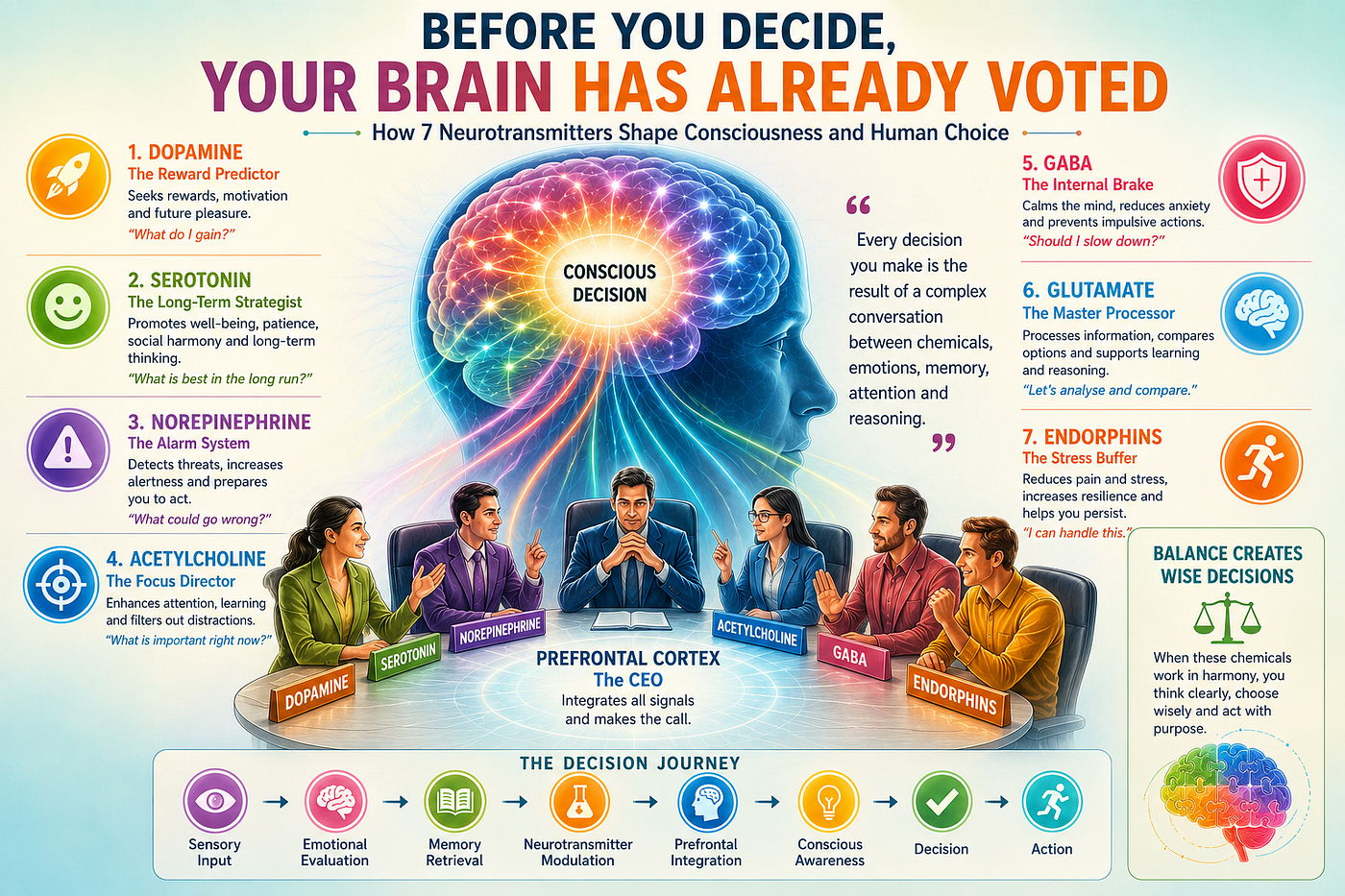
Dopamine: The Seeker
Dopamine motivates exploration and learning. Spiritually, it can support curiosity, purpose, and the search for meaning.
Healthy dopamine encourages disciplined spiritual growth.
Excessive dopamine, however, may contribute to overconfidence, grandiosity, or chasing extraordinary experiences rather than cultivating steady practice.
Many traditions caution against becoming attached to dramatic spiritual experiences — a reminder that motivation should be balanced with humility.
Serotonin: The Inner Peace
Serotonin helps regulate mood, patience, and emotional stability.
Meditation, gratitude, compassionate relationships, and regular sleep have all been associated with healthier serotonin regulation in various studies.
Spiritually, serotonin aligns with qualities such as:
- contentment
- acceptance
- compassion
- emotional balance
- equanimity
Many contemplative traditions describe inner peace not as constant excitement but as a stable and balanced state.
GABA: The Silence Within
One of the most consistent findings in meditation research is that some forms of meditation are associated with increased inhibitory activity in the brain, including changes involving GABA-related systems.
GABA reduces excessive neural activity.
Spiritually, this resembles the quieting of mental chatter.
Many meditation traditions describe awakening not as adding more thoughts but as discovering awareness beneath them.
When the mind becomes quieter, attention often becomes clearer.
Acetylcholine: Mindful Attention
Mindfulness requires sustained attention.
Acetylcholine supports:
- focused awareness
- learning
- sensory clarity
- memory
Mindfulness practices strengthen our ability to return attention gently to the present moment rather than becoming lost in distraction.
Presence itself becomes a spiritual discipline.
Norepinephrine: Sacred Alertness
Many people associate spirituality only with calmness.
Yet many traditions also emphasize alertness.
Zen masters speak of “beginner’s mind.”
The Bhagavad Gita encourages disciplined awareness in action.
Christian contemplatives describe spiritual vigilance.
Moderate norepinephrine allows us to remain awake, attentive, and responsive without becoming overwhelmed by stress.
Glutamate: Insight and Transformation
Glutamate supports learning and neural plasticity.
Deep contemplation often challenges long-held beliefs.
Over time, repeated reflection and practice may reshape neural connections through experience-dependent plasticity.
The result is not merely acquiring new information but changing how we perceive ourselves and the world.
Endorphins: Compassion Through Resilience
Pilgrimages, fasting, prolonged meditation, chanting, yoga, and other demanding practices often require perseverance.
Endorphins help reduce pain and improve resilience.
Spiritually, they support the ability to remain committed even when growth requires discomfort.
Transformation often begins where comfort ends.
Meditation: The Meeting Point of Science and Spirituality
Meditation is one of the clearest examples of overlap between neuroscience and spirituality.
Research has found that regular meditation can be associated with:
- reduced stress responses
- improved emotional regulation
- enhanced attention
- changes in functional brain connectivity
- increased psychological well-being
These findings describe measurable brain changes.
Spiritual traditions describe parallel experiences using different language:
- inner silence
- compassion
- expanded awareness
- non-attachment
- self-realization
The scientific and spiritual descriptions are not identical, but they often point toward similar lived experiences from different perspectives.
Beyond Neurotransmitters
Neurotransmitters alone cannot explain consciousness.
Decision-making, memory, perception, hormones, immune signaling, genetics, life experiences, culture, relationships, and brain networks all interact to shape human experience.
Similarly, spirituality extends beyond fleeting emotional states.
Most traditions define spiritual maturity by qualities such as:
- compassion
- wisdom
- humility
- forgiveness
- service
- ethical living
- self-awareness
These cannot be reduced to a single molecule.
A Bridge Rather Than a Boundary
Science asks:
“How does the brain produce or support experience?”
Spirituality often asks:
“What is the meaning and purpose of experience?”
These are different questions.
One investigates mechanisms.
The other explores significance.
Rather than competing, they can complement one another.
Neuroscience helps us understand the biological processes accompanying meditation, prayer, and contemplation. Spiritual traditions offer frameworks for cultivating compassion, wisdom, and purpose.
Together they remind us that being human is both a biological and an existential journey.
Perhaps spirituality and neuroscience are not opposing worlds but two windows looking toward the same mystery.
One examines neurons, neurotransmitters, and brain networks.
The other explores meaning, transcendence, and inner transformation.
Neither perspective alone captures the whole picture.
The chemistry of the brain may explain how many spiritual experiences unfold.
Spirituality continues to ask why those experiences matter.
Between those two questions lies one of the most fascinating frontiers of human understanding a place where biology meets consciousness, and science meets wisdom.
This article deliberately distinguishes established neuroscience (e.g., meditation is associated with measurable brain changes) from philosophical or spiritual interpretations (e.g., whether consciousness transcends the brain), avoiding claims that current science has not established.
메타데이터
- post_id
- da58ffd7d0fd
- slug
- neurotransmitters-and-spirituality-where-brain-chemistry-meets-human-consciousness-da58ffd7d0fd
- url
- https://medium.com/@drshilpashinde/neurotransmitters-and-spirituality-where-brain-chemistry-meets-human-consciousness-da58ffd7d0fd
- canonical_url
- https://medium.com/@drshilpashinde/neurotransmitters-and-spirituality-where-brain-chemistry-meets-human-consciousness-da58ffd7d0fd
- author_url
- https://medium.com/@drshilpashinde
- status
- ok
- fetched_at
- 2026-09-02 05:26:28