Building Bridges in the Digital Abyss: Military Confidence Building Measures and Indonesia’s Path…
The world has transformed. If battles that determined the fate of nations were once fought on land, sea, and air, a new battlefield has now…
Building Bridges in the Digital Abyss: Military Confidence Building Measures and Indonesia’s Path to Cyber Sovereignty
The world has transformed. If battles that determined the fate of nations were once fought on land, sea, and air, a new battlefield has now emerged from electrical pulses and digital codes. Cyberspace — with all its complexities — has become an arena where national sovereignty is contested, often without the thunder of cannons or the clatter of bullets. Indonesia, as the world’s fourth-largest digital population, stands at the forefront of this transformative wave. Yet a fundamental question lingers: how prepared are we to face these invisible threats?
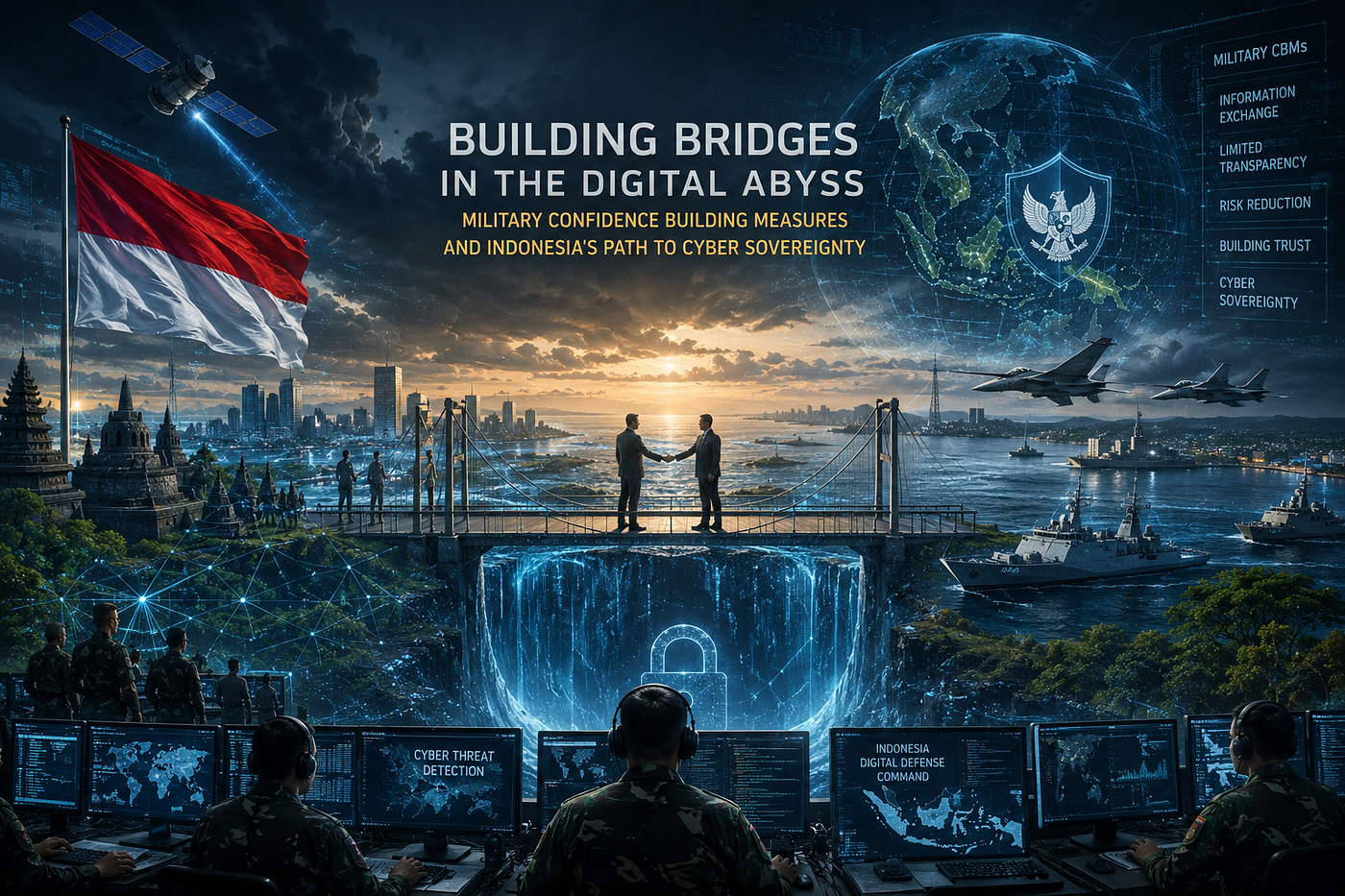
Beyond the visible frontiers of land and sea lies a new battlefield woven from data, algorithms, and invisible networks. Amid uncertainty, Indonesia seeks not only to defend its digital sovereignty but also to build bridges of trust — where diplomacy, resilience, and strategic cooperation illuminate the path through the digital abyss. (Source: AI Generated Image)
A comprehensive study published on December 3, 2019, by Hidayat Chusnul Chotimah, Muhammad Ridho Iswardhana, and Tiffany Setyo Pratiwi brought this strategic issue to the forefront with their work titled “Penerapan Military Confidence Building Measures dalam Menjaga Ketahanan Nasional Indonesia di Ruang Siber” (The Application of Military Confidence Building Measures in Safeguarding Indonesia’s National Resilience in Cyberspace). This study serves as a crucial foundation for understanding how Indonesia — amidst its limitations and complexities — endeavors to weave a defense framework in the digital realm. The deep integration of technology into every facet of human life demands that nations transcend their role as passive users and instead become active architects in maintaining cyber stability.
Deconstructing the Concept of Military CBM: A Bridge Amidst Suspicion
To comprehend Indonesia’s strategy, we must delve into the essence of Confidence Building Measures (CBM) itself. Born from humanity’s innate drive to build trust amidst uncertainty, CBM represents a set of instruments designed to reduce tensions, prevent misunderstandings, and avert conflict escalation. In the context of international relations, CBM manifests in two primary models: military CBM and non-military CBM. This study focuses on military CBM — an approach involving concrete measures in defense and military affairs to foster transparency and stability.
This concept carries profound historical resonance. During the Cold War, CBM served as a vital instrument between the United States and the Soviet Union to avert nuclear catastrophe. However, in the digital era, its application confronts far more intricate challenges. As articulated in the study, the unpredictability of military capabilities in cyberspace creates the specter of a dangerous arms race. If left unchecked, competition in the digital realm can spark misunderstandings that escalate into interstate conflict. “Because military capabilities in cyberspace are unpredictable, it certainly leads to an arms race if left unaddressed,” the researchers wrote.
Indonesia at the Crossroads: Between Transparency and Sovereignty
In practice, the application of military CBM in Indonesia remains limited and fraught with complex strategic considerations. The study identifies three primary pillars of CBM implementation: information exchange and communication, transparency and verification, and military restrictions. However, of these three aspects, Indonesia has yet to fully implement transparency and verification at the compliance level with international norms.
Why is this the case? The answer lies in the classic dilemma of national security. On one hand, the state is expected to open itself to information exchange to build trust with other nations. On the other hand, not all information can be shared given the potential threats to Indonesia’s cyber sovereignty. “The application of military CBM in Indonesia’s cyberspace remains limited because not all information can be shared with other countries, considering the potential threats to Indonesia’s cyber sovereignty,” the study reveals.
A simple analogy can illuminate this dilemma. Imagine a large house with many doors. To build trust with neighbors, one must open some doors so they can see nothing threatening lies within. However, opening all doors means inviting risk — who knows if malicious hands might slip through? This is precisely the challenge Indonesia faces: maintaining a delicate balance between necessary transparency and protected confidentiality.
Lessons from the Korean Peninsula: The Dynamics of CBM in Real-World Conflict
To enrich our analysis, we can draw valuable lessons from the implementation of CBM in the inter-Korean conflict during the 2008–2011 period. As reviewed in Firstyarinda Valentina Indraswari’s thesis, the implementation of CBM on the Korean Peninsula demonstrates just how dynamic the relationship is between trust-building instruments and conflict intensity. Communication and economic cooperation emerged as decisive factors influencing the ebb and flow of tensions between the two Koreas.
When CBM measures were reduced or even halted, suspicion flourished and conflict intensified. Conversely, when communication remained open and economies remained intertwined, conflict intensity subsided. This invaluable lesson underscores that CBM is not merely an abstract concept but a strategic instrument demanding sustained attention and commitment. “Efforts to maintain and improve the quality of CBM are prerequisites for security stability on the Korean Peninsula in particular and on the global international stage,” Indraswari concluded.
Building a Comprehensive Cybersecurity Ecosystem
Returning to Indonesia, the challenges extend beyond purely military dimensions. The study emphasizes that cybersecurity is not the sole responsibility of government. Non-state actors such as Multinational Corporations (MNCs) and Non-Governmental Organizations (NGOs) play crucial roles in protecting cyberspace security. This recognition acknowledges that in the decentralized digital landscape, cross-sector collaboration is an inevitability.
The Indonesian government, through various institutions such as the National Cyber and Crypto Agency (BSSN), has demonstrated commitment to strengthening national cyber resilience. However, the journey remains long. Indonesia must continue developing technical capabilities, strengthening regulatory frameworks, and most importantly, cultivating a cybersecurity culture across all segments of society. Because ultimately, the digital security chain is only as strong as its weakest link.
Toward the Future: Recommendations and Aspirations
From this analysis, several policy recommendations emerge. First, Indonesia must actively engage in international forums that discuss norms and rules of conduct in cyberspace. Second, strengthening technical capacity and human resources in cybersecurity must become a priority. Third, collaboration with the private sector and civil society needs continuous enhancement to create a holistic security ecosystem.
Equally important, Indonesia must continue developing a sophisticated cyber diplomacy approach — one capable of balancing the need for transparency with the protection of sovereignty. In an increasingly interconnected world, no nation can stand alone. International cooperation is the key, and CBM is one such key. However, as the researchers caution, its implementation must proceed with careful deliberation and strategic calculation.
At the conclusion of this analysis, we are reminded that cyberspace reflects the real world — a realm brimming with opportunities alongside threats. Indonesia, with all its potential and challenges, is striving to find its path through the digital darkness. This journey is indeed long and winding, yet with the right strategy and robust collaboration, national resilience in the digital realm is not a pipe dream. It is an imperative to be realized, for the future of a nation in an ever-evolving era.
REFERENCES
- Chotimah, H. C., Iswardhana, M. R., & Pratiwi, T. S. (2019). Penerapan Military Confidence Building Measures dalam Menjaga Ketahanan Nasional Indonesia di Ruang Siber. Jurnal Ketahanan Nasional, 25(3), 321–338.
- Indraswari, F. V. (2012). Pelaksanaan Confidence Building Measures (CBMs) pada Konflik Korea Selatan-Korea Utara Periode 2008–2011 [Thesis, Universitas Indonesia].
메타데이터
- post_id
- da6777ca4241
- slug
- building-bridges-in-the-digital-abyss-military-confidence-building-measures-and-indonesias-path-da6777ca4241
- url
- https://medium.com/@viorelfvm.shigoto/building-bridges-in-the-digital-abyss-military-confidence-building-measures-and-indonesias-path-da6777ca4241
- canonical_url
- https://medium.com/@viorelfvm.shigoto/building-bridges-in-the-digital-abyss-military-confidence-building-measures-and-indonesias-path-da6777ca4241
- author_url
- https://medium.com/@viorelfvm.shigoto
- status
- ok
- fetched_at
- 2026-07-21 15:40:34