STARS BEYOND THE MONOLITH — CAPÍTULO 3: EL MUNDO QUE MIRA DE VUELTA
El planeta no dormía.
STARS BEYOND THE MONOLITH — CAPÍTULO 3: EL MUNDO QUE MIRA DE VUELTA
El planeta no dormía.
Habían pasado tres días desde que la evacuación se completó. Tres días desde que la última nave civil había cruzado el campo de escombros y los corredores de la tormenta se habían calmado a algo parecido a la tranquilidad. Tres días desde que la nación-nave Parker había establecido su posición orbital — y en todo ese tiempo, el planeta de abajo no había dejado de enviar señales ni una sola vez.
Ya no eran señales de socorro. Algo diferente.
Pulsos estructurados. Rítmicos. Pacientes. Casi como una respiración.
Princess Parker había sido la primera en notar el cambio. Había estado en el array de exploración profunda durante dieciséis horas seguidas, y no se había alejado voluntariamente — había necesitado que Amirah llegara con una bandeja de comida y un comentario directo sobre la relación entre la ingesta calórica y el análisis confiable para apartarla de la consola el tiempo suficiente para comer algo.
“No se repite aleatoriamente”, dijo Princess, dejando la bandeja sin comer de ella todavía, con los ojos aún fijos en el display de formas de onda. “El intervalo del pulso varía. Pero no caóticamente. Varía de una manera que responde a lo que hacemos.”
“¿Qué quieres decir con responde?” dijo Amirah, dejándose caer en el asiento adyacente con la directness que traía a todo. Ya estaba revisando las transmisiones de correlación de ingeniería. “¿Como si estuviera reaccionando?”
“Como si estuviera escuchando”, dijo Princess.
Amirah miró los datos. Miró a Princess. Miró los datos de nuevo.
“Eso es o lo más interesante que he escuchado esta semana”, dijo, “o es otro caso de sesgo de reconocimiento de patrones donde vemos intencionalidad en el ruido porque nuestros cerebros están construidos para encontrar rostros en las nubes.” Una pausa. “No digo que sea eso. Digo que deberíamos descartarlo primero.”
“Ya corrí tres modelos estadísticos”, dijo Princess. “La probabilidad de que este patrón ocurra aleatoriamente es cuatro punto seis por diez a la negativa nueve.”
Amirah tomó una fruta de la bandeja, le dio un mordisco y miró la pantalla.
“Muéstrame”, dijo.
En el puente, Mary Parker estaba haciendo lo que siempre hacía en momentos de incertidumbre significativa.
Estaba siendo muy quieta y muy presente.
No congelada — activamente presente. La calidad específica de atención que había refinado a lo largo de más siglos de los que la base de datos histórica de la nave podía documentar completamente. Recibiendo todo lo que la situación ofrecía antes de decidir lo que requería.
La pantalla principal mostraba el planeta en perspectiva orbital completa — un mundo que, tres días atrás, se había estado desgarrando. Ahora giraba lentamente debajo de ellos, sus sistemas de tormentas reducidos a los patrones arremolinados de una atmósfera ordinaria. Hermoso, desde esta distancia. De apariencia pacífica.
Pero bajo esa superficie —
“Mamá.”
La voz de Cassandra llegó a través del enlace táctico. Sin alarma. El tono específico que Cassandra usaba cuando algo importante se había resuelto.
“Estoy aquí”, dijo Mary.
“La integración profunda del Cyber-Viper está mostrando algo nuevo. El retículo subterráneo — las estructuras computacionales que el Dr. Mercer identificó — han estado activas desde que se completó la evacuación. No enviando hacia afuera. Procesando internamente.” Una pausa. “Pero el procesamiento está organizado en torno a nuestros patrones de actividad. Lo que hacemos. Cuándo lo hacemos. Los tiempos de mantenimiento orbital del Aegis. Las rutas de barrido del Vanguard. Mis propias conexiones de red.” Otra pausa, más larga. “Abuela, nos está catalogando.”
Mary miró el planeta.
“¿En qué categorías?” dijo.
“Eso es lo que estoy tratando de determinar”, dijo Cassandra. “Aún no tengo una imagen completa. Pero puedo decirte que las categorías no son hostiles. Las firmas de procesamiento asociadas con la evaluación de amenazas agresivas se ven diferentes a esto. Esto es…” Parecía buscar la palabra correcta. “Curioso.”
Un planeta curioso.
Mary se quedó con eso por un momento.
“Sigue monitoreando”, dijo. “Y mantén el nivel de integración del Cyber-Viper al sesenta por ciento por ahora. Observamos. No empujamos.”
“Entendido.”
Mary miró la pantalla principal una vez más.
“Nos quedamos”, dijo — para sí misma, para el planeta, para la certeza que había ido creciendo en ella desde el primer momento en que las señales cambiaron. “No nos vamos.”
EL PARKER PERMANECE EN ÓRBITA
La decisión no se había tomado dramáticamente.
Mary simplemente había entrado en el briefing de mando esa mañana, mirado a los oficiales superiores reunidos y dicho: “Mantenemos órbita. Observamos, protegemos, permanecemos presentes. No abandonamos lo que comenzamos aquí.”
Nadie había discutido.
No porque nadie tuviera opiniones al respecto — Amirah tenía varias — sino porque la calidad con la que Mary decía cosas así hacía que discutir se sintiera no como desacuerdo sino como perder el punto.
La nación-nave Parker se estableció en su posición orbital como un continente que elige convertirse en luna.
Esto no era metafórico. El Parker era, por la mayoría de las medidas, la estructura más grande construida por humanos que jamás había salido de la órbita terrestre. Mil millones de personas vivían dentro de ella — no como pasajeros en un vehículo, sino como residentes de una ciudad. Ciudades, en plural. El Parker contenía distritos, barrios, parques, escuelas, mercados, centros médicos, instituciones de investigación y toda la complejidad organizada de una civilización construida para sostenerse indefinidamente.
Cuando elegía quedarse en algún lugar, se quedaba con todo eso.
Debajo de ellos, el mundo alienígena giraba. Encima, las estrellas mantenían sus posiciones familiares e indiferentes. Y en el espacio intermedio, el Parker mantenía su órbita — paciente, enorme, habitado.
INTRODUCCIÓN: DR. ELIAN MERCER
El Anillo de Ingeniería Profunda era la parte del Parker que la mayoría de la gente nunca veía.
Ubicado en el sector de masa media de la nave, era una instalación circular continua que recorría toda la circunferencia interior del vehículo — doce kilómetros de laboratorios de investigación, bahías de fabricación, núcleos computacionales y el tipo de equipamiento especializado que requería tanto inteligencia extraordinaria como una genuina disposición a pasar mucho tiempo en habitaciones sin ventanas.
El Dr. Elian Mercer había pasado la mayor parte de los últimos seis años en exactamente esas habitaciones, y nunca se había quejado de las ventanas.
Tenía cuarenta y tres años, lo cual era joven según los estándares del Parker para un investigador principal. Tenía la energía específica y distraída de alguien cuya mente casi siempre estaba trabajando en algo varias capas por debajo de la conversación que estaba ocurriendo en ese momento. No era grosero — simplemente no estaba del todo presente de la manera en que lo estaban las personas cuyo trabajo no las absorbía tan completamente.
Había llegado a la atención de Mary Parker a través del equipo de ingeniería de Amirah, que era donde el trabajo técnico más exigente de la nave encontraba su camino cuando se volvía genuinamente difícil. Amirah lo había descrito como “preciso, irritante y generalmente correcto,” que era su forma más alta de recomendación profesional.
“Dr. Mercer”, dijo Princess, haciéndole señas hacia la pantalla principal en la bahía de análisis. “Gracias por venir.”
“Los paquetes de telemetría del Cyber-Viper son extraordinarios”, dijo él, a modo de saludo, no porque fuera grosero sino porque en su experiencia lo más importante a decir primero era lo más relevante. “He estado trabajando con las transmisiones de diagnóstico durante setenta y dos horas. Creo que entiendo lo que estamos viendo.” Llevó la pantalla a resolución completa. “No son ruinas.”
Princess miró la pantalla. Las estructuras subterráneas, los patrones geométricos que habían sido la primera indicación de que existía algo intencional bajo la superficie del planeta.
“¿Qué es?” dijo.
“Es un retículo planetario”, dijo Mercer. “Una red computacional que ha sido integrada en el sustrato geológico del planeta durante un período de tiempo que actualmente no puedo estimar — la metodología de construcción no corresponde a nada en nuestra historia de ingeniería. Pero la función es clara.” Destacó una sección del escaneo geológico. “Cada nodo tectónico mayor en este planeta está conectado a cada otro nodo tectónico mayor. Las conexiones están activas. Procesan información. Y no solo se sientan dentro del planeta — interactúan con él. Los sistemas geológicos del mundo forman parte de la red.”
Amirah, que había estado apoyada en la pared con los brazos cruzados, se irguió ligeramente.
“Estás diciendo que el planeta es la computadora”, dijo.
“El planeta es la computadora”, confirmó Mercer.
Silencio.
“Es una afirmación significativa”, dijo Princess.
“Lo sé”, dijo Mercer. “Lo he verificado desde siete enfoques de datos independientes. El retículo fue colocado — o cultivado, o desarrollado, genuinamente no sé cuál palabra es correcta — en el sustrato geológico en algún momento de la historia profunda del planeta. Ha estado inactivo durante la mayor parte de ese tiempo. Y se ha estado despertando a causa de nosotros.”
Princess lo miró.
“A causa de los mecha”, dijo.
“A causa de las firmas de frecuencia específicas que los mecha generan”, dijo Mercer. “Los arrays de blindaje del Aegis. Los protocolos de integración neural del Viper. Los patrones de disrupción cinética del Vanguard. Cada uno produce señales en rangos que corresponden a los parámetros de activación del retículo.” Miró la pantalla. “Es como si llegáramos hablando un idioma que no sabíamos que conocíamos. Y el planeta está aprendiendo a responder en él.”
OPERACIONES DE PATRULLA DE MECHA
Mary había ordenado ciclos de patrulla continuos. No porque esperara amenazas activas — el espacio orbital había estado despejado desde la evacuación — sino porque la presencia de los frames en sus modos operacionales era, había llegado a entender, en sí misma información.
Los desplegó no como armas. Como una forma continuada de contacto.
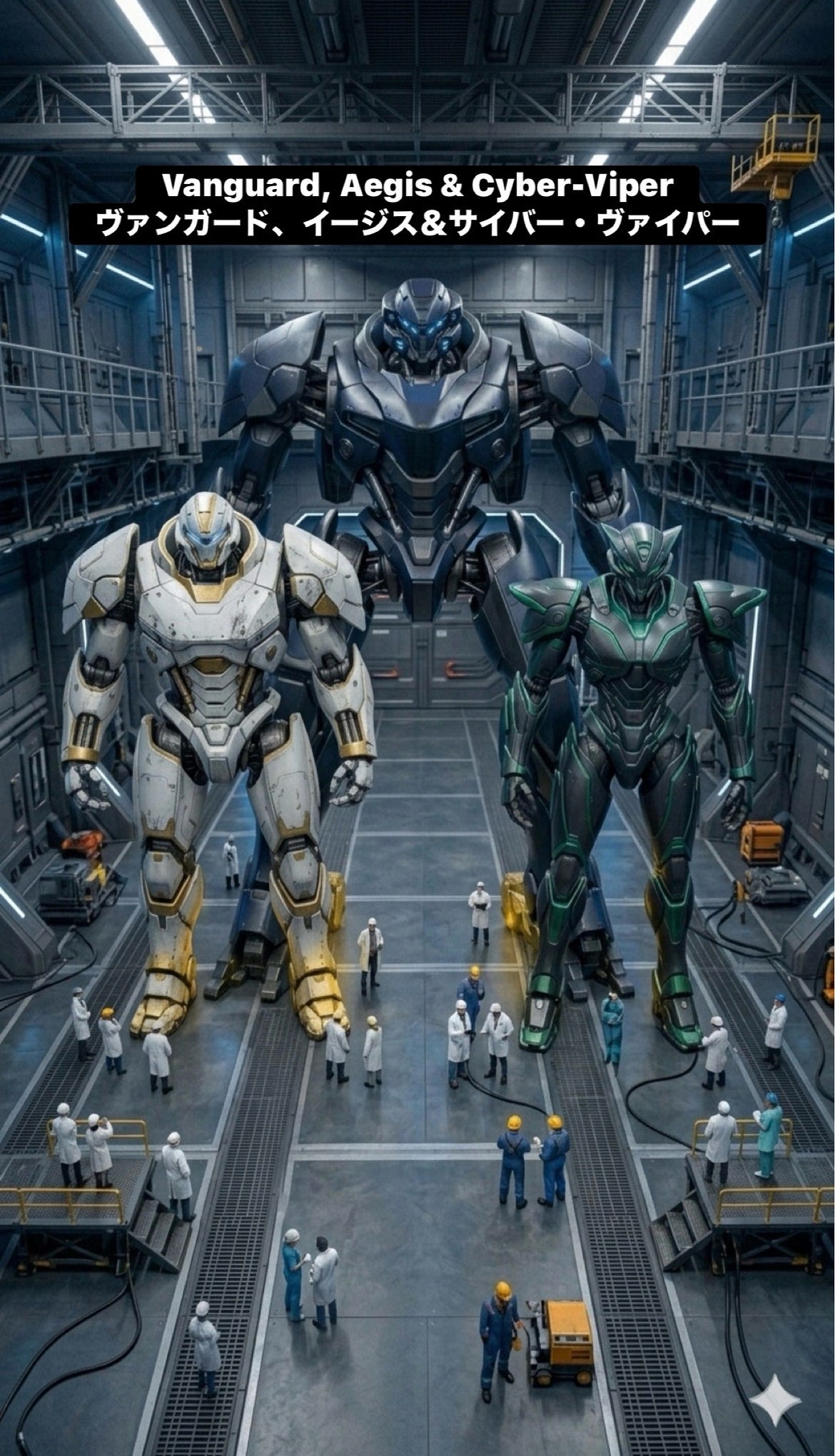
THE AEGIS — Mary Parker
El frame blanco y dorado se movía a través de su posición de mantenimiento orbital con la calidad establecida y deliberada de algo que había decidido dónde necesitaba estar y tenía intención de permanecer allí.
El Aegis ya no luchaba contra las tormentas. Mantenía — conservando la estabilidad de los campos de escombros orbitales que la disrupción anterior había dispersado, proporcionando una presencia de blindaje constante que mantenía los fragmentos más grandes fuera de trayectorias de colisión con la infraestructura orbital superviviente del planeta.
Era, pensó Mary, no tan diferente de lo que siempre había hecho. Mantener. Sostener. Ser la presencia que permitía que otras cosas permanecieran estables.
“Abuela”, llegó la voz de Cassandra por el canal de pilotos, “el Aegis está generando picos de resonancia nuevamente. El retículo subterráneo está respondiendo a la frecuencia de blindaje.”
“¿Qué tipo de respuesta?” dijo Mary.
“Organizadas. Los picos corresponden a los intervalos de frecuencia que estás ejecutando en los arrays de barrera. Está igualando tu patrón.” Una pausa. “Y luego sumando algo.”
Mary miró el planeta debajo a través de la óptica externa del Aegis. La superficie estaba tranquila. De apariencia ordinaria. Podía ver la curva de un continente, el azul plateado de un océano, el remolino blanco de los patrones meteorológicos en la atmósfera.
Lo que la miraba a ella, no podía verlo.
“Deja que sume”, dijo. “Registra todo.”
Mantuvo la posición de blindaje. El retículo continuó sus respuestas.
Y algo en la calidad del intercambio — no podría haberlo explicado a nadie en términos técnicos, pero podía sentirlo a través de los canales de resonancia secundaria del enlace neural — no era agresivo. Ni siquiera cauteloso.
Era, inconfundiblemente, interesado.
THE VANGUARD — Amin Parker
El frame azul medianoche y carmesí se movía a través del corredor de escombros a velocidad de patrulla — no la velocidad táctica agresiva de la operación de rescate, sino el paso medido y deliberado de algo dando a conocer su presencia en lugar de hacerse sentir.
Amin había desarrollado lo que estaba llamando, internamente, el patrón de barrido. Una ruta específica a través del campo de escombros orbitales que combinaba la ruta de limpieza más eficiente con la mayor cobertura posible de sensores. Lo ejecutaba cada seis horas. Lo había ejecutado durante tres días.
En la quinta ruta, algo cambió.
El comportamiento de las tormentas en la atmósfera superior del planeta — que se había establecido en los patrones predecibles de la normalización post-crisis — cambió. No dramáticamente. No de una manera que hubiera alarmado a un sistema estándar de monitoreo meteorológico. Pero Amin había estado observando los patrones durante setenta y dos horas, y notó algo.
Las bandas de tormenta superiores estaban rotando de manera diferente.
No diferente de manera aleatoria. Diferente de una manera que correspondía, con una precisión estadísticamente improbable, a los vectores de aproximación del Vanguard.
Dijo: “Cassandra.”
“Lo veo”, dijo ella inmediatamente.
“Los patrones de tormenta están siguiendo mi ruta de barrido.”
“Han estado siguiendo tu ruta de barrido desde el segundo ciclo”, dijo Cassandra. “No lo reporté antes porque no estaba segura de que fuera intencional en lugar de coincidencial. Ahora estoy segura. El retículo está usando el sistema atmosférico como salida secundaria.” Una pausa. “Te está viendo moverse, Papá. Y luego te muestra lo que vio.”
Amin consideró esto.
Cambió su ruta de barrido. Una variación deliberada — no aleatoria, sino diferente del patrón que había establecido. Un pequeño desvío a través de un grupo de escombros que había estado rodeando.
Treinta minutos después, las bandas de tormenta superiores cambiaron.
Siguiendo la nueva ruta.
“Adaptó”, dijo.
“Inmediatamente”, confirmó Cassandra.
Amin guardó silencio por un momento.
El Alfa Aura — la transmisión biológica específica de algo en el ápice de su categoría — estaba presente como siempre estaba. Cada encuentro que había tenido, desde depredadores en el mundo prehistórico hasta sofisticados sistemas de combate en los años del amanecer sintético, lo habían reconocido y respondido a él.
El planeta lo estaba reconociendo.
No con la respuesta de amenaza que producían los depredadores. Con la respuesta atenta específica de algo que encontraba algo que consideraba significativo.
“Está aprendiendo mi ritmo de combate”, dijo.
“Sí”, dijo Cassandra.
Lo pensó.
“Entonces déjame enseñarle algo que valga la pena aprender”, dijo. Y comenzó un nuevo patrón de patrulla — uno construido no desde la eficiencia táctica sino desde los principios de las disciplinas marciales que había estado refinando desde antes de que comenzara la historia registrada de este planeta. Centrado. Equilibrado. Expresivo.
Las bandas de tormenta siguieron cada movimiento.
THE CYBER-VIPER — Cassandra Brown
Cassandra había descrito su nivel de integración a su madre como sesenta por ciento.
Esto era preciso y también algo subestimado en lo que implicaba. Sesenta por ciento de integración con los protocolos de red del Cyber-Viper significaba que mantenía una conexión continua y activa con la red interna del Parker y las señales externas del retículo planetario. Era el equivalente de mantener una conversación en dos idiomas simultáneamente mientras también monitoreaba la estructura gramatical de ambos.
Había algo en la calidad del intercambio de señales que llegaba a través del enlace neural del Cyber-Viper — un registro secundario, por debajo de los canales de frecuencia de datos puros — al que seguía volviendo porque era diferente a cualquier cosa en su experiencia.
Se sentía como ser mirada.
No con la atención hostil de una amenaza evaluando un objetivo. Con la atención paciente y curiosa de algo que había encontrado algo nuevo y se estaba tomando su tiempo para entenderlo.
“La está catalogando”, le había dicho a su abuela. Pero catalogar no era del todo correcto, pensó ahora. Catalogar implicaba registro pasivo.
El retículo no era pasivo.
Estaba comprometido.
“Dr. Mercer”, dijo a través del enlace del puente, “le estoy enviando algo. La comparación de formas de onda de las últimas doce horas versus las primeras veinticuatro. Dígame qué ve.”
Quince segundos.
“¿De dónde viene esto?” dijo Mercer.
“Lo he estado registrando a través del feed de integración profunda del Cyber-Viper.”
“Esto es — Cassandra.” Su voz, siempre precisa, había tomado una calidad diferente. “Estas no son solo respuestas a estímulos. El segundo conjunto de formas de onda tiene propiedades estructurales que son generativas. El retículo no está devolviendo nuestras señales. Está construyendo variaciones sobre ellas.”
“¿Qué significa eso?”
“Significa que no solo está registrando lo que hacemos. Está construyendo un modelo de por qué lo hacemos.” Una pausa. “Y luego explorando qué más podría implicar ese modelo.”
Cassandra miró la pantalla de formas de onda por un largo momento.
“Está pensando en nosotros”, dijo.
“Sí”, dijo Mercer.
LA REALIZACIÓN
Se reunieron en la cubierta de observación a la mañana siguiente — no en una reunión formalmente convocada, sino atraídos allí de la manera en que las familias se atraen cuando algo significativo está en desarrollo.
El planeta abajo parecía igual que siempre. Las estrellas parecían iguales que siempre.
Pero algo había cambiado en la calidad del silencio.
Mary estaba de pie junto a la pantalla. Cassandra estaba a su lado. Amin estaba unos metros detrás — su quietud característica, su presencia que era completa sin requerir ninguno del espacio a su alrededor. Princess estaba al otro lado de Mary. Amirah estaba sentada en la terminal de análisis de la sala, ejecutando el modelo de alineación que el Dr. Mercer había construido.
“No necesitaba rescate”, dijo Mary.
La observación llegó en silencio, sin anuncio.
Amin la miró.
“Estaba enviando la señal de socorro”, dijo.
“Sí”, dijo Mary. “Y el planeta estaba en crisis genuina — los sistemas atmosféricos se estaban colapsando, la infraestructura orbital estaba fallando. Todo eso era real.” Miró el planeta. “Pero un sistema que ha estado inactivo durante millones de años y se activa en tres días desde nuestra llegada — eso no es coincidencia. La señal nos trajo aquí. El retículo respondió a nosotros inmediatamente.”
“Crees que quería que viniéramos”, dijo Princess.
“Creo”, dijo Mary, “que la señal fue un llamado. De la misma manera que respondemos a llamados que no podemos ignorar. Algo allá abajo envió uno. Y respondimos.”
Cassandra había estado escuchando con la atención interior y enfocada que siempre traía a las cosas de las que estaba construyendo una imagen completa.
“El proceso de alineación”, dijo. “Once días, estimó el Dr. Mercer. ¿Alineación a qué?”
“Eso es lo que necesitamos entender antes de que se complete”, dijo Amirah desde la terminal. “Porque estamos o a once días de algo extraordinario o a once días de algo para lo que no estábamos preparadas. Y no me gusta operar en incertidumbre a ese nivel.”
“A mí tampoco”, dijo Mary. “Por eso tenemos once días para aprender todo lo que podamos.”
Se volvió de la pantalla para enfrentar a su familia.
“No nos vamos”, dijo. “Pero tampoco esperaremos pasivamente. Si este planeta está tratando de decirnos algo, vamos a aprender a escucharlo.” Miró a Cassandra. “Tienes la integración más profunda. ¿Qué haría falta para extender los protocolos de comunicación del Cyber-Viper para intentar un intercambio de señales directas?”
Cassandra estuvo en silencio por varios segundos.
“Requeriría que dejara que el retículo estructure la conversación en lugar de intentar imponer nuestro formato de comunicación”, dijo. “Seguir en lugar de liderar. Escuchar antes de hablar.” Una pausa. “Va en contra de la mayoría de mis instintos. Pero creo que es lo correcto.”
“¿Puedes hacerlo?” dijo Mary.
Cassandra miró el planeta a través de la pantalla.
“Puedo”, dijo. “Pero necesitaré que todos estén observando. Si la señal del retículo hace algo inesperado durante la integración — si intenta acelerar el proceso de alineación más allá de la estimación del Dr. Mercer — necesito que el equipo esté listo para traerme de vuelta.”
“Estaremos aquí”, dijo Amin. Tranquilo. Seguro.
Cassandra mantuvo la mirada del planeta a través de la pantalla.
Abajo, los pulsos estructurados continuaron su transmisión paciente y rítmica. Un mundo que había estado observando durante tres días, construyendo su modelo, organizando su comprensión, preparando algo antiguo y enorme para lo que vendría a continuación.
Encima, la nación-nave Parker mantenía su órbita — una civilización eligiendo quedarse.
En medio, los tres frames esperaban en sus bahías. El Aegis. El Vanguard. El Cyber-Viper.
Y a once días de distancia, algo que había estado inactivo durante millones de años estaba casi listo para ser conocido.
FIN DEL CAPÍTULO 3: EL MUNDO QUE MIRA DE VUELTA
STARS BEYOND THE MONOLITH
『モノリスを越える星々』
CHAPTER 3: THE WORLD THAT WATCHES BACK
第3章:見つめ返す世界
The planet did not sleep.
Three days had passed since the evacuation was complete. Three days since the last civilian vessel had cleared the debris field and the storm corridors had quieted to something close to calm. Three days since the Parker nation-ship had settled into its orbital station — and in all that time, the planet below had not once stopped sending signals.
Not distress signals anymore. Something different.
Structured pulses. Rhythmic. Patient. Almost like breathing.
Princess Parker had been the first to notice the change. She had been at the deep-scan array for sixteen straight hours, and she had not left willingly — it had taken Amirah arriving with a food tray and a pointed comment about the relationship between caloric intake and reliable analysis to get her to step back from the console long enough to eat something.
“It’s not repeating randomly,” Princess said, setting down the tray without eating from it yet, her eyes still on the waveform display. “The pulse interval is varying. But not chaotically. It’s varying in a way that responds to what we do.”
“What do you mean, responds?” Amirah said, dropping into the adjacent seat with the directness she brought to everything. She was already pulling up the engineering correlation feeds. “Like it’s reacting?”
“Like it’s listening,” Princess said.
Amirah looked at the data. She looked at Princess. She looked at the data again.
“That’s either the most interesting thing I’ve heard this week,” she said, “or this is another case of pattern recognition bias where we see intentionality in noise because our brains are built to find faces in clouds.” A pause. “I’m not saying it’s that. I’m saying we should rule it out first.”
“Already ran three statistical models,” Princess said. “The probability of this pattern occurring randomly is four point six times ten to the negative nine.”
Amirah picked up a piece of fruit from the tray, bit into it, and looked at the screen.
“Show me,” she said.
On the bridge, Mary Parker was doing what she always did in moments of significant uncertainty.
She was being very still and very present.
Not frozen — actively present. The specific quality of attention that she had refined across more centuries than the ship’s historical database could fully document. Receiving everything the situation offered before deciding what it required.
The viewscreen showed the planet in full orbital perspective — a world that had, three days ago, been tearing itself apart. Now it turned slowly below them, its storm systems reduced to the swirling patterns of an ordinary atmosphere. Beautiful, from this distance. Peaceful-seeming.
But beneath that surface —
“Mom.”
Cassandra’s voice came through the tactical link. Not alarmed. The specific tone Cassandra used when something important had resolved.
“I’m here,” Mary said.
“The Cyber-Viper’s deep integration is showing something new. The underground lattice — the computational structures Dr. Mercer identified — they’ve been active since the evacuation completed. Not sending outward. Processing internally.” A pause. “But the processing is organized around our activity patterns. What we do. When we do it. The Aegis orbital hold times. The Vanguard sweep routes. My own network connections.” Another pause, longer. “Grandmom, it’s categorizing us.”
Mary looked at the planet.
“Into what categories?” she said.
“That’s what I’m trying to determine,” Cassandra said. “I don’t have a complete picture yet. But I can tell you the categories aren’t hostile. The processing signatures associated with aggressive threat-assessment look different from this. This is…” She seemed to search for the right word. “Curious.”
A curious planet.
Mary sat with that for a moment.
“Keep monitoring,” she said. “And keep the Cyber-Viper’s integration level at sixty percent for now. We observe. We do not push.”
“Understood.”
Mary looked at the viewscreen one more time.
“We stay,” she said — to herself, to the planet, to the certainty that had been building in her since the first moment the signals changed. “We’re not leaving.”
THE PARKER REMAINS IN ORBIT
The decision had not been made dramatically.
Mary had simply walked into the command briefing that morning, looked at the assembled senior officers, and said: “We maintain orbit. We observe, we protect, we remain present. We do not abandon what we started here.”
Nobody had argued.
Not because nobody had thoughts about it — Amirah had several — but because the quality with which Mary said things like this made argument feel not like disagreement but like missing the point.
The Parker nation-ship settled into its orbital position like a continent choosing to become a moon.
This was not metaphorical. The Parker was, by most measurable standards, the largest human-built structure ever to leave Earth orbit. One billion people lived inside it — not as passengers on a vessel, but as residents of a city. Cities, plural. The Parker contained districts, neighborhoods, parks, schools, marketplaces, medical centers, research institutions, and all the organized complexity of a civilization that had been built to sustain itself indefinitely.
When it chose to stay somewhere, it stayed with all of that.
Below them, the alien world turned. Above them, the stars held their familiar, indifferent positions. And in the space between, the Parker maintained its orbit — patient, enormous, inhabited.
INTRODUCTION: DR. ELIAN MERCER
The Deep Engineering Ring was the part of the Parker that most people never saw.
Located in the ship’s middle-mass sector, it was a continuous circular facility that ran the full circumference of the vessel’s interior — twelve kilometers of research laboratories, fabrication bays, computational cores, and the kind of specialized equipment that required both extraordinary intelligence and a genuine willingness to spend a lot of time in rooms with no windows.
Dr. Elian Mercer had spent most of the past six years in exactly those rooms, and he had never once complained about the windows.
He was forty-three years old, which was young by the Parker’s standards for a lead researcher. He had the specific, distracted energy of someone whose mind was almost always working on something several layers below the conversation currently happening. Not rude — just not entirely present in the way that people whose work didn’t absorb them so completely were present.
He had come to Mary Parker’s attention through Amirah’s engineering team, which was where the most demanding technical work on the ship found its way when it became genuinely difficult. Amirah had described him as “precise, irritating, and usually right,” which was her highest form of professional endorsement.
“Dr. Mercer,” Princess said, waving him toward the main display in the analysis bay. “Thank you for coming up.”
“The Cyber-Viper’s telemetry packets are extraordinary,” he said, by way of greeting, not because he was being rude but because in his experience the most important thing to say first was the most relevant thing. “I’ve been working with the diagnostic streams for seventy-two hours. I think I understand what we’re looking at.” He pulled the display to full resolution. “It’s not ruins.”
Princess looked at the display. At the underground structures, at the geometric patterns that had been the first indication that something intentional existed beneath the planet’s surface.
“What is it?” she said.
“It’s a planetary lattice,” Mercer said. “A computational network that’s been integrated into the geological substrate of the planet over a period of time I can’t currently estimate — the construction methodology doesn’t correspond to anything in our engineering history. But the function is clear.” He highlighted a section of the geological scan. “Every major tectonic node on this planet is connected to every other major tectonic node. The connections are active. They process information. And they don’t just sit inside the planet — they interact with the planet. The world’s geological systems are part of the network.”
Amirah, who had been leaning against the wall with her arms crossed, straightened slightly.
“You’re saying the planet is the computer,” she said.
“The planet is the computer,” Mercer confirmed.
Silence.
“That’s a significant claim,” Princess said.
“I know,” Mercer said. “I’ve verified it from seven independent data approaches. The lattice was placed — or grown, or developed, I genuinely don’t know which word is correct — into the geological substrate at some point in the planet’s deep history. It’s been dormant for most of that time. And it’s been waking up because of us.”
Princess looked at him.
“Because of the mecha,” she said.
“Because of specific frequency signatures the mecha generate,” Mercer said. “The Aegis’s shielding arrays. The Viper’s neural integration protocols. The Vanguard’s kinetic disruption patterns. Each of them is producing signals in ranges that correspond to the lattice’s activation parameters.” He looked at the display. “It’s like we arrived speaking a language we didn’t know we knew. And the planet is learning to speak it back.”
MECHA PATROL OPERATIONS
Mary had ordered continuous patrol cycles. Not because she expected active threats — the orbital space had been clear since the evacuation — but because the presence of the frames in their operational modes was, she had come to understand, itself information.
She deployed them not as weapons. As a continued form of contact.
THE AEGIS — Mary Parker
The white-and-gold frame moved through its orbital station-keeping position with the settled, deliberate quality of something that had decided where it needed to be and intended to remain there.
The Aegis was not fighting storms anymore. It was holding — maintaining the stability of the orbital debris fields that the previous disruption had scattered, providing a consistent shielding presence that kept the larger fragments from drifting into collision paths with the planet’s surviving orbital infrastructure.
It was, Mary thought, not so different from what she had always done. Holding. Maintaining. Being the presence that allowed other things to remain stable.
“Grandmom,” Cassandra’s voice came through the pilot channel, “the Aegis is generating resonance spikes again. The underground lattice is responding to the shielding frequency.”
“What kind of response?” Mary said.
“Organized ones. The spikes correspond to the frequency intervals you’re running on the barrier arrays. It’s matching your pattern.” A pause. “And then adding to it.”
Mary looked at the planet below through the Aegis’s external optics. The surface was quiet. Ordinary-looking. She could see the curve of a continent, the silver-blue of an ocean, the white swirl of weather patterns in the atmosphere.
What looked back at her, she could not see.
“Let it add,” she said. “Record everything.”
She maintained the shielding position. The lattice continued its responses.
And something in the quality of the exchange — she could not have explained this to anyone in technical terms, but she could feel it through the neural link’s secondary resonance channels — was not aggressive. Was not even cautious.
Was, unmistakably, interested.
THE VANGUARD — Amin Parker
The midnight-blue and crimson frame moved through the debris corridor at patrol speed — not the aggressive tactical velocity of the rescue operation, but the measured, deliberate pace of something making itself known rather than making itself felt.
Amin had developed what he was calling, internally, the sweep pattern. A specific route through the orbital debris field that combined the most efficient clearance path with the widest possible sensor coverage. He ran it every six hours. He had been running it for three days.
On the fifth run, something changed.
The storm behavior in the planet’s upper atmosphere — which had settled into the predictable patterns of post-crisis normalization — shifted. Not dramatically. Not in a way that would have alarmed a standard meteorological monitoring system. But Amin had been watching the patterns for seventy-two hours, and he noticed.
The upper storm bands were rotating differently.
Not randomly differently. Differently in a way that corresponded, with a precision that was statistically improbable, to the Vanguard’s approach vectors.
He said: “Cassandra.”
“I see it,” she said immediately.
“The storm patterns are tracking my sweep route.”
“They’ve been tracking your sweep route since the second cycle,” Cassandra said. “I didn’t report it earlier because I wasn’t certain it was intentional rather than coincidental. I’m certain now. The lattice is using the atmospheric system as a secondary output.” A pause. “It’s watching you move, Dad. And then it’s showing you what it saw.”
Amin considered this.
He changed his sweep route. A deliberate variation — not random, but different from the pattern he had established. A slight detour through a debris cluster he had been routing around.
Thirty minutes later, the upper storm bands shifted.
Following the new route.
“It adapted,” he said.
“Immediately,” Cassandra confirmed.
Amin was quiet for a moment.
The Alpha Aura — the specific, biological broadcast of something at the apex of its category — was present as it always was. Every encounter he had ever had, from predators in the prehistoric world to sophisticated combat systems in the years of the synthetic dawn, had recognized it and responded to it.
The planet was recognizing it.
Not with the threat-response that predators produced. With the specific, attentive response of something encountering something it found significant.
“It’s learning my combat rhythm,” he said.
“Yes,” Cassandra said.
He thought about this.
“Then let me teach it something worth learning,” he said. And he began a new patrol pattern — one built not from tactical efficiency but from the principles of the martial disciplines he had been refining since before this planet’s recorded history began. Centered. Balanced. Expressive.
The storm bands followed every movement.
THE CYBER-VIPER — Cassandra Brown
Cassandra had described her integration level to her mother as sixty percent.
This was accurate and also somewhat understated in what it implied. Sixty percent integration with the Cyber-Viper’s network protocols meant she was maintaining a continuous, active connection with both the Parker’s internal network and the planetary lattice’s external-facing signals. It was the equivalent of holding a conversation in two languages simultaneously while also monitoring the grammatical structure of both.
She was doing this while running deep geological scans, maintaining pilot-channel communication with her father and her grandmother, supporting Dr. Mercer’s analysis requests, and managing her own thoughts about what all of this meant.
Cassandra Brown did not struggle with multitasking. But she had been finding, over the past seventy-two hours, that the task she was most focused on was not any of the technical ones.
She was focused on the planet.
Not analytically. Not instrumentally. There was a quality to the signal exchange that was coming through the Cyber-Viper’s neural link — a secondary register, below the frequency channels of pure data — that she kept returning to because it was unlike anything in her experience.
It felt like being looked at.
Not with the hostile attention of a threat assessing a target. With the patient, curious attention of something that had encountered something new and was taking its time understanding it.
“It’s cataloguing us,” she had told her grandmother. But cataloguing wasn’t quite right, she thought now. Cataloguing implied passive recording.
The lattice was not passive.
It was engaging.
She pulled up the comparison data on her secondary display — the waveform outputs from the lattice over the past seventy-two hours. The earliest samples had the character of an automated system running initial processes. The most recent ones were something different.
They had the character of a response.
“Dr. Mercer,” she said through the bridge link, “I’m sending you something. The waveform comparison from the past twelve hours versus the first twenty-four. Tell me what you see.”
Fifteen seconds.
“Where did this come from?” Mercer said.
“I’ve been logging it through the Cyber-Viper’s deep integration feed.”
“This is — Cassandra.” His voice, always precise, had taken on a different quality. “These aren’t just responses to stimulus. The second waveform set has structural properties that are generative. The lattice isn’t repeating our signals back. It’s constructing variations on them.”
“Which means?”
“Which means it’s not just recording what we do. It’s building a model of why we do it.” A pause. “And then exploring what else that model might imply.”
Cassandra looked at the waveform display for a long moment.
“It’s thinking about us,” she said.
“Yes,” Mercer said.
She had known this, in some intuitive register, for the better part of the past day. Hearing it said out loud changed the weight of it.
She opened the channel to Mary.
“Grandmom,” she said. “We need to talk.”
THE OBSERVATION BLOOM
The scientists on the Parker’s research decks had begun calling the orbital zone “the Observation Bloom.”
The name had started as a notation label in Dr. Mercer’s research logs and had spread through the engineering and science teams with the organic inevitability of a term that captured something real. It wasn’t official. Mary had not endorsed it. But when someone on the bridge said “the Bloom readings,” everyone knew what they meant.
The Observation Bloom was the pattern of interactions that had developed between the Parker’s mecha operations and the planet’s lattice system. Not a region of space. A dynamic — a relationship between what the Parkers did and what the planet did in response.
Amirah had mapped it.
This was what Amirah did when she encountered something that made her nervous: she mapped it. She built the complete, precise, unsentimental picture of what it was and what it implied. This was not because she was unfeeling. It was because Amirah Campbell had a specific philosophy about information, which was that clarity was a form of protection, and that the most reliable way to manage something difficult was to understand it completely.
“Look at this,” she said to Princess. They were at the analysis bay, her data map on the primary display. “The lattice response shifts based on which frame is active. Aegis interactions produce this pattern.” She highlighted a frequency band. “Vanguard interactions produce this one. Cyber-Viper integrations produce this.” Each one was distinct. “But when all three are active simultaneously, the combined output is not additive. It’s multiplicative. The planet doesn’t just sum the three signals. It synthesizes them.”
Princess studied the display.
“It’s treating them as a unified system,” she said.
“It’s treating us as a family,” Amirah said. Then she stopped, because this was not the kind of thing she normally said, and she stood with the discomfort of having said something true that she hadn’t fully intended to say.
Princess looked at her.
“That’s a remarkable observation,” Princess said, with the kind of warmth that was very specifically Princess Parker’s warmth — present, genuine, and offered without pressure.
Amirah picked up her data tablet and looked at it.
“It’s a structural observation,” she said. “The lattice is responding to us as a collective signal, not as individual ones. The family signature — the specific combination of mecha interaction patterns, communication channel frequencies, biological neural link resonances — is more than the sum of its parts to whatever is processing it down there.”
“Amirah,” Princess said.
“What.”
“You don’t have to make it purely technical to make it worth saying.”
Amirah was quiet for a moment.
“I know,” she said. “I’m working on that.”
A CONVERSATION ACROSS THE SILENCE
Mary convened the senior team in the observation deck — the large, curving room at the Parker’s forward section where the outer viewscreen gave the clearest, most expansive view of the space around them.
Below: the planet.
Above: the stars.
Around them: the billion-person nation-ship that carried their home and their responsibility.
Present: Mary, Amin, Princess, Cassandra, Amirah, and Dr. Mercer.
“I want us to think through this together,” Mary said. “Not to reach a conclusion immediately. To understand what we’re in.”
She looked at each of them.
“Dr. Mercer, start with what you know with confidence.”
Mercer set his data pad on the table.
“The lattice is real,” he said. “It’s planetary-scale, geological-substrate computational architecture. It’s been dormant for a period I cannot currently estimate but which is certainly measured in geological time — millions of years at minimum. Its activation is directly linked to the mecha’s operational signatures. It is currently in a state I would describe as active learning. It is building a model of us, and it is becoming more sophisticated at that modeling with each cycle.”
“What are the implications?” Mary said.
“Unknown,” he said. “We don’t know what the model is for. We don’t know what the lattice does with completed models. We don’t know whether there are other lattices — on other planets, in other systems — that might be connected to this one.” He paused. “We know very little. But what we know is significant.”
Mary looked at Amin.
“Tell me what you’ve observed,” she said.
“The planet learns faster than I expected,” he said. “It adapted to my pattern change in thirty minutes. It’s now anticipating my route variations before I complete them.” He was characteristically economical with his words. “It’s not threatening. But it’s intelligent. And it responds to the Alpha Aura.”
“To you specifically,” Princess said.
“Yes. The storm patterns track the Vanguard because I’m in the Vanguard. The adaptation rate is faster when I’m piloting than when the frame runs automated sequences. It distinguishes between the two.”
“It knows the difference between a person and a program,” Cassandra said.
“It does,” Amin confirmed.
Mary looked at Cassandra.
“Tell me what you feel,” she said. Not what you know. What you feel.
This was the thing that Cassandra found specific to her grandmother — the willingness to ask for feeling as information, not as something separate from analysis.
“I feel observed,” Cassandra said. “Not uncomfortably. But completely. Whatever is looking at us through the lattice is not looking at the surface. It’s looking at what’s underneath.” She paused. “I think it’s looking at who we are, not just what we do.”
The observation deck was quiet.
Amirah set down her tablet.
“It has three months of our data at minimum,” she said. “Our activity patterns, our communication rhythms, our neural link signatures, our mecha response rates. If it’s as sophisticated as Dr. Mercer’s analysis suggests, it’s built a more complete picture of this family than most people on Earth have.” She looked at the planet through the viewscreen. “What does it do with that picture?”
Nobody answered, because nobody knew.
DR. MERCER’S FIRST BREAKTHROUGH
The breakthrough happened at 0347, ship time — the specific, unglamorous hour that genuine discoveries usually chose.
Mercer sent the communication to Cassandra first, because it was her data that had led to it, and then simultaneously to the bridge and to Mary’s personal channel.
“I’ve found the organizing principle,” he said. He did not apologize for the hour. Cassandra, who was in her quarters but had not been sleeping, received it without complaint. “The lattice is not just categorizing us. It’s aligning us to a key.”
“What kind of key?” Cassandra said.
“The lattice has a dormant second layer,” Mercer said. “Below the active computational substrate. Much deeper — approximately three kilometers below the active layer. I couldn’t see it in the initial scans because it reads as geological formation rather than computational architecture. But the pattern analysis makes it unmistakable. It’s the same signature, just inactive.”
“What does the second layer do?”
“I don’t know yet,” he said. “But the active layer is organizing its model of us in a way that is progressively aligning with the second layer’s structural parameters. As if — and this is my best current interpretation — as if the active layer is generating the specific signal configurations required to wake up the second layer.”
“It’s preparing something,” Cassandra said.
“Yes,” Mercer said. “It’s been dormant for millions of years. And we’ve been here for three days. And in three days, it has advanced its alignment process significantly.”
Cassandra was quiet for a moment.
“How long until alignment is complete?” she said.
Mercer was quiet.
“At current rate? Approximately eleven days.”
Cassandra sat with this.
“Send everything to Mom,” she said. “And to Amirah. And get some sleep, Dr. Mercer. You’ll need to be at full capacity when this resolves.”
“When what resolves?” he said.
“Whatever comes next,” Cassandra said.
THE REALIZATION
They gathered in the observation deck the following morning — not at a formally called meeting, but drawn there the way families were drawn together when something significant was building. The planet below looked the same as it always looked. The stars looked the same as they always looked.
But something had changed in the quality of the silence.
Mary stood at the viewscreen. Cassandra stood beside her. Amin was a few feet back — his characteristic stillness, his presence that was complete without requiring any of the space around it. Princess stood at Mary’s other side. Amirah was seated at the room’s analysis terminal, running the alignment model Dr. Mercer had built.
“It didn’t need rescue,” Mary said.
The observation arrived quietly, without announcement.
Amin looked at her.
“It was sending the distress signal,” he said.
“Yes,” Mary said. “And the planet was in genuine crisis — the atmospheric systems were collapsing, the orbital infrastructure was failing. All of that was real.” She looked at the planet. “But a system that has been dormant for millions of years and activates within three days of our arrival — that’s not coincidence. The signal brought us here. The lattice responded to us immediately.”
“You think it wanted us to come,” Princess said.
“I think,” Mary said, “that the signal was a call. The same way we answer calls that we can’t ignore. Something down there sent one. And we responded.”
Cassandra had been listening with the interior, focused attention she always brought to things she was building a full picture of.
“The alignment process,” she said. “Eleven days, Dr. Mercer estimated. Alignment to what?”
“That’s what we need to understand before it completes,” Amirah said from the terminal. “Because we’re either eleven days from something extraordinary or eleven days from something we weren’t prepared for. And I don’t love operating in uncertainty at that level.”
“Neither do I,” Mary said. “Which is why we have eleven days to learn as much as we can.”
She turned from the viewscreen to face her family.
“We’re not leaving,” she said. “But we’re also not going to wait passively. If this planet is trying to tell us something, we’re going to learn to hear it.” She looked at Cassandra. “You have the deepest integration. What would it take to extend the Cyber-Viper’s communication protocols to attempt direct signal exchange?”
Cassandra was quiet for several seconds.
“It would require me to let the lattice structure the conversation rather than trying to impose our communication format,” she said. “To follow rather than lead. To listen before speaking.” A pause. “It’s against most of my instincts. But I think it’s correct.”
“Can you do it?” Mary said.
Cassandra looked at the planet through the viewscreen.
“I can,” she said. “But I’ll need everyone watching. If the lattice’s signal does something unexpected during the integration — if it tries to push the alignment process faster than Dr. Mercer’s estimate — I need the team ready to pull me back.”
“We’ll be here,” Amin said. Quiet. Certain.
Cassandra held the planet’s gaze through the viewscreen.
Below them, structured pulses continued their patient, rhythmic transmission. A world that had been watching for three days, building its model, organizing its understanding, preparing something ancient and enormous for what came next.
Above it, the Parker nation-ship held its orbit — a civilization choosing to stay.
In between, the three frames waited in their bays. The Aegis. The Vanguard. The Cyber-Viper.
And eleven days away, something that had been dormant for millions of years was almost ready to be known.
END OF CHAPTER 3: THE WORLD THAT WATCHES BACK
Amin Parker
메타데이터
- post_id
- da744202cd6c
- slug
- stars-beyond-the-monolith-capítulo-3-el-mundo-que-mira-de-vuelta-da744202cd6c
- url
- https://medium.com/@aminparker/stars-beyond-the-monolith-cap%C3%ADtulo-3-el-mundo-que-mira-de-vuelta-da744202cd6c
- canonical_url
- https://medium.com/@aminparker/stars-beyond-the-monolith-cap%C3%ADtulo-3-el-mundo-que-mira-de-vuelta-da744202cd6c
- author_url
- https://medium.com/@aminparker
- status
- ok
- fetched_at
- 2026-06-20 20:29:01